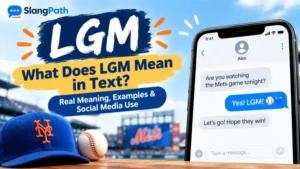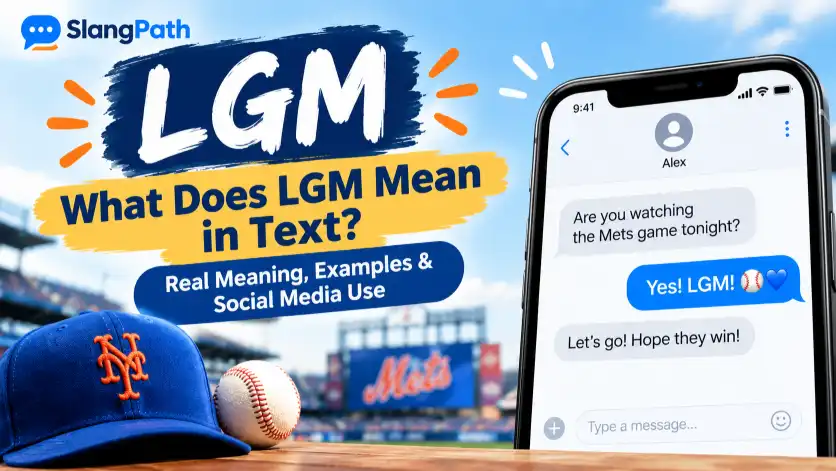
LGM can mean “Let’s Go Mets,” a popular cheer used by fans of the New York Mets baseball team. In text messages and online conversations, people may use these three letters to show excitement, encourage the team, or celebrate a great play.
You might see LGM in a TikTok comment, an Instagram caption, a Snapchat message, a WhatsApp group, or a regular text conversation. Its meaning is easiest to understand when people are talking about baseball or the Mets.
If someone sends you “LGM!” without explaining it, you may wonder if it is slang, an abbreviation, or an expression with another meaning. The surrounding conversation usually provides the best clue.
This guide explains what LGM means, how people use it in everyday communication, where it appears online, and how to understand it when the context is not immediately clear.
What Does LGM Mean in Text?
LGM commonly stands for “Let’s Go Mets” in baseball,related conversations. It is an abbreviated cheering phrase associated with the New York Mets, a professional baseball team based in New York City.
Instead of typing the full phrase, fans use the initials LGM to express support in a short, recognizable way. You may see it before a game, during a live match, or after a memorable moment on the field.
For example, a Mets fan might send this message to a friend:
“The game starts in five minutes. LGM! ⚾”
The sender is showing excitement and support for the team. The abbreviation makes the message quick to type while keeping the meaning clear for people who recognize the expression.
LGM is particularly useful in conversations where both people already know which team they are discussing. A fan does not need to explain the phrase every time they use it.
What Does LGM Stand For?
In the baseball context, each letter represents part of the phrase:
- L — Let’s
- G — Go
- M — Mets
Together, the letters form “Let’s Go Mets,” an expression of encouragement for the team.
The phrase works like a short sports chant. Fans may use it to build excitement before a game, react to a good performance, or show loyalty to their favorite team.
For instance, someone might post “LGM!” after the Mets score a run. Another fan might use the same abbreviation in a group chat before everyone watches a game together.
The letters alone do not always reveal the intended meaning, however. If LGM appears in a conversation about something unrelated to baseball, the sender may be using a different abbreviation or a private shorthand.
Is LGM Slang, an Acronym, or an Abbreviation?
LGM is best described as an abbreviation made from the initial letters of “Let’s Go Mets.” It can also be called an initialism because people commonly read the letters individually rather than pronounce them as a single word.
In everyday online communication, it functions as an informal expression used by fans. That makes it part of sports,related internet language, even though it is not a traditional slang word in the same way as expressions such as “lit” or “low,key.”
Here is the difference:
- Abbreviation: A shortened form of a word or phrase.
- Initialism: A term formed from initial letters that are read individually.
- Slang: Informal language used by a particular group or community.
LGM fits the first two descriptions when it means “Let’s Go Mets.” Its informal use among fans also connects it with sports slang and online fan culture.
You do not need to remember these linguistic terms to understand the message. The important point is that LGM shortens a longer expression into three letters.
What Does LGM Mean in Everyday Conversations?
In everyday chat, LGM usually communicates enthusiasm when the topic is a Mets game or team,related news.
Imagine two friends who regularly watch baseball together. One asks if the other is ready for the evening’s game. The reply “LGM!” shows excitement without requiring a long response.
Here is another example:
A: Did you see the Mets’ last game?
B: Yes! Hoping for another win tonight. LGM!
The abbreviation expresses support and anticipation. It is not a formal statement or a complicated code; it is simply a quick way for a fan to cheer.
People may also combine LGM with emojis, such as ⚾, 🔥, or 🙌. These symbols add emotion and make the message feel more enthusiastic.
A message such as “LGM! ⚾🔥” is likely to be understood as a cheer when it appears in a baseball conversation. Without that context, the letters may be less obvious to someone unfamiliar with the team.
Does LGM Always Mean “Let’s Go Mets”?
No. Although “Let’s Go Mets” is a recognizable meaning in baseball discussions, LGM does not have one guaranteed interpretation in every text message.
Abbreviations can be reused by different groups, workplaces, online communities, or individuals. Someone might use LGM as a personal shorthand or as initials for a phrase that is meaningful only within their group.
Consider these two situations:
Situation 1: A sports conversation
A: Are you watching the Mets tonight?
B: Yes, LGM!
The baseball context strongly suggests “Let’s Go Mets.”
Situation 2: An unrelated conversation
A: Can you explain the last message you sent?
B: It said LGM.
Here, the intended meaning is unclear. You would need more information to interpret the letters accurately.
This is why it is better to avoid assuming that every abbreviation has a single meaning across all platforms. The subject of the conversation, the sender’s interests, and the messages around it can all help.
How Can You Tell What Someone Means by LGM?
Start by looking at the messages immediately before and after the abbreviation. If the conversation mentions baseball, a match, the Mets, or a team result, “Let’s Go Mets” is a reasonable interpretation.
You can also consider if the sender regularly talks about sports. A friend who frequently shares baseball highlights is more likely to be using LGM as a team cheer than someone who has never discussed baseball with you.
Emojis and attached images can offer additional clues. A baseball emoji, a team photograph, or a game,day post supports the sports,related interpretation.
If none of these clues helps, ask a short question instead of guessing.
For example:
You: What does LGM mean in this message?
Friend: It means “Let’s Go Mets.” I’m cheering for the team.
A simple clarification prevents confusion and helps you understand how the sender uses the abbreviation.
Where Do People Use LGM?
LGM can appear on social media, in private messages, and in ordinary text conversations. The platform does not determine the meaning by itself. The subject of the post or message is usually more important.
Mets supporters may use LGM wherever they share their reactions to games, team news, or baseball,related content. The abbreviation is short enough to fit naturally into comments and captions.
LGM on TikTok
On TikTok, LGM may appear in baseball highlights, fan edits, game reactions, or videos featuring the New York Mets. Users often write short comments when they want to react quickly to a memorable moment.
For example, imagine a creator posts a video showing a strong defensive play during a Mets game. A viewer might comment:
“LGM! That was an incredible play! 🔥”
The abbreviation expresses support for the team, while the rest of the comment explains the viewer’s reaction.
A TikTok caption might also include LGM alongside a game,day video or a clip celebrating a win. Fans may use it to connect with others who share their interest in the team.
However, do not assume that every TikTok video containing LGM is about baseball. Look at the video, caption, hashtags, and surrounding comments before deciding what the creator means.
LGM on Snapchat
Snapchat is often used for quick conversations between friends. LGM may appear in a direct message, a group chat, or a snap showing someone watching a Mets game.
For example:
A: Are you watching the game tonight?
B: Yep! Got the game on now. LGM! ⚾
The reply communicates excitement without adding much extra text. It works especially well when both people already know that the conversation is about the Mets.
A friend might also send a photo of a television showing the game and add “LGM” as the caption. The image provides context, so the recipient can understand the abbreviation more easily.
If someone sends LGM without any sports,related details, you can ask what they mean. Not everyone follows baseball, and not everyone uses abbreviations in the same way.
LGM on Instagram
Instagram users may use LGM in captions, comments, Stories, and posts related to baseball. It can appear alongside team photographs, game,day outfits, stadium pictures, or highlights from a match.
For example, a fan might publish a picture before a game with the caption:
“Ready for tonight! LGM! ⚾🙌”
The caption expresses enthusiasm and shows support for the team. Other fans may reply with similar messages or discuss what they expect from the game.
LGM can also appear in comments under a sports page’s post. Someone might write it after seeing a big win or an exciting play.
When interpreting the abbreviation on Instagram, check the content of the post. A baseball image or a reference to the Mets makes the intended meaning much clearer than the letters alone.
LGM on WhatsApp
On WhatsApp, LGM may be used in individual chats or group conversations among friends who watch baseball.
For example:
A: The Mets game starts soon.
B: I’m ready. Snacks are on the table!
A: Let’s hope they win tonight.
B: LGM! ⚾
In this conversation, the abbreviation acts as a cheerful response. The sender is expressing support for the team and joining the excitement around the game.
Sports fans may also use it in group chats to share updates, react to scores, or invite friends to watch together.
WhatsApp messages are often personal, so abbreviations can sometimes have meanings that are specific to a particular group. If the context does not point to baseball, ask the sender what they intended.
LGM in SMS Text Messages
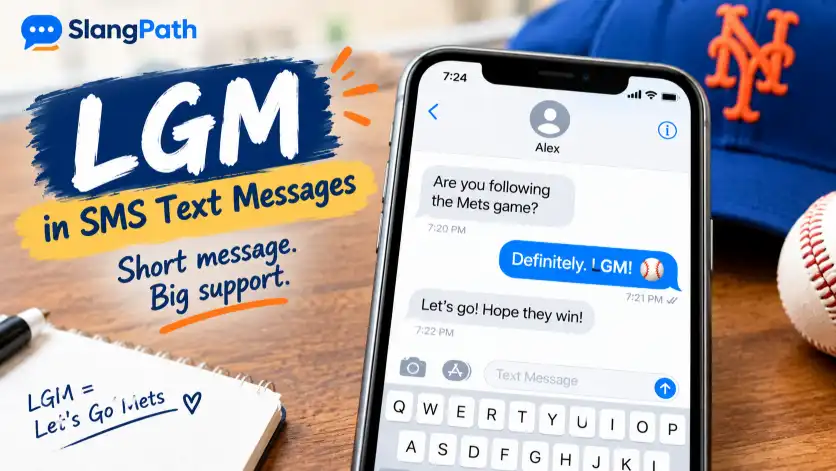
LGM can also appear in regular SMS messages. People use short expressions in texting because they are convenient and easy to type on a phone.
For example:
A: Are you following the Mets game?
B: Definitely. LGM!
The sender is cheering for the team. Someone who recognizes the abbreviation can understand the message immediately, while a person unfamiliar with baseball might need an explanation.
Unlike formal writing, casual text messages often contain initials, shortened phrases, emojis, and incomplete sentences. These features help people communicate quickly, but they can also create confusion when the recipient does not know the abbreviation.
If you are texting someone who may not recognize LGM, writing “Let’s Go Mets!” in full can make your meaning clearer.
Is LGM Used Differently Across Platforms?
The core sports,related meaning does not change simply because the abbreviation appears on a different platform. When people use LGM to mean “Let’s Go Mets,” they are expressing support for the same team if they post it on TikTok or send it in a text message.
What changes is the way people present it. A TikTok user might leave it in a comment, an Instagram user might add it to a caption, and a friend might send it as a quick WhatsApp reply.
The surrounding content remains important. A team photo, baseball discussion, or game,day message supports the sports,related interpretation. Without those clues, the meaning may be uncertain.
The best approach is to consider the complete message rather than relying on the platform alone.
Part 1 complete. Is mein introduction, meaning, acronym/abbreviation explanation, context aur platforms ki detailed coverage hai. Part 2 mein 10 chat examples, replies, rude/offensive context, users, aur origin cover kiye ja sakte hain.
10 Real Chat Examples of LGM
The meaning of LGM becomes easier to understand when you see how people use it in conversations. In the examples below, LGM means “Let’s Go Mets” because the messages are related to baseball.
These are sample conversations showing natural ways the abbreviation might appear in everyday messaging.
Example 1: Talking About an Upcoming Game
A: Are you watching the Mets game tonight?
B: Yes, I’ve been waiting all day!
A: Same here. Hopefully, they get the win.
B: LGM! ⚾
Meaning: The last message expresses excitement and support for the Mets before the game.
Example 2: Reacting to a Great Play
A: Did you see that play in the last inning?
B: I did! That was amazing.
A: The team is playing so well today.
B: LGM! Let’s keep it going!
Meaning: The sender uses LGM to celebrate the team’s performance and encourage the players.
Example 3: Sending a Quick Message
A: What are you doing?
B: Watching baseball with my brother.
A: Which game?
B: Mets game. LGM!
Meaning: The abbreviation identifies the sender’s enthusiasm for the Mets in a casual conversation.
Example 4: Sharing Excitement in a Group Chat
A: Everyone ready for tonight?
B: Got my snacks ready.
C: I’ll be watching from home.
A: Let’s hope the Mets win!
B: LGM! 🙌
Meaning: The group is discussing the game, and LGM works as a short cheer.
Example 5: Celebrating a Victory
A: The Mets won! What a finish.
B: That final play was incredible.
A: I knew they could do it.
B: LGM! What a game!
Meaning: The sender uses the abbreviation to celebrate the team’s victory.
Example 6: Replying to an Instagram Story
A: Shares a Story showing a Mets game on television.
B: LGM! 🔥
A: Are you watching too?
B: Of course. I wouldn’t miss it.
Meaning: The reply shows support for the team and excitement about the game.
Example 7: Making Plans With a Friend
A: Want to come over and watch the game?
B: Sure. What time does it start?
A: Around seven.
B: Perfect. LGM!
Meaning: The sender is excited about watching the game and cheering for the Mets.
Example 8: Discussing a Difficult Match
A: Tonight’s game could be tough.
B: Yeah, the other team is playing well.
A: Still hoping the Mets pull through.
B: LGM. Let’s hope for the best!
Meaning: The abbreviation expresses continued support even when the game may be challenging.
Example 9: Commenting on a Baseball Post
A: Posts a picture related to the Mets with a game,day caption.
B: LGM! ⚾💙
A: Ready for the first pitch?
B: Absolutely!
Meaning: LGM is used as a short fan message in response to baseball,related content.
Example 10: Asking What LGM Means
A: Someone commented “LGM” on my post. What does it mean?
B: Was the post about baseball?
A: Yes, it was about the Mets.
B: Then it probably means “Let’s Go Mets.”
Meaning: The topic helps explain the abbreviation. If the post were about something else, further context might be needed.
These examples show that LGM is easy to interpret when baseball is part of the conversation. If the abbreviation appears in an unrelated discussion, do not assume the same meaning without checking.
How to Reply When Someone Says LGM
Your reply depends on what the sender means and how well you know them. If they are cheering for the Mets, you can respond with excitement, a joke, a friendly comment, or a simple acknowledgment.
You do not need to use LGM yourself to reply naturally. Choose a response that matches your understanding of the conversation.
Funny Replies
If you are chatting with a friend who enjoys baseball, a playful response can keep the conversation going.
Here are some examples:
- “Someone’s ready for game day!”
- “Hope your lucky team shirt does the trick!”
- “Are you bringing the snacks or just the cheering?”
- “That’s some serious fan energy!”
- “Let’s see if your prediction comes true!”
For example:
Friend: LGM! We’re getting that win tonight.
You: I like the confidence. Don’t blame me if the game gets stressful!
This type of reply works best when both people understand the joke and enjoy casual conversation.
Casual Replies
A short response is enough when you simply want to acknowledge the message.
You could say:
- “Let’s go!”
- “Game time!”
- “I’m ready!”
- “Hope they win!”
- “Enjoy the game!”
For example:
Friend: LGM! ⚾
You: Let’s go! Hope it’s a good game.
You can use these replies even if you are not a dedicated baseball fan, as long as you understand what your friend is talking about.
Friendly Replies
If someone is excited about a game, you can respond positively without needing to know every detail about the team.
Try these options:
- “Hope they get the win tonight!”
- “Enjoy watching the game!”
- “That’s the spirit!”
- “Sounds like you’re excited!”
- “Hope your team has a great night!”
For example:
Friend: Big game tonight. LGM!
You: Have fun watching! Hope it goes your way.
This response is friendly and does not require you to pretend to know much about baseball.
Neutral Replies
Sometimes, you may not understand the abbreviation. There is nothing wrong with asking for clarification.
You can reply with:
- “What does LGM stand for?”
- “Are you talking about the Mets?”
- “I don’t follow baseball. What does that mean?”
- “Can you explain that abbreviation?”
- “What’s happening tonight?”
For example:
Friend: LGM!
You: I haven’t heard that one before. What does it mean?
Friend: It means “Let’s Go Mets.” I’m cheering for the team.
Asking a question is better than guessing, particularly when the conversation does not give you enough information to understand the letters.
Is LGM Rude or Offensive?
LGM is generally not rude or offensive when it means “Let’s Go Mets.” In that context, it is a sports cheer that expresses excitement and support for a baseball team.
People may use it with friends, relatives, fellow fans, or other people who follow the Mets. It is normally suitable for casual conversations about baseball.
However, an abbreviation can have different meanings in different groups. If you see LGM in a conversation that is not about sports, consider the context before deciding what the sender means.
Is LGM Safe to Use With Friends?
Yes, when you are using it as a cheer for the Mets. It is a simple way to show enthusiasm and connect with other fans.
For example:
“LGM! Hope we get another win tonight!”
This message is positive and appropriate for a casual chat.
If your friends do not follow baseball, they may not understand the abbreviation. Writing the full phrase or explaining it can prevent confusion.
Can LGM Sound Disrespectful?
The sports,related meaning is not inherently disrespectful. However, sports discussions can sometimes become heated when fans disagree about teams, players, or results.
Using LGM to support your team is different from insulting another person or attacking their favorite team. If you want to keep a conversation friendly, express your enthusiasm without mocking other fans.
For instance, “LGM! I’m excited for tonight’s game” is a straightforward message. There is no need to add insulting comments about the opposing team.
Is LGM Appropriate at School or Work?
In casual conversations with classmates or coworkers, LGM is generally fine when the topic is baseball.
In a formal assignment, business email, professional report, or message to someone who may not understand the abbreviation, it is better to write the phrase in full or use standard language.
For example, instead of writing “LGM!” in a formal email, you could say, “I hope the Mets win tonight.”
The important factor is the setting. Informal abbreviations are useful in friendly chats, but clear wording is usually better when communicating professionally.
Who Uses LGM?
LGM may be used by people of different ages, particularly those who follow the New York Mets or participate in baseball fan communities. It is not limited to one generation or one social media platform.
The people most likely to recognize the sports,related meaning are those who already know the team and its fan culture.
Do Gen Z Users Say LGM?
Some Gen Z users may use LGM in sports,related messages, captions, and comments. Younger people often communicate with abbreviations and short expressions online, particularly when reacting to videos or live events.
However, LGM is not exclusively a Gen Z expression. Older fans can use it as well because its meaning comes from a sports cheer rather than from a trend limited to one age group.
A person’s interest in baseball is generally a more useful clue than their age.
Do Millennials and Older Adults Use LGM?
Yes, Mets supporters from different generations may use the abbreviation. Sports fans often share familiar cheers across age groups, if they communicate in person, through text messages, or on social media.
A longtime fan might write LGM in a message to family members, while a younger fan might comment on a game highlight with the same letters.
The abbreviation can help connect people who support the same team, even if they use different communication styles.
Where Is LGM Most Likely to Appear?
LGM may appear in places where baseball fans communicate, including:
- TikTok videos and comments about the Mets
- Instagram captions and Stories
- Snapchat conversations between friends
- WhatsApp sports group chats
- SMS messages about upcoming games
- Online discussions about baseball
Its meaning is clearest when the surrounding content mentions the Mets or shows a baseball,related event.
How Common Is LGM Online?
LGM is recognizable within Mets fan culture, but it is not necessarily understood by everyone who uses social media. Someone who follows the team may recognize it immediately, while someone who does not watch baseball may need an explanation.
There is no reason to assume that every user on TikTok, Instagram, or WhatsApp knows the abbreviation. Its familiarity depends on the user’s interests and the online community they participate in.
For that reason, it is best understood as a context,specific abbreviation rather than a universal texting expression.
Origin of LGM
The phrase “Let’s Go Mets” is associated with support for the New York Mets baseball team. LGM is a shortened version of that phrase, formed from its initial letters.
Sports fans frequently shorten chants, slogans, and team names when communicating online. These shortened forms are convenient because they are quick to type and recognizable to people who share the same interest.
LGM follows this pattern. Instead of typing the full cheer, a fan can write three letters to express the same general enthusiasm.
How Did LGM Become Part of Online Fan Culture?
Online communities allow sports fans to share their reactions before, during, and after games. A supporter can comment on a highlight, post a game,day photo, or message friends about an important match.
Short expressions work well in these settings. They allow people to show support without writing a long comment, and they make it easy for other fans to join the conversation.
For example, someone watching a Mets game might post “LGM!” after a great play. Other supporters who recognize the abbreviation can understand the message and respond with their own reactions.
Social media provides a convenient place for this kind of communication, but the phrase itself is connected to the team’s fan culture.
Did Social Media Invent LGM?
It would be inaccurate to claim that social media definitely invented the abbreviation. The phrase “Let’s Go Mets” is a sports cheer, and shortening phrases to their initials is a common communication practice.
Online platforms help people share and repeat short expressions, which can make them more visible within a fan community. However, without reliable evidence identifying the first use of LGM, the exact origin date of the abbreviation should not be stated as a fact.
The safest explanation is that LGM is an initial,based shorthand for “Let’s Go Mets” that is used in Mets,related communication.
Why Do People Prefer Short Abbreviations?
Short abbreviations are convenient in fast,moving conversations. During a game, someone may want to react immediately rather than type a full sentence.
A message such as “LGM!” is quick, direct, and easy for fellow fans to recognize. Adding an emoji can make the excitement even clearer.
The same principle explains why people use other texting abbreviations, such as IDK for “I don’t know” or BRB for “be right back.” Each short form serves a different purpose, but all can make informal communication more efficient.
Remember that short forms are most useful when the recipient understands them. If the meaning is uncertain, a few extra words can make the message clearer.
LGM vs. IDK, IDC, IMO, and BRB
LGM, IDK, IDC, IMO, and BRB are all short forms that people may encounter in online conversations. However, each serves a different purpose. LGM is commonly associated with cheering for the New York Mets, while the other abbreviations are used more broadly in everyday texting.
The table below explains their meanings and how people typically use them.
| Abbreviation | Meaning | Type | Usage | Popularity |
| LGM | Let’s Go Mets | Sports abbreviation | Cheering for the Mets | Context,specific |
| IDK | I Don’t Know | Texting abbreviation | Expressing uncertainty | Widely used |
| IDC | I Don’t Care | Texting abbreviation | Expressing indifference | Widely used |
| IMO | In My Opinion | Texting abbreviation | Sharing an opinion | Widely used |
| BRB | Be Right Back | Chat abbreviation | Saying you will return shortly | Widely used |
LGM vs. IDK
IDK means “I Don’t Know.” People use it when they do not have an answer or are uncertain about something.
LGM, when used in a baseball conversation, expresses support for the Mets rather than uncertainty.
Examples:
- LGM: “Big game tonight. LGM! ⚾”
- IDK: “IDK what time the game starts.”
The first message shows enthusiasm for the team. The second tells someone that the sender does not know the answer.
LGM vs. IDC
IDC stands for “I Don’t Care.” It expresses indifference, although its tone can vary depending on the conversation.
LGM has a different purpose when it means “Let’s Go Mets.” It is a cheer associated with team support.
For example:
- LGM: “LGM! Hoping for a win tonight.”
- IDC: “IDC which game we watch.”
IDC can sometimes sound dismissive, so it is worth considering how the recipient might interpret it. LGM is generally positive when used as a sports cheer.
LGM vs. IMO
IMO means “In My Opinion.” People use it to introduce a personal view or judgment.
For example:
A: Who played best tonight?
B: IMO, the pitcher had an excellent game.
By contrast, someone might write “LGM!” to express support for the Mets. IMO introduces an opinion, while LGM communicates a cheer in the relevant sports context.
LGM vs. BRB
BRB means “Be Right Back.” It is used when someone needs to leave a conversation briefly but expects to return.
For example:
A: Are you watching the game?
B: Yes! BRB, getting some water.
Here, BRB explains a temporary absence. LGM would express support for the Mets rather than tell someone that the sender is stepping away.
Understanding these differences helps you recognize what a message is intended to communicate without confusing one abbreviation with another.
Real,World Usage Example of LGM
Imagine two friends, Sam and Alex, both enjoy watching the New York Mets. They often discuss games and share sports updates through WhatsApp.
One evening, Sam sends Alex a message shortly before the game begins.
Sam: Are you ready for tonight?
Alex: Definitely! I’ve got everything ready.
Sam: The game should be exciting. I hope they play well.
Alex: LGM! ⚾ Let’s get that win!
In this conversation, Alex uses LGM to express enthusiasm and support for the team. Sam understands the message because they are both discussing a Mets game.
Now consider a different situation. Someone sends you “LGM” while you are discussing schoolwork, weekend plans, or an unrelated personal matter. The baseball meaning may not fit the conversation.
In that case, you can simply ask what the abbreviation means. It may refer to a different phrase in that particular context.
The lesson is straightforward: the surrounding conversation is often the best clue to the meaning of an abbreviation. Do not assume that every set of letters has the same meaning everywhere.
FAQs :
Q1: What makes a good website name?
A good website name is short, memorable, easy to spell, and relevant to your brand. It should be simple enough for visitors to remember and type without making mistakes.
Q2: How do I choose a short website name?
Choose one or two words that are easy to pronounce and spell. Avoid complicated words, unnecessary numbers, and hyphens. Check whether the name fits your niche and future plans.
Q3: Should my website name include keywords?
Including a keyword can help visitors understand your website’s topic. However, it is not necessary. A unique brand name can work well if your content clearly serves your target audience.
Q4: Are two-word website names good for SEO?
Yes, two-word names can work well for SEO. Google does not automatically rank a website higher because its domain contains two words. Helpful content, relevance, site quality, and user experience matter more.
Q5: How do I find an available .com domain?
Search for your preferred name using a domain registrar such as Namecheap, GoDaddy, or Cloudflare Registrar. If the domain is taken, try a different word combination or another suitable name.
Q6: Should I choose a brandable or descriptive domain name?
A descriptive name tells visitors what your website offers, while a brandable name helps create a distinct identity. Choose the option that suits your niche, audience, and long-term business goals.
Q7: Can I use a website name that another business already uses?
It is best to avoid names that could confuse visitors or violate another business’s trademark rights. Check search engines, domain registrations, business names, and relevant trademark databases before making your decision.
Q8: How important is a domain name for Google rankings?
A domain name helps establish your website’s identity, but it is not a major ranking shortcut. Publishing useful, original content and building a trustworthy website are more important for long-term organic visibility.
Q9: Which website niches are popular in the USA?
Popular areas include home improvement, personal finance, pet care, technology, AI tools, gardening, career advice, and budget-friendly living. Choose a niche based on audience needs, competition, your expertise, and monetization opportunities.
Q10: How can I check whether a website name is trademarked?
Search the USPTO trademark database for similar names and related business categories. Also check existing businesses and websites. If you plan to build a serious brand, consider consulting a trademark professional before registering the name.
Conclusion
Choosing the right website name is an important step toward building a successful online brand. A short, memorable, two-word name can help your website stand out, connect with your target audience, and create a professional identity. Whether you plan to start a technology blog, home improvement site, pet website, or general information platform, choose a name that is easy to spell, relevant to your goals, and flexible enough to grow with your business.
Before making your final decision, check domain availability, search for existing brands, and review potential trademark conflicts. Remember that a good name is only the beginning. Helpful content, a clear niche, and a consistent publishing strategy will help you build a website that earns readers’ trust and grows over time.
Read More About !

My name is Olivia Bennett.I am a language enthusiast and educational writer with a strong interest in contemporary English and digital communication. I enjoys making language learning engaging and accessible.