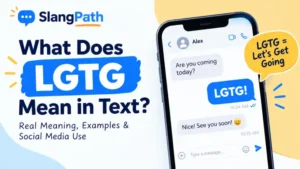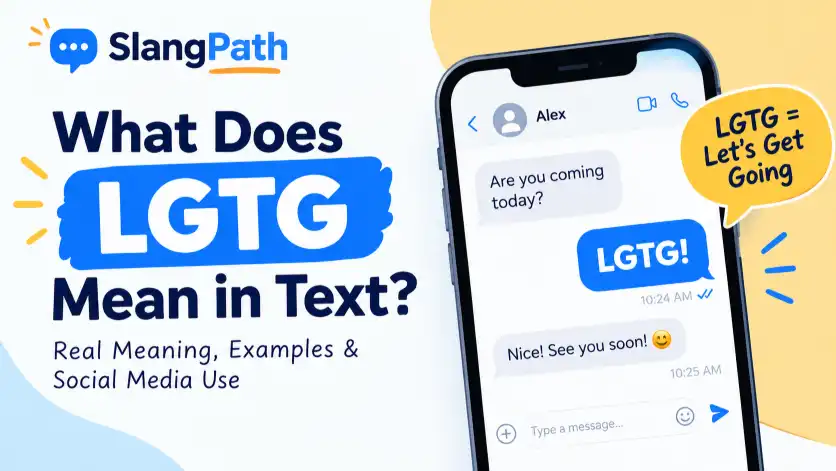
LGTG usually means “Looks Good to Go” in text messages. People use it to say that something looks ready, acceptable, or prepared. You may see LGTG in chats, work messages, gaming conversations, and on social media.
The abbreviation can be useful when someone wants to confirm that a plan, outfit, document, project, or other item is ready. For example, if a friend asks if their presentation looks okay, you might reply, “LGTG!”
However, the exact meaning can depend on the conversation. Some people may use LGTG to mean “Let’s Get This Going,” especially when they want to encourage a group to start an activity.
Understanding the surrounding message will help you work out what the sender means and choose an appropriate reply.
LGTG Meaning in Text
LGTG most commonly stands for “Looks Good to Go.” It is an informal abbreviation used in digital communication to indicate that something appears ready or that no major changes seem necessary.
For example, imagine your friend sends you a picture of an outfit before going to a party. You look at it and reply, “LGTG!”
Your message means that the outfit looks good and your friend can go ahead with their plans.
People also use the abbreviation when checking documents, reviewing plans, confirming arrangements, or discussing if something is ready to use.
Here are a few simple examples:
- “I checked the schedule. LGTG.”
- “Your presentation looks good to me. LGTG!”
- “Are we ready for the trip?” “Yep, LGTG.”
- “The design looks fine. LGTG.”
In these messages, LGTG communicates approval or readiness without requiring a long explanation.
What Does LGTG Stand For?
The letters in LGTG represent the phrase “Looks Good to Go.”
- L — Looks
- G — Good
- T — To
- G — Go
The phrase suggests that something has been checked and appears ready for the next step.
For example, if a person finishes preparing a document and asks you to review it, you might respond, “LGTG.” This indicates that the document looks acceptable and can move forward.
The abbreviation is not limited to one type of conversation. It can be used for personal plans, school assignments, creative projects, and workplace tasks.
Is LGTG Slang or an Abbreviation?
LGTG is best described as an informal initialism or texting abbreviation. It is formed from the first letters of the words in a phrase, and people generally read the letters individually rather than pronouncing them as one word.
It is also sometimes grouped with internet slang because it appears in casual online communication.
Here is the difference between these terms:
- Initialism: A shortened expression formed from the first letters of several words, such as LGTG.
- Texting abbreviation: A shorter form used to make messages quicker to type.
- Internet slang: Informal words and expressions used in online conversations.
In everyday use, you do not need to know these technical distinctions to understand the message. If someone writes “LGTG,” they are usually saying that something looks ready or acceptable.
What Does LGTG Mean in Everyday Conversations?
The meaning becomes clearer when you consider what the people are discussing.
When friends are getting ready for a trip, LGTG can mean it’s time to leave. During a presentation review, it may mean everything is ready. In a chat about an outfit, it can suggest that someone is dressed and ready to head out.
Consider these examples:
Example 1: Checking a plan
A: “I booked the tickets and reserved the hotel.”
B: “Perfect, LGTG!”
Here, the reply means the arrangements appear ready.
Example 2: Reviewing a document
A: “Can you check the final version before I send it?”
B: “Just checked it. LGTG.”
The sender is confirming that the document looks acceptable.
Example 3: Getting ready to go out
A: “Does this outfit look okay?”
B: “LGTG! You look great.”
In this case, the abbreviation communicates approval and reassurance.
Can LGTG Have More Than One Meaning?
Yes. Although “Looks Good to Go” is a common interpretation, abbreviations can have different meanings in different conversations.
Another possible expansion is “Let’s Get This Going.” Someone might use it to encourage others to begin an activity, start a project, or stop waiting around.
For example:
A: “Everyone is here, and we’ve got everything ready.”
B: “LGTG! Let’s start.”
In this context, the sender may intend the phrase “Let’s Get This Going.”
The distinction depends on the message:
- If someone is checking if something is ready, LGTG may mean “Looks Good to Go.”
- If someone is encouraging a group to begin, it may mean “Let’s Get This Going.”
Not every person uses the abbreviation in exactly the same way. When the context is unclear, asking the sender what they mean is the safest option.
LGTG vs. Ready to Go
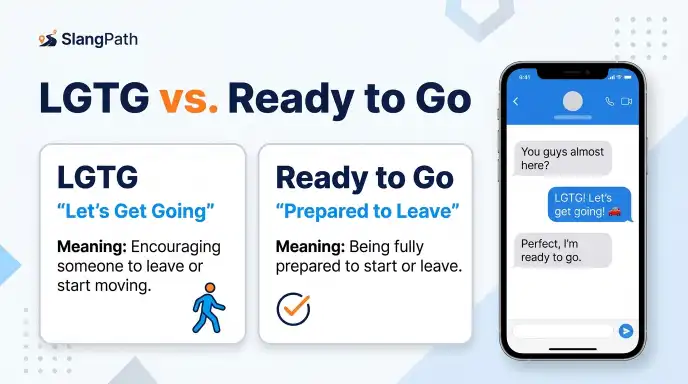
LGTG and “ready to go” communicate similar ideas, but they are not always interchangeable.
“Ready to go” directly states that someone or something is prepared. “Looks Good to Go” often suggests that the sender has checked something and believes it is acceptable.
For example:
- “The bags are ready to go.” This means the bags are packed or prepared.
- “I checked your bags. LGTG.” This suggests that everything looks fine.
The difference is small, but it can help you understand the tone of a message.
Where Do People Use LGTG?
LGTG can appear in different online spaces, including private messages, group chats, social media comments, and professional conversations. Its meaning generally depends more on the situation than on the platform.
People often use it when they want to confirm readiness quickly.
LGTG Meaning on TikTok
On TikTok, LGTG may appear in comments, direct messages, captions, or conversations about videos and trends.
Someone might use it when approving a video idea, reviewing a creator’s outfit, or confirming that a post is ready to publish.
Examples include:
- “This edit is LGTG.”
- “The outfit is LGTG for tonight.”
- “Caption looks good. LGTG!”
Imagine that a creator shares a draft video with a friend and asks if it is ready to upload. The friend might reply, “LGTG, post it!”
This means the video looks ready to publish.
LGTG is not an official TikTok feature or a term exclusive to the platform. It is an abbreviation that people may carry over from ordinary texting and other online communities.
LGTG Meaning on Snapchat
On Snapchat, people may use LGTG in direct messages or group chats when making plans or checking if something looks right.
For example, a friend might send a picture of their outfit before meeting everyone. You could reply, “LGTG!” to say that it looks good and they are ready to go.
Other examples include:
- “We leaving in five? LGTG.”
- “Your snap looks great. LGTG!”
- “Everything packed? LGTG on my side.”
In these situations, the abbreviation helps keep the conversation short and informal.
The sender may also use it when confirming arrangements with friends, such as deciding when to leave or checking if everyone has finished getting ready.
LGTG Meaning on Instagram
On Instagram, LGTG can be used in direct messages, comments, and conversations about posts, Reels, outfits, or creative content.
For example, someone might ask a friend to review a caption before publishing a post. The friend could respond, “Caption looks good. LGTG.”
This means the caption appears ready to use.
Other examples include:
- “New profile pic is LGTG.”
- “The Reel looks great. LGTG!”
- “Checked the caption. You’re LGTG.”
The abbreviation can be useful when people want to approve something quickly without writing a full sentence.
Its meaning is not unique to Instagram, though. The same expression can be used in text messages and other social media conversations.
LGTG Meaning on WhatsApp
WhatsApp is another place where LGTG can appear in personal chats and group conversations.
Friends may use it while organizing trips, arranging meetups, checking plans, or confirming that everyone is ready.
For example:
A: “I’ve booked the restaurant for 7 p.m.”
B: “Nice, LGTG!”
The reply indicates that the arrangement seems settled.
People might also use LGTG in family group chats or school project discussions.
Examples:
- “Got everything packed. LGTG.”
- “The meeting details are correct. LGTG.”
- “Everyone has confirmed. LGTG!”
Because WhatsApp supports both casual and professional conversations, the tone depends on the people involved. The abbreviation is usually suitable for informal group chats, but a complete sentence may be better when communicating with someone who is unfamiliar with texting shorthand.
LGTG Meaning in SMS Text Messages
In SMS messages, LGTG usually communicates that something looks ready, acceptable, or prepared.
For example, a person might text their friend, “I’m outside, are you ready?” The friend could answer, “LGTG,” to indicate that they are nearly ready or that everything is in order.
It can also be used when someone wants a quick confirmation:
- “Checked the address. LGTG.”
- “The plan works for me. LGTG.”
- “Everything is packed. LGTG!”
The exact interpretation can vary slightly. Sometimes the sender is confirming that a task is complete; in other cases, they are simply saying that everything appears fine.
If the abbreviation appears in an unfamiliar context, read the messages around it before deciding what it means.
Real LGTG Text Conversation Examples
LGTG ka meaning samajhne ka sab se easy tareeqa real,life texting situations dekhna hai. People use this abbreviation when checking if something is ready, approving a plan, reviewing work, or encouraging others to begin.
The examples below show how LGTG can fit into different conversations. Remember that the context helps determine if someone means “Looks Good to Go” or, in some situations, “Let’s Get This Going.”
1. Getting Ready to Leave Home
A: Are you ready? We’re leaving in ten minutes.
B: Almost. Just putting on my shoes.
A: Okay, I’m LGTG already.
B: Give me two more minutes!
Meaning: The first person is saying they are ready to leave. Here, the message communicates readiness rather than approval of an item.
2. Asking a Friend About an Outfit
A: Be honest, does this outfit look good for tonight?
B: Yeah, LGTG! The jacket looks great.
A: I wasn’t sure about the shoes.
B: They match perfectly. Don’t change anything.
Meaning: The sender is saying that the outfit looks good and is ready for the occasion.
3. Reviewing a School Assignment
A: I finished my assignment. Can you check it quickly?
B: I read everything. The answers look correct, and LGTG.
A: Great! I’ll submit it before the deadline.
B: Good luck!
Meaning: The reviewer believes the assignment looks ready to submit. However, LGTG is an informal opinion, not a guarantee that every answer is correct.
4. Preparing for a Weekend Trip
A: Did everyone book their tickets?
B: Yes, everyone has confirmed.
A: And the hotel reservation?
B: Done yesterday. LGTG!
A: Perfect. I’ll finish packing tonight.
Meaning: The arrangements appear complete, so the group can move forward with its travel plans.
5. Checking an Instagram Reel
A: I’ve finished editing the Reel. Should I upload it?
B: Let me watch it one more time.
A: Sure, tell me if anything needs changing.
B: Just watched it. LGTG! The transitions look smooth.
Meaning: The video appears ready to publish. The second person also gives a reason for their approval.
6. Confirming a Group Project
A: Is everyone finished with their slides?
B: Yes, I added the last two slides this morning.
A: Did anyone check the final presentation?
B: I checked it with Sara. LGTG for tomorrow.
A: Excellent. We can practice after class.
Meaning: The group believes the presentation is prepared for the next day.
7. Making Plans for Dinner
A: Should we meet at the restaurant at 7 p.m.?
B: Works for me.
A: I made the reservation for four people.
B: Perfect, LGTG.
A: See you there!
Meaning: The plans are settled, and the sender confirms that everything appears ready.
8. Playing an Online Game
A: Everyone online? We need one more player.
B: I’m here.
A: Great. Is your setup working?
B: Yep, LGTG. Let’s start the match.
A: Let’s win this one!
Meaning: The player is ready to participate. In gaming conversations, LGTG can be used as a quick readiness confirmation.
9. Checking a Work Email
A: Can you review this email before I send it to the client?
B: I checked the wording and corrected one small typo.
A: Anything else I should change?
B: No, LGTG from my side.
A: Thanks. I’ll send it now.
Meaning: The colleague believes the email is ready. In a workplace, it can be helpful to specify exactly what was checked instead of relying only on an abbreviation.
10. Starting a Group Activity
A: We’ve got the equipment, and everyone is here.
B: LGTG! Let’s get this going.
A: Finally! I’ve been waiting all morning.
B: Same here. Let’s start.
Meaning: In this example, the sender may be using LGTG to mean “Let’s Get This Going.” The wording around the abbreviation suggests that the group should begin.
11. Checking a Birthday Invitation
A: I’ve designed the birthday invitation. What do you think?
B: The colors look nice, and the date is correct.
A: Should I send it to everyone?
B: LGTG! Go ahead.
A: Thanks for checking it.
Meaning: The invitation looks acceptable and is ready to share.
12. Confirming a Meeting
A: Is our online meeting still happening at 3 p.m.?
B: Yes, the link is working.
A: Did you send it to the whole team?
B: Yep, everyone’s got it. LGTG.
A: Great, I’ll join a few minutes early.
Meaning: The meeting arrangements appear ready.
13. Asking About a New Profile Picture
A: I’m thinking of changing my profile picture. Is this one okay?
B: LGTG! It’s clear, and the lighting is good.
A: Better than my old one?
B: Definitely, in my opinion.
Meaning: The friend approves of the picture and thinks it is ready to use.
14. Organizing a Family Event
A: Have we arranged the food for Sunday?
B: Yes, the restaurant confirmed our order.
A: What about the decorations?
B: My sister picked them up this morning. LGTG!
A: Wonderful. Now we can relax.
Meaning: The preparations are complete, so the family can move ahead with the event.
15. Checking a Design Before Publishing
A: Here’s the final version of the website banner.
B: The text looks good. Did you check it on mobile?
A: Yes, it fits properly on both mobile and desktop.
B: Great, LGTG from my side.
A: I’ll publish the update this afternoon.
Meaning: The reviewer considers the banner ready after checking its appearance.
How to Reply When Someone Says LGTG
The best response depends on what the other person is confirming. They may be saying that a design looks good, that preparations are complete, or that they are personally ready to leave.
You do not need to reply with another abbreviation. A short, clear message is often enough.
Funny Replies to LGTG
Funny replies work best when you are talking to friends or people who understand your humor. They add personality without changing the basic meaning of the conversation.
Here are some examples:
- “Finally! I thought we’d never be ready.”
- “Green light received. Let’s roll!”
- “Mission accepted!”
- “Ready for action!”
- “Operation complete. Snacks secured.”
- “About time! Let’s do this.”
- “The world isn’t ready for us.”
- “Let’s go before something else comes up.”
- “Perfect. Time to make some memories.”
- “Ready enough to pretend we have everything under control.”
Example conversation:
A: “Everything is packed. LGTG.”
B: “Green light received. Adventure mode activated!”
A: “Just don’t forget the snacks.”
B: “Snacks are the most important part.”
This type of response is suitable for casual conversations. It may not be appropriate when someone is discussing a serious deadline or an important work task.
Casual Replies to LGTG
Casual replies are simple and natural. They work well when someone confirms a plan or says that something is ready.
You can reply with:
- “Awesome, let’s go!”
- “Perfect, see you there.”
- “Cool, let’s do it.”
- “Sounds good to me.”
- “Great, we’re all set.”
- “Okay, let’s get started.”
- “Nice, thanks for confirming.”
- “Sweet, I’ll be there.”
- “Alright, see you soon.”
- “Good stuff!”
Example conversation:
A: “The tickets are booked. LGTG.”
B: “Awesome, see you at the station!”
The reply acknowledges the update and moves the conversation forward.
Friendly Replies to LGTG
Friendly replies are useful when someone has helped you, reviewed something, or confirmed an arrangement.
Try these responses:
- “Thanks for checking!”
- “Great, I appreciate it.”
- “Thanks for letting me know.”
- “Awesome, glad everything looks good.”
- “Perfect, thanks for your help.”
- “Thanks! I’ll go ahead with it.”
- “That’s great news.”
- “Appreciate you taking a look.”
- “Wonderful, see you soon.”
- “Thanks for making sure everything is ready.”
Example conversation:
A: “I checked your presentation. LGTG.”
B: “Thanks for reviewing it. I really appreciate your help.”
The response is polite and recognizes the effort the other person made.
Neutral Replies to LGTG
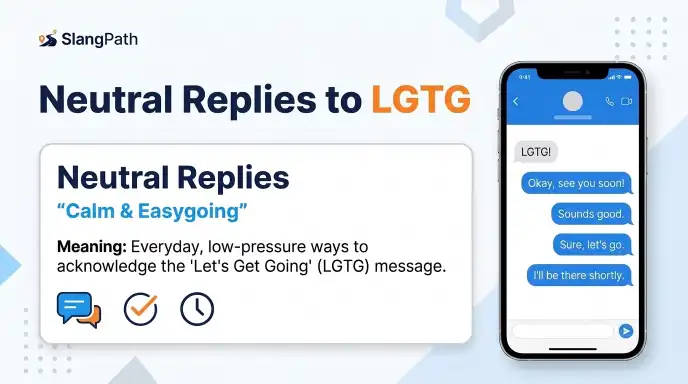
Neutral replies are useful when you want to keep the conversation professional, direct, or brief.
Examples include:
- “Okay.”
- “Understood.”
- “Sounds good.”
- “Confirmed.”
- “All right, thanks.”
- “I’ll proceed.”
- “Thanks for confirming.”
- “Noted, I’ll move forward.”
- “That works.”
- “I’ll take it from here.”
Example conversation:
A: “The updated document looks good. LGTG.”
B: “Thanks for confirming. I’ll send the final version.”
This style is useful for routine work conversations where a simple acknowledgment is enough.
How to Reply When Someone Uses LGTG to Start an Activity
Sometimes the context suggests that LGTG means “Let’s Get This Going.” In that case, the sender is encouraging people to begin instead of merely confirming that something looks acceptable.
Possible replies include:
- “Let’s do it!”
- “I’m ready.”
- “Let’s get started.”
- “Finally, let’s go!”
- “Everyone’s here. Start whenever you’re ready.”
- “Ready when you are.”
- “Let’s make it happen.”
For example:
A: “We’ve got everyone here. LGTG!”
B: “Let’s do it. I’ll start the presentation.”
The reply matches the sender’s intention to begin.
What If You Don’t Understand LGTG?
If you cannot tell what the sender means, asking a short question is better than guessing.
You could write:
- “Do you mean everything is ready?”
- “Are we good to start?”
- “What does LGTG mean in this message?”
- “Just checking, is everything okay?”
- “Do you mean you’re ready to leave?”
The surrounding conversation usually provides enough information to understand the abbreviation. However, clarification is especially helpful when the message concerns work, deadlines, or important plans.
Is LGTG Rude or Offensive?
LGTG is generally not rude or offensive. When it means “Looks Good to Go,” it usually expresses approval, readiness, or confirmation. It is a practical abbreviation rather than an insult.
For example, if someone sends you a draft and you respond, “LGTG,” you are usually telling them that the draft appears ready.
However, the way a message sounds depends on the situation. A brief reply can feel friendly in one conversation but too abrupt in another.
Is LGTG Safe to Use With Friends?
Yes. LGTG is generally suitable for casual messages with friends, family members, and classmates who understand texting abbreviations.
You might use it to confirm that you are ready for a trip, approve an outfit, or tell a friend that their video looks good.
For example:
A: “Are we still meeting at six?”
B: “Yep, LGTG!”
The reply is short and friendly. There is no obvious rude or offensive meaning in this context.
If your friend does not understand the abbreviation, simply writing “I’m ready” or “Looks good to go” will make your meaning clearer.
Is LGTG Appropriate at School?
LGTG can work in informal school group chats, especially when students are coordinating a project, checking a presentation, or confirming plans.
For example:
“Checked the slides. LGTG for tomorrow.”
This tells classmates that the slides appear ready.
However, formal assignments and messages to teachers generally benefit from complete sentences. Instead of using LGTG in an email, you could write:
“The presentation is ready for tomorrow’s class.”
This sounds clearer and more professional.
The important point is to choose wording that suits the communication setting.
Can You Use LGTG at Work?
LGTG may be appropriate in quick workplace chats, particularly when colleagues already understand the abbreviation.
For example:
A: “Have you reviewed the updated design?”
B: “Yes, LGTG.”
The reply suggests that the design looks acceptable.
However, there is a difference between informal approval and formal authorization. Saying something looks good does not necessarily mean that it has passed every required check or received official approval.
For important documents, client deliverables, financial decisions, or safety procedures, be specific about what you reviewed and if any additional approval is required.
A clearer workplace response might be:
“I reviewed the document, and the formatting looks good. The final approval is still pending.”
This avoids confusion about the status of the work.
Can LGTG Sound Dismissive?
Sometimes. The abbreviation itself is not dismissive, but a very short response may feel abrupt if the other person expects detailed feedback.
Imagine that a friend has spent hours preparing a project and asks you to review it. If you reply only “LGTG,” they may wonder if you actually looked at the details.
A more helpful response would be:
“Looks good to go! The layout is clear, and I like the introduction.”
This confirms readiness while providing useful feedback.
The lesson is simple: use LGTG when a brief confirmation is enough. When someone needs detailed advice or reassurance, explain your thoughts instead of relying on four letters.
Who Uses LGTG?
LGTG is not limited to one age group or online community. People can use it whenever they want to confirm that something is ready or appears acceptable.
Its usefulness depends on the conversation, the person’s familiarity with abbreviations, and the communication platform.
Do Teenagers and Gen Z Use LGTG?
Teenagers and Gen Z users may encounter LGTG in group chats, gaming communities, social media messages, and conversations about plans.
For example, friends might use it when deciding if to leave for an event or when checking if a video is ready to post.
However, LGTG is not exclusive to Gen Z. Some younger users may prefer expressions such as “ready,” “all set,” or “good to go.”
It is more accurate to describe LGTG as a general informal abbreviation than to associate it with only one generation.
Do Adults Use LGTG?
Adults may use LGTG in personal conversations, group messages, and workplace chats.
Someone organizing a family event might write “LGTG” after confirming the arrangements. A colleague might use it to indicate that a draft appears ready for review or publication.
The expression is practical because it communicates readiness quickly.
Still, not everyone uses texting shorthand. If you are unsure if the recipient understands it, spelling out the phrase is a sensible choice.
Is LGTG Common on Social Media?
LGTG can appear in comments, direct messages, online communities, and conversations about creative projects or personal plans.
Its frequency may vary from one platform or community to another. There is not enough reason to assume that it is equally popular on every social network.
People who frequently use abbreviations may recognize it immediately, while others may need the surrounding message to understand it.
Origin of LGTG
LGTG is formed from the first letters of “Looks Good to Go.” The phrase communicates that something appears ready for the next step.
There is no universally established origin that identifies a single person, platform, or date as the creator of this abbreviation.
How Did LGTG Become a Texting Abbreviation?
Digital communication encouraged people to shorten common expressions. Text messages and online chats often reward quick, compact wording, especially when people are coordinating activities or exchanging updates.
LGTG fits this pattern because it compresses a longer phrase into four letters.
Instead of typing “I’ve checked everything, and it looks ready,” someone may write “LGTG” when the surrounding conversation already explains what they are discussing.
The abbreviation is especially useful when people need to confirm progress without repeating information everyone already knows.
Did TikTok or Snapchat Create LGTG?
There is no reliable basis for saying that TikTok or Snapchat invented LGTG.
The abbreviation can be used across different messaging platforms because its meaning comes from an ordinary English expression rather than a platform,specific feature.
Social media can help abbreviations spread between groups, but that does not establish where a particular term first appeared.
Is the Origin of LGTG Certain?
The meaning “Looks Good to Go” is a common interpretation, but the exact history of the abbreviation is not clearly established.
“Let’s Get This Going” is another possible interpretation in some conversations. The wording around the abbreviation can help determine which meaning the sender intends.
For that reason, it is best to explain LGTG through its current usage rather than claim a specific invention date or origin without reliable evidence.
LGTG vs. IDK, IDC, IMO, and BRB
LGTG is different from common texting abbreviations such as IDK, IDC, IMO, and BRB because it usually communicates readiness or approval, while the others express uncertainty, indifference, an opinion, or a temporary departure.
Although these abbreviations can appear in the same conversation, each one serves a different purpose.
| Abbreviation | Meaning | Type | Usage | Popularity |
| LGTG | Looks Good to Go | Texting abbreviation | Confirming readiness or approval | Context,dependent |
| IDK | I Don’t Know | Texting abbreviation | Expressing uncertainty | Widely recognized |
| IDC | I Don’t Care | Texting abbreviation | Expressing indifference | Widely recognized |
| IMO | In My Opinion | Internet abbreviation | Sharing a personal viewpoint | Widely recognized |
| BRB | Be Right Back | Texting abbreviation | Indicating a short absence | Widely recognized |
LGTG vs. IDK
IDK means “I Don’t Know.” People use it when they are unsure about something or do not have an answer.
LGTG, by comparison, often means “Looks Good to Go,” indicating that something appears ready.
Example:
A: “Is the presentation ready?”
B: “LGTG. I checked all the slides.”
In this conversation, LGTG communicates that the presentation appears ready.
Now consider a different response:
A: “What time does the presentation start?”
B: “IDK. I haven’t checked.”
Here, IDK expresses uncertainty.
LGTG vs. IDC
IDC means “I Don’t Care.” It expresses indifference toward a choice, situation, or outcome.
LGTG generally communicates that something is ready or acceptable.
For example:
A: “Should we use the blue or black design?”
B: “IDC, either is fine.”
This response expresses indifference, although the tone can sound dismissive depending on the situation.
Compare it with:
A: “Does the final design look okay?”
B: “LGTG!”
The second response indicates approval rather than indifference.
LGTG vs. IMO
IMO stands for “In My Opinion.” It introduces a personal viewpoint or judgment.
LGTG is commonly used to confirm that something looks ready.
For example:
A: “Which picture should I post?”
B: “IMO, the second one looks better.”
The sender is sharing a preference.
In another conversation:
A: “Does the edited picture look ready?”
B: “LGTG!”
The sender is confirming that the picture appears ready to publish.
LGTG vs. BRB
BRB means “Be Right Back.” People use it when they need to step away briefly and expect to return.
LGTG does not normally communicate a temporary absence. Instead, it indicates readiness or approval.
For example:
A: “Can you check the document?”
B: “BRB, I need to answer the door.”
The sender is temporarily leaving the conversation.
Compare that with:
A: “Did you check the document?”
B: “Yes, LGTG.”
The sender is confirming that the document looks ready.
Real,World Example of LGTG
Imagine that three friends are preparing for a weekend road trip. They have been discussing the journey in a WhatsApp group for several days.
One friend books the hotel, another checks the car, and the third prepares a list of things to pack. Before leaving, they want to make sure everything is organized.
The conversation might look like this:
A: “Hotel booked, bags packed, and the route saved.”
B: “Did you check the fuel?”
A: “Yes, the tank is full.”
B: “Perfect, LGTG!”
In this situation, LGTG means “Looks Good to Go.” The sender believes the arrangements are complete and the group is ready to leave.
The abbreviation makes sense because everyone already knows what they are discussing. There is no need to repeat every detail.
However, if someone uses LGTG in an unfamiliar conversation, the meaning may not be immediately obvious. Looking at the surrounding messages usually helps clarify the intended meaning.
Common Mistakes People Make When Using LGTG
Although LGTG is a short expression, there are a few mistakes that can cause confusion.
1. Assuming It Always Has the Same Meaning
“Looks Good to Go” is a common interpretation, but some people may use LGTG to mean “Let’s Get This Going.”
For example, “The equipment is ready. LGTG!” could suggest that the group should begin.
Read the surrounding conversation instead of assuming every sender intends the same expansion.
2. Using It When a Detailed Explanation Is Needed
LGTG works well as a quick confirmation, but it may not provide enough information when someone needs specific feedback.
For example, replying “LGTG” to a complicated project review does not explain what you checked or if any issues remain.
A more useful response would be, “The layout and spelling look good. The final figures still need checking.”
3. Using It in Every Professional Message
Some workplaces encourage brief messages, while others prefer complete sentences and formal communication.
If your manager or client is unfamiliar with LGTG, writing “The document is ready for review” will be clearer.
Choose your wording based on the recipient and the importance of the message.
4. Confusing Readiness With Official Approval
Saying that something looks good to go does not always mean it has received formal permission.
For example, a draft may look complete but still require approval from a manager.
When authorization matters, clearly state if the work has been reviewed, approved, or simply prepared.
5. Thinking LGTG Is Exclusive to Social Media
LGTG is not limited to TikTok, Snapchat, Instagram, or WhatsApp. It can also appear in ordinary SMS messages, online games, group chats, and workplace messaging.
Its meaning generally depends on the conversation rather than the platform.
Frequently Asked Questions
Q1: What does LGTG mean in text messages?
LGTG usually means “Looks Good to Go.” It tells someone that something appears ready, acceptable, or prepared. In some contexts, it may mean “Let’s Get This Going.”
Q2: What does LGTG mean on TikTok?
On TikTok, LGTG can mean “Looks Good to Go.” People may use it in comments or messages to say that a video, outfit, or post looks ready.
Q3: Is LGTG slang?
LGTG is an informal texting abbreviation or initialism commonly used in digital communication. It is often grouped with internet slang.
Q4: Is LGTG rude or offensive?
No, LGTG is generally neither rude nor offensive. It usually communicates approval or readiness, although a very short response may sometimes sound abrupt.
Q5: How should you reply to LGTG?
You can reply with “Sounds good,” “Perfect, let’s go,” “Thanks for checking,” or “Let’s get started.” Choose a response that matches the conversation.
Q6: What does LGTG mean on Snapchat?
On Snapchat, LGTG usually means “Looks Good to Go.” Friends may use it to approve an outfit, confirm plans, or say that something is ready.
Q7: What does LGTG mean on WhatsApp?
On WhatsApp, LGTG commonly indicates that plans or preparations look ready. For example, someone might write “LGTG” after confirming a meeting or completing a group task.
Q8: Can LGTG mean “Let’s Get This Going”?
Yes, some people may use LGTG to mean “Let’s Get This Going.” This interpretation suggests that it is time to begin an activity. The intended meaning depends on context.
Q9: Can I use LGTG at work?
Yes, LGTG can be suitable for informal workplace chats when everyone understands the abbreviation. For formal emails or important approvals, a complete sentence is usually clearer.
Q10: What is the difference between LGTG and good to go?
“Good to go” is the full expression people use to indicate readiness. LGTG is a shortened form commonly understood as “Looks Good to Go,” although it can have other context,dependent interpretations.
Conclusion
LGTG usually means “Looks Good to Go” in text messages. People use it when something appears ready, a plan has been confirmed, or an item has been checked and looks acceptable. It can appear in casual conversations, group chats, gaming discussions, and workplace messages.
The abbreviation is generally friendly and not offensive. However, its meaning can vary, and some people use it to mean “Let’s Get This Going.” Always consider the surrounding conversation before deciding what someone intends.
If you are chatting with friends, LGTG can be a convenient way to confirm readiness. In formal situations, writing the complete phrase can help avoid confusion.
Read More About !

Michael Brooks is a language writer at SlangPath with 7+ years of experience creating simple, practical content on English slang and everyday expressions.