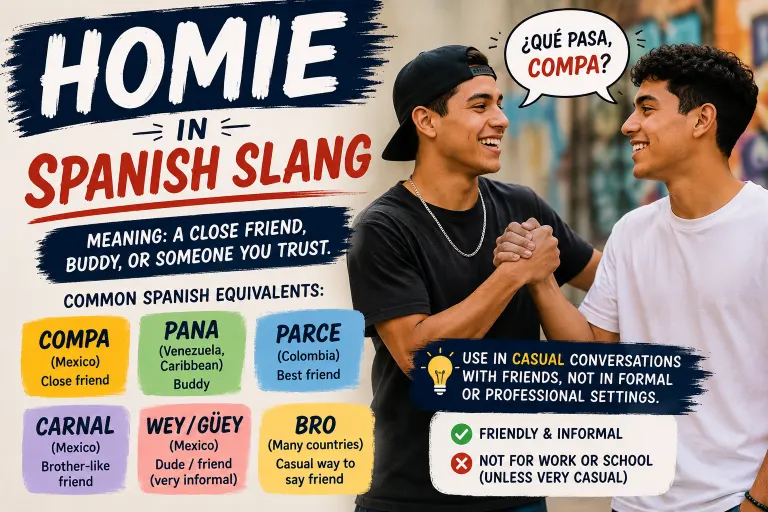
Homie in Spanish slang usually refers to a close friend, trusted companion, or someone you consider part of your inner circle. While Spanish does not have one universal word that perfectly translates homie, many countries use their own slang expressions with the same friendly meaning.
People search for homie in Spanish slang because they hear the word in songs, movies, social media, or conversations with Spanish speakers. They often want to know which Spanish word sounds natural in different countries and whether it is polite to use. In this guide, you’ll learn the most common Spanish slang words for “homie,” how they are used, where they are popular, and when you should avoid them.
Quick Answer: Homie in Spanish Slang
Homie in Spanish slang usually means a close friend or trusted buddy. Common Spanish slang equivalents include compa, pana, carnal, parcero, wey, and bro, depending on the country. The best word depends on where the speaker is from because Spanish slang changes from region to region.
What Does Homie in Spanish Slang Mean?
The word homie originally comes from English slang and refers to someone you trust like family. It often describes a lifelong friend, neighborhood companion, or someone who always has your back.
Spanish speakers express this same idea using local slang instead of a direct translation. Because every Spanish-speaking country has its own expressions, there is no single Spanish word that replaces homie everywhere.
In most conversations, a Spanish slang word for homie shows:
- Friendship
- Loyalty
- Trust
- Familiarity
- Respect between friends
The tone is almost always casual and informal.
Is There a Direct Spanish Translation for “Homie”?
No. There is no exact Spanish translation that works in every country.
Instead, native speakers choose different slang words depending on where they live.
| English | Spanish Slang | Common Region | Meaning |
| Homie | Compa | Mexico | Close friend |
| Homie | Pana | Venezuela, Caribbean | Buddy |
| Homie | Carnal | Mexico | Brother-like friend |
| Homie | Parcero (Parce) | Colombia | Best friend |
| Homie | Wey (Güey) | Mexico | Friend (very informal) |
| Homie | Bro | Many countries | Modern casual friend |
Learning the regional differences helps you sound more natural.
Different Meanings of Homie in Spanish Slang
Although the basic idea stays the same, homie can describe different kinds of relationships.
A Close Friend
This is the most common meaning.
It refers to someone you know well and trust.
Example:
“Carlos is my homie. We grew up together.”
Spanish equivalent:
“Carlos es mi compa.”
A Childhood Friend
Sometimes homie describes someone from your hometown or neighborhood.
These friendships often last for many years.
Example:
“I’m meeting my old homies this weekend.”
A Loyal Companion
A homie is someone who supports you during both good and difficult times.
This meaning focuses on loyalty rather than simply knowing someone.
A Casual Way to Address Someone
In some conversations, people use homie the same way they use bro, buddy, or pal.
For example:
“What’s up, homie?”
The Spanish version depends on the country and local slang.
Where Is Homie in Spanish Slang Commonly Used?
Many Spanish slang words for homie appear in everyday conversation.
Common places include:
- Text messages
- Social media posts
- TikTok videos
- Instagram comments
- Snapchat chats
- Reddit discussions
- Discord servers
- Online gaming
- Music lyrics
- Friendly conversations
Some words are also common in movies and television from specific countries.
Most Common Spanish Slang Words for Homie
Compa

Compa is one of the best-known Mexican slang words for a close friend.
It comes from compadre but today simply means a trusted buddy.
Example
“¿Qué pasa, compa?”
Meaning
“What’s up, buddy?”
Pana
Pana is extremely popular in Venezuela, Puerto Rico, and several Caribbean communities.
It refers to a good friend.
Example
“Él es mi pana.”
Meaning
“He’s my close friend.”
Carnal
Carnal literally means “brother,” but in Mexican slang it often means a friend who feels like family.
It suggests a deeper connection than an ordinary friendship.
Example
“Ese es mi carnal.”
Meaning
“That’s my brother-like friend.”
More Spanish Slang Words for Homie
Parcero (Parce)
Parcero, often shortened to parce, is one of the most popular slang words in Colombia. It means a close friend, buddy, or trusted companion.
You will hear it in everyday conversations, music, and social media. It has a warm and friendly tone.
Example
“¡Hola, parce! ¿Cómo estás?”
Meaning
“Hey, buddy! How are you?”
Güey (Wey)
Güey (sometimes spelled wey) is very common in Mexico. Depending on the situation, it can mean friend, dude, or simply you.
Friends often use it with each other in a relaxed way. However, the tone matters. When spoken angrily, it can sound disrespectful.
Example
“¿Qué haces, güey?”
Meaning
“What are you doing, dude?”
Bro
Many younger Spanish speakers simply use the English word bro. It is especially common online and among people who watch English-language content.
You can hear bro on:
- TikTok
- YouTube
- Discord
- Online gaming
- Text messages
It has become part of modern internet slang in many Spanish-speaking communities.
Where Are These Words Commonly Used?
Different countries prefer different slang terms.
| Country or Region | Popular Word for “Homie” |
| Mexico | Compa, Carnal, Güey |
| Colombia | Parcero, Parce |
| Venezuela | Pana |
| Puerto Rico | Pana |
| Spain | Tío (in casual speech) |
| Many Spanish-speaking countries | Bro |
If you travel or chat online with Spanish speakers, choosing the local word makes your conversation sound more natural.
Platform Usage
Text Messages
Friends often use these words as greetings or casual nicknames.
Examples
- “Hola, compa.”
- “¿Todo bien, pana?”
- “Gracias, parce.”
TikTok
Creators use these words in comedy videos, lifestyle content, and reaction clips to sound friendly and relatable.
InstagramComments like these are common:
- “Ese es mi compa.”
- “Mi pana siempre apoyando.”
- “Grande, parce.”
Discord and Gaming
Gamers often mix English and Spanish.
Examples include:
- “Vamos, bro.”
- “Buena partida, compa.”
- “Gracias, pana.”
This mix of languages is common in international gaming communities.
Is Homie in Spanish Slang Rude, Offensive, or Harmless?
In most situations, these words are friendly and harmless when used between people who know each other.
However, context is important.
| Word | Usually Friendly | Can Sound Rude |
| Compa | ✔ Yes | Rarely |
| Pana | ✔ Yes | Very rarely |
| Parcero | ✔ Yes | Rarely |
| Carnal | ✔ Yes | Rarely |
| Bro | ✔ Yes | Almost never |
| Güey | Usually | Sometimes, depending on tone |
If you are speaking with teachers, customers, managers, or someone you have just met, it is usually better to avoid slang until you know the situation.
Can You Use These Words at Work?
Usually, no.
These expressions are designed for casual conversations.
In professional settings, it is safer to use polite alternatives such as:
- Amigo
- Compañero
- Señor
- Señora
- Colega (common in some regions)
Formal language creates a more respectful first impression.
Real-Life Examples
Friends Meeting
Luis: “¡Hola, compa! Hace tiempo que no te veía.”
David: “Sí, vamos por un café.”
Gaming Chat
Player 1: “Buen trabajo, bro.”
Player 2: “Gracias, pana.”
Social Media Comment
“Siempre apoyando a mis parceros.”
Meaning: “Always supporting my close friends.”
Family Gathering
“Mi carnal viene esta noche.”
Here, carnal refers to a brother-like friend or sibling, depending on the speaker and context.
Why Do People Use These Slang Words?
People use these expressions because they make conversations feel:
- More relaxed
- More personal
- More friendly
- More natural
- More expressive
Calling someone compa, pana, or parce often shows trust and familiarity instead of formal distance.
These words also help people connect with local culture. Using the right slang for a country can make conversations feel more authentic, especially when talking with native speakers.
Origin and History of “Homie”
The English word homie developed from homeboy, a term that became widely recognized in American urban communities, especially within African American Vernacular English (AAVE). It originally referred to someone from the same neighborhood or “home.”
Over time, homie expanded beyond its original community and became common in music, movies, online gaming, and social media. Today, people around the world use it to describe a close friend.
Spanish speakers generally do not translate the word directly. Instead, they use local slang such as compa, pana, parce, or carnal, depending on their country and culture.
Similar Slang or Related Terms
If you want to say “homie” in different ways, these words have similar meanings.
| Word | Meaning | Common Region |
| Compa | Close friend | Mexico |
| Pana | Buddy | Venezuela, Puerto Rico |
| Parcero (Parce) | Best friend | Colombia |
| Carnal | Brother-like friend | Mexico |
| Bro | Friend or buddy | Many countries |
| Amigo | Friend | All Spanish-speaking countries |
| Colega | Colleague or friend | Spain and Latin America |
| Tío | Dude | Spain |
Each word has its own cultural flavor, so choosing the correct one depends on where the conversation takes place.
When Should You Avoid Using It?
Although these slang words are friendly, they are not suitable for every situation.
Avoid using them when:
- Talking to your teacher for the first time.
- Speaking with your boss or manager.
- Writing formal emails.
- Attending job interviews.
- Talking to older people who prefer formal language.
- Speaking with someone you have just met.
Using polite language first is usually the safest choice. As you become familiar with the person, you can follow their communication style.
Common Misunderstandings
Every Country Uses the Same Word
This is not true.
Spanish slang changes from one country to another. A word that sounds natural in Mexico may not be common in Colombia or Spain.
“Homie” Always Means Best Friend
Not always.
Sometimes people use homie for a close friend. Other times, it is simply a casual greeting similar to dude or bro.
Slang Is Always Appropriate
No.
Friendly slang works best in casual conversations. Formal situations usually require standard Spanish.
Frequently Asked Questions
Q1. What does “homie” mean in Spanish slang?
It usually means a close friend, trusted buddy, or someone you know well. Common Spanish equivalents include compa, pana, parce, and carnal.
Q2. Is there one Spanish word for “homie”?
No. Different Spanish-speaking countries use different slang words.
Q3. Which Spanish word is most common in Mexico?
Compa, carnal, and güey are among the most common informal choices.
Q4. Is “homie” rude?
No. It is generally friendly and informal. However, some local slang words, such as güey, can sound rude if spoken with an angry tone.
Q5. Can I use these words with my teacher?
It is better to use formal language unless your teacher clearly prefers casual conversation.
Q6. Which Spanish word is closest to “buddy”?
Pana, compa, and parce are all close equivalents, depending on the country.
Conclusion
Homie in Spanish slang does not have one exact translation because every Spanish-speaking region has its own informal expressions. Words like compa, pana, parcero, carnal, and bro all express friendship, trust, and familiarity in different ways.
The best choice depends on the country, the situation, and your relationship with the other person. If you are speaking casually with friends, these slang words can help you sound more natural. In professional or formal settings, standard Spanish remains the better option. Understanding these regional differences will help you communicate with confidence and avoid awkward misunderstandings.
Read Moer About!

My name is Olivia Bennett.I am a language enthusiast and educational writer with a strong interest in contemporary English and digital communication. I enjoys making language learning engaging and accessible.