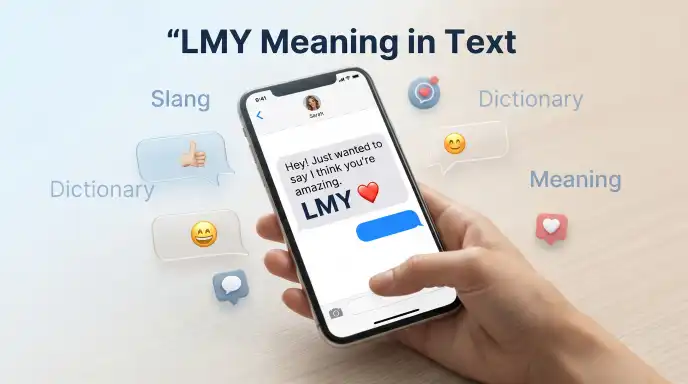
LMY usually means “Love and Miss You” in text messages. It is a casual abbreviation people use to show affection and tell someone that they miss them.
You may see LMY in texting, Snapchat, Instagram DMs, WhatsApp chats, or other casual online conversations. The meaning is usually easy to understand when you look at the messages around it.
The abbreviation can be used between romantic partners, close friends, or family members. It does not automatically mean that the conversation is romantic.
People often search for lmy mean in text because short internet abbreviations can be confusing, especially when someone sends only three letters without explaining them.
LMY Meaning in Text
LMY commonly means “Love and Miss You.” It is an informal texting abbreviation used to express affection and tell someone that you miss them.
The three letters can be understood as:
- L = Love
- M = Miss
- Y = You
The word “and” is understood between the main words.
For example:
“Goodnight LMY ❤️”
This can mean:
“Goodnight. Love and miss you.”
LMY is not normally used like a regular English word. Instead, it works as a short form in digital communication.
Is LMY Slang or an Abbreviation?
LMY is best described as an informal texting abbreviation. It can also be grouped with internet slang because people use it in casual digital conversations.
It is different from ordinary vocabulary because the letters stand for a longer expression.
You would normally expect to see it in a message such as:
“Have a safe trip. LMY!”
rather than in formal writing.
The abbreviation makes the message shorter while keeping its emotional meaning.
What Does LMY Mean in Everyday Chat?
In everyday conversation, LMY usually communicates warmth, affection, or that the sender is missing someone.
For example:
A: I wish you were here tonight.
B: Same.
A: LMY ❤️
In this situation, the meaning is clear because the conversation is personal.
LMY can also appear at the end of a conversation:
“Talk to you tomorrow. LMY!”
Here, it works almost like an affectionate goodbye.
Is LMY the Same as ILY?
LMY and ILY are related, but they are not exactly the same.
ILY usually means “I Love You.”
LMY commonly means “Love and Miss You.”
The difference is that LMY adds the idea of missing someone.
For example:
- ILY = I Love You
- LMY = Love and Miss You
Both can express affection, but the second one specifically communicates that the sender misses the other person.
Where People Use LMY
LMY can appear on several social media and messaging platforms. The basic meaning usually stays the same, but the tone can depend on the conversation and the relationship between the people.
LMY on TikTok
On TikTok, LMY may appear in comments, direct messages, or conversations between people who know each other.
For example:
“I miss your old videos. LMY!”
Or someone might send it privately after discussing a personal memory.
TikTok has its own large collection of abbreviations and slang, so context is important. A short abbreviation may not always have one fixed interpretation.
If you see LMY in a personal TikTok conversation, “Love and Miss You” is a likely meaning when the surrounding messages are affectionate.
LMY on Snapchat
Snapchat is another place where short texting expressions are common.
People often communicate quickly through snaps and chats, so abbreviations can make messages shorter.
For example:
“Goodnight! LMY ❤️”
A close friend might also write:
“Have fun tonight. LMY!”
The capitalization does not matter. LMY, lmy, and Lmy can all communicate the same idea.
Snapchat conversations are often informal, so an abbreviation like LMY can fit naturally there.
LMY on Instagram
On Instagram, LMY may appear in:
- Direct messages
- Comments
- Story replies
- Private conversations
- Casual captions
For example:
“Miss hanging out with you. LMY!”
If a romantic partner sends this message, it may have an intimate meaning. If a close friend sends it, it can simply express friendship and affection.
The relationship between the sender and receiver is therefore important.
LMY on WhatsApp
WhatsApp conversations often include abbreviations because people use the app for quick personal messaging.
Someone might write:
“Made it home. LMY.”
Or:
“Talk tomorrow. LMY ❤️”
In these examples, the abbreviation acts as a short emotional sign,off.
WhatsApp groups can be different. If someone simply writes “LMY” in a large group and nobody knows what they mean, the context may not be enough to understand it.
When that happens, asking the sender is perfectly reasonable.
LMY in SMS Text Messages
LMY can also appear in ordinary SMS messages.
Although people now use many messaging apps, traditional texting still uses abbreviations because they make messages quicker to type.
For example:
“Hope your exam goes well. LMY!”
The sender may be trying to communicate encouragement and affection at the same time.
The important point is that LMY belongs to informal communication. It is generally more suitable for personal messages than formal writing.
Why Do People Use LMY?
People use abbreviations like LMY mainly because they make casual communication quick and familiar.
Instead of typing:
“I love you and I miss you.”
someone can write:
“LMY ❤️”
The shorter version may feel more natural in a text conversation.
It can also make an emotional message feel less formal.
For people who already understand each other’s texting habits, a few letters can communicate a complete thought.
However, short does not always mean clearer. If the other person has never seen LMY before, they may not understand it immediately.
Does LMY Always Mean “Love and Miss You”?
Not necessarily.
“Love and Miss You” is a common interpretation of LMY, but the abbreviation is not as standardized as terms such as IDK, LOL, or BRB.
This means context matters.
For example:
“Goodnight LMY ❤️”
strongly suggests an affectionate meaning.
But if someone sends only:
“LMY?”
without any surrounding conversation, you may not know exactly what they intended.
If the meaning is unclear, the best approach is simply to ask.
You could reply:
“What does LMY mean here?”
That is better than assuming and potentially misunderstanding the message.
LMY in Casual Online Communication
One reason LMY fits naturally into online communication is that internet language often favors speed and simplicity.
People regularly shorten common expressions when talking through phones and social media.
Examples include:
- IDK — I Don’t Know
- IDC — I Don’t Care
- IMO — In My Opinion
- BRB — Be Right Back
- ILY — I Love You
- LMY — Love and Miss You
These abbreviations can make conversations feel relaxed and conversational.
LMY is more personal than many of the other examples because it expresses emotion rather than simply communicating information.
That is why you are more likely to see it in a private conversation than in a random public comment.
When LMY Sounds Natural
LMY usually fits situations where there is already some level of personal connection.
For example:
“I miss our old weekends. LMY!”
sounds natural between close friends.
Likewise:
“Goodnight, LMY ❤️”
can sound natural between romantic partners.
A family member might also use:
“Take care of yourself. LMY.”
The expression works because the relationship makes the affectionate tone understandable.
When LMY May Sound Strange
The same abbreviation can feel unusual when sent to someone you barely know.
For example, sending:
“LMY!”
to a new coworker may create confusion because the message sounds more personal than normal workplace communication.
Likewise, LMY is usually unnecessary in:
- Formal emails
- School assignments
- Academic writing
- Job applications
- Business reports
- Official documents
In these situations, complete sentences are clearer and more appropriate.
Real Chat Examples of LMY
The easiest way to understand LMY is to see how it can appear in an actual conversation. The abbreviation usually makes the most sense when the relationship and previous messages are clear.
Example 1: Saying Goodnight
A: I’m getting sleepy.
B: Same here. I have an early morning tomorrow.
A: Okay, goodnight. LMY ❤️
B: Goodnight! LMY too.
Here, LMY is being used as an affectionate way to end the conversation.
Example 2: Missing a Friend
A: Do you remember our weekend coffee trips?
B: Of course 😂 We need to do that again.
A: Seriously, I miss those days.
B: Same. LMY!
In this conversation, LMY does not have to be romantic. Close friends can use affectionate expressions too.
Example 3: A Romantic Text
A: I wish you were here right now.
B: Me too.
A: Hopefully we can meet this weekend.
B: I hope so ❤️
A: LMY.
Because the conversation is clearly romantic, LMY has a more intimate tone.
Example 4: A Family Conversation
A: Did you get home safely?
B: Yes, I just arrived.
A: Good. Get some rest.
B: I will.
A: LMY.
Here, the abbreviation simply shows care and affection between family members.
Example 5: After a Trip
A: The vacation was amazing!
B: Glad you had fun.
A: I already miss everyone.
B: We miss you too. LMY!
The abbreviation adds an emotional touch to the conversation.
Example 6: Supporting Someone
A: Today was honestly terrible.
B: I’m sorry. Do you want to talk about it?
A: Maybe later. Thanks for being there.
B: Anytime. LMY.
Here, LMY expresses emotional support and closeness.
Example 7: A Quick Goodbye
A: I have to head out now.
B: No worries.
A: I’ll message you tomorrow. LMY!
B: Talk tomorrow ❤️
The short expression works naturally as a personal goodbye.
Example 8: Remembering Someone
A: I found our old school pictures today.
B: No way 😂 Send them!
A: You looked so different back then.
B: So did you!
A: Haha. LMY.
The abbreviation gives the ending a warm, nostalgic feeling.
Example 9: Before an Important Day
A: Nervous about tomorrow?
B: A little. I really hope everything goes well.
A: You’ll do great. Don’t worry.
B: Thanks, I needed that.
A: LMY. Good luck!
Here, LMY is combined with encouragement.
Example 10: A Simple Text
A: Made it home.
B: Great!
A: Talk tomorrow. LMY ❤️
B: Okay, sleep well.
This is one of the simplest ways the abbreviation can appear in a text.
How to Reply When Someone Says “LMY”
Your response depends on your relationship with the sender and how you feel about the message.
If you are close to the person, you can respond warmly. If you are unsure what they mean, asking for clarification is completely fine.
There is no single “correct” reply.
Funny Replies
If you and the sender normally joke around, a playful answer can work well.
Try responses such as:
- “I knew you missed me 😂”
- “Finally, you admit it!”
- “Miss me already? 😂”
- “Aww, someone is feeling emotional.”
- “The feeling better be mutual 😂”
- “Okay, okay, I miss you too!”
A funny response works best when the other person understands your sense of humor.
Casual Replies
If you want to keep things simple, you can use a short response.
Examples include:
- “LMY too!”
- “Miss you too!”
- “Same here!”
- “Aww, same!”
- “Talk soon!”
- “You too ❤️”
These replies are useful when you want to acknowledge the message without making the conversation overly emotional.
Friendly Replies
If the sender is a close friend or family member, a warmer response may feel more natural.
You could say:
- “Love and miss you too!”
- “Miss you lots!”
- “Same here. Hope we meet soon.”
- “Sending love!”
- “I miss you too. Take care!”
- “Hopefully we can catch up soon.”
A full sentence can sometimes be better than another abbreviation, especially if you want your response to sound sincere.
Neutral Replies
What if you are not sure what LMY means?
You do not need to guess.
You can simply ask:
- “What do you mean by LMY?”
- “Sorry, what does LMY mean here?”
- “What does that abbreviation mean?”
- “Just checking—what do you mean?”
- “I’m not familiar with LMY.”
This is particularly useful because LMY is not as universally recognized as abbreviations such as LOL, IDK, or BRB.
What If You Do Not Feel the Same Way?
You should not feel pressured to respond with “LMY too” just because someone sent LMY to you.
If the message feels more affectionate than your relationship, a polite and neutral answer is enough.
For example:
“That’s sweet of you. Take care!”
Or:
“Thanks, I appreciate that.”
You can acknowledge the person’s message without making a promise or expressing feelings you do not share.
This is especially important if the sender’s message catches you off guard.
Is LMY Rude or Offensive?
No, LMY is generally not considered rude or offensive.
When it means “Love and Miss You,” it normally communicates affection, care, or emotional closeness.
The abbreviation itself does not contain an insult, swear word, or offensive expression.
However, if it is appropriate depends on the person and situation.
For example, LMY may feel perfectly normal between two close friends but unusual when sent to a manager or teacher.
The problem in a formal situation is not that the abbreviation is offensive. It is that the message may sound too personal or informal.
Is LMY Safe to Use?
In ordinary personal conversations, LMY is generally safe to use.
It can work well when:
- You know the person well.
- You normally communicate casually.
- Affectionate language is normal in your relationship.
- The conversation is personal rather than formal.
If you are uncertain, writing the full phrase is often clearer.
Can You Use LMY at School?
You can use LMY in a casual message to a friend from school.
For example:
“Good luck tomorrow. LMY!”
But you should avoid it in formal schoolwork.
Do not normally put texting abbreviations into:
- Essays
- Research papers
- Formal assignments
- School applications
- Academic presentations
Formal writing requires clearer language.
Can You Use LMY at Work?
Generally, it is better to avoid LMY in professional communication.
A message to a colleague might be casual, but workplace communication still needs to remain appropriate for the relationship.
For example, writing:
“Thanks for helping with the project. LMY!”
could be confusing or unnecessarily personal.
A professional alternative would be:
“Thanks for your help. I really appreciate it.”
That communicates the intended message without creating ambiguity.
Who Uses This Term?
LMY can be used by different age groups, but it is most naturally associated with informal digital communication.
People who regularly use texting abbreviations may recognize it more quickly than someone who rarely uses social media or messaging apps.
It can appear in conversations between teenagers, young adults, and older users who are comfortable with online shorthand.
The important thing is that LMY is not restricted to one particular age group.
Gen Z and LMY
Gen Z is familiar with a large number of internet abbreviations, slang terms, and shortened expressions.
However, knowing internet slang does not mean every Gen Z user will automatically recognize LMY.
Some abbreviations are extremely common. Others are used by smaller groups or appear only in particular conversations.
For example, most frequent internet users are likely to recognize:
- LOL
- IDK
- OMG
- BRB
- IMO
LMY is less universal.
That means you should not assume that everyone reading it will understand it immediately.
Is LMY Common Online?
LMY is best considered a less common texting abbreviation rather than one of the most widely recognized internet abbreviations.
You are more likely to encounter it in personal conversations than in general online discussions.
Someone may use it because it feels quicker or more natural than writing the entire phrase.
Another person may prefer:
“Miss you ❤️”
instead of LMY.
Both communicate a similar emotional idea, but the second version is immediately understandable to almost everyone.
LMY and Different Relationships
The same abbreviation can have different emotional meanings depending on the relationship between the people involved.
Between Romantic Partners
LMY can have a clearly romantic tone when used by partners.
For example:
“Goodnight. LMY ❤️”
In this setting, the abbreviation can feel intimate and affectionate.
Between Close Friends
Friends can also use LMY.
A friend who has moved away might write:
“Wish you were here. LMY!”
There is no requirement for the phrase to be romantic.
Between Family Members
Parents, siblings, cousins, and other relatives may use affectionate messages too.
For example:
“Take care on your trip. LMY.”
The surrounding relationship makes the meaning clear.
Between New Acquaintances
This is where caution is useful.
If someone you have only recently met sends LMY, you may not know if they are being friendly, romantic, playful, or simply using an abbreviation differently.
In that case, context is your best clue.
Why Context Matters With LMY
Internet language changes quickly.
A short abbreviation may have one meaning in one community and a different meaning somewhere else. Some abbreviations also develop several interpretations over time.
That is why it is risky to interpret LMY based only on the three letters.
Look at:
- The sentence around it
- The platform
- Your relationship with the sender
- The tone of the conversation
- Any emojis or other words nearby
For example:
“Goodnight LMY ❤️”
has a very different context from seeing:
“LMY?”
on its own.
If the meaning remains unclear, asking the sender is the simplest solution.
LMY as Part of Modern Texting Language
Texting has changed the way people express themselves.
People often remove words, shorten phrases, use initials, or replace emotions with emojis.
Abbreviations such as IDK, IDC, IMO, and BRB save typing time. LMY serves a slightly different purpose because it communicates a personal feeling.
The goal is not always speed.
Sometimes a short abbreviation simply feels more natural in a casual chat.
For example:
“Miss you ❤️”
is already short, but:
“LMY ❤️”
can feel like an expression that belongs specifically to texting culture.
This is one reason slang dictionaries and language resources need to explain not only what an abbreviation means, but also how people actually use it.
When a Full Phrase Is Better Than LMY
There are times when writing the complete message is more effective.
Use the full phrase when:
- The recipient may not know the abbreviation.
- You want to sound especially sincere.
- The conversation is emotional or serious.
- You are writing formally.
- There is a possibility of misunderstanding.
For example, instead of:
“LMY.”
you might write:
“I really love and miss you.”
The longer message takes a few extra seconds to type, but it leaves almost no uncertainty about what you mean.
Sometimes clarity matters more than convenience.
Origin of the Term
The exact origin of LMY is not completely clear.
Unlike some older and more established texting abbreviations, there is no widely accepted record showing one specific person, website, or platform that created LMY.
The expression likely developed naturally from the way people shorten phrases in digital conversations. “Love and Miss You” can easily be reduced to its main letters, creating LMY.
This kind of shortening became more common as people began communicating through SMS, instant messaging, online chat rooms, and social media.
Internet Culture and LMY
Internet culture has played a major role in the growth of short forms.
People often want their messages to feel quick, relaxed, and conversational. Instead of typing a complete sentence every time, they may use familiar abbreviations.
Emotional phrases are also frequently shortened in personal conversations.
For example:
“I love you and miss you.”
can become:
“LMY ❤️”
The shorter version can feel more natural in a fast,moving conversation.
Is the Origin of LMY Certain?
No.
It is safer to describe the origin as uncertain or informal rather than claiming that a particular person invented it.
Another important point is that LMY is not as standardized as very common abbreviations such as IDK, LOL, or BRB. Different online sources may occasionally give LMY alternative meanings.
Therefore, the conversation itself should always be considered.
LMY vs. IDK, IDC, IMO, and BRB
LMY belongs to the larger group of texting abbreviations, but each abbreviation serves a different purpose.
| Abbreviation | Meaning | Type | Usage | Popularity |
| LMY | Love and Miss You | Texting abbreviation | Affectionate personal conversations | Less common |
| IDK | I Don’t Know | Text abbreviation | Showing uncertainty | Very common |
| IDC | I Don’t Care | Text abbreviation | Showing indifference | Very common |
| IMO | In My Opinion | Text abbreviation | Introducing an opinion | Very common |
| BRB | Be Right Back | Text abbreviation | Saying you will return soon | Very common |
The main difference is what each abbreviation communicates.
LMY is emotional and personal. It usually expresses affection and missing someone.
IDK is used when a person does not know something.
IDC expresses a lack of concern or interest.
IMO tells the reader that what follows is the sender’s opinion.
BRB is used when someone is temporarily leaving a conversation.
Which One Is Most Personal?
Among these examples, LMY is the most directly emotional.
For example:
“IDK what happened.”
shares information about uncertainty.
But:
“LMY ❤️”
communicates a personal feeling.
This is why LMY is more likely to appear in private conversations than general discussions.
Is LMY as Common as IDK or BRB?
No.
IDK and BRB are widely recognized texting abbreviations. LMY is less universally recognized.
Someone who frequently uses messaging apps may understand LMY immediately, but another person may need to ask what it means.
That is perfectly normal with less,established internet abbreviations.
Real,World Usage Example
Imagine that two close friends have lived in different cities for several months.
They used to meet every weekend, but now they mostly communicate through WhatsApp.
One evening, they start talking about an old memory.
A: Remember when we’d get coffee every Saturday?
B: Of course 😂 Those were good times.
A: I really miss those weekends.
B: Same. We should do it again when you visit.
A: Definitely. LMY!
In this situation, LMY works as a short expression of affection.
The conversation is already personal, so the abbreviation does not need a long explanation.
Now imagine a different situation.
A: Hey, goodnight!
B: Goodnight. LMY ❤️
Here, the romantic or affectionate tone is even clearer because of the context and heart emoji.
These examples show why you should not look at the abbreviation in isolation.
How Context Changes the Meaning
Texting abbreviations are often understood through context rather than through the letters alone.
Consider this message:
“LMY ❤️”
The heart emoji reinforces the affectionate interpretation.
Now compare it with:
“What does LMY mean?”
Here, the person is not using LMY as an emotional expression. They are simply asking about the abbreviation.
This may seem obvious, but it shows why the surrounding words matter.
When you encounter an unfamiliar abbreviation, look at the complete conversation before deciding what it means.
The Relationship Matters Too
The sender’s relationship with you can provide another important clue.
If your partner writes:
“Goodnight LMY ❤️”
the intended meaning is likely affectionate.
If a close friend writes:
“LMY! We need to hang out soon.”
it may simply express friendship.
If a stranger sends the same abbreviation, you may need more information before interpreting it.
When to Use LMY
LMY is best suited to informal, personal communication.
You can use it when you are talking with someone who understands your texting style.
Good situations can include:
- Private messages
- Casual texts
- Conversations with close friends
- Messages to family members
- Romantic conversations
- Informal social media chats
The key is familiarity.
If both people regularly use texting abbreviations, LMY is unlikely to cause confusion.
When to Avoid LMY
There are also situations where using LMY is not a good choice.
Avoid it in formal or professional communication, especially when the recipient may not understand internet shorthand.
Examples include:
- Job applications
- Formal business emails
- Academic papers
- School assignments
- Official letters
- Professional reports
For example, writing:
“LMY”
in a formal workplace email could look confusing or overly casual.
A complete sentence is usually a better option.
Instead of:
“LMY.”
you could write:
“I love and miss you.”
That is clearer and works better when there is any doubt about the abbreviation.
Why LMY Can Be Confusing
LMY is relatively short and intuitive once you know the expression behind it, but it is not one of the most universally recognized texting terms.
This creates two common problems.
First, someone may not know what the letters stand for.
Second, the same abbreviation can sometimes be interpreted differently depending on the online community or context.
That is why a good understanding of slang involves more than memorizing definitions.
You also need to understand where the term appears, who uses it, and how it sounds in a conversation.
For LMY, the affectionate interpretation is especially likely when the surrounding message talks about love, missing someone, saying goodbye, or remembering a person.
LMY and Emojis
People sometimes combine LMY with emojis to make the emotional tone clearer.
Common examples include:
“LMY ❤️”
“LMY 🥰”
“LMY ❤️❤️”
“Goodnight LMY 😘”
The emoji does not create the meaning of LMY. Instead, it adds emotional context.
A heart may make the message seem romantic or affectionate, while a smiling emoji can make it feel lighter and friendlier.
Still, emojis can also vary in meaning between people, so the relationship remains important.
Does LMY Have to Be Romantic?
No.
Although LMY can be romantic, it does not automatically mean that the sender has romantic feelings.
People can use affectionate expressions with:
- Partners
- Close friends
- Parents
- Children
- Siblings
- Other family members
For example:
“Safe travels! LMY!”
could easily come from a family member.
The meaning should therefore be interpreted based on the relationship rather than assuming that every use is romantic.
LMY in Lowercase
You may see lmy instead of LMY.
There is normally no difference in meaning.
People frequently type abbreviations in lowercase because casual texting does not always follow standard capitalization rules.
For example:
“goodnight lmy ❤️”
and:
“Goodnight LMY ❤️”
can communicate the same idea.
The style may change, but the intended abbreviation remains the same.
Frequently Asked Questions
Q1: What does LMY mean in text messages?
LMY commonly means “Love and Miss You.” It is an informal abbreviation used to express affection and say that you miss someone.
Q2: What does LMY mean on TikTok?
On TikTok, LMY can be used as an informal abbreviation meaning “Love and Miss You,” especially in personal messages or affectionate conversations. Context is important.
Q3: Is LMY slang?
Yes. LMY can be considered informal texting slang or a texting abbreviation. It is used mainly in casual digital communication.
Q4: Is LMY rude or offensive?
No. LMY is generally not rude or offensive. It normally communicates affection or care. However, it may be too personal for some formal or professional situations.
Q5: How should you reply to LMY?
If you feel the same way, you can reply “LMY too,” “Miss you too,” or “Love and miss you too.” If you are unsure what it means, ask the sender.
Q6: Does LMY always mean Love and Miss You?
Not necessarily. “Love and Miss You” is a common interpretation, but LMY is not completely standardized. Check the surrounding conversation when the meaning is unclear.
Q7: Can friends use LMY?
Yes. Close friends can use LMY to express affection or say that they miss each other. It does not have to be romantic.
Q8: Is LMY the same as ILY?
No. ILY usually means “I Love You,” while LMY commonly means “Love and Miss You.” LMY adds the idea of missing someone.
Q9: Can I write lmy instead of LMY?
Yes. Lowercase lmy can be used in casual texting and generally has the same meaning as uppercase LMY.
Q10: Should I use LMY at work?
It is usually better to avoid LMY in professional communication. Use clear, complete language instead, especially in formal emails and workplace documents.
Conclusion
LMY commonly means “Love and Miss You” in text messages. It is an informal abbreviation used to express affection and tell someone that you miss them.
You may see it in texts, Snapchat, Instagram, WhatsApp, TikTok, and other casual online conversations. Romantic partners can use it, but close friends and family members can use it as well.
The meaning is usually easiest to understand from the surrounding conversation. Because LMY is less standardized than abbreviations such as IDK, IMO, and BRB, you should not assume that every use has exactly the same meaning.
Use LMY when you are having a casual conversation with someone who understands texting shorthand. For school assignments, professional messages, and other formal situations, writing the complete phrase is usually clearer.
In short, when someone sends “LMY” in an affectionate conversation, they are most likely saying “Love and Miss You.”
Read More About !

Michael Brooks is a language writer at SlangPath with 7+ years of experience creating simple, practical content on English slang and everyday expressions.