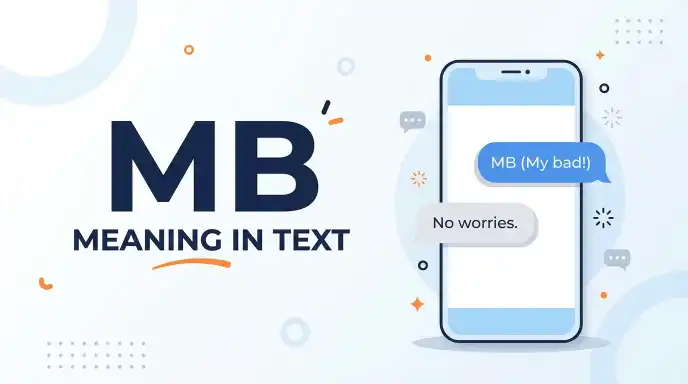
MB in text usually means “my bad,” a casual way to admit a mistake or apologize in messages and online chats.
MB can mean “my bad” in text messages, especially when someone admits a mistake or apologizes casually. It can also mean “megabyte” in technology conversations or “maybe” in some informal chats. The exact meaning depends on the conversation and the words around it.
You might see MB in messages on TikTok, Snapchat, Instagram, WhatsApp, or ordinary SMS texts. People often use short abbreviations to communicate quickly without typing complete sentences.
For example, if a friend texts, “MB, I forgot to reply,” they probably mean “My bad, I forgot to reply.” They are admitting that they made a mistake.
If you have searched for mb mean in text, this guide will help you understand its common meanings, recognize it in real conversations, and learn how to use it naturally.
MB Mean in Text
In texting, MB can stand for “my bad.” This expression is a casual way to acknowledge a mistake, accept responsibility, or apologize for something small.
People often use it when they forget something, misunderstand a message, send incorrect information, or make a minor mistake.
For example:
- “MB, I thought the meeting was tomorrow.”
- “Oh, MB! I sent you the wrong picture.”
- “MB, I didn’t see your message earlier.”
In these examples, MB communicates that the sender recognizes what went wrong. It is similar to saying “Sorry, my mistake” or “That was my fault.”
However, MB does not always mean “my bad.” In technology discussions, it commonly means “megabyte,” a unit used to measure digital information. Some people may also use MB as shorthand for “maybe,” although that interpretation is less standard and depends heavily on context.
What Does MB Stand For in Texting?
The most likely meaning of MB in a casual conversation depends on the subject being discussed.
1. My Bad
This is a common interpretation in everyday texting. Someone uses it to admit a mistake or offer a quick, informal apology.
Example:
A: You sent the wrong address.
B: MB, here’s the correct one.
Here, B acknowledges the mistake and provides the correct information.
2. Megabyte
MB can also refer to a megabyte in conversations about phones, computers, files, photos, videos, and internet downloads.
Example:
A: How large is the picture?
B: It’s about 5 MB.
In this case, MB refers to the file’s size, not an apology.
3. Maybe
In some informal conversations, a person might use MB to suggest “maybe.” However, this is not as widely established as “my bad” or the technical meaning “megabyte.”
Example:
A: Are you coming to the party tonight?
B: MB, I’ll let you know.
The intended meaning may be “Maybe,” but the abbreviation could confuse the reader. Writing the full word is usually clearer.
How Do You Know Which Meaning of MB Someone Intended?
Look at the message before and after MB. The topic often makes the intended meaning clear.
When someone apologizes, admits a mistake, or explains why they forgot something, MB most likely means “my bad.”
In conversations about file sizes, storage space, downloads, or phone memory, MB usually stands for “megabyte.”
A person discussing future plans or an uncertain decision might use MB to mean “maybe,” but this meaning is less common.
Clarify common MB meaningsAdd quick text examplesMake the opening more direct
Explain MB with chat examplesClarify MB’s most common meaning
Consider these three examples:
- “MB, I forgot your birthday.” — My bad.
- “The document is only 2 MB.” — Megabytes.
- “MB, I’ll come after work.” — Possibly maybe, depending on the sender’s habits.
When the meaning is unclear, you can simply ask, “What do you mean by MB here?” There is no need to guess.
Is MB Slang or an Abbreviation?
When MB means “my bad,” it is an informal texting abbreviation commonly associated with internet slang. The original expression, “my bad,” is a casual phrase used to accept responsibility for a mistake.
When MB means “megabyte,” it is a technical abbreviation rather than slang. It is widely used in computing and digital storage.
The abbreviation itself does not have one fixed meaning in every situation. Its role depends on the context in which it appears.
In casual chats, MB may help someone apologize with just two letters. In a technical discussion, the same letters communicate information about a file or the amount of digital data.
Is MB the Same as My Bad?
When someone uses MB as an apology in a text message, yes, it usually stands for “my bad.”
For example:
“MB, I forgot to call you.”
This means:
“My bad, I forgot to call you.”
The expression acknowledges the mistake without necessarily making the conversation overly serious. It is particularly suitable for small everyday errors between friends, classmates, relatives, or people who communicate informally.
However, MB is not a complete replacement for every kind of apology. If you have seriously hurt someone’s feelings or made a significant mistake at work, a more thoughtful and specific apology is usually better.
For example, “I’m sorry I missed the deadline. I understand that it caused problems, and I’ll make sure it doesn’t happen again” communicates more responsibility than simply writing “MB.”
Where Do People Use MB?
MB can appear on many messaging and social media platforms. When it means “my bad,” it is usually part of a casual conversation. When it refers to megabytes, it is more likely to appear in discussions about technology or digital files.
MB Meaning on TikTok
On TikTok, MB may appear in video comments, direct messages, replies, or conversations between creators and viewers.
Someone might use it after misunderstanding a comment, forgetting to respond, or making an error during a conversation.
Examples:
- “MB, I thought you meant the other video.”
- “Oh MB, I didn’t notice your comment.”
- “MB, I got the song name wrong.”
In these situations, MB means “my bad.” It allows users to acknowledge a small mistake without writing a long apology.
The meaning can change when the discussion is about technology. For instance, a TikTok creator talking about downloading a large video might use MB to describe the file size.
Do not assume that every occurrence of MB has the same meaning just because it appears on TikTok. Read the surrounding message to understand what the person intends.
MB Meaning on Snapchat
On Snapchat, MB can be used in quick chats between friends. People might send it when they forget to reply to a Snap, misunderstand a message, or accidentally send something to the wrong person.
Examples:
- “MB, I was busy earlier.”
- “MB, I sent that to the wrong chat.”
- “Oh MB, I didn’t mean to leave you on opened.”
Here, MB is a casual way to acknowledge an error or apologize.
For example, if a friend asks why you did not respond to their message, you could say, “MB, I was at school and couldn’t check my phone.”
This wording is informal and generally suitable for friendly conversations. In more serious situations, explaining what happened and offering a sincere apology may be more appropriate.
MB Meaning on Instagram
On Instagram, MB may appear in direct messages, comments, or conversations about Reels and posts.
A user might use it after tagging the wrong person, misunderstanding a caption, or sharing incorrect information.
Examples:
- “MB, I tagged the wrong account.”
- “MB, I thought this was your old post.”
- “My bad, I misunderstood your caption.”
The first two examples use MB as shorthand for “my bad,” while the third writes the full expression.
People may also encounter MB in discussions about photo and video sizes. If someone asks how large an image file is, MB probably refers to megabytes.
The platform does not determine the meaning by itself. The topic of the conversation is what matters most.
MB Meaning on WhatsApp
WhatsApp is another place where MB can appear in private messages and group chats.
Friends and family members may use it when correcting a mistake or explaining a misunderstanding.
Examples:
- “MB, I gave you the wrong time.”
- “MB, I forgot to add you to the group.”
- “MB, I thought you were picking me up.”
In each case, MB means “my bad.” The sender is accepting responsibility for a small error.
Imagine a group of friends planning a dinner. One person tells everyone to meet at 7 PM, then realizes the booking is actually for 7:30 PM. They might write, “MB, the reservation is at 7:30.”
This short reply corrects the information and acknowledges the mistake.
MB Meaning in SMS Text Messages
MB can also be used in ordinary SMS conversations, not just on social media.
For example:
- “MB, I missed your call.”
- “MB, I’ll send the notes tonight.”
- “MB, I gave you the wrong number.”
These messages use MB as a quick substitute for “my bad.”
Still, not everyone knows the same abbreviations. If you are texting a teacher, employer, customer, or someone who prefers formal communication, writing “Sorry, that was my mistake” is often clearer.
In technical SMS conversations, MB may instead refer to a file size or data usage. For example, someone might ask if a 20 MB attachment is too large to send.
Does MB Mean the Same Thing on Every Platform?
Not necessarily. The abbreviation often means “my bad” in casual conversations, but its interpretation changes with the topic.
| Platform or context | Likely meaning | Example |
| TikTok comments | My bad | “MB, I misunderstood.” |
| Snapchat chats | My bad | “MB, I was busy.” |
| Instagram DMs | My bad | “MB, wrong account.” |
| WhatsApp messages | My bad | “MB, the time changed.” |
| Technology discussions | Megabyte | “The file is 10 MB.” |
| Informal messages about plans | Possibly maybe | “MB, I’ll come later.” |
The last meaning is less standardized than the others. If you want your message to be understood immediately, writing “maybe” in full is a safer choice.
Add missing FAQ and usage sectionsClarify MB’s most likely meaning first
10 Real Chat Examples of MB in Text
Seeing MB in real conversations makes its meaning easier to understand. In these examples, MB usually means “my bad,” but the surrounding context shows how people use it naturally.
Example 1: Forgetting to Reply
A: Hey, why didn’t you reply to my message yesterday?
B: MB, I got busy with homework and forgot.
A: No worries.
Meaning: B admits forgetting to reply and offers a casual apology.
Example 2: Sending the Wrong Picture
A: You sent me a picture of someone else.
B: Oh, MB! That was meant for my cousin.
A: Haha, it’s okay.
Meaning: B acknowledges accidentally sending the wrong picture.
Example 3: Getting the Time Wrong
A: You said the movie started at 6, but it’s at 7.
B: MB, I read the schedule wrong.
A: Good thing we checked.
Meaning: B accepts responsibility for giving the wrong time.
Example 4: Missing a Phone Call
A: I called you twice this morning.
B: MB, my phone was on silent.
A: I wanted to ask about the assignment.
Meaning: B explains why the calls were missed and acknowledges the situation.
Example 5: Making a Mistake in a Game
A: You used the wrong move!
B: MB, I pressed the wrong button.
A: It’s fine. Let’s try again.
Meaning: B admits making a mistake while playing.
Example 6: Forgetting to Bring Something
A: Did you bring my notebook?
B: MB, I left it on my desk.
A: Can you bring it tomorrow?
B: Sure, I’ll remember.
Meaning: B admits forgetting the notebook.
Example 7: Misunderstanding a Message
A: I meant Saturday, not Sunday.
B: Oh, MB. I misunderstood your text.
A: That’s okay. Saturday works.
Meaning: B acknowledges the misunderstanding and corrects it.
Example 8: Tagging the Wrong Person
A: Why did you tag me in that photo?
B: MB, I meant to tag your sister.
A: No problem.
Meaning: B apologizes for tagging the wrong person on social media.
Example 9: Talking About a File
A: Can you send me the presentation?
B: Sure. It’s about 8 MB, so it should be easy to share.
A: Great, send it when you can.
Meaning: Here, MB means “megabytes,” not “my bad.” The conversation is about a digital file.
Example 10: Discussing Weekend Plans
A: Are you coming to the match tomorrow?
B: MB, I’ll let you know tonight.
A: Okay, just tell me before I book the tickets.
Meaning: B may intend “maybe,” but this use is not standard and could be confusing. A clearer response would be “Maybe, I’ll let you know tonight.”
These conversations show why context matters. MB can be a quick apology, a technical measurement, or an informal shorthand whose intended meaning needs clarification.
How to Reply When Someone Says MB
If someone sends you MB as an apology, your response depends on what happened. For a small mistake, a simple acknowledgment is usually enough.
Funny Replies to MB
If you are talking to a close friend and the mistake is minor, you can respond with humor.
- “I’ll forgive you this time 😂”
- “Mistake accepted!”
- “You’re lucky I’m in a good mood.”
- “It’s okay, human error happens.”
- “Fine, but you owe me a snack 😂”
For example:
A: MB, I forgot to bring your charger.
B: Fine, but you owe me a chocolate bar 😂
This kind of response works best when both people understand that the conversation is playful.
Casual Replies to MB
These are simple responses for everyday situations:
- “It’s okay.”
- “No worries.”
- “All good.”
- “Don’t worry about it.”
- “It happens.”
Example:
A: MB, I forgot to send you the notes.
B: No worries. Send them when you can.
These replies acknowledge the apology without making a small mistake into a bigger issue.
Friendly Replies to MB
If someone seems worried about making a mistake, a warm response can reassure them.
- “It’s completely fine!”
- “Don’t stress about it.”
- “Thanks for letting me know.”
- “No problem at all.”
- “We’re good, don’t worry.”
For example:
A: MB, I couldn’t answer your call earlier.
B: No problem at all. I hope everything is okay!
A friendly response helps maintain a positive conversation.
Neutral Replies to MB
Sometimes you may want to acknowledge the message without sounding overly casual or emotional.
You can say:
- “Understood.”
- “Thanks for clarifying.”
- “Okay, thanks for letting me know.”
- “That’s fine.”
- “Got it.”
These replies are useful when the mistake concerns a schedule, a document, or another practical matter.
What If the Mistake Actually Matters?
Not every mistake can be dismissed with “No worries.” If someone repeatedly forgets an important responsibility or causes a real problem, you can acknowledge the apology while explaining what needs to change.
For example:
A: MB, I missed the deadline again.
B: Thanks for apologizing. I need the file by tomorrow so we can finish the project.
You can accept someone’s apology without pretending that the problem does not matter.
Also, if a person simply writes MB and you cannot tell if they mean “my bad” or “maybe,” ask them to clarify. A short question is better than misunderstanding the conversation.
Is MB Rude or Offensive?
MB is generally not rude or offensive when it means “my bad.” It is a casual expression that acknowledges a mistake.
People commonly use it with friends, classmates, relatives, and other people they communicate with informally. However, if it is appropriate depends on the situation and the seriousness of the mistake.
Is MB Safe to Use With Friends?
Yes. MB is usually fine for casual conversations with friends.
For example:
“MB, I forgot to call you.”
This sounds like an informal acknowledgment of a mistake. Your friend may simply reply, “It’s okay.”
In a playful conversation, MB can also keep the exchange short and relaxed.
Can MB Sound Rude?
It can sound dismissive if the situation requires a sincere apology.
Imagine that someone has been waiting for an hour because you forgot an important meeting. Sending only “MB” might make it seem as though you are not taking the inconvenience seriously.
A more considerate message would be:
“I’m really sorry I kept you waiting. I should have let you know earlier.”
The problem is not the abbreviation itself. It is if your response matches the seriousness of the situation.
Is MB Appropriate at School or Work?
In informal group chats with classmates or coworkers, MB may be acceptable if everyone understands it.
For formal communication, a complete apology is generally better. Teachers, managers, clients, and professional contacts may expect clearer wording.
Compare these messages:
- Casual: “MB, I forgot the homework.”
- More formal: “I’m sorry I forgot to submit the assignment. I’ll make sure to complete it as soon as possible.”
The second message communicates responsibility more clearly.
Does MB Have Any Offensive Meaning?
In ordinary texting, MB is not generally considered offensive. Its common meanings—“my bad” and “megabyte”—are neutral.
However, abbreviations can have specialized meanings within particular communities. If MB appears in an unfamiliar or sensitive conversation, do not assume its meaning without considering the context.
Who Uses MB in Text Messages?
MB is used by people who communicate through messaging apps, social media, gaming chats, and online communities. Its use is not restricted to one age group.
Do Gen Z Users Use MB?
Gen Z users may use MB in quick messages, especially when admitting a small mistake or responding to a misunderstanding.
For example:
“MB, I thought you were talking about someone else.”
Short expressions like this fit informal conversations where people want to communicate quickly.
However, MB is not exclusive to Gen Z. Other generations may use it too, particularly if they are familiar with internet abbreviations.
Do Millennials and Older Users Understand MB?
Many millennials and older internet users recognize “my bad” as a casual expression. Some also use its abbreviation in messages.
Others may be more familiar with the complete phrase than the shortened version. If you are texting someone who rarely uses slang, writing “my bad” is more likely to be understood.
The same applies to people who use MB only in its technical sense of megabytes.
Where Is MB Commonly Used?
You may encounter MB in:
- Private text messages
- Snapchat and Instagram conversations
- WhatsApp group chats
- TikTok comments and replies
- Online gaming chats
- Technology discussions
- Conversations about file sizes and storage
The exact frequency varies by platform and community. MB is recognizable, but it is not necessarily used by every person or in every conversation.
Is MB Still Used Today?
Yes, MB remains useful because it is short and easy to type. When used as “my bad,” it offers a quick way to acknowledge an error in informal conversation.
The technical meaning is also well established in computing and digital storage. Because both uses remain relevant, the context is especially important when interpreting the abbreviation.
Replace the ambiguous maybe exampleAdd a direct meaning summary
Origin of MB in Texting
The abbreviation MB does not have one universally documented origin because it is used for different purposes. Its meaning as “my bad” comes from a much older English expression, while its technical meaning has a separate history.
Where Did “My Bad” Come From?
“My bad” is an informal English expression used to admit responsibility for a mistake. It became familiar in American English and gained wider recognition through popular culture, sports, and everyday conversation.
As text messaging and online chats became more common, people began shortening familiar expressions to save time. MB developed as a convenient written form of “my bad.”
Instead of typing the full phrase, someone could simply write “MB” after forgetting something, making an error, or misunderstanding a message.
How Internet Culture Helped Spread MB
Internet communication encourages short, recognizable expressions. Chat rooms, instant messaging, online games, and social media all helped make abbreviations a normal part of digital conversations.
MB fits naturally into this style because it is easy to type and can communicate a quick acknowledgment of a mistake.
For example, a player who makes an error during an online game might write “MB” to apologize to teammates. A friend who forgets to reply to a message might use the same abbreviation.
The phrase can travel between platforms without changing its basic meaning.
Why Does MB Also Mean Megabyte?
The technical meaning of MB developed separately from its casual texting use. In computing, MB is the standard symbol commonly used for a megabyte, a unit for describing digital information.
You may see it when checking the size of a photo, document, video, or downloaded file.
For example:
- A picture might be 3 MB.
- A document might be 2 MB.
- A video might be 150 MB.
In these examples, MB has nothing to do with apologizing. It describes the amount of digital data associated with a file.
Is the Origin of MB Completely Clear?
The separate meanings are clear, but there is no single confirmed starting point for every use of MB in online communication.
The safest explanation is that MB became a useful abbreviation for “my bad” in informal messaging, while its technical meaning was already established in computing.
Understanding these two common uses will help you interpret most messages that contain MB.
MB vs. Other Common Texting Abbreviations
MB is part of a much larger collection of abbreviations used in digital conversations. Some communicate an apology, others express uncertainty, and some help people respond quickly.
The following table compares MB with IDK, IMO, and BRB.
| Abbreviation | Meaning | Type | Usage | Popularity |
| MB | My bad | Informal apology | Admitting a mistake | Common in casual chats |
| IDK | I don’t know | Response abbreviation | Expressing uncertainty | Common |
| IMO | In my opinion | Opinion abbreviation | Sharing a personal view | Common |
| BRB | Be right back | Status abbreviation | Saying you will return shortly | Common |
Note: MB can also mean megabyte in technical contexts.
MB vs. IDK
MB usually means “my bad,” while IDK means “I don’t know.”
Example:
A: You sent me the wrong link.
B: MB, here’s the correct one.
Now compare:
A: What’s the name of that song?
B: IDK, but I’ll try to find it.
The first person admits a mistake. The second person says they do not know something.
MB vs. IMO
MB and IMO have different purposes.
- MB: “My bad, I forgot the meeting.”
- IMO: “IMO, we should meet earlier.”
The first acknowledges an error. The second introduces a personal opinion or suggestion.
Both abbreviations are common in informal digital communication, but they are not interchangeable.
MB vs. BRB
BRB means “be right back.” It tells someone that you are stepping away temporarily and expect to return.
For example:
A: Are you still there?
B: BRB, I need to answer the door.
MB, by contrast, is often used to acknowledge a mistake.
Example:
A: You forgot to send the document.
B: MB, I’ll send it now.
Knowing the differences between these abbreviations makes texting easier to understand.
Real,World Usage Example: When a Friend Texts MB
Imagine that you and a friend are planning to meet at a café after school. You agree to meet at 4 PM, but your friend accidentally tells you the wrong location.
When you arrive, you discover that the group is waiting at another café nearby. You message your friend to explain the confusion.
Your conversation might look like this:
You: Hey, I’m at the café near the bus stop. Where are you?
Friend: We’re at the one beside the bookstore.
You: I thought you said the bus stop café.
Friend: MB, I gave you the wrong location.
You: No worries. I’ll come over.
In this situation, MB means “my bad.” Your friend acknowledges the mistake and accepts responsibility for the confusion.
You can reply with “No worries” because the problem is minor and easily fixed.
If the mistake had caused a serious problem, a longer apology might be more appropriate. The important point is that MB is most useful when a brief acknowledgment is enough.
Frequently Asked Questions
Q1. What does MB mean in text messages?
MB often means “my bad” in casual text messages. It is used to acknowledge a mistake or offer a quick apology. In technology,related messages, it can mean “megabyte.”
Q2. What does MB mean on TikTok?
On TikTok, MB can mean “my bad” when someone admits a mistake in a comment or message. The meaning may differ if the discussion is about technology or file sizes.
Q3. Is MB slang?
When it means “my bad,” MB is an informal texting abbreviation associated with internet slang. When it means “megabyte,” it is a technical abbreviation.
Q4. Is MB rude or offensive?
MB is generally not rude or offensive. However, using only “MB” after a serious mistake may sound dismissive, so a more complete apology can be appropriate.
Q5. How should you reply to MB?
You can reply with “No worries,” “It’s okay,” “All good,” or “Thanks for letting me know.” Choose a response that matches the situation and your relationship with the sender.
Q6. What does MB mean on Snapchat?
On Snapchat, MB commonly means “my bad” when someone acknowledges a mistake, forgets to reply, or sends something incorrectly.
Q7. Can MB mean maybe?
Some people may use MB as shorthand for “maybe,” but this meaning is less standard. Writing “maybe” in full is clearer and helps avoid confusion.
Q8. What does MB mean in gaming?
In gaming chats, MB often means “my bad” when a player admits an error. For example, a player might write “MB, I missed the shot.” In technical discussions, it can still mean megabyte.
Q9. What does MB mean when talking about file size?
When discussing pictures, videos, documents, downloads, or storage, MB means megabyte. For example, a 10 MB file contains a certain amount of digital data.
Q10. Is MB the same as sorry?
Not exactly. MB means “my bad” and acknowledges a mistake. It can work as a casual apology, but “sorry” may be more suitable for situations that require a sincere or formal expression of regret.
Conclusion
MB can have several meanings, but “my bad” is a common interpretation in casual text messages. People use it to admit mistakes, acknowledge misunderstandings, and offer quick apologies. In technology conversations, MB usually means “megabyte,” and its interpretation as “maybe” is less standard.
You may see MB on TikTok, Snapchat, Instagram, WhatsApp, in SMS messages, and in online gaming chats. The surrounding conversation is the best way to identify the intended meaning.
MB is generally fine for casual communication with friends and classmates. For serious mistakes or professional situations, a clear and thoughtful apology is usually better than a two,letter abbreviation.
Once you understand the context, recognizing MB becomes simple. If the message is still unclear, ask the sender what they mean rather than guessing.
Read More About !

Michael Brooks is a language writer at SlangPath with 7+ years of experience creating simple, practical content on English slang and everyday expressions.