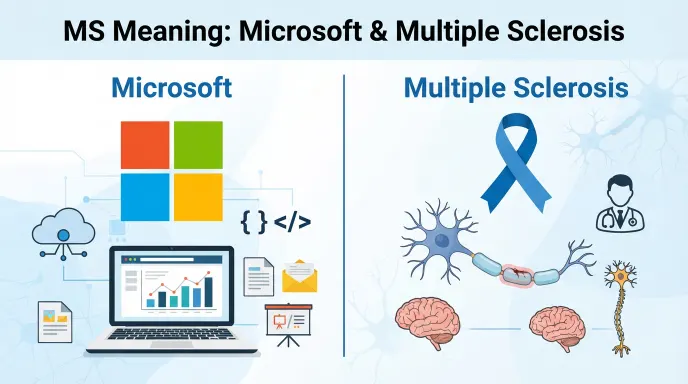
MS slang is a context-based abbreviation that most commonly means “miss” in texting, but it can also stand for Microsoft, Multiple Sclerosis, or other terms depending on the conversation.
MS slang is one of those internet abbreviations that can be confusing because it has more than one meaning. If you receive “MS” in a text message, a Discord chat, or a social media comment, the meaning depends on the conversation. In some cases, it simply means “Miss.” In others, it can stand for “Microsoft,” “Multiple Sclerosis,” or another phrase related to a specific topic.
That is why understanding the context is more important than memorizing a single definition. Looking at who sent the message, the topic being discussed, and the platform where it appears will usually tell you which meaning is intended.
Quick Answer:MS Slang Meaning
MS slang most commonly means “Miss” in texting. However, it can also refer to Microsoft, Multiple Sclerosis, or other abbreviations depending on the context of the conversation.
What Does MS Mean in Text?
In everyday texting, MS usually stands for “Miss.”
People often shorten words while texting to save time. Instead of writing the full word, they use abbreviations that are quick to type.
For example:
- “I ms talking to you.”
- “You’ll ms the party if you’re late.”
Here, MS simply replaces the word miss.
However, this isn’t the only meaning.
Depending on the conversation, MS may also refer to:
| Meaning | Common Context |
| Miss | Casual texting |
| Microsoft | Technology discussions |
| Multiple Sclerosis | Medical conversations |
| Master of Science | Education |
| Mississippi | U.S. state abbreviation |
Because it has several meanings, you should always read the surrounding conversation before deciding what it means.
MS Full Form in Slang
Unlike many internet abbreviations that have one fixed meaning, MS does not have a single official slang full form.
Instead, its meaning changes based on the topic.
The most common slang-related meanings include:
MS = Miss
Used when talking about missing someone or something.
Example:
“I ms hanging out with everyone.”
MS = Microsoft
Common in gaming, computers, and software discussions.
Example:
“MS released another update.”
MS = Multiple Sclerosis
Used in health-related conversations.
Example:
“She was diagnosed with MS.”
MS = Master of Science
Common in education.
Example:
“He completed his MS degree.”
Is MS Rude, Offensive, or Neutral?
The abbreviation MS is generally neutral.
It is not considered rude or offensive by itself.
Its tone depends entirely on how it is used.
| Tone | Is MS Appropriate? |
| Friendly | Yes |
| Casual | Yes |
| Professional | Sometimes |
| Academic | Yes |
| Medical | Yes |
Unlike slang insults or offensive abbreviations, MS is safe in most conversations.
Where Is MS Commonly Used?
You may see MS in many online and offline situations.
Text Messages
Friends often shorten words when texting quickly.
Example:
“I ms you already.”
Social Media
People may use MS in comments or captions when talking about missing friends or memories.
Platforms include:
- TikTok
- Snapchat
Gaming
Gamers often use MS to mean Microsoft, especially when discussing:
- Xbox
- Windows
- Game updates
School and College
Students commonly use MS when talking about:
- Master of Science degrees
- School titles
- Academic programs
Medical Discussions
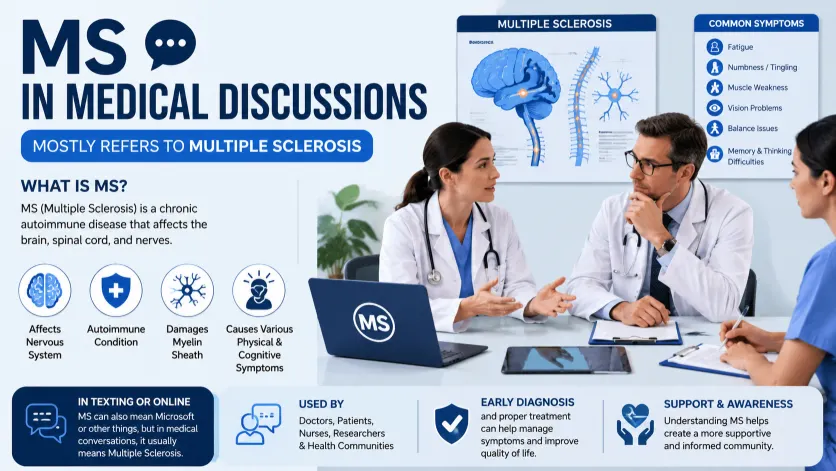
Doctors, patients, and health communities often use MS as shorthand for Multiple Sclerosis.
Because this meaning is important, avoid assuming it means “Miss” in health-related conversations.
Tone and Context
Context completely changes the meaning of MS.
For example:
Text Message
“I ms you.”
Meaning:
“I miss you.”
Technology Forum
“MS fixed the bug.”
Meaning:
Microsoft fixed the bug.
Medical Group
“Living with MS.”
Meaning:
Multiple Sclerosis.
The surrounding words make the intended meaning clear.
Why People Use MS
People like short abbreviations because they save time.
Common reasons include:
- Faster typing
- Casual conversations
- Character limits
- Mobile texting
- Internet culture
- Easy communication
Short abbreviations have become a normal part of digital communication.
Is MS Safe for Social Media?
Yes.
MS is generally safe to use on:
- TikTok
- Discord
- Snapchat
- X (formerly Twitter)
Just make sure readers understand which meaning you intend.
For example:
Instead of writing:
“MS helped me.”
You could write:
“Microsoft helped me.”
or
“I miss you.”
to avoid confusion.
Origin and Background of MS Slang
The abbreviation MS did not begin as internet slang. It has been used for decades in different fields, including education, medicine, technology, and geography. As texting became more popular, people started shortening common words to type faster. In casual conversations, some users began using MS as a short form of “miss.”
Today, there is no single official origin for MS as slang. Its meaning depends on the platform and the people using it. Unlike internet slang such as “LOL” or “BRB,” MS is considered a context-based abbreviation rather than a universal slang term.
Why Context Matters
One of the biggest mistakes people make is assuming MS always has the same meaning.
Here are a few examples:
| Message | Meaning |
| “I MS you every day.” | I miss you. |
| “MS released a security patch.” | Microsoft. |
| “She has MS.” | Multiple Sclerosis. |
| “He earned an MS in Biology.” | Master of Science. |
Reading the entire message helps you understand the correct meaning.
Real-Life Examples of MS Slang
Friendly Tone
These examples show MS in friendly conversations.
- “I MS hanging out with you.”
- “We all MS our old school days.”
- “I’ll MS you while you’re away.”
- “Everyone will MS your jokes.”
The tone is warm and emotional.
Casual Tone
People often use abbreviations in everyday texting.
Examples:
- “MS u already.”
- “Don’t MS the fun.”
- “I really MS those weekends.”
- “You’ll MS the movie if you’re late.”
The messages are informal and easy to understand.
Argumentative Tone
Sometimes MS appears during disagreements.
Examples:
- “You’ll MS my help later.”
- “Don’t say you’ll never MS me.”
- “One day you’ll MS what you had.”
Here, the abbreviation carries a stronger emotional tone.
Gaming Context
In gaming communities, MS usually does not mean “miss.”
Instead, it often refers to Microsoft.
Examples:
- “MS fixed the Xbox issue.”
- “The MS servers are working now.”
- “MS announced a new feature.”
Gamers understand the meaning because of the discussion topic.
Social Media Examples
You may see MS in captions, comments, or posts.
Examples:
- “MS summer already.”
- “Going to MS this place.”
- “We all MS our childhood.”
These posts are usually emotional or nostalgic.
MS Meaning on Different Platforms
Text Messages
Most common meaning:
Miss
Example:
“I MS talking to you.”
Usually means:
- Miss
- Memories
- Missing someone
Example:
“MS these beautiful sunsets.”
Snapchat
Friends often use MS when chatting quickly.
Example:
“MS u ❤️”
Discord
The meaning depends on the server.
Examples include:
- Microsoft
- Miss
- Master Server (in some gaming communities)
Always read previous messages for context.
Because Reddit has communities for almost every topic, MS can have many meanings.
Examples:
- Technology discussions → Microsoft
- Health forums → Multiple Sclerosis
- Relationship posts → Miss
Comparison of MS With Similar Slang
| Slang | Meaning | Common Usage |
| MS | Miss (or context-based meanings) | Texting, social media |
| IMO | In My Opinion | Discussions |
| IDK | I Don’t Know | Casual chats |
| BRB | Be Right Back | Messaging |
| TTYL | Talk To You Later | Friendly conversations |
| ILY | I Love You | Personal messages |
Unlike most internet slang, MS changes meaning based on the conversation.
Why People Prefer Using MS
People use abbreviations because they make communication faster.
Common reasons include:
- Faster typing on phones
- Saving time
- Keeping messages short
- Following internet texting habits
- Casual communication with friends
Many people naturally shorten familiar words without thinking about it.
Impact of Using MS in Communication
Using abbreviations like MS can make conversations feel relaxed and informal.
Advantages
- Saves time
- Easy to type
- Common in texting
- Makes casual chats feel natural
Disadvantages
- Can confuse new readers
- Has several meanings
- May look unprofessional in formal writing
- Depends heavily on context
For this reason, avoid using MS in important emails or business documents unless the meaning is obvious.
When to Avoid Using MS
There are situations where writing the full word is a better choice.
Avoid using MS when:
- Writing professional emails
- Creating legal documents
- Preparing school assignments unless referring to a Master of Science degree
- Speaking with people unfamiliar with internet slang
- Discussing medical topics where confusion could occur
Using the complete word helps prevent misunderstandings.
Polite Alternatives
If you mean “miss,” you can simply write the full word instead of the abbreviation.
Examples include:
- I miss you.
- I wish you were here.
- Thinking about you.
- I can’t wait to see you again.
- Looking forward to meeting you.
These phrases are clearer and work well in both personal and professional communication.
Is MS Safe for Children?
Generally, yes.
When used to mean “miss,” the abbreviation is harmless and family-friendly.
Parents should simply remember that MS has multiple meanings. Encouraging children to read the full conversation before interpreting abbreviations helps improve digital communication skills.
(FAQs)
Q1. What does MS mean in slang?
In slang and casual texting, MS most commonly means “miss.” However, it can also stand for Microsoft, Multiple Sclerosis, or Master of Science, depending on the conversation.
Q2. What does MS stand for in text messages?
In most text messages, MS stands for “miss.” For example, “I MS you” usually means “I miss you.”
Q3. Is MS an offensive slang term?
No. MS is generally a neutral abbreviation. It is not considered rude or offensive. The meaning depends on the context in which it is used.
Q4. What does MS mean on social media?
On platforms like Instagram, Snapchat, TikTok, and Facebook, MS often means “miss” when people talk about someone or remember a past event. In technology-related posts, it may refer to Microsoft.
Q5. What does MS mean in gaming?
In gaming communities, MS usually refers to Microsoft, especially in discussions about Xbox, Windows, or Microsoft game services. Some games may also use “ms” to mean milliseconds (latency or ping), so context is important.
Q6. How can I tell which meaning of MS is correct?
Look at the surrounding words and the topic of the conversation. A health discussion may refer to Multiple Sclerosis, while a text saying “I MS you” almost certainly means “I miss you.”
Quick Recap
| Situation | Meaning of MS |
| Texting a friend | Miss |
| Technology discussion | Microsoft |
| Medical conversation | Multiple Sclerosis |
| College or university | Master of Science |
| Gaming | Microsoft or milliseconds (ping), depending on context |
Common Mistakes to Avoid
Many people misunderstand MS because they assume it always has one meaning. Keep these tips in mind:
- Don’t assume MS always means “miss.”
- Read the full conversation before deciding its meaning.
- Avoid using MS in formal writing if it could confuse readers.
- Write the full word when clarity is important.
- Be aware that different online communities may use the abbreviation differently.
Key Takeaways
- MS has multiple meanings.
- In casual texting, it most often means “miss.”
- In technology, it commonly means Microsoft.
- In healthcare, it usually refers to Multiple Sclerosis.
- In education, it can mean Master of Science.
- Context is the key to understanding the correct definition.
Conclusion
MS slang is a flexible abbreviation with several meanings, so there is no single definition that fits every situation. In everyday texting, it most commonly means “miss,” but in technology, education, healthcare, and gaming, it often represents something entirely different.
Before using or interpreting MS, consider the topic, platform, and audience. A quick look at the surrounding conversation will usually reveal the intended meaning. When there is any chance of confusion, writing the full word is the best choice. Understanding context will help you communicate more clearly and avoid misunderstandings in texts, social media posts, online forums, and everyday conversations.
Read More About!

Michael Brooks is a language writer at SlangPath with 7+ years of experience creating simple, practical content on English slang and everyday expressions.