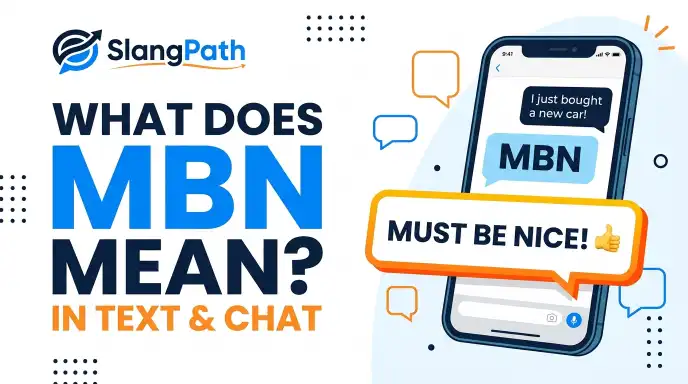
MBN usually means “must be nice” in text messages and on social media. People use it when someone shares something enjoyable, exciting, or fortunate that they wish they could experience, too.
You may see MBN in TikTok comments, Snapchat messages, Instagram posts, WhatsApp chats, and regular text messages. For example, if your friend says they are going on vacation, you might reply, “MBN 😭” to show that you wish you could go as well.
The abbreviation can express playful envy, admiration, or sarcasm. Its exact tone depends on the conversation and your relationship with the person using it.
Understanding MBN helps you interpret online conversations and respond naturally without mistaking a joke for a serious complaint.
MBN Meaning in Text
In texting, MBN stands for “must be nice.” It is an informal abbreviation people use when reacting to someone else’s good fortune, enjoyable experience, or comfortable situation.
Imagine your friend tells you they have the whole weekend off while you have several assignments to finish. You might respond with “MBN” because their situation sounds much better than yours at that moment.
The phrase does not always mean you are genuinely jealous. Sometimes it is simply a playful way to say, “That sounds great. I wish I could do that, too.”
What Does “Must Be Nice” Actually Mean?
The expression “must be nice” suggests that something seems pleasant, convenient, or desirable. People often use it when another person has an opportunity or experience they would also enjoy.
Here are a few everyday examples:
- Your friend sleeps until noon while you have to wake up early: “MBN.”
- Someone receives a brand,new phone: “MBN, I need an upgrade.”
- Your classmate finishes all their homework before the weekend: “MBN, I’m still working.”
- A friend shares pictures from a beach holiday: “MBN 😭.”
In these situations, the speaker is reacting to something that makes the other person’s life seem easier or more enjoyable.
Is MBN Slang, an Acronym, or an Abbreviation?
MBN is an informal initialism commonly used in texting and internet conversations. The letters stand for the words “must be nice.”
People often describe it as slang because it is associated with casual digital communication. More precisely, it is an initialism formed from the first letters of a phrase.
You do not need to remember the technical definition to understand it. When someone sends MBN after hearing your good news, they are usually saying that your situation sounds appealing.
Does MBN Always Mean “Must Be Nice”?
No abbreviation has exactly the same meaning in every situation. Although “must be nice” is a common meaning of MBN in casual online conversations, specialized communities may use the same letters differently.
The surrounding message usually provides the best clue.
For example:
- “You get every Friday off? MBN!” expresses admiration or envy.
- “MBN to have no responsibilities” may be sarcastic.
- “You got concert tickets? MBN 😭” suggests that the sender wishes they could attend, too.
If MBN appears in a technical discussion or a conversation about a particular organization, consider if a different meaning fits better.
Where People Use MBN
MBN appears across social media, messaging apps, and everyday digital conversations. Its basic meaning stays the same, but the tone can change depending on the platform and the situation.
MBN on TikTok
On TikTok, MBN may appear in comments on videos about vacations, shopping, relationships, expensive purchases, or exciting personal experiences.
For example, someone uploads a video showing their new gaming setup. A viewer comments:
“MBN, my setup is still from 2018 😭”
The commenter is jokingly expressing envy because the creator has something they would also like.
TikTok’s short,video format encourages quick reactions, making three,letter expressions convenient. MBN can communicate admiration or playful jealousy without requiring a long explanation.
However, not every comment is meant seriously. Emojis, the video’s subject, and the relationship between the creator and commenter can help reveal the intended tone.
MBN on Snapchat
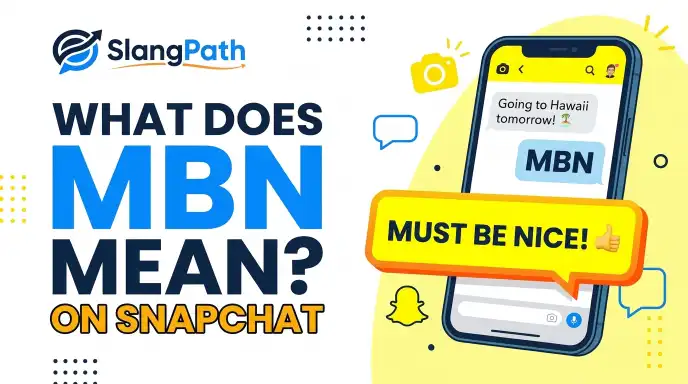
On Snapchat, people may use MBN in private messages, group chats, or replies to snaps.
Imagine a friend sends you a picture from a restaurant while you are studying at home. You reply:
“MBN, that food looks amazing.”
Your message means that you wish you could enjoy the same meal.
The abbreviation also works when friends talk about new clothes, parties, weekend plans, or relaxing days. Since Snapchat conversations are often informal, MBN can feel more natural than typing the complete phrase.
MBN on Instagram
Instagram users may write MBN in comments, story replies, and direct messages.
Suppose someone posts a picture of their new car. A friend comments, “MBN 🔥,” suggesting that the car looks impressive and that they would enjoy having one themselves.
You might also see MBN under travel photos, concert pictures, birthday posts, and lifestyle content.
The surrounding context matters. A smiling emoji may make the comment feel friendly, while a critical follow,up could make it sound sarcastic.
MBN on WhatsApp
On WhatsApp, MBN can be a quick reaction to something another person shares.
For example:
Friend: I finished all my work, so I’m watching movies tonight.
You: MBN 😭 I still have three assignments left.
Friend: Good luck getting them done!
Here, you are saying that your friend’s free evening sounds appealing because you are still busy.
The abbreviation can also appear in family chats and conversations about holidays, gifts, shopping, or personal achievements. If the recipient is unfamiliar with internet slang, writing “must be nice” in full can make your meaning clearer.
MBN in SMS and Regular Text Messages
MBN is not limited to social media. People can use it in ordinary SMS messages on their phones.
Consider this exchange:
Friend: My manager gave me tomorrow off.
You: MBN! I have to work a double shift.
Your response expresses envy about your friend’s day off. It does not necessarily mean that you are angry or resentful.
MBN works best when both people understand informal texting language. In a conversation with someone who rarely uses abbreviations, the full phrase is easier to understand.
Real Chat Examples of MBN
The following conversations show how people might use MBN in everyday situations. The tone ranges from friendly and humorous to mildly sarcastic.
1. When Someone Goes on Vacation
A: We’re flying to Dubai next week!
B: MBN 😭 I need a vacation so bad.
A: I’ll send you pictures!
Meaning: B wishes they could take a similar trip.
2. When a Friend Gets a New Phone
A: My parents just bought me the new iPhone.
B: MBN, I’m still using my old phone.
A: Haha, yours still works, though.
Meaning: B is expressing playful envy about the new phone.
3. When Someone Has No Homework
A: I finished all my assignments yesterday.
B: MBN. I haven’t even started mine.
A: Good luck 😂
Meaning: B wishes they were also free from schoolwork.
4. When a Friend Gets the Day Off
A: I don’t have to work tomorrow.
B: MBN! I have an early shift.
A: Hopefully your shift goes quickly.
Meaning: B envies the friend’s free day.
5. When Someone Has a Relaxing Weekend
A: I’m staying home all weekend and doing absolutely nothing.
B: MBN 😭 I have plans both days.
A: Cancel them and relax!
Meaning: B wishes they had the same opportunity to rest.
Real Chat Examples of MBN (Continued)
The meaning of MBN becomes easier to understand when you see how it fits into different conversations. These examples show how people might use it when discussing gifts, achievements, entertainment, and everyday life.
6. When Someone Receives a Gift
A: Look what my sister got me for my birthday!
B: MBN, that’s such a nice gift.
A: I know, right? I love it.
Meaning: B admires the gift and wishes they could receive something similar.
7. When a Friend Gets Good Grades
A: I got 95% on my exam!
B: MBN, I barely passed mine.
A: You’ll do better next time.
Meaning: B is comparing their result with the friend’s success. The response could be playful or slightly frustrated, depending on their relationship.
8. When Someone Goes to a Concert
A: I’m seeing my favorite singer tonight.
B: MBN 😭 I couldn’t get tickets.
A: I’ll record a few clips for you.
Meaning: B wishes they could attend the concert, too.
9. When Someone Has an Expensive Lifestyle
A: We booked a hotel with a private pool.
B: MBN 😂 that sounds incredible.
A: It’s going to be so much fun.
Meaning: B is reacting to an experience that sounds luxurious or exciting.
10. When Someone Is Being Sarcastic
A: I slept for ten hours and woke up at noon.
B: MBN, some of us have responsibilities.
A: Okay, okay 😂
Meaning: B is joking about the difference between their schedules. Depending on the relationship, the response could also sound mildly critical.
These examples show that MBN usually reacts to someone else’s circumstances. The abbreviation alone does not tell you if the sender is genuinely jealous, joking, or being sarcastic.
How to Reply When Someone Says MBN
Your response depends on the situation and your relationship with the other person. A close friend may appreciate a funny reply, while a classmate or coworker may respond better to something simple and polite.
Funny Replies to MBN
If you and the other person regularly joke around, a humorous response can keep the conversation relaxed.
- “Come trade places with me 😂”
- “Your turn is coming!”
- “MBN? You can join me next time.”
- “Living the dream, apparently 😎”
- “Don’t worry, your lucky day is coming.”
- “I’ll enjoy it on your behalf 😂”
For example, if your friend says MBN after you mention a relaxing weekend, you could reply, “Come over next time, and we can relax together.”
The key is to keep the joke friendly. Avoid teasing someone about money, family circumstances, or other sensitive subjects if they might take it personally.
Casual Replies to MBN
A casual response works when you want to acknowledge the message without making a big deal out of it.
- “Haha, yeah!”
- “It’s pretty nice, not gonna lie.”
- “I know, right?”
- “You should come next time.”
- “Hopefully you get to do it soon.”
- “Yeah, I’m excited!”
These replies are useful in ordinary conversations with friends, classmates, and people you know well.
Friendly Replies to MBN
Sometimes MBN suggests that the sender wishes they could share your experience. You can respond in a way that includes them rather than making the conversation about the difference between your situations.
- “We’ll do it together next time!”
- “I hope you get the chance soon.”
- “You should come with me next time.”
- “Hopefully something good happens for you, too.”
- “Let’s plan something fun together.”
For instance, if your friend says MBN because you are going to a concert, you could reply, “Let’s try to get tickets together next time!”
This acknowledges their feelings and gives the conversation a positive direction.
Neutral Replies to MBN
You may not always know if someone is joking or being sarcastic. A neutral reply is helpful when you want to keep things polite.
- “Yeah, it’s been great.”
- “Hopefully you get a chance, too.”
- “It was a nice experience.”
- “Maybe you can try it sometime.”
- “I got lucky this time.”
Neutral replies are particularly useful when talking to a coworker, acquaintance, or someone you do not know very well.
What If MBN Sounds Sarcastic?
Do not immediately assume the sender is angry. They might be joking about your plans or comparing your circumstances with theirs.
You could respond, “Haha, hopefully things get easier for you,” or ask, “Wait, are you joking or actually upset?”
If the person seems genuinely frustrated, acknowledging their feelings is usually more helpful than arguing over the meaning of three letters.
Is MBN Rude or Offensive?
MBN is not inherently rude or offensive. It is an informal expression that can communicate admiration, envy, humor, or sarcasm. Its tone depends on the surrounding words and the situation.
For example, “MBN, that trip looks amazing!” sounds friendly and positive. In contrast, “MBN, must be nice to have everything handed to you” can sound bitter or judgmental.
The second statement implies that the person has received advantages without earning them. That criticism comes from the full message rather than the abbreviation itself.
Is MBN Safe to Use With Friends?
Yes, MBN is generally fine among friends who understand your sense of humor.
People often use it when discussing vacations, new purchases, free time, good grades, and other enjoyable experiences. It can be a playful way to say that someone else has something you would also like.
Still, consider the other person’s feelings. Someone dealing with financial difficulties, family problems, or a stressful situation might not appreciate jokes that compare their circumstances with yours.
Can MBN Sound Passive,Aggressive?
Yes. A message can sound passive,aggressive when it indirectly expresses resentment or criticism instead of stating those feelings openly.
Consider this example:
“Must be nice to have your parents pay for everything.”
Depending on the conversation, this could sound like a criticism of the other person’s financial support. It carries a stronger message than simply writing “MBN” under a holiday picture.
To understand the intended tone, consider your relationship with the sender, the subject of the conversation, and any additional comments.
Is MBN Appropriate at School or Work?
MBN is usually acceptable in informal conversations with friends or classmates. However, it is not the best choice for formal emails, professional reports, or messages to someone who expects professional language.
Instead of writing “MBN” to a manager who mentions an upcoming holiday, you could say, “That sounds like a great opportunity. I hope you enjoy it.”
In a relaxed workplace group chat, the abbreviation may be perfectly fine. The important thing is to consider your audience and the communication style expected in that setting.
Who Uses MBN?
MBN can be used by people of different ages, although its short format fits naturally into modern digital conversations.
Do Teenagers and Gen Z Use MBN?
Teenagers and Gen Z users may encounter MBN in social media comments, direct messages, group chats, and conversations about everyday experiences.
It is particularly useful when people compare plans, purchases, free time, or exciting events. The phrase allows someone to express envy without turning the conversation into a serious discussion.
However, MBN is not exclusive to Gen Z. Adults can use it as well, especially when they are familiar with texting abbreviations.
Which Platforms Are Associated With MBN?
You may see MBN in several places online:
- TikTok: Comments about travel, lifestyle videos, achievements, and purchases.
- Snapchat: Quick reactions to friends’ snaps and personal updates.
- Instagram: Story replies, comments, and direct messages.
- WhatsApp: Conversations with friends, relatives, and group chats.
- SMS: Ordinary text messages between phone users.
The abbreviation is not tied to one platform. Its usefulness comes from its short length and recognizable meaning.
How Common Is MBN Online?
MBN is a recognizable informal abbreviation, but its frequency varies between online communities, platforms, and topics. Some social circles may use it regularly, while others may rarely encounter it.
It is best not to assume that everyone understands it. Many users recognize “must be nice” immediately, while others may need the phrase explained.
If you see MBN in an unfamiliar message, look at what the person is reacting to before deciding how to interpret it.
Origin of MBN
The exact origin of MBN as an internet abbreviation is not clearly established. The expression is best understood as a shortened written form of the familiar English phrase “must be nice.”
The full phrase can be used sincerely to recognize something enjoyable. It can also carry sarcasm when a person feels that someone else has an easier or more fortunate life.
How Internet Culture Helped Popularize MBN
Text messaging and online communication encourage short expressions that are easy to type and recognize. Initialisms such as IDK, BRB, and IMO became familiar because they communicate common phrases using fewer characters.
MBN follows the same general pattern. It turns “must be nice” into three letters that fit easily into a comment or quick message.
Social media provides many opportunities to react to other people’s experiences. Vacation videos, shopping posts, celebrations, and personal achievements create natural situations for a brief expression of envy or admiration.
Is There a Confirmed First Use of MBN?
A definitive first use of MBN in digital communication is difficult to establish without reliable historical evidence. It would be misleading to identify a particular person, website, or year as its origin without a trustworthy source.
The safest explanation is that MBN developed as an abbreviation of a familiar English phrase and became useful in informal digital conversations.
Its present,day meaning is easier to establish than its exact history: in casual texting, it commonly means “must be nice.”
MBN vs. IDK, IDC, IMO, and BRB
MBN, IDK, IDC, IMO, and BRB are all short expressions used in digital communication. However, each serves a different purpose.
| Abbreviation | Meaning | Type | Usage | Popularity |
| MBN | Must be nice | Initialism | Reacting to someone’s good fortune or experience | Recognized in informal online conversations |
| IDK | I don’t know | Initialism | Expressing uncertainty or a lack of knowledge | Widely recognized |
| IDC | I don’t care | Initialism | Expressing indifference or a lack of concern | Widely recognized |
| IMO | In my opinion | Initialism | Introducing a personal view or judgment | Widely recognized |
| BRB | Be right back | Initialism | Telling someone you will return shortly | Widely recognized |
These popularity descriptions are general, not rankings based on a current usage survey.
MBN vs. IDK
MBN means “must be nice,” while IDK means “I don’t know.”
You might write MBN when a friend talks about an amazing holiday. You would use IDK when somebody asks you a question you cannot answer.
Example:
Friend: We’re going to a theme park tomorrow!
You: MBN!
Friend: What time does it open?
You: IDK. Let me check.
MBN vs. IDC
IDC stands for “I don’t care.” It communicates indifference, although it can sometimes sound dismissive.
MBN, by contrast, reacts to something that seems enjoyable or fortunate.
For example, “MBN, I wish I could go” expresses a desire to share an experience. “IDC where we go” indicates that the speaker has no strong preference about the destination.
MBN vs. IMO
IMO means “in my opinion.” People use it to introduce a personal view, especially when discussing preferences, recommendations, or disagreements.
MBN is a reaction rather than an expression of opinion.
For instance, “IMO, this is the best restaurant in town” introduces a judgment. “MBN, you get to eat there tonight” expresses envy about someone else’s plans.
MBN vs. BRB
BRB means “be right back.” It tells another person that the speaker is temporarily leaving a conversation but intends to return.
MBN does not communicate a break or a future action. It expresses a reaction to someone else’s circumstances.
Knowing these distinctions makes it easier to understand short messages without confusing unrelated abbreviations.
Real,World Example of MBN
Imagine two classmates talking after school. One student explains that their parents are taking them on a weekend trip, while the other has to stay home and prepare for an exam.
Their conversation might look like this:
Student A: My family is going to the mountains this weekend.
Student B: MBN 😭 I have a test on Monday.
Student A: You can come with us next time!
Student B: Hopefully! Have fun.
In this situation, MBN communicates that Student B wishes they could enjoy the same trip. The message is not necessarily a complaint or an insult. It is a quick, informal reaction to a difference in their plans.
Now imagine Student B replies, “MBN, your parents do everything for you.” The meaning becomes more critical because the additional words suggest resentment about the support Student A receives.
The abbreviation stays the same, but the surrounding language changes the tone. That is why it is useful to read the complete message instead of judging the abbreviation on its own.
MBN vs. IDK, IDC, IMO, and BRB
MBN, IDK, IDC, IMO, and BRB are common abbreviations used in text messages and online conversations. Each has a different meaning, so understanding the difference helps you use them correctly.
| Abbreviation | Meaning | Type | Usage | Popularity |
| MBN | Must be nice | Initialism | Reacting to someone’s good fortune | Recognized in casual chats |
| IDK | I don’t know | Initialism | Expressing uncertainty | Widely recognized |
| IDC | I don’t care | Initialism | Expressing indifference | Widely recognized |
| IMO | In my opinion | Initialism | Sharing a personal opinion | Widely recognized |
| BRB | Be right back | Initialism | Saying you will return shortly | Widely recognized |
These descriptions reflect general usage, not rankings based on a current usage survey.
MBN vs. IDK
MBN means “must be nice,” while IDK means “I don’t know.”
People use MBN when reacting to something another person gets to enjoy. IDK is used when they do not know an answer or are unsure about something.
Example:
A: I’m going on vacation next week!
B: MBN! I haven’t had a holiday in ages.
A: Do you know when the school trip is?
B: IDK. I’ll ask tomorrow.
MBN vs. IDC
IDC stands for “I don’t care.” It expresses indifference or a lack of concern, while MBN reacts to another person’s situation.
For example, “MBN, you get every weekend off” suggests that the speaker wishes they had the same free time. “IDC where we go for dinner” means the speaker does not mind which place the group chooses.
IDC can sound dismissive in certain situations, so consider the tone before using it.
MBN vs. IMO
IMO means “in my opinion.” It introduces a personal view, whereas MBN expresses a reaction to something that seems enjoyable or fortunate.
For example:
- “IMO, this is the best restaurant in town.” The speaker is sharing an opinion.
- “You get to eat there tonight? MBN!” The speaker wishes they could have the same experience.
MBN vs. BRB
BRB means “be right back.” People use it when they need to leave a conversation temporarily but expect to return.
MBN has a different purpose. It reacts to another person’s good fortune or enjoyable circumstances.
For example, “BRB, someone’s at the door” tells a friend that you will return shortly. “MBN, you get to leave work early” expresses envy about someone else’s schedule.
Real,World Example of MBN
Imagine two classmates talking after school. One student is planning a weekend trip, while the other needs to stay home and prepare for an exam.
Their conversation might look like this:
Student A: My family is going to the mountains this weekend.
Student B: MBN 😭 I have a test on Monday.
Student A: You can come with us next time!
Student B: Hopefully! Have fun.
In this situation, MBN means that Student B wishes they could enjoy the same trip. The response is not necessarily a complaint or an insult. It is a quick way to express playful envy.
Now imagine Student B says, “MBN, your parents pay for everything.” The tone becomes more critical because the additional words suggest resentment about Student A’s circumstances.
The abbreviation stays the same, but the surrounding message changes its tone. Reading the complete conversation helps you understand what the sender really means.
Frequently Asked Questions
Q1. What does MBN mean in text messages?
MBN usually means “must be nice.” People use it to react to someone else’s good fortune, enjoyable experience, or comfortable situation.
Q2. What does MBN mean on TikTok?
On TikTok, MBN means “must be nice.” It often appears in comments on videos about vacations, expensive purchases, relationships, achievements, and exciting experiences.
Q3. Is MBN slang?
Yes, MBN is informal texting and internet language. More precisely, it is an initialism formed from the phrase “must be nice.”
Q4. Is MBN rude or offensive?
MBN is not inherently rude or offensive. It can sound friendly or humorous, but sarcastic wording may make it seem jealous or passive,aggressive.
Q5. How should you reply to MBN?
You can reply with “Haha, yeah!” or “You should come next time.” If the sender seems disappointed, try “Hopefully you get to do it soon.”
Q6. What does MBN mean from a friend?
A friend usually uses MBN to react to your plans, possessions, or good news. They may be expressing playful envy or saying that your experience sounds enjoyable.
Q7. What does MBN mean with a crying emoji?
“MBN 😭” often expresses exaggerated envy or disappointment. The sender may wish they could enjoy the same experience, although the emoji can also make the comment humorous.
Q8. Can MBN be sarcastic?
Yes. MBN can sound sarcastic when someone believes another person has an easier life, more money, or fewer responsibilities. The context helps reveal the intended tone.
Q9. Should I use MBN in a professional message?
It is better to avoid MBN in formal emails and professional documents. In a relaxed workplace chat, it may be acceptable if everyone understands the abbreviation.
Q10. Does MBN have meanings other than “must be nice”?
MBN can have different meanings in specialized contexts, but “must be nice” is a common interpretation in casual texting and social media. Check the surrounding conversation if the meaning is unclear.
Conclusion
MBN usually means “must be nice” in text messages and online conversations. People use it to react to someone else’s good fortune, exciting plans, free time, or enjoyable experiences.
You may encounter it on TikTok, Snapchat, Instagram, WhatsApp, and through ordinary SMS messages. Depending on the context, it can express friendly admiration, playful envy, or sarcasm.
When replying, consider the sender’s tone and your relationship with them. MBN is generally fine in casual conversations, but it can sound critical when used to make negative comparisons.
Remembering the meaning of MBN will help you understand most of its uses online. If a message seems unclear, read the surrounding conversation or ask the sender what they mean.
Read More About !

Michael Brooks is a language writer at SlangPath with 7+ years of experience creating simple, practical content on English slang and everyday expressions.