80s and 90s slang refers to informal words and phrases that became popular or strongly associated with youth culture during the 1980s and 1990s.
These expressions appeared in everyday conversations, movies, television, music, school life, sports, gaming, and different youth communities.
People search for 80s and 90s slang to understand old movies and songs, create realistic retro characters, explore popular culture, or use nostalgic expressions today.
Some terms from these decades are still common, while others now sound dated, humorous, or intentionally retro.
In this guide, you will learn about popular 80s slang words, well-known 90s slang expressions, their meanings, cultural associations, modern usage, and the differences between the two decades.
You will also see realistic examples and learn when older slang may sound natural or out of place.
Quick Answer: What Does 80s and 90s Slang Mean?
80s and 90s slang means informal words and expressions associated with youth and popular culture during the 1980s and 1990s. Examples include rad, gnarly, tubular, bogus, stoked, as if, my bad, da bomb, phat, and talk to the hand.
Some remain familiar today, while others are mainly used for humor, nostalgia, creative writing, or references to retro culture.
What Does 80s and 90s Slang Mean?
The phrase 80s and 90s slang does not refer to one particular word. It describes a broad group of informal expressions that became popular or strongly associated with these two decades.
Different communities influenced this vocabulary. Surfing, skateboarding, hip-hop, music, movies, television, school culture, gaming, and other youth groups all played a role.
That means there was never one universal list that every teenager used.
For example, gnarly became strongly associated with surfing and extreme experiences, while gag me with a spoon became linked with Valley Girl-style speech. During the 1990s, expressions such as as if, my bad, and da bomb became widely recognizable through popular culture.
It is also important to separate origin from popularity. A word may be called “80s slang” because it became popular during that decade even if people used it before the 1980s.
Popular 80s Slang Words and Their Meanings
The 1980s produced many memorable slang expressions. Some came from specific communities, while others spread through entertainment and everyday youth culture.
| 80s Slang Word | Meaning |
|---|---|
| Rad | Very cool or impressive |
| Gnarly | Extreme, difficult, dangerous, or impressive |
| Tubular | Excellent or cool |
| Bogus | Fake, unfair, false, or disappointing |
| Stoked | Very excited |
| Grody | Disgusting or unpleasant |
| Dweeb | An awkward or uncool person |
| Bodacious | Excellent, impressive, or attractive |
| Wannabe | Someone trying to imitate another person |
| Veg out | Relax and do very little |
| Wig out | Become very upset, excited, or overwhelmed |
| Chill pill | A humorous way to tell someone to calm down |
These expressions did not all originate in the 1980s. Some simply became especially recognizable during that period.
Rad: A Classic 80s Slang Expression
Rad is short for radical and can mean very cool, exciting, or impressive.
“That new skateboard is totally rad.”
The word became strongly associated with surfing, skateboarding, and youth culture. Today, rad is still understood, although using it seriously can give a sentence a retro feel.
Gnarly and Its Different Meanings
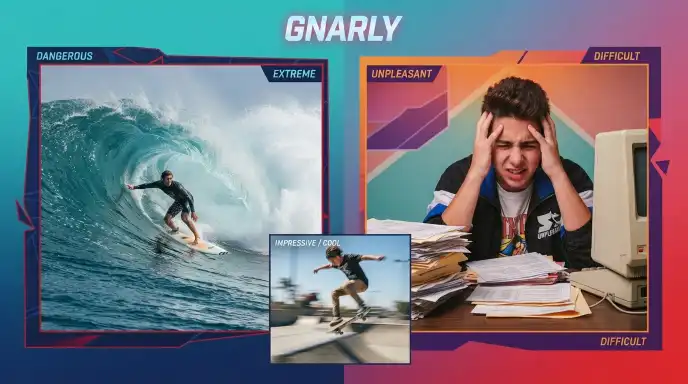
Gnarly is interesting because its meaning depends heavily on context. It can describe something difficult, dangerous, extreme, impressive, unpleasant, or severe.
“That was a gnarly wave.”
Here, the speaker may mean the wave was intense or dangerous.
“I had a gnarly headache.”
In this sentence, it suggests that the headache was severe or unpleasant.
This is a good example of why slang should always be understood in context.
Tubular in 1980s Slang
Tubular became associated with surf culture and later became a general expression for something excellent or cool.
“Your new bike is tubular!”
Today, the expression usually sounds intentionally retro. A person may use it as a joke or to create an unmistakable 1980s mood.
Bogus: An 80s Expression That Survived
Bogus can mean fake, false, unfair, or disappointing.
“They canceled the game at the last minute. That’s bogus.”
Unlike some strongly dated expressions, bogus remains recognizable and can still appear in casual English.
Stoked Means Very Excited
Stoked means very excited or enthusiastic about something.
“I’m totally stoked about the concert.”
It remains understandable and can still sound natural in casual conversation.
Grody Means Disgusting
Grody describes something disgusting, unpleasant, or gross.
“That old refrigerator is seriously grody.”
Today, it sounds much more dated than words such as gross or disgusting.
More Classic 1980s Slang Expressions
Gag Me With a Spoon
Gag me with a spoon was a humorous way to express disgust and became closely associated with Valley Girl culture in the 1980s.
“You expect me to eat that? Gag me with a spoon!”
Today, it usually sounds deliberately old-fashioned or humorous.
Dweeb
Dweeb describes someone viewed as awkward, uncool, or socially uncomfortable.
“Don’t call him a dweeb just because he likes computers.”
It can be playful between friends, but it can also become an insult when used seriously.
Veg Out
Veg out means to relax and spend time doing very little.
“I’m staying home tonight to veg out and watch movies.”
This expression has survived better than many other 1980s terms.
Wig Out
Wig out means to become extremely upset, excited, shocked, or overwhelmed.
“She totally wigged out when she saw the surprise.”
The exact feeling depends on context.
Take a Chill Pill
Take a chill pill is a playful way to tell someone to calm down or relax.
“Take a chill pill. Everything is going to be fine.”
Depending on tone, it can sound friendly, sarcastic, or slightly dismissive.
Popular 90s Slang Words and Their Meanings
The 1990s brought another mix of informal expressions. Music, television, movies, youth culture, hip-hop, R&B, and gaming all influenced the slang people encountered during the decade.
| 90s Slang | Meaning |
|---|---|
| As if! | No way; I don’t believe you |
| Da bomb | Extremely good |
| Dope | Cool or excellent |
| Fly | Cool or stylish |
| Fresh | Cool, stylish, or impressive |
| Homey | Friend or close companion |
| My bad | My mistake |
| Phat | Excellent, attractive, or stylish |
| Props | Respect or credit |
| Scrub | An unsuccessful or undesirable person |
| Sike | Just kidding or tricking someone |
| Tight | Very good or cool |
| Wassup? | What’s up? |
| Talk to the hand | A dismissive way of saying you do not want to listen |
As with 1980s slang, these words were not necessarily invented in the 1990s. Some had earlier histories but became particularly visible during the decade.
As If! in 90s Slang
As if! is a sarcastic way to reject an idea or express disbelief.
“You think I’m going to apologize first? As if!”
The phrase became strongly associated with 1990s teen culture and was famously used in Clueless.
My Bad Means My Mistake
My bad is a casual way to admit responsibility for a mistake.
“My bad. I sent the message to the wrong person.”
Unlike many retro expressions, this phrase still feels natural in informal communication.
Da Bomb
Da bomb was used to describe something excellent, impressive, or especially good.
“That new restaurant is da bomb.”
Today, it usually creates a noticeable 1990s or nostalgic feel.
Phat
Phat was a positive slang term used for something considered excellent, attractive, or stylish.
“Those sneakers are phat.”
The spelling and usage are strongly associated with 1990s popular culture.
Fly
Fly could describe someone or something as stylish, cool, or attractive.
“Those clothes are really fly.”
The positive slang use of fly has a history that extends beyond the 1990s, but it remained prominent in popular culture during that decade.
80s Slang vs. 90s Slang
There is no perfect dividing line between the two periods. Some expressions crossed decades, while others became popular in specific communities rather than across an entire generation.
| 1980s Associations | 1990s Associations |
|---|---|
| Rad | As if! |
| Tubular | Da bomb |
| Gnarly | Phat |
| Grody | My bad |
| Stoked | Fly |
| Bodacious | Fresh |
| Bogus | Homey |
| Dweeb | Props |
| Gag me with a spoon | Talk to the hand |
| Chill pill | Wassup? |
The main difference is often cultural association rather than exact invention.
A term may have existed before the 1980s but become strongly connected with that decade. Another expression may have continued into the 1990s even though people remember it as an “80s” term.
For that reason, it is more accurate to describe many expressions as popular during a decade rather than claiming that the decade invented them.
Where Was 80s and 90s Slang Commonly Used?
These slang expressions appeared in many areas of everyday life.
School and Teen Conversations
Young people often used informal language while talking with friends at school.
“That test was bogus.”
Here, bogus means the speaker thought the test was unfair or disappointing.
Music and Youth Culture
Music helped spread slang between communities. The 1990s especially saw hip-hop and R&B influence wider youth vocabulary.
However, it is important to avoid assuming that every expression came from music. Different terms had different cultural paths.
Movies and Television
Movies and television helped make certain expressions memorable. A phrase used by a popular character could become widely recognizable, even if not everyone used it in everyday conversation.
Surfing and Skateboarding
Surf and skate communities helped popularize expressions such as gnarly, rad, and tubular.
Some of these words later moved beyond their original communities.
Gaming Culture
Gaming communities also developed informal language around arcade games, consoles, computers, competition, and multiplayer play.
However, not every term from this period should be labeled gaming slang. Many expressions were general youth slang that gamers also used.
Why Did People Use 80s and 90s Slang?
People use slang to make communication more casual, expressive, funny, or connected to a particular group.
During these decades, slang could communicate:
- Friendship
- Humor
- Excitement
- Group identity
- Rebellion
- Cultural connection
- A relaxed attitude
Popular media then helped some expressions move from smaller communities into mainstream culture.
This is why old slang can tell us something about the period. The expressions were connected to music, fashion, entertainment, hobbies, and social groups.
Is 80s and 90s Slang Still Used Today?
Some expressions remain part of casual English, while others are mainly used for nostalgia or humor.
Still Recognizable or Occasionally Used
- Awesome
- Bogus
- Dope
- Fresh
- My bad
- Stoked
- Wannabe
Mostly Retro Today
- Tubular
- Gag me with a spoon
- Talk to the hand
- Da bomb
- Grody
A dated expression has not necessarily disappeared. People may use it intentionally in memes, jokes, costumes, retro-themed content, or conversations about older movies and music.
For example:
“That outfit is totally tubular!”
A modern speaker may be making a joke rather than trying to speak exactly like someone from the 1980s.
80s and 90s Slang on Social Media
Retro expressions can still appear on TikTok, Instagram, Reddit, Snapchat, and other online communities.
People often use them for:
- Nostalgia
- Humor
- Retro captions
- Movie references
- Music references
- Generational jokes
- Vintage-themed content
A caption such as:
“This is totally rad.”
may intentionally create an older cultural feel.
Retro Slang on TikTok
TikTok creators may use older expressions when discussing 1980s or 1990s fashion, movies, music, childhood memories, or vintage technology.
The expression often works as a cultural reference rather than ordinary modern slang.
Older Expressions on Reddit
Reddit discussions about childhood, old movies, games, music, and generational differences can include retro expressions.
Because Reddit contains many different communities, a phrase that feels natural in one group may seem unusual in another.
Retro Language in Gaming
Gaming content may use older slang when discussing classic arcade games, consoles, or childhood gaming memories.
It is better to treat these terms as retro language used in gaming contexts rather than assuming they all originated in gaming.
Is 80s and 90s Slang Rude or Offensive?
Most retro slang is harmless, but some terms can become insulting depending on how they are used.
For example, dweeb can describe someone as awkward or uncool. It may be a joke between friends, but it can also hurt someone when used as an insult.
Similarly, scrub can be negative when used to describe someone as unsuccessful or undesirable.
Before using a term, consider:
- Who are you talking to?
- What does it mean in this context?
- Is it directed at another person?
- Could it sound insulting?
- Is the situation formal or casual?
Slang is not automatically offensive simply because it is informal. Tone, intention, and context matter.
Is Retro Slang Appropriate at Work?
Some mild expressions may work in a relaxed workplace, but strongly dated or dismissive slang is usually better avoided in professional communication.
For example:
“My bad. I’ll fix it.”
may be acceptable in a casual workplace.
But:
“Talk to the hand!”
would usually sound dismissive and unprofessional.
For formal situations, clearer alternatives are safer:
- “I made a mistake.”
- “That’s disappointing.”
- “That sounds great.”
- “I’ll take care of it.”
- “I agree.”
Can You Use Retro Slang With Teachers or Parents?
You can use harmless expressions with people you know, but the situation matters.
For example:
“That movie was awesome!”
is unlikely to cause confusion.
However:
“Whatever, talk to the hand.”
would usually sound disrespectful.
Positive or descriptive expressions are generally safer than slang used to dismiss, mock, or insult another person.
Generational and Regional Differences in Slang
Not everyone in the 1980s or 1990s used the same vocabulary.
Slang could vary according to:
- Region
- Age
- Community
- Cultural background
- Music preferences
- Hobbies
- Social groups
A phrase that was common in one area could be unfamiliar elsewhere.
This is especially important when discussing expressions linked to specific cultural communities. Some 1990s slang became more widely known through African American English and hip-hop culture, while other expressions were linked to surf culture, skateboarding, Valley Girl speech, television, or movies.
Calling all of these simply “teen slang” can hide important differences in their backgrounds.
When Should You Avoid Using Retro Slang?
You should be careful with older slang when:
- Writing a formal email
- Applying for a job
- Speaking in an interview
- Writing an academic assignment
- Communicating with a client
- Talking to someone you do not know
- Using a term as an insult
- You are unsure of its meaning
- You want to sound highly professional
Retro slang can be great for casual conversations, creative writing, humor, and nostalgia. The key is to match the language with the audience and situation.
Why Does Old Slang Sound Funny Today?
Some expressions become closely connected with a particular era. Years later, using them can create a humorous or nostalgic effect.
Consider:
“That is totally tubular, dude!”
Most readers understand the intended meaning, but the sentence sounds deliberately retro.
The words communicate an idea while also suggesting a particular time, personality, or cultural style.
That makes older slang useful for:
- Comedy
- Movies
- Fiction
- Character development
- Memes
- Nostalgia content
- Retro marketing
Is Using 80s and 90s Slang “Cringe”?
Not automatically. It depends on how and why you use it.
Using one old expression as a joke is different from filling every sentence with dated slang.
For example:
“That game was totally tubular.”
This can work as a playful 1980s reference.
The problem appears when someone uses several strongly dated expressions without considering their context or audience. The language may then feel forced.
The slang itself is not the problem. Whether it fits the situation is what matters.
Common Misunderstandings About Retro Slang
Not Every Slang Word Was Invented in Its Decade
Some expressions became popular during the 1980s or 1990s even though they existed earlier.
Popularity and invention are not the same thing.
Not Everyone Used the Same Words
Different communities had different slang. A popular movie phrase does not prove that every teenager used it in daily conversation.
Not All Retro Slang Is Outdated
Some expressions survived and became normal informal English.
Others remain recognizable but are rarely used seriously today.
The Internet Was Not the Main Source
Most 1980s slang spread through face-to-face conversations, television, movies, music, radio, school, magazines, and cultural communities.
The internet became more relevant to language during the 1990s, but it was not the main source of most expressions associated with the earlier part of the decade.
Real-Life Examples of 80s and 90s Slang
Seeing slang in context makes its tone easier to understand.
Friendly Example
“That new skateboard is totally rad.”
Meaning: The skateboard is very cool.
Excited Example
“I’m so stoked for the concert tonight.”
Meaning: The speaker is very excited.
Casual Apology
“My bad. I thought you already had the tickets.”
Meaning: The speaker is admitting a mistake.
Sarcastic Example
“You think I’m going to believe that? As if!”
Meaning: The speaker strongly doubts or rejects the idea.
Retro Compliment
“Those sneakers are fresh.”
Meaning: The sneakers look stylish or cool.
Negative Example
“Stop calling him a dweeb just because he likes science.”
Meaning: Dweeb is being used as an insult for someone considered awkward or uncool.
Comparing Popular 80s and 90s Slang
| Slang Term | Era Association | Meaning | Tone Today |
|---|---|---|---|
| Rad | 1980s | Very cool | Retro but recognizable |
| Gnarly | 1980s | Extreme or impressive | Still used in some settings |
| Tubular | 1980s | Excellent or cool | Very retro |
| Bogus | 1980s | Fake, unfair, or disappointing | Still recognizable |
| Stoked | 1980s | Very excited | Still used casually |
| Grody | 1980s | Disgusting | Dated |
| As if! | 1990s | Disbelief or rejection | Strongly retro |
| My bad | 1990s | My mistake | Still common |
| Da bomb | 1990s | Extremely good | Very retro |
| Phat | 1990s | Excellent or stylish | Mostly nostalgic |
| Fresh | 1990s association | Stylish or cool | Still recognizable |
| Talk to the hand | 1990s | Stop listening to me | Dated |
Which Retro Slang Is Still Useful Today?
Some expressions are easier to use naturally than others.
More Natural Today
- Awesome
- My bad
- Dope
- Fresh
- Stoked
- Bogus
- Wannabe
More Obviously Retro
- Tubular
- Gag me with a spoon
- Talk to the hand
- Da bomb
- Grody
- Wastoid
The second group is not necessarily wrong. These words simply create a stronger nostalgic or old-fashioned effect.
How to Use 80s and 90s Slang Without Sounding Forced
If you want to use retro expressions today, keep these points in mind.
Use Slang Sparingly
One old expression can create a funny or nostalgic effect. Too many can make dialogue sound unnatural.
Match the Context
A surf-related expression may work well in a beach-themed joke but feel strange in a formal email.
Know Your Audience
Older audiences may recognize a phrase from personal experience. Younger audiences may know it from movies, memes, or social media.
Understand the Tone
Know whether a term is positive, negative, sarcastic, dismissive, or insulting before using it.
Respect Cultural Background
Some expressions developed within specific communities. Avoid suggesting that every person from the 1980s or 1990s used the same slang.
Polite Alternatives to Negative Retro Slang
If an older expression sounds insulting, you can use a clearer alternative.
For “dweeb,” use: awkward person, nerd, or socially awkward person.
- Awkward person
- Nerd
- Someone who is socially uncomfortable
For “scrub,” use: beginner, inexperienced person, or someone who needs practice.
- Beginner
- Inexperienced person
- Someone who needs more practice
Instead of bogus when describing disappointment, you could say:
- “That’s disappointing.”
- “That’s unfair.”
- “That’s frustrating.”
Instead of talk to the hand, you could say:
- “I don’t want to discuss this right now.”
- “Let’s talk later.”
- “I need a break from this conversation.”
Clear language reduces the chance of misunderstanding or offending someone.
Why Do People Still Search for 80s and 90s Slang?
People continue to search for these expressions because they appear in older movies, television, music, books, interviews, memes, and nostalgia content.
Common reasons include:
- Understanding an old movie
- Learning the meaning of a song reference
- Writing realistic period dialogue
- Creating retro content
- Understanding generational language
- Making a nostalgic caption
- Comparing older and newer slang
- Remembering a phrase from childhood
- Understanding a meme or cultural reference
For writers, knowing the time period and tone of an expression can be just as important as knowing its basic meaning.
Are 80s and 90s Slang Terms Safe for Social Media?
Most harmless retro expressions are fine for social media.
People commonly use them for:
- Nostalgia
- Humor
- Memes
- Retro fashion
- Movie references
- Music references
- Generational jokes
- Character-based content
However, avoid slang that insults people or depends on offensive stereotypes. A phrase that seems funny to one audience may sound disrespectful to another.
What Makes Retro Slang Different From Modern Internet Slang?
Modern internet slang can spread quickly through online platforms and communities.
Much of the slang associated with the 1980s and early 1990s spread through different channels, including television, movies, music, radio, magazines, schools, and face-to-face conversations.
This helps explain why older slang often feels connected to a particular pop-culture era, while newer expressions can be closely tied to specific online communities.
Frequently Asked Questions About 80s and 90s Slang
Q1. What is the most popular 80s slang?
Well-known examples include rad, gnarly, tubular, bogus, stoked, grody, and dweeb.
Q2. What is the most popular 90s slang?
Popular examples include as if, my bad, da bomb, phat, dope, fly, fresh, props, and talk to the hand.
Q3. What does “rad” mean in 80s slang?
Rad means very cool, exciting, or impressive. It became strongly associated with 1980s youth and surf culture.
Q4. What does “my bad” mean in 90s slang?
My bad is a casual way to say “my mistake.” It remains common in informal English today.
Q5. What does “as if” mean in 90s slang?
As if! is a sarcastic way to reject an idea or express disbelief. It became strongly associated with 1990s teen culture.
Q6. Is 80s and 90s slang still used today?
Yes. Some expressions remain part of casual English, while others are mainly used for nostalgia, humor, memes, and references to older popular culture.
Q7. Is retro slang appropriate at work?
Mild expressions may work in relaxed settings, but strongly dated or dismissive expressions are better avoided in professional communication.
Q8. Why do people use 80s and 90s slang today?
People often use it to create humor, express nostalgia, reference older movies or music, or give content a retro personality.
Conclusion
80s and 90s slang includes a wide range of informal expressions shaped by youth culture, music, movies, television, sports, surfing, skateboarding, hip-hop, gaming, and other communities.
The 1980s are often associated with expressions such as rad, gnarly, tubular, bogus, stoked, and gag me with a spoon. The 1990s are remembered for expressions such as as if, my bad, da bomb, phat, fresh, and talk to the hand.
Some of these words still sound natural today, while others create an obvious retro effect. Not every term originated in the decade associated with it, so it is better to consider popularity, cultural background, and context.
The best way to understand or use older slang is simple: look at the meaning, tone, audience, cultural background, and time period. A little retro slang can add personality and nostalgia, but using it intentionally will always sound more natural than forcing it into every conversation.
Read More About !
- Horse Meaning Slang: What Does “Horse” Mean in Slang?
- FOB Slang Meaning in Text: What Does FOB Mean?
- LLBC Meaning in Texting, Social Media, and Rap

Michael Brooks is a language writer at SlangPath with 7+ years of experience creating simple, practical content on English slang and everyday expressions.