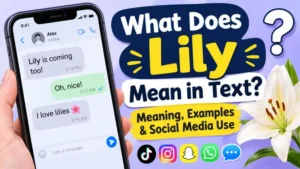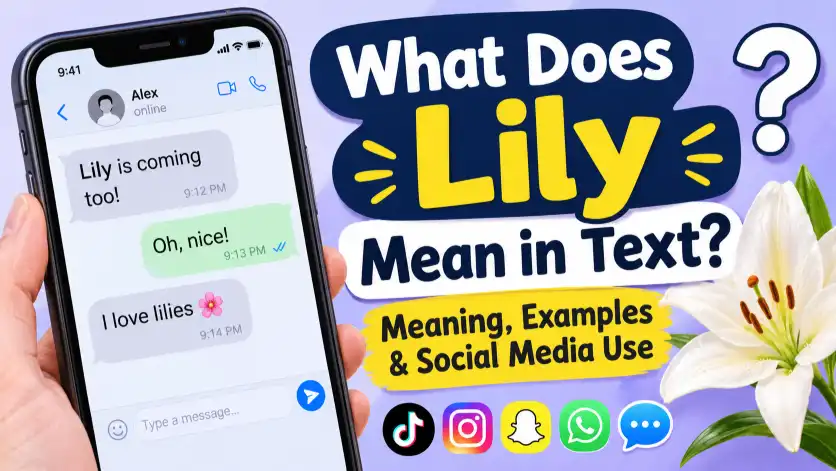
When someone writes “Lily” in a text message, it usually refers to a person’s name or a beautiful flowering plant.
It is not a widely recognized texting abbreviation, acronym, or internet slang term. The intended meaning depends on the conversation.
You might see Lily in a WhatsApp message, TikTok comment, Snapchat conversation, Instagram caption, or regular SMS. Someone may use it to mention a friend, talk about flowers, address another person, or refer to a social media username.
The word can sometimes create confusion when it appears without enough context. For example, if someone comments “Lily is so pretty,” they could be talking about a person or a flower, depending on the picture or discussion.
Understanding the surrounding message makes it easier to identify what the sender means. Below, we will explore the different uses of Lily, its meaning in everyday conversations, and how people use it across social media platforms.
1. Lily Meaning in Text
Lily usually refers to a person’s name or a type of flower in text messages. It is an ordinary English word rather than a commonly recognized internet slang expression.
Unlike popular texting abbreviations such as LOL, BRB, IDK, and IMO, Lily does not represent a shortened phrase. People generally use it in its regular meaning when communicating online.
For example, imagine receiving this message:
“Lily said she will meet us after school.”
The sender is talking about someone named Lily. There is no hidden abbreviation or special slang meaning in this sentence.
Now consider another message:
“I really love white lilies. They look so elegant.”
Here, Lily refers to a flower. The sender is expressing an opinion about a particular type of plant.
Both examples show that the meaning depends on the subject being discussed. You should consider the complete sentence before deciding what someone means.
Is Lily Slang, an Acronym, or an Abbreviation?
Lily is generally classified as a personal name and the name of a flower. It is not normally considered an acronym, abbreviation, or established texting slang.
These terms have different meanings in digital communication:
- Slang: Informal expressions used in casual conversations, often among particular social groups or online communities.
- Acronym: A word created using the first letters of several words, such as LOL (Laughing Out Loud).
- Abbreviation: A shortened version of a word or phrase, such as ASAP (As Soon As Possible).
- Lily: A regular English word and personal name that can appear in both formal and informal communication.
People sometimes assume that unfamiliar words appearing in text messages must have a special internet meaning. However, many ordinary English words are also used as usernames, nicknames, and social media expressions.
Lily is a good example of this. Someone might write it in a short message without intending anything beyond mentioning a person or flower.
What Does Lily Mean in Everyday Chat?
In everyday conversations, Lily can be understood in several ways. The sender’s intention, the topic, and the relationship between the people chatting can help you identify the correct meaning.
Here are four common possibilities.
1. Lily as a Person’s Name
The most straightforward meaning is a person’s name. Lily is commonly used as a feminine given name, so it may appear when someone talks about a friend, family member, classmate, or colleague.
For example:
“Have you invited Lily to the birthday party?”
The sender wants to know if someone named Lily has received an invitation.
Another example:
“Lily is waiting for your reply.”
This means a person named Lily is expecting a response.
2. Lily as a Flower
Lily is also the name of a flowering plant. Lilies are known for their attractive petals, different colors, and pleasant appearance.
People may mention them when discussing gardens, decorations, gifts, or special occasions.
For example:
“My mother loves lilies, so I bought her a bunch.”
The sender is talking about flowers rather than a person.
Another example:
“These pink lilies would look beautiful in the living room.”
The word describes a type of flower being used for decoration.
3. Lily as a Nickname
Some people use Lily as a nickname for a friend, family member, or someone they care about.
It can be a person’s actual name or an affectionate variation of a longer name.
For example:
“Goodnight, Lily. Talk to you tomorrow!”
In this message, Lily is being used to address someone directly.
Nicknames are common in personal messaging because they can make conversations feel familiar and friendly.
4. Lily as a Social Media Username
On platforms such as TikTok and Instagram, people often choose personal names, flower names, or creative combinations for their usernames.
For example:
“Did you see Lily’s latest video?”
The sender may be talking about a creator whose username or display name is Lily.
Similarly, someone might write:
“Follow Lily for more flower photography.”
In this case, Lily could be the name of an account or creator.
Can Lily Have Different Meanings Depending on Context?
Yes. Although Lily has recognizable everyday meanings, the intended reference can change according to the conversation.
Consider these messages:
- “Lily is my best friend.” — Refers to a person.
- “I planted lilies last weekend.” — Refers to flowers.
- “Hey, Lily, are you coming?” — Addresses someone directly.
- “Lily just uploaded a new video.” — Could refer to a social media creator.
- “I named my kitten Lily.” — Refers to a pet’s name.
Notice that the spelling remains the same, but the subject changes.
This is why reading the complete sentence is more useful than trying to find a separate slang definition for every word.
Does Lily Have a Hidden Meaning in Texting?
There is no widely established hidden texting meaning for Lily. It is not generally used as a secret code or popular abbreviation in everyday internet conversations.
However, individual groups may give ordinary words special meanings through inside jokes, personal nicknames, or shared experiences.
For example, two friends might use Lily as a nickname for a particular person or even as a private joke. Someone outside that group may not understand the reference immediately.
If you receive a message containing only “Lily,” you may need to ask the sender what they mean.
A simple question such as “Are you talking about someone named Lily?” can clear up the confusion.
2. Where People Use Lily
Lily can appear on almost any platform where people communicate through written messages. Its basic meaning usually stays the same, but the surrounding conversation can provide additional information.
For example, a flower enthusiast might use Lily when sharing garden pictures, while a teenager might mention someone named Lily in a group chat.
Understanding how the word appears on different platforms can help you interpret it more naturally.
Lily on TikTok
TikTok is a popular platform for short videos, comments, trends, and online conversations. People frequently mention names in captions and comment sections, which means you may come across Lily in different situations.
For example, someone might comment:
“Lily looks absolutely beautiful!”
If the video shows a person, the commenter is probably talking about someone named Lily.
However, if the video shows a flower arrangement, the same word could refer to a lily flower.
TikTok users may also include Lily in their usernames, video descriptions, or hashtags.
Here are a few more examples:
- “Lily deserves more attention.”
- “I love Lily’s new video.”
- “Those lilies are my favorite flowers.”
- “Is Lily your real name?”
- “Where can I find these flowers?”
The meaning becomes clearer when you consider the video and the conversation happening underneath it.
It is also important to remember that a word appearing frequently in TikTok comments does not automatically make it a trending slang expression.
Lily on Snapchat
Snapchat is mainly used for private messages, snaps, stories, and conversations between friends.
On this platform, Lily may appear as someone’s contact name, display name, or username.
For example:
“Lily sent you a snap.”
This notification,style sentence identifies the person who sent the snap.
Friends may also use the word while making plans:
A: Are you coming to the mall?
B: Yes, Lily is coming too.
A: Great, let’s meet at 5.
Here, Lily is simply the name of another person joining the plan.
Snapchat users may also use flower,related words in captions and stories. Someone sharing a picture of a garden might write:
“Fresh lilies make my day.”
In that situation, the word describes flowers rather than a person.
Lily on Instagram
Instagram includes photographs, reels, stories, captions, comments, and direct messages. Because users share different types of content, Lily can appear in several contexts.
For example, a person might comment:
“Lily, you look amazing!”
This is a direct message or public comment addressed to someone.
Another user might write:
“These lilies are perfect for spring.”
Here, the word refers to flowers.
Instagram users may also include Lily in their profile names, photography pages, fashion accounts, or personal brands.
Consider these examples:
- “Lily shared some beautiful pictures.”
- “I love the flowers in Lily’s garden.”
- “Can you tag Lily in this post?”
- “Lily’s new outfit looks great.”
- “These white lilies are so pretty.”
If you see Lily in an Instagram bio or username, it may simply be the account owner’s chosen name.
Lily on WhatsApp
WhatsApp is commonly used for personal conversations, family groups, school discussions, and workplace communication.
People often mention Lily when discussing someone they know.
For example:
A: Who is coming to dinner tonight?
B: Lily and Emma are joining us.
A: Okay, I’ll prepare everything.
In this conversation, Lily is one of the people attending dinner.
Another example:
“Please send Lily the meeting details.”
The sender wants you to share some information with a person named Lily.
The word can also appear in WhatsApp status updates. Someone might share a photograph of flowers with the caption:
“Beautiful lilies from my garden.”
This is a normal use of the flower name.
Lily in SMS Text Messages
SMS messages are often shorter than social media posts, but people still use ordinary names and words in the same way.
For example:
“Tell Lily I’ll be there in ten minutes.”
The sender is asking you to pass information to someone.
Another message might say:
“Are these lilies available in different colors?”
Here, the discussion is about flowers.
Lily does not have a separate meaning in SMS messages. People generally use it as a person’s name, a nickname, or a reference to the flower. Its meaning stays the same whether someone sends it through a phone message or an online chat.
Lily in Gaming Chats and Online Communities
In online gaming and community chats, Lily may appear as a player’s username, nickname, or display name. Gamers often choose flower-inspired names because they are simple, memorable, and easy to recognize.
For example:
- “Is Lily joining our team tonight?”
- “Lily just sent a message in Discord.”
- “Ask Lily if she wants to play another round.”
In these examples, Lily identifies a player or community member rather than a gaming abbreviation or special online expression.
Explain Lily as a nicknameAdd a direct chat-reply example
Players often choose short, memorable usernames, and flower names are sometimes used as part of those identities.
For example:
“Has Lily joined the game yet?”
The sender may be asking about another player.
Someone might also write:
“Lily is on our team tonight.”
This means a player with that name is participating.
In these settings, Lily could be a real name, gaming nickname, or display name. You should not assume it refers to a particular gaming term without additional context.
Why Platform Context Matters
The platform alone does not determine the meaning. The content surrounding the word is much more important.
If you see Lily under a flower photograph, it may refer to the plant. If you see it in a conversation about school, family, or friends, it is more likely to be someone’s name.
A little attention to the conversation can prevent unnecessary confusion and help you understand the sender correctly.
3. Real Chat Examples of Lily
Understanding a word becomes much easier when you see how people use it in actual conversations. Lily can appear in different types of messages, depending on if someone is talking about a person, a flower, a nickname, or an online profile.
Here are 10 realistic texting conversations that show how the word can be used naturally.
Example 1: Talking About a Friend
A: Are you coming to the party tonight?
B: Yes, Lily is coming with me.
A: Great! I haven’t seen her in ages.
Meaning: Lily is the name of someone attending the party. The conversation is about making plans with friends.
Example 2: Asking About Someone
A: Do you know Lily from school?
B: Yes, we are in the same class.
A: Oh, that’s nice! Is she in your group?
B: Yes, we work on projects together.
Meaning: The sender is asking about a person named Lily. The name helps identify someone they both might know.
Example 3: Talking About Flowers
A: What flowers did you buy for your garden?
B: I bought some white lilies.
A: They must look beautiful!
B: Yes, I planted them near the entrance.
Meaning: Here, lilies refers to flowers. The conversation is about gardening rather than a person’s name.
Example 4: Making Weekend Plans
A: Who is joining us for lunch on Sunday?
B: Lily and Sarah.
A: Okay, I’ll book a table for four.
B: Perfect! I’ll let them know.
Meaning: Lily is one of the people joining the group for lunch.
Example 5: Complimenting a Picture
A: Did you see my new garden picture?
B: Yes! Those lilies are gorgeous.
A: Thanks! They finally started blooming.
B: You should share more pictures like that.
Meaning: The word refers to lily flowers. The sender is complimenting their appearance.
Example 6: Asking Someone to Contact Lily
A: Can you tell Lily about tomorrow’s meeting?
B: Sure, I’ll message her.
A: Please send her the time as well.
B: No problem!
Meaning: Lily is the person who needs to receive the meeting information.
Example 7: Using Lily as a Nickname
A: Good morning, Lily!
B: Good morning! How are you?
A: I’m doing great. What about you?
B: Pretty good, thanks!
Meaning: Lily is being used to address someone directly. It may be the person’s actual name or a nickname.
Example 8: Discussing a Social Media Post
A: Who is that girl in your latest post?
B: That’s Lily, my cousin.
A: You both look great!
B: Thank you! We had a lovely day.
Meaning: Lily identifies the person appearing in the Instagram post.
Example 9: Discussing Favorite Flowers
A: What’s your favorite flower?
B: I really like lilies.
A: White ones or pink ones?
B: White ones! They look so elegant.
Meaning: Lily refers to a type of flower. The conversation is about personal preferences.
Example 10: Talking About a Message
A: Did Lily text you yesterday?
B: Yes, she asked about the homework.
A: Did you send her the answers?
B: Yes, I helped her with the questions.
Meaning: Lily is the name of someone who sent a text message.
What Do These Examples Teach Us?
These conversations show that Lily does not have one special meaning in every situation.
Sometimes it identifies a person, sometimes it describes a flower, and sometimes it works as a nickname or online identity.
If you receive a message containing this word, look at the previous messages and the topic being discussed. That will usually help you understand what the sender means.
4. How to Reply When Someone Says Lily
Your response depends on how the other person uses the word.
For example, if someone says, “Lily is coming with us,” you might ask who Lily is or simply say that sounds good.
If someone shares a picture of lilies, you can respond with a compliment about the flowers.
You do not need a special slang reply because Lily is not a commonly recognized texting abbreviation.
Here are some natural responses for different situations.
Funny Replies
If you are chatting with friends and want to make the conversation entertaining, you can use a little humor.
- “Wait, which Lily are we talking about?”
- “Lily is becoming the main character!”
- “I need the full Lily story.”
- “Okay, now I’m curious!”
- “Is Lily famous now?”
- “Sounds like Lily has a busy schedule!”
- “Tell me everything!”
- “Lily is getting all the attention today!”
Example conversation:
A: Lily is coming with us tomorrow.
B: Lily is becoming the main character!
A: Haha, she’s just joining us for lunch.
B: Okay, now I understand!
These responses are suitable for relaxed conversations where both people understand the joke.
Casual Replies
Sometimes a short and simple response is all you need. Casual replies help keep the conversation moving without making it unnecessarily complicated.
You can say:
- “Oh, okay!”
- “Got it.”
- “Really?”
- “That’s interesting.”
- “I see what you mean.”
- “Sounds good!”
- “Okay, thanks for telling me.”
- “That’s nice!”
Example conversation:
A: Lily will be joining us for dinner.
B: Oh, that’s nice!
A: Yes, she confirmed a few minutes ago.
B: Sounds good!
These replies work well in everyday messages with friends, classmates, and family members.
Friendly Replies
If you know the person being mentioned, you can respond warmly and make the conversation feel more personal.
Try these friendly responses:
- “Oh, I know Lily!”
- “Tell Lily I said hi!”
- “That’s so nice!”
- “I hope she can make it.”
- “I’m looking forward to seeing her.”
- “Aww, that’s lovely!”
- “Please say hello to her for me.”
- “That’s wonderful news!”
Example conversation:
A: I invited Lily to the birthday party.
B: That’s so nice! Tell her I said hi.
A: Sure, I will.
B: I hope we all have a great time!
These replies are especially useful when someone is sharing positive news or making plans.
Neutral Replies
Sometimes you may not recognize the name or understand the context. In that situation, neutral responses are a better choice.
Here are some examples:
- “Who is Lily?”
- “Can you tell me more?”
- “Do you mean Lily from school?”
- “I’m not sure who you’re talking about.”
- “Are you referring to the flower or someone named Lily?”
- “Could you explain what you mean?”
- “Which Lily are you talking about?”
- “Can you give me a little context?”
Example conversation:
A: Lily is coming tomorrow.
B: Which Lily are you talking about?
A: My cousin Lily.
B: Oh, now I understand!
What If Someone Sends Only the Word Lily?
If someone sends you just “Lily” without any explanation, the meaning may not be clear.
They could be trying to get someone’s attention, mentioning a name, sharing a flower,related reference, or correcting something in an earlier conversation.
Instead of guessing, you can respond:
- “What about Lily?”
- “Are you talking about someone?”
- “Did you mean the flower?”
- “Can you explain?”
A simple clarification is often the easiest way to avoid misunderstanding.
5. Is Lily Rude or Offensive?
No. Lily is not generally considered a rude, offensive, or inappropriate word.
It is commonly used as a personal name and as the name of a flowering plant. There is no widely accepted negative meaning attached to it in ordinary texting.
People use it in friendly conversations, family messages, school discussions, social media captions, and professional communication.
However, the tone of a complete message can sometimes change how it sounds.
For example:
“Ask Lily to call me.”
This is a normal and respectful request.
But consider:
“Stop acting like Lily.”
This sentence could sound critical depending on who Lily is and what the sender means. The negative tone comes from the sentence, not from the name itself.
Is Lily Safe to Use With Friends?
Yes. You can comfortably use Lily when talking about someone with that name or discussing flowers.
For example:
- “Lily is joining us today.”
- “I love Lily’s new pictures.”
- “These lilies look beautiful.”
- “Tell Lily I’ll call her later.”
These are ordinary expressions that do not carry an offensive meaning.
You should simply make sure that you are using someone’s name respectfully.
Is Lily Appropriate at School?
Yes. Lily is perfectly suitable for school conversations, classroom discussions, homework messages, and educational writing.
For example:
- “Lily will present her project tomorrow.”
- “Please give this notebook to Lily.”
- “Lily has completed the assignment.”
- “We learned about different types of lilies in science class.”
There is no reason to avoid the word in an educational setting.
Is Lily Appropriate at Work?
Yes. The word is also appropriate in professional communication.
You might see it in an email, workplace group chat, meeting schedule, or project discussion.
Examples:
- “Lily will share the updated report.”
- “Please contact Lily for further information.”
- “The flowers in the reception area are lilies.”
- “Lily is responsible for the presentation.”
These sentences use the word naturally and professionally.
Can Lily Be Used in Formal Writing?
Yes. Lily can be used in formal writing when it refers to a person or flower.
For example, a school report might mention a student named Lily, while a gardening article might discuss different lily varieties.
The word itself is not informal or unprofessional.
When Should You Be Careful?
Although Lily is not offensive, you should pay attention to the context when discussing another person.
Avoid using someone’s name in a way that makes them uncomfortable, spreads private information, or creates unnecessary embarrassment.
Similarly, if someone uses Lily as a personal nickname, respect their preference rather than assuming they want everyone to call them that.
The main point is simple: Lily is a normal and safe word, but respectful communication always matters.
6. Who Uses This Term?
Lily is used by people of different ages and backgrounds. Since it is a common personal name and the name of a flower, it is not limited to one generation or a particular online community.
People may use it in personal conversations, social media posts, school discussions, and professional messages.
Teenagers and Young Adults
Teenagers and young adults may use Lily when chatting with classmates, friends, or people they follow online.
For example:
- “Lily is coming to school tomorrow.”
- “Did you see Lily’s new Instagram post?”
- “I think Lily has a new account.”
In these conversations, the word usually refers to someone they know or follow.
Young users may also include Lily in their gaming usernames, profile names, and social media identities.
Gen Z Usage
Gen Z communicates through short messages, emojis, abbreviations, and informal expressions. Lily can naturally appear in these conversations, but it is not a recognized Gen Z slang abbreviation.
For example:
“OMG, Lily looks amazing in that picture!”
Here, Lily is simply someone’s name. The informal tone comes from the overall message rather than the word itself.
It is important to distinguish between words that young people use and expressions that actually have a special slang definition.
Adults and Older Users
Adults may use Lily in family conversations, workplace messages, social media comments, and everyday communication.
For example:
- “Lily will visit us this weekend.”
- “Please ask Lily to send the documents.”
- “My daughter loves lily flowers.”
The word is not restricted to younger internet users.
Common Online Platforms
You may encounter Lily across many digital platforms, including:
- TikTok: In video captions, comments, and creator usernames.
- Instagram: In profile names, stories, posts, and direct messages.
- Snapchat: In contact names, snaps, and private conversations.
- WhatsApp: In personal chats and group messages.
- Facebook: In comments, personal profiles, and community discussions.
- Discord: In usernames, server conversations, and gaming chats.
- SMS: In regular text messages between phone users.
How Often Does Lily Appear Online?
Lily appears in many online conversations because it is used as both a personal name and a flower name.
However, its appearance should not be confused with the popularity of a slang expression.
Unlike LOL, IDK, or BRB, Lily is not generally used as a shortened phrase to save typing time.
Its frequency depends on the conversation. A gardening community may use it when discussing flowers, while a school group may mention it because someone in the class has that name.
7. Origin of the Term Lily
The word Lily has a much older history than modern texting, social media, and internet culture.
It originally developed from the name of the lily flower and later became a popular personal name in English,speaking communities.
Understanding its history helps explain why the word is used in so many different situations today.
Historical Origin of Lily
The English word lily is historically connected to the Latin word lilium and the Greek word leirion, both associated with the lily flower.
The flower has been recognized in different parts of the world for centuries.
Over time, its name became familiar in everyday language and was eventually adopted as a personal name.
This explains why Lily can refer to both a plant and a person.
Lily as a Flower Name

Lilies are flowering plants belonging to the genus Lilium.
They are known for their attractive flowers, different colors, and distinctive shapes. Some varieties are grown in gardens, while others are used in bouquets and decorative arrangements.
Different lily colors can carry different symbolic associations.
For example:
- White lilies: Often associated with purity and remembrance.
- Pink lilies: Commonly connected with admiration and affection.
- Orange lilies: Sometimes associated with confidence and energy.
- Yellow lilies: Often associated with happiness and friendship.
These meanings are cultural associations rather than fixed rules. Their symbolism can change depending on the occasion and tradition.
Lily as a Personal Name
Lily became a popular feminine given name because of its connection with the flower.
Many parents choose flower,inspired names because they sound familiar, gentle, and meaningful.
Lily is also sometimes used as a nickname for longer names, although it is widely given as an independent first name.
Today, it is recognized in many English,speaking countries and appears in books, films, television, and everyday conversations.
Did Lily Come From Internet Culture?
No. Lily did not originate from texting apps, TikTok, Snapchat, or any modern social media platform.
The word existed long before the internet became part of everyday communication.
Social media has simply provided additional places where people can use it.
For example, someone might use Lily as:
- A TikTok username.
- An Instagram display name.
- A gaming nickname.
- A contact name in WhatsApp.
- A reference to a person in an online discussion.
These uses are connected to modern digital communication, but they do not change the original meaning of the word.
Is There a Confirmed Slang Origin?
There is no widely documented or generally accepted internet slang origin for Lily as a texting expression.
If you see someone using it differently in a particular online community, it could be a personal nickname, an inside joke, a username, or a community,specific reference.
Without additional context, it would be misleading to claim that Lily has a secret or universal internet meaning.
8. Lily vs. IDK, IDC, IMO, and BRB
Lily is different from common texting abbreviations such as IDK, IDC, IMO, and BRB.
These expressions represent shortened phrases that help people communicate quickly. Lily, on the other hand, is generally used as a name or an ordinary English word.
Understanding the differences can help you recognize if someone is using an abbreviation or simply mentioning a familiar word.
| Term | Meaning | Type | Usage | Popularity |
| Lily | A personal name or flower | Name / Word | Referring to someone or a flower | Common |
| IDK | I Don’t Know | Abbreviation | Expressing uncertainty | Very common |
| IDC | I Don’t Care | Abbreviation | Showing a lack of interest | Very common |
| IMO | In My Opinion | Abbreviation | Sharing a personal opinion | Common |
| BRB | Be Right Back | Abbreviation | Saying you will return shortly | Common |
Lily vs. IDK
IDK means “I Don’t Know.” People use it when they are unsure about something or do not have an answer.
Example:
A: What time is Lily arriving?
B: IDK, she hasn’t told me yet.
Here, IDK expresses uncertainty, while Lily identifies the person being discussed.
Lily vs. IDC
IDC means “I Don’t Care.” It is used to express a lack of interest or concern about something.
Example:
A: Does Lily want to watch the movie?
B: IDK, but IDC which movie we choose.
In this conversation, IDC communicates the sender’s attitude toward the movie selection.
Lily vs. IMO
IMO means “In My Opinion.” It is commonly used before sharing a personal view.
Example:
A: What do you think about Lily’s new dress?
B: IMO, it looks beautiful.
Here, IMO introduces an opinion, while Lily identifies the person whose dress is being discussed.
Lily vs. BRB
BRB means “Be Right Back.” People use it when they need to leave a conversation temporarily.
Example:
A: Is Lily online?
B: BRB, I’ll check.
The sender uses BRB to explain that they will return shortly.
Why Is This Comparison Important?
These words serve different purposes in digital conversations.
IDK, IDC, IMO, and BRB shorten common expressions, while Lily usually identifies a person or refers to a flower.
Recognizing this difference makes it easier to understand messages without assuming that every unfamiliar word is internet slang.
9. Real,World Usage Example
Imagine that two friends are planning a birthday celebration over WhatsApp.
One friend sends a message:
“Are we inviting Lily too?”
The other replies:
“Yes, Lily said she would love to come.”
In this situation, Lily is simply the name of someone they both know. There is no abbreviation or hidden meaning involved.
Now imagine a different situation.
Someone shares a photograph of a beautiful garden on Instagram and writes:
“My favorite flowers are lilies.”
Here, the word refers to flowers rather than a person.
A third situation could involve a social media creator.
Someone might comment:
“Lily’s new video is amazing!”
In this example, Lily could be the creator’s name or online username.
All three situations use the same word, but the meaning changes according to the subject.
This is why context is important when understanding everyday digital language.
You do not always need to search for a special slang definition. Sometimes, an ordinary English meaning is the correct answer.
10. Frequently Asked Questions
Q1. What does Lily mean in text messages?
Lily usually refers to someone’s name or the lily flower in text messages. Its exact meaning depends on the conversation.
Q2. What does Lily mean on TikTok?
On TikTok, Lily may be a person’s name, username, nickname, or reference to the flower. It does not have one widely recognized TikTok slang meaning.
Q3. Is Lily slang?
No. Lily is generally an ordinary English word and a personal name. It is not commonly recognized as a texting abbreviation or internet slang expression.
Q4. Is Lily rude or offensive?
No. Lily is not generally considered rude or offensive. It is a normal name and flower reference.
Q5. How should you reply to Lily?
Your response depends on the context. You can say “Who is Lily?”, “Oh, that’s nice!” or “Tell Lily I said hi!” if someone is talking about a person.
Q6. Does Lily have a secret meaning in texting?
There is no widely established secret texting meaning for Lily. If someone uses it differently, the meaning may depend on a personal joke or a specific online community.
Q7. Is Lily a girl’s name?
Yes. Lily is commonly used as a feminine given name. It is also the name of a flowering plant.
Q8. What does a lily flower symbolize?
Lily flowers are often associated with purity, beauty, renewal, and remembrance. Their symbolism can differ across cultures and occasions.
Q9. Is Lily a Gen Z abbreviation?
No. Lily is not a commonly recognized Gen Z abbreviation. Young people may use it in messages, but usually as a name or flower reference.
Q10. Can I use Lily in professional messages?
Yes. Lily is appropriate in professional communication when referring to someone by that name or discussing the flower.
Conclusion
Lily usually means a person’s name or a type of flower when it appears in text messages and social media conversations. It is not a widely recognized texting abbreviation, acronym, or internet slang expression.
People use it naturally on TikTok, Snapchat, Instagram, WhatsApp, and other platforms when talking about someone or something related to flowers.
You can safely use the word in everyday conversations, school messages, and professional communication. If its meaning is unclear, look at the surrounding message or ask the sender what they mean.
The main thing to remember is that Lily does not have one special texting meaning. Context helps you understand how someone is using it.
Read More About !

Michael Brooks is a language writer at SlangPath with 7+ years of experience creating simple, practical content on English slang and everyday expressions.