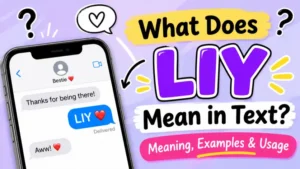
LIU usually means “Look It Up” in text messages. People use this abbreviation when they want someone to search for information independently rather than asking another person to explain everything.
You may encounter LIU in text messages, social media comments, group chats, and online discussions. It is an informal expression that can make conversations shorter and quicker.
Although LIU may look confusing when you see it for the first time, its basic meaning is simple. It suggests that an answer or explanation can be found by searching online or checking another source.
However, not everyone uses or recognizes this abbreviation. Its meaning can also depend on the conversation, so understanding the surrounding message is important before deciding what someone means.
What Does LIU Mean in Text?
LIU stands for “Look It Up.” It is an informal texting abbreviation that people may use when they want someone to find information by searching for it independently.
The phrase is commonly associated with searching for answers through Google, online dictionaries, websites, books, or other information sources.
For example, imagine that you are chatting with a friend and ask what a particular English word means. Your friend might respond:
“LIU. You’ll find the meaning in seconds.”
This response means that your friend thinks the information is easy to find and suggests that you search for it yourself.
LIU can be used in different situations, including casual conversations, educational discussions, online questions, and social media comments.
The Simple Meaning of LIU
The easiest way to understand LIU is to think of it as a shorter way of saying “Look It Up.”
People use this expression when they believe someone can find an answer without needing another person to explain it.
For instance, if someone asks about the capital of a country, a friend might respond with LIU because the answer is available through a quick search.
The abbreviation can communicate several simple ideas:
- Search for the answer yourself.
- Check the information online.
- Find the meaning in a dictionary.
- Look for details on an official website.
- Research the topic before asking someone.
- Check an available source for more information.
The exact message depends on the situation. Sometimes it is friendly advice, while other times it may sound like a direct instruction.
What Does LIU Stand For?
LIU uses the first letters of three words:
| Letter | Word |
| L | Look |
| I | It |
| U | Up |
Together, these letters form LIU, which represents “Look It Up.”
Unlike expressions that communicate emotions or reactions, LIU is mainly connected with finding information.
For example:
A: What does this abbreviation mean?
B: LIU in an online dictionary.
The second person is recommending that the first person search for the abbreviation rather than wait for an explanation.
What Does LIU Mean When a Girl or Boy Texts You?
If a girl or boy sends you LIU, it generally has the same meaning: “Look It Up.”
The abbreviation does not have a special romantic meaning simply because someone uses it in a message.
However, the person’s tone and relationship with you can change how the message feels.
For example:
A: What does this word mean? I’ve never seen it before.
B: LIU 😂
In this conversation, the sender may be joking or suggesting that the answer is easy to find.
Another example:
A: Can you explain this question to me?
B: LIU first, then ask me if you’re still confused.
Here, the person wants the other individual to try searching before requesting additional help.
It is important not to assume that LIU indicates flirting, attraction, anger, or disrespect. The surrounding conversation provides more useful clues.
Is LIU a Positive or Negative Expression?
LIU is neither automatically positive nor negative. It is a neutral expression that can communicate different attitudes depending on how someone uses it.
A friendly message might include an emoji or a helpful suggestion.
For example:
“LIU on Google 😂 It’s easy to find!”
This sounds casual and playful.
On the other hand, a message such as “Stop asking me and LIU” may sound impatient because the sender does not want to answer the question.
The difference is not in the three letters themselves. It comes from the words surrounding them and the relationship between the people communicating.
Is LIU a Slang Word, Acronym, or Abbreviation?
LIU is best classified as an initialism and texting abbreviation. It is sometimes grouped with internet slang because people use it in informal digital conversations.
These terms have slightly different meanings.
Slang: Slang includes informal expressions used in everyday communication. Examples include cool, awesome, and lit.
Acronym: An acronym is formed from the first letters of several words and pronounced as a complete word.
Initialism: An initialism is also formed from the first letters of words, but people pronounce each letter separately.
Abbreviation: An abbreviation is a shortened form of a word or phrase.
LIU is an initialism because its letters represent the words “Look It Up.”
It can also be described as a texting abbreviation because it shortens a common expression for digital communication.
Why Do People Use LIU Instead of Writing the Complete Phrase?
People often use abbreviations because they want to communicate quickly without typing a complete sentence.
Digital conversations frequently involve short questions and direct replies. Writing three letters instead of three separate words can make a message shorter.
There are several reasons someone might choose LIU:
1. Faster communication
Typing LIU is quicker than writing “Look It Up.” This can be convenient when people are having a quick conversation.
2. Casual messaging
Friends sometimes prefer informal expressions instead of complete sentences. Short abbreviations can make their conversations feel relaxed.
3. Direct suggestions
LIU communicates a simple suggestion without requiring a lengthy explanation.
4. Online communication habits
People who regularly participate in online discussions may become familiar with different abbreviations and shortened expressions.
5. Playful conversations
Some people use short expressions to tease friends who repeatedly ask questions that can be answered through a simple search.
However, shorter messages are not always better. If someone does not understand LIU, writing the complete phrase can prevent confusion.
Is LIU Common in Everyday Texting?
LIU is relatively uncommon compared with widely recognized expressions such as LOL, IDK, BRB, and OMG.
Many people understand the phrase “Look It Up” but may not immediately recognize its three,letter form.
For example, someone who regularly uses internet abbreviations might understand LIU without asking for an explanation. Another person might think it is a typo, a username, or an unfamiliar abbreviation.
This difference is normal because not every internet expression becomes popular among all age groups and online communities.
LIU is more likely to make sense when the conversation involves a question, an explanation, or a request for information.
Examples of LIU in Everyday Conversations
Understanding an abbreviation becomes easier when you see it used naturally.
Here are a few additional examples:
Example 1:
A: What does this word mean?
B: LIU in a dictionary.
The sender recommends checking a dictionary for the definition.
Example 2:
A: Do you know when the movie comes out?
B: LIU online. The date should be available.
The sender suggests searching for the movie’s release date.
Example 3:
A: How do I fix this phone problem?
B: LIU on the manufacturer’s website.
The sender recommends checking the official website for instructions.
These examples show that LIU is mainly used to encourage independent searching rather than communicate a particular emotion.
Where Do People Use LIU?
LIU can appear in different forms of digital communication, including private messages, social media comments, and online group discussions.
It is not restricted to a particular application. However, its meaning may not be immediately clear to everyone because it is less familiar than many common texting abbreviations.
LIU on TikTok
TikTok is widely used for short videos, entertainment, educational content, and online discussions. People often ask questions in video comments when they want to understand something they have watched.
LIU may be used as a response when someone asks a question that can easily be answered through an online search.
For example:
User A: What does this English expression mean?
User B: LIU. You’ll find the definition online.
The second user is suggesting that the first person search for the expression.
Another possible conversation could be:
User A: Where can I find information about this historical event?
User B: LIU on Google first.
Here, the reply encourages independent research.
However, LIU is not an official TikTok abbreviation, and its use is not widespread enough to assume that every user will understand it.
LIU on Snapchat
Snapchat conversations are usually informal and often involve quick messages between friends.
People may use LIU when someone asks for information that is easy to find online.
For example:
Friend A: What’s the name of that actor?
Friend B: LIU 😂
The response suggests searching for the actor’s name.
The expression may also appear in conversations where friends joke about someone asking too many simple questions.
For example:
Friend A: What’s the weather like tomorrow?
Friend B: LIU, I’m not a weather reporter!
This is a playful example of how someone might use the expression in casual messaging.
LIU on Instagram
Instagram allows users to communicate through comments, stories, and direct messages.
LIU may appear when someone wants another person to search for information instead of expecting an immediate answer.
For example:
Person A: What’s the name of this song?
Person B: LIU in the comments. Someone already mentioned it.
The second person is directing the user toward information that may already be available.
It can also appear in discussions about celebrities, products, movies, and other subjects.
However, the abbreviation does not have a separate Instagram,specific meaning. Its interpretation depends on the context.
LIU in Online Group Chats
Group chats are another setting where people may use short expressions.
When several people are discussing a topic, one member might ask a question that another member believes can be answered through a quick search.
For example:
Member A: Does anyone know what this technical word means?
Member B: LIU first. There are plenty of explanations online.
This response suggests searching for the answer before asking the group.
The expression can save time, but it is not always the most helpful response. If someone is genuinely confused, explaining the information directly may be more useful.
Where Else Do People Use LIU?
LIU is not limited to TikTok, Snapchat, or Instagram. People can also use this abbreviation in private messaging applications, regular text messages, and online communities.
Its basic meaning generally remains the same: “Look It Up.” However, the way someone uses it can depend on the conversation and their relationship with the other person.
LIU on WhatsApp
WhatsApp is commonly used for personal conversations, family groups, school discussions, and communication with friends.
People sometimes use short expressions to make their messages quicker. LIU may appear when someone asks a question that can easily be answered by searching online.
For example:
Friend A: Do you know the meaning of this English word?
Friend B: LIU on Google. You’ll find it there.
Friend A: Okay, I’ll check.
In this conversation, the second friend is suggesting that the first person search for the definition independently.
LIU might also appear in a WhatsApp group when someone repeatedly asks questions about general information.
For example:
Member A: When is the next public holiday?
Member B: LIU on the official government website.
Member A: Thanks, I’ll check.
The sender is directing the other person toward a source where the information may be available.
LIU in SMS and Regular Text Messages
LIU can also be used in ordinary SMS conversations. It does not require an internet,based messaging application to communicate its meaning.
For example:
A: Do you know the price of this phone?
B: Not sure. LIU on the company’s website.
A: Okay, I’ll search for it.
Here, the sender is recommending that the other person check the company’s website for current pricing information.
However, not everyone understands less common abbreviations. If you are texting someone who prefers complete sentences, writing “Look It Up” may be clearer.
LIU in Discord Chats
Discord is used by gaming communities, study groups, hobby communities, and online discussion servers.
People often ask questions about games, software, technical terms, and different topics.
LIU may appear when someone suggests searching for information before asking other members.
For example:
Member A: How do I change my character’s settings?
Member B: LIU in the game guide.
Member A: Found it. Thanks!
The abbreviation works as a short suggestion to check an available resource.
However, it is not a special Discord command or official Discord feature.
LIU in Gaming Conversations
Gaming communities often use abbreviations to communicate quickly during gameplay.
Players may discuss game rules, character abilities, missions, maps, and equipment.
For example:
Player A: How do I unlock this achievement?
Player B: LIU in the game’s guide.
Player A: Okay, I’ll check.
In this situation, LIU suggests finding the answer independently.
It is worth remembering that gamers use many abbreviations that have different meanings depending on the game and community. Therefore, the surrounding conversation is important.
LIU in Online Forums and Discussion Groups
Online forums allow people to ask questions and share information about different subjects.
LIU may appear when a member asks something that other users believe has already been explained.
For example:
Member A: Can someone explain what this computer error means?
Member B: LIU first. There are several guides available.
Member A: I’ll search for them.
This type of response encourages independent research.
Still, a helpful community should allow people to ask questions when they genuinely need guidance. Not every question has an obvious answer.
10 Real Chat Examples of LIU
The following conversations show how LIU might appear in everyday digital communication. They cover questions about education, entertainment, technology, social media, and general knowledge.
These examples are illustrative and demonstrate the meaning “Look It Up.”
Example 1: Asking About a Word
A: What does this English word mean?
B: LIU in an online dictionary.
A: Okay, I’ll check.
Meaning: The second person suggests searching for the word’s definition rather than explaining it directly.
Example 2: Talking About Homework
A: Do you know the answer to question five?
B: LIU in your textbook first.
A: I couldn’t find it there.
B: Then I’ll help you understand it.
Meaning: The sender suggests checking the textbook before asking for additional help.
Example 3: Discussing a Movie
A: When was this movie released?
B: LIU, bro. The information is online.
A: Fine, I’ll search.
Meaning: The friend thinks the release date is easy to find through an online search.
Example 4: A Funny Conversation
A: Who invented the telephone?
B: LIU 😂 I’m not a history teacher.
A: I was just asking!
B: Haha, search it!
Meaning: The sender uses LIU jokingly to suggest finding the answer online.
Example 5: Asking About a Song
A: What’s the name of that song you posted?
B: LIU in the comments. Someone already mentioned it.
A: Oh, I found it.
Meaning: The sender recommends checking the comments to find the song’s name.
Example 6: Talking in a Group Chat
A: Does anyone know what this abbreviation means?
B: LIU first, then tell us what you find.
A: Let me search.
C: Share the answer with everyone!
Meaning: The group member suggests researching the abbreviation before asking others.
Example 7: Asking About a Celebrity
A: How old is that actor?
B: LIU. His birthday information is available online.
A: Okay, thanks!
Meaning: The sender recommends searching for the actor’s age.
Example 8: Friendly Teasing
A: Can you tell me where this restaurant is?
B: Bro, LIU 😂 It’s literally on the map.
A: I wanted your recommendation!
B: Oh, then try the one near the city center.
Meaning: The sender initially jokes about searching for the restaurant but then offers a recommendation.
Example 9: A Direct Reply
A: What does this technical term mean?
B: LIU on Google.
A: There are too many results. Which one should I read?
B: Check a reliable educational website.
Meaning: The person suggests searching online and using a trustworthy source.
Example 10: Finding School Information
A: I need to know when the next exam starts.
B: LIU on your school’s official website. The schedule should be there.
A: Found it. The exam starts Monday.
Meaning: The sender recommends checking the school’s official website for accurate information.
How to Reply When Someone Says LIU?
If someone sends you LIU, you can respond in different ways depending on the situation.
You do not need to write a long message. A short response is usually enough when someone simply suggests searching online.
However, if you want to continue the conversation, you can respond with a joke, ask for clarification, or request additional help.
Funny Replies to LIU
If a close friend sends you LIU, you can reply with something humorous.
Here are some playful responses:
- “I thought you were Google! 😂”
- “My search engine is on vacation.”
- “Why search when I have you?”
- “Okay, Professor Internet!”
- “Google should pay me for this research.”
- “I wanted your expert opinion!”
- “Even Google needs a break!”
- “I asked you, not the internet!”
Example conversation:
A: LIU.
B: I thought you were my personal Google! 😂
This type of response is suitable for relaxed conversations between friends.
Casual Replies to LIU
Sometimes, you simply want to acknowledge the suggestion and move on.
You can use these natural replies:
- “Okay, I’ll check.”
- “Sure, searching now.”
- “Alright, thanks.”
- “Let me look it up.”
- “Got it!”
- “I’ll find out.”
- “Okay, no problem.”
- “Thanks for the suggestion.”
Example conversation:
A: LIU on Google.
B: Sure, I’ll check it out.
These replies are simple and do not create unnecessary discussion.
Friendly Replies to LIU

If you want someone to explain something instead of asking you to search independently, you can respond politely.
Try these messages:
- “Can you explain it briefly?”
- “I wanted to hear your explanation.”
- “I’ll search, but tell me what you think.”
- “Could you give me a small hint?”
- “I tried searching, but I’m still confused.”
- “Can you share a useful source?”
- “I’d appreciate your help.”
- “Can we discuss it for a minute?”
Example conversation:
A: LIU first.
B: I tried, but I couldn’t understand the explanation. Can you help?
This response makes your request clear without sounding argumentative.
Neutral Replies to LIU
If you do not want to continue the conversation, neutral replies are useful.
Examples include:
- “Okay.”
- “Understood.”
- “I’ll check.”
- “Thanks for letting me know.”
- “I’ll search for it.”
- “Noted.”
- “Alright.”
- “I’ll look into it.”
These responses are suitable for casual conversations where you simply want to acknowledge the message.
What If You Don’t Understand LIU?
If you receive LIU and do not know what it means, there is nothing wrong with asking the sender.
You can write:
- “What does LIU mean?”
- “Are you saying I should search for it?”
- “Do you mean Look It Up?”
- “Can you explain that abbreviation?”
For example:
A: LIU.
B: What does LIU stand for?
A: Look It Up.
B: Oh, got it!
Asking for clarification is often better than guessing the meaning and misunderstanding the conversation.
When Should You Use LIU in a Conversation?
Although LIU can make messages shorter, it is not appropriate for every situation.
Knowing when to use it can help you communicate naturally without making someone feel ignored.
Use LIU when:
- You are chatting casually with friends.
- Someone asks for information that is easy to find.
- You are joking with someone you know well.
- You are participating in an informal online discussion.
- You want to suggest checking an available source.
Avoid using LIU when:
- Someone genuinely needs your help.
- You are discussing a sensitive subject.
- You are communicating with a teacher or manager.
- The other person is confused and needs an explanation.
- You are writing a formal email or professional message.
For example, telling a friend to LIU about a movie release date may be perfectly fine. However, responding with only LIU when a classmate needs help understanding a difficult lesson may seem unhelpful.
The best approach is to consider what the other person needs before choosing your response.
Is LIU Rude or Offensive?
LIU is not generally considered a rude or offensive expression. Its basic meaning, “Look It Up,” is neutral and simply suggests that someone should search for information independently.
However, the way a person uses LIU can affect how the message sounds. A friendly suggestion may feel helpful, while a short or impatient response may make someone feel ignored.
Understanding the situation is important before deciding if the sender is being rude.
When Is LIU Not Rude?
LIU is usually harmless when people use it in relaxed conversations or friendly discussions.
For example:
A: What does this word mean?
B: LIU 😂 It’s easy to find.
In this situation, the second person may simply be joking or suggesting that the answer is available online.
It can also be helpful when someone needs to find information from a reliable source rather than depend on another person’s memory.
When Can LIU Sound Rude?
Although the abbreviation itself is neutral, it can sound dismissive in certain situations.
For example:
A: I’m having trouble understanding this topic. Can you help me?
B: LIU.
The response may feel unfriendly because the first person is asking for genuine assistance.
LIU might sound rude when:
- Someone uses it to avoid helping another person.
- The sender responds impatiently to a genuine question.
- Someone uses it sarcastically during an argument.
- The other person has already tried searching but cannot understand the information.
- The conversation involves an important or sensitive subject.
A little explanation can make the message more respectful.
Is LIU Safe for Kids and Teenagers?
Yes. When used to mean “Look It Up,” LIU does not contain profanity or an inherently harmful expression.
Children and teenagers may encounter it in group chats, online discussions, and social media comments.
Parents and teachers can explain that it is simply an informal abbreviation and that its tone depends on the situation.
It is also useful to teach young internet users to check reliable sources rather than trusting every result they find online.
Can You Use LIU at School?
LIU is generally acceptable in casual conversations with classmates.
For example:
Student A: What’s the meaning of this word?
Student B: LIU in your English dictionary.
This is an informal suggestion between students.
However, when communicating with teachers, it is better to use complete and respectful sentences.
Instead of writing:
“LIU.”
You could write:
“You can find the definition in an English dictionary.”
This makes the suggestion clearer and more polite.
Is LIU Appropriate at Work?
LIU is not usually the best choice for professional communication.
A colleague might interpret a short response as a lack of interest in helping them.
For example, if someone asks about a work procedure, responding only with LIU may sound dismissive.
Better alternatives include:
- “Please check the official documentation.”
- “You can find the details in the company guide.”
- “I recommend reviewing the instructions.”
- “The information is available on the official website.”
These responses communicate the same general suggestion in a more professional way.
Who Uses LIU?
LIU may be used by people who are familiar with online abbreviations and informal digital communication.
However, it is not a universally popular texting expression. Many internet users recognize the full phrase “Look It Up” without regularly using its shortened form.
Its use can vary depending on people’s communication habits, online communities, and familiarity with texting shorthand.
Do Teenagers Use LIU?
Teenagers may encounter LIU in social media comments, private messages, and group conversations.
Many young internet users are familiar with shortened expressions because they regularly communicate through messaging applications and online platforms.
However, LIU is not one of the most recognizable Gen Z abbreviations.
Expressions such as LOL, IDK, OMG, and BRB are generally more familiar to everyday internet users.
Do Gen Z Users Understand LIU?
Gen Z users may understand LIU when they encounter it in a conversation about searching for information.
However, understanding an abbreviation does not necessarily mean someone uses it regularly.
Some people prefer writing “Google it,” “search online,” or “look it up” because these expressions are clearer.
The popularity of individual abbreviations also changes over time, so an expression that appears in one online community may remain unfamiliar elsewhere.
Do Millennials Use LIU?
Millennials may recognize LIU through their experience with online messaging, internet forums, and texting abbreviations.
Some may use it when communicating casually with friends or colleagues they know well.
Others may prefer complete phrases because they are easier to understand.
There is no fixed age group that owns or exclusively uses this expression.
Which Platforms Are Associated With LIU?
LIU can potentially appear across several digital platforms.
| Platform | Possible use |
| TikTok | Responding to questions in comments |
| Snapchat | Suggesting an online search to a friend |
| Using it in direct messages or discussions | |
| Sending short replies in private or group chats | |
| Discord | Suggesting that someone check a guide or resource |
| SMS | Shortening an ordinary text message |
| Online forums | Encouraging independent research |
These are possible usage settings, not a ranking of platforms where LIU is most popular.
How Often Does LIU Appear Online?
LIU is relatively uncommon compared with familiar expressions such as IDK, LOL, BRB, and OMG.
People often write the complete phrase instead of using the abbreviation.
For example, someone might say:
“Look it up on Google.”
Rather than:
“LIU on Google.”
This is one reason you may not encounter LIU very often in everyday conversations.
Its meaning is still understandable when the surrounding discussion makes it clear that someone is talking about finding information.
Origin of LIU
The exact historical origin of LIU as a texting abbreviation is not clearly established.
However, its formation is straightforward. It takes the first letters of the phrase “Look It Up” and turns them into a shorter expression.
The abbreviation fits into the wider development of internet language, where people began shortening common expressions to make digital conversations quicker.
How Did LIU Develop?
As text messaging and internet communication became more common, people started using shortened expressions to save time.
Early SMS messages encouraged concise communication because some mobile services had character limits.
Internet chatrooms and instant messaging services also helped popularize abbreviations.
Examples include:
- IDK – I Don’t Know.
- BRB – Be Right Back.
- IMO – In My Opinion.
- IDC – I Don’t Care.
- LOL – Laughing Out Loud.
- LIU – Look It Up.
These expressions demonstrate how people use initial letters to communicate familiar phrases in fewer characters.
LIU follows a similar pattern.
How Has Internet Culture Influenced LIU?
Internet culture encourages people to share information quickly.
Online discussions often involve questions about unfamiliar words, popular topics, technology, entertainment, and general knowledge.
Instead of explaining every detail, someone may suggest that another person search for the answer.
The phrase “Look It Up” communicates this idea directly.
LIU provides a shorter way to express that suggestion, especially in informal conversations.
However, it is not possible to identify a particular social media platform as the confirmed birthplace of the abbreviation.
Is the Origin of LIU Confirmed?
No reliable historical record establishes the exact person, date, or online community that first introduced LIU as a texting abbreviation.
Its meaning is formed from ordinary English words, but the precise history of its digital use remains uncertain.
It is more accurate to describe LIU as an informal initialism associated with online communication rather than claim that it originated on TikTok, Snapchat, or another specific platform.
LIU vs. IDK, IDC, IMO, and BRB
LIU belongs to the broader category of internet and texting abbreviations.
However, it has a different purpose from expressions such as IDK, IDC, IMO, and BRB.
Some abbreviations communicate feelings, others express opinions, and some suggest an action.
The following comparison makes their meanings easier to understand.
| Abbreviation | Meaning | Type | Usage | Popularity |
| LIU | Look It Up | Initialism | Suggesting someone search for information | Relatively uncommon |
| IDK | I Don’t Know | Initialism | Expressing uncertainty | Very common |
| IDC | I Don’t Care | Initialism | Expressing a lack of interest | Very common |
| IMO | In My Opinion | Initialism | Sharing a personal viewpoint | Common |
| BRB | Be Right Back | Initialism | Informing someone of a temporary absence | Very common |
LIU vs. IDK
LIU and IDK have completely different meanings.
LIU means “Look It Up,” while IDK means “I Don’t Know.”
For example:
A: What’s the capital of Australia?
B: IDK. You can LIU.
The first abbreviation communicates that the person does not know the answer. The second suggests searching for it.
LIU vs. IDC
IDC stands for “I Don’t Care.”
People use it when they want to express that something does not matter to them or that they have no particular preference.
For example:
A: Should we watch a comedy or an action movie?
B: IDC. Choose whatever you like.
LIU does not express indifference. It suggests finding information independently.
LIU vs. IMO
IMO means “In My Opinion.”
It is used when someone wants to share a personal viewpoint.
For example:
A: Which movie do you think is better?
B: IMO, the first one is much better.
LIU has a different purpose because it encourages someone to search for information rather than share an opinion.
LIU vs. BRB
BRB stands for “Be Right Back.”
It is commonly used when someone temporarily leaves a conversation but plans to return.
For example:
A: Are you still there?
B: BRB, getting some water.
LIU is about finding information, whereas BRB communicates a temporary absence.
Real,World Usage Example of LIU
Imagine two classmates are preparing a school assignment together.
One student needs information about a historical event but does not know where to find the answer.
Instead of checking the textbook or searching online, they ask their classmate.
Their conversation might look like this:
Student A: Do you know when the first moon landing happened?
Student B: LIU. You can find the date online.
Student A: Okay, I’ll check.
Student B: Make sure you use a reliable source.
In this situation, LIU simply encourages independent research.
The second student is not necessarily being rude. They believe the information is easy to find and want their classmate to check it.
Now consider a different situation.
A student asks for help understanding a difficult mathematics problem, and their classmate responds only with “LIU.”
This response may feel unhelpful because the student needs an explanation rather than a simple search suggestion.
These situations demonstrate why context matters when interpreting texting abbreviations.
LIU can be useful in casual communication, but helping someone directly is sometimes a better choice.
Frequently Asked Questions
1. What does LIU mean in text messages?
LIU usually means “Look It Up.” People use it when suggesting that someone search for information independently.
2. What does LIU mean on TikTok?
On TikTok, LIU can mean “Look It Up” when someone uses it in response to a question or comment. Its meaning depends on the conversation.
3. Is LIU slang?
LIU is an informal texting abbreviation and initialism. It is sometimes considered internet slang because people use it in casual online communication.
4. Is LIU rude or offensive?
No, LIU is not inherently offensive. However, it can sound dismissive when someone uses it instead of helping a person who genuinely needs assistance.
5. How should you reply to LIU?
You can respond with “Okay, I’ll check,” “Thanks,” or “Got it.” For a funny reply, try “I thought you were Google!”
6. What does LIU mean on Snapchat?
On Snapchat, LIU usually means “Look It Up.” Someone may use it when suggesting that a friend search online for an answer instead of asking others.
7. What does LIU mean on WhatsApp?
On WhatsApp, LIU can mean “Look It Up.” People may use it in private messages or group chats to suggest finding information independently.
8. Is LIU commonly used by Gen Z?
LIU may be understood by some Gen Z users, but it is not among the most popular texting abbreviations. Expressions such as LOL, IDK, and BRB are more widely recognized.
9. Does LIU have a different meaning on social media?
LIU generally means “Look It Up” in this texting context. However, it may represent a name, username, or another expression in a particular online community. Always consider the surrounding conversation.
10. Can I use LIU in professional messages?
It is better to avoid LIU in formal communication because it may sound too casual or dismissive. Instead, write “Please check the official website” or “You can find the information in the documentation.”
Conclusion
LIU usually stands for “Look It Up” in text messages and online conversations. People use it when they want someone to search for information independently rather than ask another person for an answer.
You may encounter this abbreviation in social media comments, WhatsApp messages, Snapchat conversations, and online communities. However, it is less common than popular expressions such as IDK, LOL, and BRB.
LIU is generally harmless, but its tone can sometimes sound dismissive. It is suitable for casual conversations with friends, while complete and polite sentences are better for school and professional communication.
Understanding the meaning and context of LIU will help you recognize it and respond naturally when someone uses it.
Read More About !

Michael Brooks is a language writer at SlangPath with 7+ years of experience creating simple, practical content on English slang and everyday expressions.