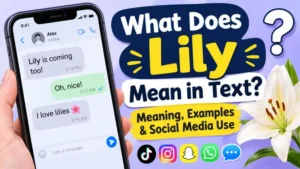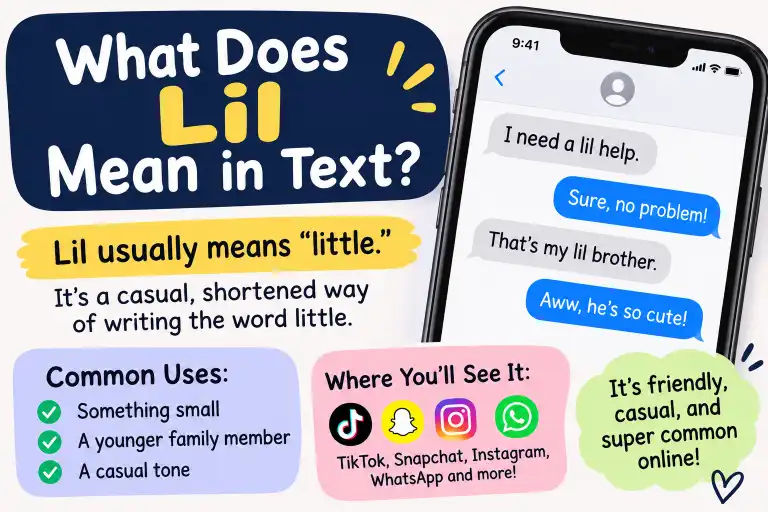
Lil in text usually means “little.” It is an informal, shortened spelling that people use in messages and online conversations to describe something small, young, cute, or familiar. You may see it on TikTok, Snapchat, Instagram, WhatsApp, and in everyday texting.
The word is popular in casual conversations because it sounds relaxed and friendly. Instead of typing the complete word “little,” someone may write “lil” to keep a message short or give it a playful tone.
For example, someone might text, “I have a lil question” instead of “I have a little question.” Both sentences have the same basic meaning, but the shorter version feels more casual.
If you have seen this word in a message or social media comment and wondered what the sender meant, this guide explains its meaning, common uses, examples, and appropriate replies.
What Does Lil Mean in Text?
In texting, lil is an informal shortened spelling of the word “little.” It is not usually an acronym because each letter does not represent a separate word.
People use it in everyday conversations when they want their messages to sound more natural, relaxed, or playful.
The meaning can change slightly depending on the sentence. It may describe something small, refer to a young person, or make a statement sound softer.
For example:
- “I need a lil help.” means I need a little help.
- “Wait a lil longer.” means wait a little longer.
- “That’s my lil brother.” means that’s my younger brother.
- “I have a lil surprise for you.” means I have a small surprise for you.
In each example, the word replaces “little” without changing the main message.
Is Lil Slang or an Abbreviation?
Lil is considered informal slang or a shortened spelling of “little.” It is commonly used in casual writing, particularly in texting, social media posts, music, and online conversations.
Unlike abbreviations such as IDK (I don’t know) or BRB (be right back), lil does not represent a complete phrase. It is simply a shorter way of writing an existing word.
You might notice that people use it more often when chatting with friends than when writing formal messages.
Different Meanings of Lil Depending on Context
Although the basic meaning is “little,” it can communicate slightly different ideas.
1. Something small
Someone might use it to describe a small object, amount, or action.
Example: “Can you give me a lil piece?”
2. A younger family member
It can refer to a younger sibling or someone younger in a family.
Example: “My lil sister is starting school tomorrow.”
3. Something cute or sweet
In affectionate conversations, it can make a sentence sound warmer.
Example: “Look at that lil puppy!”
4. A small amount of something
People sometimes use it when talking about time, effort, money, or quantity.
Example: “I just need a lil more time.”
5. A casual way to soften a statement
It can make a request sound less direct or demanding.
Example: “I have a lil favor to ask.”
The surrounding words help you understand which meaning the sender intends.
Where Do People Use Lil?
This shortened word appears across many digital platforms. Since it is easy to understand and quick to type, people use it in personal messages, captions, comments, and online discussions.
Here is how it commonly appears on different platforms.
Lil on TikTok
On TikTok, people use lil in video captions, comments, usernames, and conversations.
It often appears when someone wants to describe something cute, funny, small, or relatable.
For example:
- “This lil dog made my day.”
- “Just a lil reminder to stay positive.”
- “I need a lil break from everything.”
- “That lil dance was actually amazing.”
TikTok users also encounter the word in music,related content and creator names.
In these situations, it generally has the same meaning as “little.” However, the tone may be playful, affectionate, or humorous.
Lil on Snapchat
On Snapchat, lil is commonly used in quick chats and personal messages.
People may use it when talking about their plans, sharing pictures, or sending casual updates.
Examples include:
- “Send me a lil snap.”
- “I have a lil surprise for you.”
- “Wait a lil bit.”
- “Just taking a lil break.”
It can also make a message sound more relaxed instead of overly serious.
For example, “I need a little time” sounds straightforward, while “I need a lil time” feels more conversational.
Lil on Instagram
Instagram users often write lil in captions, comments, stories, and direct messages.
It works especially well in casual posts where people want their wording to feel friendly and natural.
Some examples are:
- “A lil happiness from today.”
- “Just a lil photo dump.”
- “My lil sunshine.”
- “A lil moment worth remembering.”
The word can also appear in comments when someone reacts to a picture or video.
For example, a comment saying “Look at this lil cutie” is usually expressing affection or appreciation.
Lil on WhatsApp
On WhatsApp, people use lil in everyday conversations with friends, relatives, and other contacts.
It is especially common in informal messages where complete sentences are not always necessary.
Examples:
- “I’ll be there in a lil while.”
- “Can you wait a lil?”
- “I need a lil advice.”
- “Let’s talk in a lil bit.”
The meaning is normally easy to understand from the rest of the conversation.
However, if someone uses it while discussing something important, pay attention to the complete sentence rather than assuming it is only playful.
Lil in SMS Text Messages
Traditional SMS conversations also use lil because shorter spellings have been part of informal texting for years.
Before modern social media became popular, people often shortened words to save typing time and make messages quicker.
For example:
Person A: Are you coming today?
Person B: Yeah, just give me a lil time.
Here, lil simply means little. The sender is asking for a short amount of additional time.
It does not carry a hidden meaning or indicate a special texting code.
10 Real Chat Examples of Lil in Text
The easiest way to understand this word is to see how people use it in actual conversations.
Below are ten realistic examples covering different situations.
Example 1: Asking for Help
A: Can you help me with something?
B: Sure, what do you need?
A: Just a lil help with my homework.
Meaning: The sender needs a little assistance with homework.
Example 2: Talking About Time
A: Are you ready to leave?
B: Almost!
A: Okay, I’ll wait a lil longer.
Meaning: The sender is willing to wait for a little more time.
Example 3: Showing Affection
A: Look at this picture of my puppy.
B: Aww, what a lil cutie!
Meaning: The person is describing the puppy in an affectionate way.
Example 4: Making a Request
A: Hey, can I ask you something?
B: Of course.
A: I need a lil favor.
Meaning: The sender wants to ask for a small favor.
Example 5: Talking About a Younger Sibling
A: Who is that in your photo?
B: That’s my lil brother.
A: He’s so cute!
Meaning: Lil refers to the sender’s younger brother.
Example 6: Making Plans
A: Want to go shopping this evening?
B: Sure, I just need a lil break first.
A: No problem!
Meaning: The sender wants a short rest before going shopping.
Example 7: Sharing Excitement
A: Guess what happened today!
B: What happened?
A: I got a lil surprise from my parents.
Meaning: The sender received a small or special surprise.
Example 8: Casual Conversation
A: How was your day?
B: Pretty good, just had a lil busy morning.
A: Glad everything went well.
Meaning: The sender had a somewhat busy morning.
Example 9: Asking for More Information
A: Did you understand the instructions?
B: Mostly, but I need a lil clarification.
A: I’ll explain it again.
Meaning: The sender needs a little more explanation.
Example 10: Friendly Message
A: You seem quiet today.
B: Just having a lil tired day.
A: Hope you feel better soon!
Meaning: The sender is feeling slightly tired.
How to Reply When Someone Says “Lil”?
When someone uses lil in a message, you usually do not need a special response. The word simply means “little,” so your reply should depend on the complete message and the situation.
For example, if someone says, “I need a lil help,” you can offer assistance. If they say, “Look at this lil puppy,” you can respond with something cute or funny.
Here are some natural replies you can use in different conversations.
Funny Replies to Lil
If the conversation is playful, a little humor can make your response more entertaining.
- “How little are we talking?”
- “A lil or a whole lot?”
- “That’s the smallest request I’ve ever heard!”
- “Only a lil? I expected more!”
- “Small word, big expectations!”
- “Okay, but make it extra little!”
- “A lil something always turns into a big thing.”
Example:
A: I need a lil favor.
B: How lil are we talking?
A: Just something simple.
B: Alright, now I’m listening!
Casual Replies to Lil
Casual responses are useful when you are talking to friends, classmates, or people you know well.
- “Sure, no problem.”
- “Okay, take your time.”
- “Yeah, that’s fine.”
- “Got you!”
- “Of course.”
- “Sounds good.”
- “Alright, whenever you’re ready.”
Example:
A: Give me a lil time.
B: Sure, take your time.
A: Thanks!
B: No worries.
Friendly Replies to Lil
When someone uses the word in a sweet or affectionate message, you can respond warmly.
- “Aww, that’s cute!”
- “Of course, happy to help.”
- “You’re always welcome.”
- “That’s so sweet.”
- “Anything for you!”
- “Hope it makes you smile.”
- “Sending you a little happiness too!”
Example:
A: Look at this lil puppy!
B: Aww, it’s adorable!
A: I know, I can’t stop looking at it.
B: Such a cutie!
Neutral Replies to Lil
Sometimes you may not want to sound funny or overly friendly. Simple responses work perfectly well.
- “Okay.”
- “Understood.”
- “That’s fine.”
- “No problem.”
- “Sure.”
- “I see.”
- “Alright, thanks.”
Example:
A: I need a lil more information.
B: Sure, what would you like to know?
A: Just the details about tomorrow.
B: I’ll send them shortly.
How to Choose the Right Reply
The best response depends on what the other person is trying to communicate.
| Situation | Suitable Reply |
| Asking for help | “Sure, what do you need?” |
| Asking for time | “Take your time.” |
| Sharing something cute | “Aww, that’s adorable!” |
| Making a joke | “How little is little?” |
| Asking a favor | “Of course, tell me.” |
| Giving an update | “Okay, thanks for letting me know.” |
You do not need to repeat the word lil in your response. A normal conversational reply is enough.
Is Lil Rude or Offensive?
No, lil is generally not considered rude or offensive. It is an informal spelling of “little” and is commonly used in friendly conversations.
Most people understand it as a casual expression rather than an insult. However, the meaning and tone can depend on how someone uses it.
For example, calling a puppy “my lil buddy” sounds affectionate. Calling an adult “a lil kid” during an argument could sound disrespectful or mocking.
The word itself is not offensive, but the surrounding sentence can change how it feels.
Is It Safe to Use in Conversations?
Yes, you can normally use lil in everyday conversations with people you know.
It is suitable for:
- Friendly text messages.
- Casual social media comments.
- Instagram captions.
- Snapchat conversations.
- WhatsApp chats.
- Informal messages with classmates.
For example:
“Just need a lil break before we start.”
This sounds relaxed and natural in an informal conversation.
Is Lil Appropriate at School?
In casual conversations with classmates, using lil is generally fine.
However, when writing school assignments, examination answers, essays, or formal emails to teachers, it is better to use the complete word “little.”
For example:
- Casual: “I need a lil more time.”
- Formal: “I need a little more time.”
Both communicate the same idea, but the second version is more appropriate for academic writing.
Can You Use Lil at Work?
It depends on the workplace and the type of communication.
In an informal team chat, lil might be acceptable if everyone communicates casually. However, in professional emails, reports, business proposals, and official documents, using standard English is usually a better choice.
For instance:
- Informal: “I have a lil question about the meeting.”
- Professional: “I have a quick question about the meeting.”
Using the complete word helps your writing look clearer and more professional.
Who Uses the Term Lil?
Lil is used by different age groups, especially people who regularly communicate through text messages and social media.
It is not limited to one generation, country, or online community. Its simple meaning makes it easy for most English speakers to understand.
Do Gen Z Users Say Lil?
Yes, Gen Z users commonly use lil in casual digital communication.
They may include it in captions, comments, personal messages, and humorous posts.
For example:
- “Just having a lil moment.”
- “Need a lil vacation.”
- “My lil comfort zone.”
- “A lil update from today.”
For younger internet users, it often creates a relaxed and expressive tone.
However, the word existed long before Gen Z became active on social media. It is not a newly invented internet abbreviation.
Do Millennials Use Lil?
Millennials also use lil in everyday conversations, particularly when messaging friends or posting on social platforms.
Some people prefer this spelling because it feels natural and less formal than “little.”
For example:
“Let’s grab a lil coffee after work.”
This is an ordinary informal sentence that most people can understand.
Do Teenagers Use Lil?
Teenagers may use lil when chatting with classmates, commenting on videos, or sharing personal updates.
It can appear in messages about family members, pets, hobbies, and everyday activities.
For example:
“Taking my lil sister shopping today.”
Here, the word simply describes a younger sister.
Where Is Lil Most Commonly Seen?
You can encounter this spelling in several online spaces:
- TikTok comments and captions.
- Snapchat messages.
- Instagram posts and direct messages.
- WhatsApp conversations.
- SMS text messages.
- Online gaming chats.
- Music lyrics and entertainment content.
It is a familiar informal expression, but there is no reliable universal measurement showing exactly how frequently people use it across every platform.
What Is the Origin of Lil?
The spelling lil comes from the spoken and informal shortened form of the English word “little.”
It developed as a casual way of representing how people pronounce the word in everyday speech. Rather than writing every letter, people began using shorter forms in informal communication.
Unlike many modern internet abbreviations, it did not originate from a particular social media platform.
How Did Lil Become Popular?
The word became familiar through everyday speech, music, entertainment, and popular culture.
It has also appeared in hip,hop and rap culture, where shortened spellings and informal expressions are often used in artist names, lyrics, and creative writing.
Over time, the spelling became recognizable to a wider online audience.
As internet communication expanded, people naturally carried familiar spoken expressions into their messages.
Lil in Music and Pop Culture
You may have noticed lil in the names of music artists and other entertainment personalities.
In this context, it can be used as part of a nickname or artistic identity.
It does not always describe someone’s actual age or physical size. Sometimes it is simply a stylistic choice.
This is one reason people may encounter the spelling outside ordinary text conversations.
Is the Exact Origin Known?
The exact first use of lil is difficult to establish because shortened spellings existed in informal speech and writing before modern social media.
However, its connection to “little” is clear.
It is best understood as a long,established informal spelling that became even more visible through music, texting, and internet culture.
Lil vs. IDK vs. IDC vs. IMO vs. BRB
Lil, IDK, IDC, IMO, and BRB are all expressions you may encounter in online conversations.
However, they do not have the same meaning or grammatical function. Some are shortened spellings of regular words, while others represent complete phrases.
Here is a simple comparison.
| Term | Meaning | Type | Usage | Popularity |
| Lil | Little | Informal shortened spelling | Describing something small or making a statement casual | Common |
| IDK | I Don’t Know | Acronym | Expressing uncertainty | Common |
| IDC | I Don’t Care | Acronym | Showing a lack of interest or concern | Common |
| IMO | In My Opinion | Acronym | Sharing a personal opinion | Common |
| BRB | Be Right Back | Acronym | Saying you will return shortly | Common |
Lil vs. IDK
Lil means “little,” while IDK means “I don’t know.”
For example:
- “I need a lil help.” means the sender needs a little assistance.
- “IDK what to do.” means the sender does not know what to do.
The two expressions serve completely different purposes.
Lil vs. IDC
Lil describes something small or adds a casual tone to a sentence. IDC expresses that someone does not care about something.
For example:
- “Give me a lil time.” means the sender needs a little time.
- “IDC about the result.” means the sender does not care about the result.
IDC can sometimes sound dismissive, while lil is generally neutral or affectionate.
Lil vs. IMO
Lil is a shortened spelling of “little,” whereas IMO means “in my opinion.”
Examples:
- “I have a lil suggestion.” means the sender has a small suggestion.
- “IMO, this is the best option.” means the sender is sharing a personal opinion.
Lil vs. BRB
Lil means “little,” while BRB means “be right back.”
For example:
- “Wait a lil longer.” asks someone to wait a little more.
- “BRB, I’ll call you.” tells someone that the sender will return shortly.
Understanding these differences can help you read informal messages without confusing ordinary shortened words with texting acronyms.
Real,World Usage of Lil
Lil is not limited to social media or online conversations. People also use it in everyday situations when speaking casually with family members, friends, classmates, or coworkers.
Imagine someone is getting ready to leave home. Their sibling asks if they are ready, but they need a few more minutes.
The conversation might look like this:
A: Are you ready? We need to leave.
B: Almost! Just give me a lil more time.
A: Okay, I’ll wait downstairs.
In this situation, lil means “little.” The person is simply asking for a short amount of extra time.
Here is another example:
A: What did you buy today?
B: Just a lil gift for my sister.
A: That’s sweet! What’s the occasion?
B: Her birthday is tomorrow.
Here, lil describes a small or modest gift.
These examples show that the word does not have a complicated meaning. It is simply a relaxed way to communicate something in everyday life.
When Should You Use Lil?
You can use this spelling when talking casually and want your message to sound friendly or informal.
It works naturally in sentences such as:
- “I need a lil rest.”
- “Let’s take a lil walk.”
- “Just wanted to share a lil update.”
- “Give me a lil more time.”
- “I have a lil something for you.”
The important thing is to consider your audience. If you are writing a formal email, school assignment, or professional document, use “little” instead.
Frequently Asked Questions
Q1. What Does Lil Mean in Text Messages?
Lil means “little.” It is an informal shortened spelling used in text messages to describe something small, a short amount, or a younger person. For example, “I need a lil help” means “I need a little help.”
Q2. What Does Lil Mean on TikTok?
On TikTok, lil usually means “little.” People use it in captions, comments, usernames, and videos to describe something cute, small, or special. Its meaning generally depends on the surrounding sentence.
Q3. Is Lil Slang?
Yes, lil is an informal slang spelling or shortened form of “little.” It is commonly used in texting, social media, music, and everyday casual conversations.
Q4. Is Lil Rude or Offensive?
No, lil is generally not rude or offensive. It is a harmless informal expression. However, the complete sentence and the speaker’s tone can affect how a message is understood.
Q5. How Should You Reply to Lil?
Your response depends on the conversation. You can say “Sure,” “No problem,” “Take your time,” or “How little?” if the conversation is playful.
Q6. What Does Lil Mean From a Girl?
If a girl uses lil in a message, she usually means “little.” For example, “I need a lil break” means she needs a little rest. It does not automatically indicate romantic interest or flirting.
Q7. What Does Lil Mean From a Guy?
When a guy writes lil, he is generally using an informal version of “little.” He might say “Give me a lil time” or “That’s my lil brother.” The exact meaning depends on the message.
Q8. Is Lil the Same as Little?
Yes, lil usually has the same basic meaning as little. The main difference is spelling and tone. Little is standard English, while lil is more casual and commonly used in informal conversations.
Q9. Can I Use Lil in Professional Messages?
It is better to avoid lil in formal workplace communication, business emails, and official documents. Use the complete word “little” instead. However, it may be acceptable in relaxed conversations with coworkers.
Q10. Why Do People Write Lil Instead of Little?
People use lil because it is shorter, quicker to type, and gives messages a relaxed tone. It can also reflect the way people pronounce “little” in everyday speech.
Conclusion
Lil is a common informal spelling of “little” used in text messages, social media posts, and everyday online conversations. People write it when describing something small, talking about a younger family member, or making a message sound more relaxed and friendly.
You may see it on TikTok, Snapchat, Instagram, WhatsApp, and SMS. Its meaning is usually simple, but the surrounding sentence helps you understand the sender’s exact intention.
You can comfortably use lil when chatting with friends or posting casual content. For school assignments, professional emails, and formal writing, choosing the complete word “little” is a better option.
Understanding this simple expressionhttps://www.merriam-webster.com/dictionary/conversation makes it easier to follow everyday digital conversations without getting confused by informal spellings.
Read More About !

My name is Olivia Bennett.I am a language enthusiast and educational writer with a strong interest in contemporary English and digital communication. I enjoys making language learning engaging and accessible.