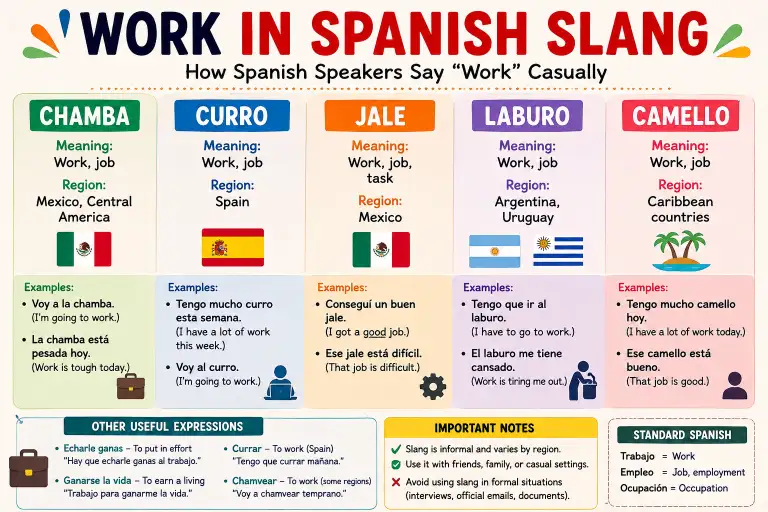
Work in spanish slang is a phrase people search when they want to know how Spanish speakers casually talk about jobs, working, making money, or putting in effort. Unlike formal Spanish words found in textbooks, slang expressions change depending on the country, age group, and social setting.
Spanish-speaking communities use different informal words for “work” in daily conversations, text messages, social media posts, and casual chats. A word that sounds normal in Mexico may not be common in Spain or Argentina. Understanding these differences helps language learners communicate more naturally and avoid awkward translations.
People often look for Spanish slang for work because they want to understand conversations on platforms like TikTok, Instagram, Reddit, gaming chats, or everyday messages.
Quick Answer:work in spanish slang
In Spanish slang, “work” can be expressed with informal words like “chamba” (job/work, common in Mexico and some Latin American countries), “curro” (work, common in Spain), and “jale” (job/work, used in parts of Mexico). The best word depends on the region and context.
What Does Work in Spanish Slang Mean?
When people search for work in spanish slang, they usually want casual ways to say “work,” “job,” or “working hard” in Spanish conversations.
The standard Spanish word for work is “trabajo”, but native speakers often use slang alternatives in relaxed situations.
Examples:
- “Tengo mucho trabajo.”
= “I have a lot of work.” - “Tengo mucha chamba.”
= “I have a lot of work.” (casual Mexican Spanish) - “Tengo mucho curro.”
= “I have a lot of work.” (casual Spain Spanish)
Slang words make conversations sound more natural among friends, coworkers, and online communities.
However, slang is not always universal. Spanish is spoken across many countries, and each region has developed its own expressions.
Work in Spanish Slang Full Form / Definition
There is no single “full form” for work in spanish slang because slang words are not abbreviations. They are informal vocabulary choices used instead of the formal word trabajo.
Some common slang terms include:
| Spanish Slang Word | Meaning | Common Region |
| Chamba | Work, job, gig | Mexico, Central America, parts of Latin America |
| Curro | Work, job | Spain |
| Jale | Work, job, task | Mexico |
| Laburo | Work, employment | Argentina, Uruguay |
| Camello | Work/job | Some Caribbean countries |
Each term carries a slightly different cultural feeling.
For example:
- Chamba often sounds friendly and everyday.
- Curro is very common in casual conversations in Spain.
- Laburo is strongly associated with Rioplatense Spanish.
Popular Spanish Slang Words for Work
Chamba
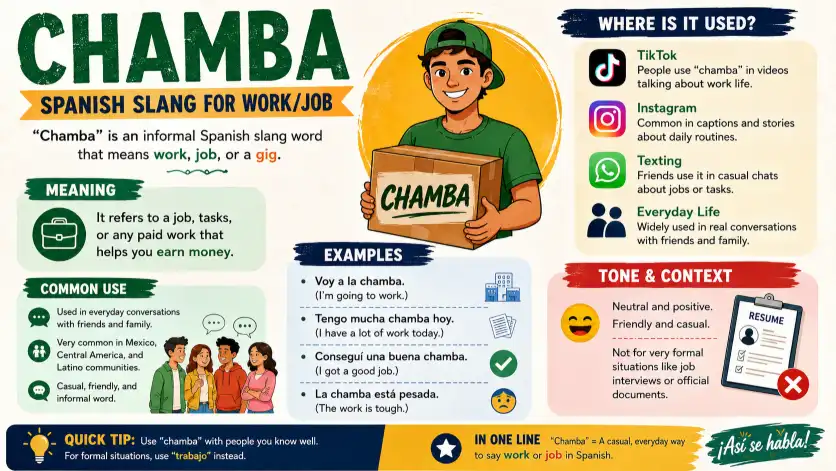
Chamba is one of the most recognized slang words for work in Mexican Spanish.
People use it when talking about their job, daily tasks, or earning money.
Examples:
- “Voy a la chamba.”
- “I’m going to work.”
- “La chamba está pesada hoy.”
- “Work is tough today.”
The word is common in casual conversations, texting, and social media among Spanish speakers from Mexico and nearby regions.
It usually sounds relaxed and friendly, not rude.
Curro
Curro is the Spanish slang word commonly used in Spain for work or a job.
Examples:
- “Tengo mucho curro esta semana.”
- “I have a lot of work this week.”
- “Estoy buscando curro.”
- “I’m looking for a job.”
Someone in Spain might use curro with friends, coworkers, or in informal online conversations.
It is less common in Latin American countries, where other words are preferred.
Jale
Jale is another informal word used in parts of Mexico.
It can mean work, a job, or a task.
Examples:
- “Conseguí un buen jale.”
- “I got a good job.”
- “Ese jale está difícil.”
- “That job/task is difficult.”
Depending on the location, “jale” can have slightly different meanings, so context matters.
Laburo
Laburo is popular in Argentina and Uruguay.
It comes from Italian influence and is widely understood in those regions.
Examples:
- “Tengo que ir al laburo.”
- “I have to go to work.”
- “El laburo me tiene cansado.”
- “Work is making me tired.”
It is a normal everyday slang term in Rioplatense Spanish.
Is Work in Spanish Slang Rude, Offensive, or Neutral?
Most Spanish slang words for work are neutral and casual.
They are not considered offensive when used in the right situation.
For example:
✅ Talking with friends:
- “Estoy en la chamba.”
- “Tengo mucho curro.”
✅ Casual workplace conversation:
- “Ese jale está complicado.”
However, slang may not always be suitable in formal situations.
Avoid using slang when:
- Writing a professional email
- Applying for a job
- Speaking in a formal interview
- Writing academic documents
In those cases, use:
- Trabajo = work
- Empleo = employment/job
- Ocupación = occupation
Where Is Work in Spanish Slang Commonly Used?
Spanish slang for work appears in many informal spaces.
Text Messages
Friends often use slang when chatting about their jobs.
Example:
“¿Cómo va la chamba?”
= “How’s work going?”
Social Media
Platforms like TikTok, Instagram, and Facebook often feature regional slang.
Users may post:
“Después de una larga semana de curro.”
= “After a long work week.”
Gaming Communities
Gamers sometimes use slang when discussing tasks, grinding, or earning rewards.
Example:
“Ese jale fue difícil.”
= “That task was difficult.”
Everyday Conversations
Native speakers commonly use these words with friends and family.
Slang makes conversations feel more natural and less formal.
Real-Life Examples of Work in Spanish Slang Usage
Understanding slang becomes easier when you see how native speakers actually use these words. The meaning can change slightly depending on the country, relationship, and situation.
Friendly Conversations
Friends often use slang words to talk casually about their jobs or daily responsibilities.
Examples:
Spanish:
“¿Qué tal la chamba hoy?”
English:
“How was work today?”
Spanish:
“Estoy cansado del curro, necesito descansar.”
English:
“I’m tired from work, I need to rest.”
These examples sound natural between friends because slang creates a relaxed tone.
Casual Workplace Conversations
Some coworkers use slang with people they know well.
Examples:
Spanish:
“Este jale tiene muchos problemas.”
English:
“This job/task has many problems.”
Spanish:
“Tenemos mucho curro esta semana.”
English:
“We have a lot of work this week.”
However, using slang with a manager, client, or formal business contact may not always be appropriate.
Argumentative or Frustrated Context
People may also use slang when complaining about work.
Examples:
Spanish:
“Esta chamba me está matando.”
English:
“This job is exhausting me.”
Spanish:
“El curro de hoy fue horrible.”
English:
“Today’s work was terrible.”
These expressions show emotion rather than a literal meaning.
Social Media Context
On social media, Spanish speakers often use slang to make posts sound more personal.
Examples:
Spanish:
“Sobreviviendo la chamba de lunes.”
English:
“Surviving Monday’s work.”
Spanish:
“Después del curro, toca relajarse.”
English:
“After work, it’s time to relax.”
These phrases are common in captions, memes, and casual online conversations.
Origin and Background of Work-Related Spanish Slang
Spanish slang for work developed through regional cultures, history, and everyday speech.
The formal word trabajo has existed for centuries, but communities created their own informal versions to express work in a more personal way.
Origin of Chamba
The word chamba is strongly connected with Mexican and Central American Spanish. It became popular as an everyday term for employment and labor.
Today, many speakers use it naturally when talking about jobs, especially in informal conversations.
Example:
“Encontré una nueva chamba.”
= “I found a new job.”
Origin of Curro
The word curro became common in Spain as a casual term for work.
It is widely used among younger generations and adults in relaxed settings.
Example:
“Voy al curro.”
= “I’m going to work.”
In Spain, hearing someone say curro is completely normal in everyday speech.
Origin of Laburo
Laburo is influenced by Italian immigration in Argentina and Uruguay.
It became part of local slang and is now an important part of Rioplatense Spanish vocabulary.
Example:
“El laburo está difícil.”
= “The job market/work is difficult.”
Comparison of Spanish Slang Words for Work
Different Spanish-speaking regions use different slang terms. Here is a simple comparison:
| Slang Word | Meaning | Region | Tone |
| Chamba | Work/job | Mexico, Central America | Casual, friendly |
| Curro | Work/job | Spain | Casual, everyday |
| Jale | Work/task/job | Mexico | Informal |
| Laburo | Work/job | Argentina, Uruguay | Very common locally |
| Trabajo | Work | All Spanish-speaking countries | Neutral/formal |
The best choice depends on where the Spanish speaker is from.
For example:
A person from Mexico may naturally say:
“Ir a la chamba.”
A person from Spain may say:
“Ir al curro.”
Both mean:
“Going to work.”
Work in Spanish Slang vs Formal Spanish
Spanish has different levels of communication. Slang is useful, but it is important to understand when to use it.
| Situation | Better Choice |
| Talking with friends | Chamba, curro, laburo |
| Texting casually | Regional slang words |
| Workplace conversation with friends | Slang may be acceptable |
| Job application | Trabajo, empleo |
| Business emails | Trabajo, puesto, empleo |
| Academic writing | Trabajo, ocupación |
Slang creates a friendly connection, but formal language shows professionalism.
When to Avoid Using Work in Spanish Slang
Although slang is common, learners should be careful because regional expressions may not work everywhere.
Avoid slang when:
Writing Professional Messages
A job application should use formal Spanish.
Instead of:
“Busco una buena chamba.”
Use:
“Busco una oportunidad laboral.”
Meaning:
“I am looking for a job opportunity.”
Speaking in Formal Interviews
During interviews, professional vocabulary is safer.
Use:
- Trabajo
- Experiencia laboral
- Empleo
- Carrera profesional
Avoid regional slang unless the interviewer uses it first.
Talking With People From Unknown Regions
A slang word that sounds natural in one country may sound strange somewhere else.
For example:
- Chamba is common in Mexico.
- Curro is common in Spain.
- Laburo is common in Argentina.
A Spanish learner should consider the speaker’s location before choosing slang.
Polite Alternatives to Work Slang
If you want a more universal Spanish word, use these options:
Trabajo
Meaning:
Work/job.
Example:
“Tengo mucho trabajo hoy.”
“I have a lot of work today.”
Empleo
Meaning:
Employment or job position.
Example:
“Estoy buscando empleo.”
“I am looking for employment.”
Puesto de trabajo
Meaning:
Job position.
Example:
“Encontré un nuevo puesto de trabajo.”
“I found a new job position.”
Actividad laboral
Meaning:
Work activity.
Example:
“Mi actividad laboral es intensa.”
“My work activity is intense.”
These options are better for formal communication.
Why People Use Work in Spanish Slang
People use slang because it makes communication easier and more natural.
Common reasons include:
Cultural Identity
Regional slang connects people to their community.
Someone from Mexico may feel more connected when using words like chamba.
Faster Communication
Slang is often shorter and easier in casual conversations.
Instead of saying:
“Tengo mucho trabajo.”
Someone may say:
“Tengo mucha chamba.”
Friendly Tone
Slang can make conversations feel warmer and less formal.
Friends often prefer informal words because they sound more personal.
Online Communication
Social media encourages shorter and more casual language.
Spanish slang appears frequently in:
- TikTok captions
- Instagram posts
- Text messages
- Online communities
Impact of Using Work in Spanish Slang in Communication
Using slang can make conversations feel more natural, but it also requires awareness of context. The same word can create a friendly connection in one situation and sound inappropriate in another.
Positive Effects of Using Slang
Makes Conversations More Natural
Native speakers often use slang in everyday life. Learning these words helps language learners understand real conversations instead of only textbook Spanish.
For example:
Formal:
“Voy a mi trabajo.”
Casual:
“Voy a la chamba.”
Both mean:
“I’m going to work.”
The second option sounds more relaxed in certain regions.
Helps Understand Local Culture
Spanish slang reflects the culture and history of different communities.
Words like:
- Chamba
- Curro
- Laburo
show how different Spanish-speaking regions developed their own ways of speaking.
Learning these expressions helps people understand movies, music, social media, and conversations more easily.
Builds Better Connections
Using a local slang word correctly can make conversations feel warmer.
For example, someone visiting Mexico may understand that chamba is a common everyday word. However, using it naturally requires knowing the situation and audience.
Is Work in Spanish Slang Safe for Social Media?
Yes, most work-related Spanish slang is safe for social media because these words are usually neutral and casual.
People commonly use them in:
- TikTok videos
- Instagram captions
- Facebook posts
- Online conversations
- Messaging apps
Examples:
“Un día más en la chamba.”
Meaning:
“Another day at work.”
“Después del curro, descanso.”
Meaning:
“After work, I rest.”
These expressions are normal among Spanish speakers.
However, remember that social media reaches international audiences. A slang word familiar in one country may confuse users from another country.
Common Mistakes When Using Spanish Work Slang
Language learners sometimes make mistakes when using slang.
Mistake 1: Using Regional Slang Everywhere
Not every Spanish speaker uses the same slang.
Example:
A person from Spain may understand curro better than chamba.
A person from Mexico may prefer chamba.
Always consider the region.
Mistake 2: Using Slang in Formal Situations
Slang is designed for casual communication.
Avoid using:
- Chamba
- Curro
- Jale
- Laburo
in formal documents unless you are intentionally writing informal content.
Mistake 3: Translating Slang Word-for-Word
Slang does not always work through direct translation.
For example:
“Curro” does not simply mean every possible type of work. It specifically carries a casual meaning in Spain.
Understanding the feeling behind the word is more important than memorizing translations.
Similar Spanish Slang Expressions Related to Work
Besides words meaning “work,” Spanish speakers use other slang expressions connected to jobs and effort.
| Expression | Meaning | Example |
| Echarle ganas | Put in effort / try hard | “Hay que echarle ganas al trabajo.” |
| Ganarse la vida | Earn a living | “Trabajo para ganarme la vida.” |
| Currar | To work (Spain) | “Tengo que currar mañana.” |
| Chamvear | To work (informal variation in some regions) | “Voy a chamvear temprano.” |
These expressions describe working, effort, and earning money.
(FAQs)
Q.1 What is the slang word for work in Spanish?
The slang word depends on the country. Common examples include chamba in Mexico, curro in Spain, and laburo in Argentina and Uruguay.
Q.2 Is “chamba” the same as “trabajo”?
Yes, both can mean “work” or “job.” The difference is that chamba is informal slang, while trabajo is the standard Spanish word.
Q.3 What does “curro” mean in Spanish slang?
“Curro” means work or a job in casual Spanish, especially in Spain. It is commonly used in everyday conversations.
Q.4 Can I use Spanish work slang in a professional setting?
Usually, it is better to use formal words like trabajo or empleo in professional situations such as interviews, emails, or official documents.
Q.5 What does “laburo” mean?
“Laburo” is an informal word for work commonly used in Argentina and Uruguay.
Q.6 Is Spanish work slang offensive?
Most Spanish slang words for work are not offensive. They are casual expressions, but their appropriateness depends on the situation and audience.
Quick Summary of Work in Spanish Slang
Here are the main words to remember:
- Trabajo → Standard Spanish word for work
- Chamba → Casual work/job (common in Mexico)
- Curro → Casual work/job (common in Spain)
- Jale → Informal job/work/task (used in parts of Mexico)
- Laburo → Work/job (common in Argentina and Uruguay)
The phrase work in spanish slang does not refer to one single expression. Spanish-speaking communities use different slang words based on their region and culture.
Conclusion
Work in spanish slang includes several informal expressions used by Spanish speakers in daily conversations. Words like chamba, curro, and laburo can replace the standard word trabajo, but each one belongs to a different region.
These slang terms are useful for understanding real conversations, social media posts, and casual messages. However, context matters. Use slang with friends and informal conversations, while choosing formal words like trabajo or empleo for professional situations.
Learning regional slang helps you communicate more naturally and understand the rich variety of Spanish-speaking cultures.
Read More About !
- What Is Yachting Slang? Meaning, Uses, and Examples
- Cool in Slang: Meaning, Uses, and Examples
- FTW Slang: Meaning, Examples, and How to Use It Correctly

Michael Brooks is a language writer at SlangPath with 7+ years of experience creating simple, practical content on English slang and everyday expressions.