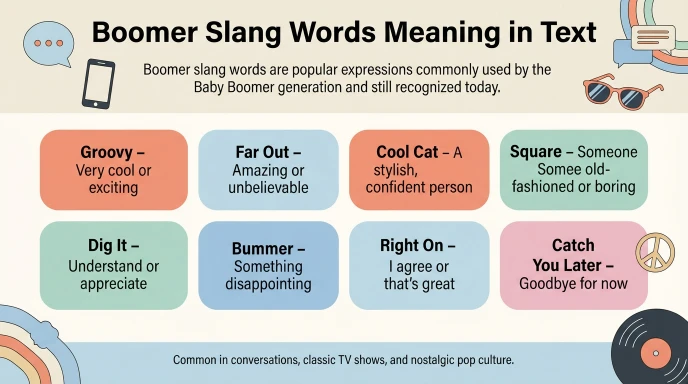
Boomer slang words are classic expressions popular with the Baby Boomer generation that are still used today to add humor, nostalgia, or casual meaning in conversations.
Boomer slang words are classic expressions that became popular with the Baby Boomer generation, generally people born between 1946 and 1964.
Many people search for these terms because they hear them from parents, grandparents, movies, TV shows, or social media posts that joke about older generations. While some of these expressions sound old-fashioned today, many are still understood and occasionally used in everyday conversations.
Learning boomer slang can help you understand older movies, family conversations, historical pop culture, and even internet memes. Some terms have stayed popular for decades, while others have been replaced by newer slang from younger generations.
Quick Answer:
Boomer slang words are informal expressions commonly used by the Baby Boomer generation. They often describe people, situations, or emotions in a fun, casual, or memorable way.
What Does Boomer Slang Words Mean in Text?
Boomer slang words are informal phrases that were especially popular during the 1950s through the 1980s. Unlike internet abbreviations, these are regular words or expressions that reflect the culture of their time.
Today, people may use them:
- To sound nostalgic
- As a joke
- In family conversations
- In movies and TV shows
- In memes about older generations
Many younger people recognize these expressions even if they don’t use them regularly.
Full Form / Definition of Boomer Slang Words
There is no full form because “boomer slang words” is not an acronym.
Definition:
Boomer slang refers to informal vocabulary and expressions commonly associated with the Baby Boomer generation.
Related searches include:
- boomer slang meaning
- boomer slang words list
- old generation slang
- classic American slang
- vintage slang words
Is Boomer Slang Rude, Offensive, or Neutral?
Most boomer slang is completely neutral and harmless.
However, some older expressions may sound outdated or insensitive by today’s standards.
Generally Neutral
- Cool
- Groovy
- Far out
- Right on
- Hang loose
Can Sound Old-Fashioned
- Square
- Dork
- Gee whiz
Use With Caution
Some slang created decades ago may contain stereotypes that are no longer considered respectful. If you’re unsure, it’s better to choose modern, neutral language.
Common Boomer Slang Words and Their Meanings
| Slang Word | Meaning | Still Used Today? |
| Groovy | Excellent or fashionable | Sometimes |
| Far Out | Amazing or unbelievable | Rarely |
| Cool | Great or impressive | Yes |
| Right On | I completely agree | Occasionally |
| Hang Loose | Relax and don’t worry | Yes |
| Square | Someone boring or old-fashioned | Less common |
| Bummer | Something disappointing | Yes |
| Dig It | Understand or appreciate | Occasionally |
| Bread | Money | Rarely |
| Foxy | Attractive person | Sometimes |
| Chick | Girl or young woman | Less common |
| Cat | Cool person | Mostly historical |
| Heavy | Serious or emotionally important | Occasionally |
| Bogus | Fake or unfair | Yes |
| Crash | Sleep or stay overnight | Yes |
Is “Boomer” Itself Slang?
Yes, depending on context.
Originally, “Boomer” simply described members of the Baby Boomer generation.
Today, online it can also refer to:
- Someone who dislikes modern technology
- Someone with old-fashioned opinions
- Someone resistant to change
This newer meaning became especially popular through memes like:
“OK Boomer.”
The phrase is usually humorous but may sound dismissive depending on the conversation.
Where Is Boomer Slang Commonly Used?
Boomer slang appears in several places today.
Movies and TV Shows
Classic films from the 1960s, 1970s, and 1980s often include these expressions.
Family Conversations
Parents and grandparents may naturally use these phrases.
Social Media
Sometimes younger users use boomer slang ironically or for nostalgic humor.
Platforms include:
- TikTok
Books
Older novels and magazines often contain these expressions.
Real-Life Examples of Boomer Slang Usage
Friendly
“That new guitar is groovy.”
Casual
“What a bummer that the concert got canceled.”
Agreement
“Right on! That’s exactly what I was thinking.”
Relaxed Conversation
“Just hang loose. Everything will work out.”
Excitement
“That car is far out!“
Understanding
“I dig what you’re saying.”
Origin and Background of Boomer Slang
Boomer slang developed during major cultural changes in America and other English-speaking countries.
It was influenced by:
- Rock and roll
- Surf culture
- Hippie culture
- Television
- Youth movements
- College campuses
Many expressions spread through music, radio, and popular movies before the internet existed.
Some survived because they were simple and easy to remember.
Why People Still Use Boomer Slang
Even decades later, these expressions remain popular because they:
- Sound fun
- Show nostalgia
- Create humor
- Connect generations
- Appear in classic entertainment
Sometimes younger people intentionally use boomer slang to sound playful or ironic.
Boomer Slang vs Modern Gen Z Slang
| Boomer Slang | Modern Equivalent | Meaning |
| Groovy | Fire | Excellent |
| Far Out | confused | Incredible |
| Cool | Cool | Great |
| Dig It | I Get It | Understand |
| Bread | Cash | Money |
| Square | NPC | Boring person |
| Right On | Facts | I agree |
| Bummer | That’s Rough | Disappointing |
Both generations use slang differently, but the goal is the same: making communication more expressive and personal.
When Should You Avoid Using Boomer Slang?
Avoid these expressions if:
- Your audience may not understand them.
- You’re writing formal documents.
- You’re communicating professionally.
- The slang could sound outdated or confusing.
Formal emails, business reports, and academic writing usually work better without slang.
Polite Alternatives
Instead of older slang, you can use modern neutral English.
| Boomer Slang | Polite Alternative |
| Groovy | Excellent |
| Foxy | Attractive |
| Chick | Woman |
| Square | Traditional |
| Bread | Money |
These alternatives are suitable in professional settings.
Why People Use Boomer Slang
People use these expressions because they:
- Add personality
- Express emotion quickly
- Show cultural identity
- Bring humor
- Create nostalgia
Language naturally changes over time, and every generation develops its own unique slang.
Impact of Using Slang in Communication
Slang makes conversations feel:
- More natural
- More relaxed
- More personal
- More memorable
However, using too much slang can confuse people from different age groups or cultures.
Choosing the right expression for the right audience is always important.
Is Boomer Slang Safe for Social Media?
Yes.
Most common boomer slang is perfectly safe on platforms like:
- TikTok
- X
- Snapchat
Just remember that some older expressions may feel outdated, so consider your audience before posting.
Examples in Different Contexts
Friendly
“Your new bike looks groovy!”
Casual Conversation
“What a bummer that it started raining.”
Argumentative
“I dig your point, but I still disagree.”
Gaming
“That victory was far out!“
Social Media
“This retro outfit is absolutely groovy.”
Family
“My dad still says ‘Right on!‘ whenever he agrees.”
Frequently Asked Questions
Q1:What are boomer slang words?
They are informal expressions that became popular with the Baby Boomer generation.
Q2:What does “groovy” mean?
“Groovy” means excellent, fashionable, or very cool.
Q3:Is boomer slang still used?
Yes. Many classic expressions like “cool,” “bummer,” and “hang loose” are still heard today.
Q4:Is “OK Boomer” offensive?
It depends on context. It is often humorous but can sound dismissive if used to mock someone.
Q5:Why do younger people use boomer slang?
Mostly for nostalgia, humor, memes, or references to classic pop culture.
Q6:What’s the difference between boomer slang and Gen Z slang?
Boomer slang reflects older cultural trends, while Gen Z slang is influenced by internet culture, gaming, memes, and social media.
Q7. Are boomer slang words still used today?
Answer: Yes, some boomer slang words are still used today, while others are mostly heard in nostalgic conversations.
Q8. Where can you hear boomer slang words?
Answer: You can hear boomer slang in classic movies, TV shows, family conversations, and older generations’ speech.
Q9. Why should you learn boomer slang words?
Answer: Learning boomer slang helps you understand older expressions, pop culture, and conversations with older adults.
Q10. What is the difference between boomer slang and Gen Z slang?
Answer: Boomer slang comes from older generations and traditional culture, while Gen Z slang is shaped by social media and internet trends.
Conclusion
Boomer slang words are a fascinating part of English language history. They reflect the culture, music, entertainment, and social changes of the Baby Boomer generation. While some expressions have become outdated, many—including cool, bummer, and hang loose—remain part of everyday English.
Understanding these terms helps you appreciate older conversations, classic movies, and even modern internet jokes. Whether you’re learning English, exploring language history, or simply curious about vintage expressions, knowing when and how to use boomer slang will make your communication more engaging and culturally aware.
Read More About!
- Slang Fire Meaning in Text: Definition, Uses & Examples
- How to Say Cool in Spanish Slang Meaning in Text

Michael Brooks is a language writer at SlangPath with 7+ years of experience creating simple, practical content on English slang and everyday expressions.