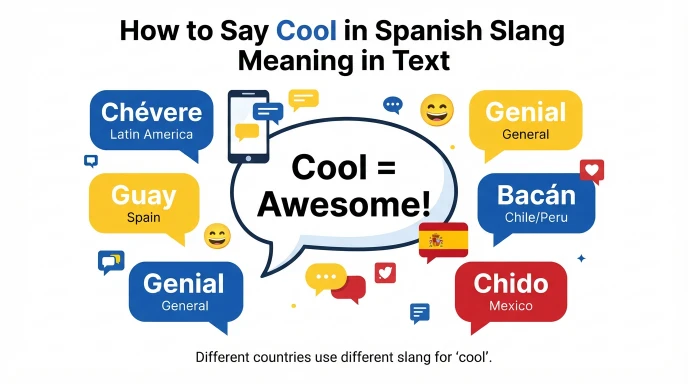
“Cool” in Spanish slang can be said as chévere, guay, genial, or padre, depending on the country, and all mean something awesome, great, or impressive.
How to say cool in Spanish slang is a common question for travelers, language learners, and anyone who watches Spanish movies, listens to Latin music, or chats with Spanish-speaking friends online. While English speakers often say “cool,” Spanish has many slang words that express the same idea. The right word depends on the country, the situation, and the people you’re talking to.
For example, someone in Spain may say one word, while someone in Mexico, Argentina, or Colombia may use a completely different expression. Learning these slang terms helps you sound more natural and understand conversations on social media, in text messages, and in everyday life.
Quick Answer
There isn’t one universal Spanish slang word for “cool.” Popular options include guay (Spain), chévere (many Latin American countries), chido (Mexico), copado (Argentina), bacano (Colombia), and genial, depending on the region and context.
What Does “Cool” Mean in Spanish Slang?
In Spanish slang, “cool” usually describes something that is:
- Awesome
- Great
- Fun
- Interesting
- Stylish
- Impressive
- Excellent
Instead of translating the English word directly, native speakers usually choose a local slang expression.
For example:
English:
“That’s a cool idea.”
Spain:
“¡Qué guay!”
Mexico:
“¡Qué chido!”
Colombia:
“¡Qué bacano!”
Each sentence means roughly the same thing, but the slang changes depending on where the speaker is from.
Does “Cool” Have a Full Form in Spanish Slang?
No.
Unlike internet abbreviations such as LOL or BRB, “cool” in Spanish slang is not an abbreviation and has no full form.
Instead, Spanish speakers use different informal words that all express a similar meaning.
Most Common Ways to Say Cool in Spanish Slang
1. Guay (Spain)
Meaning: Cool, awesome, great.
This is one of the most common slang words in Spain. You’ll hear it in conversations between friends, at school, and in everyday life.
Tone
- Friendly
- Casual
- Positive
Examples
“¡Qué guay está ese coche!”
That car is so cool!
“La película fue muy guay.”
The movie was really cool.
2. Chido (Mexico)
Meaning: Cool, awesome, nice.
“Chido” is one of the best-known Mexican slang words and is used by people of all ages in informal conversations.
Tone
- Friendly
- Informal
Examples
“Tu camiseta está bien chida.”
Your shirt is really cool.
“Fue un concierto muy chido.”
It was a really cool concert.
3. Chévere (Latin America)
Meaning: Cool, great, excellent.
“Chévere” is common in countries such as Venezuela, Peru, Ecuador, parts of Central America, and the Caribbean.
Tone
- Positive
- Relaxed
Examples
“¡Qué chévere!”
That’s awesome!
“Tu idea está muy chévere.”
Your idea is really cool.
4. Bacano (Colombia)
Meaning: Awesome, cool, fantastic.
“Bacano” is especially popular in Colombia and is commonly heard in everyday speech.
Tone
- Friendly
- Informal
Examples
“Ese restaurante es bacano.”
That restaurant is awesome.
“La fiesta estuvo muy bacana.”
The party was really cool.
5. Copado (Argentina)
Meaning: Cool, great, fun.
Argentine Spanish often uses copado to describe enjoyable experiences or likable people.
Examples
“Fue un viaje muy copado.”
It was a really cool trip.
“Él es muy copado.”
He’s really cool.
6. Genial (Many Spanish-Speaking Countries)
Meaning: Great, excellent, cool.
Although not strictly slang everywhere, genial is widely used in everyday conversation.
Examples
“¡Genial!”
Great!
“La idea es genial.”
The idea is awesome.
7. Padre (Mexico)
Meaning: Cool, great.
In Mexican Spanish, padre can describe something impressive or enjoyable.
Examples
“Está padre.”
That’s cool.
“Qué padre estuvo el partido.”
The game was awesome.
8. Brutal (Spain and Latin America)
Meaning: Amazing, incredible.
Originally meaning “brutal” in the literal sense, this word is often used positively to describe something outstanding.
Examples
“Ese gol fue brutal.”
That goal was incredible.
“La actuación estuvo brutal.”
The performance was amazing.
9. De Lujo (Spain)
Meaning: Excellent, first-class, really cool.
This phrase literally means “luxurious,” but people often use it to praise something.
Example
“Todo salió de lujo.”
Everything turned out great.
10. Buenísimo
Meaning: Very good, awesome.
This word works in nearly every Spanish-speaking country and is easy for beginners to remember.
Example
“El concierto estuvo buenísimo.”
The concert was amazing.
Quick Comparison Table
| Spanish Slang | English Meaning | Common Region |
| Guay | Cool | Spain |
| Chido | Cool | Mexico |
| Chévere | Awesome | Venezuela, Peru, Caribbean, Central America |
| Bacano | Cool | Colombia |
| Copado | Great | Argentina |
| Padre | Cool | Mexico |
| Brutal | Amazing | Spain & Latin America |
| Genial | Great | Many countries |
| Buenísimo | Excellent | Most Spanish-speaking countries |
| De lujo | Fantastic | Spain |
Where Is “Cool” Spanish Slang Commonly Used?
These expressions are used in many everyday situations, including:
- Talking with friends
- Family conversations
- School and university
- Text messages
- Social media posts
- Instagram captions
- TikTok videos
- YouTube comments
- Casual workplace conversations
- Travel and tourism
Because Spanish slang varies by country, the same word may sound perfectly natural in one place but uncommon in another.
For example:
- A teenager in Madrid is more likely to say guay.
- Someone in Mexico City may naturally say chido.
- A speaker in Bogotá might choose bacano.
Learning these regional differences helps you communicate more naturally and better understand native speakers.
Is “Cool” in Spanish Slang Rude, Offensive, or Neutral?
Most Spanish slang words for “cool” are neutral and friendly. They are commonly used in everyday conversations with friends, classmates, coworkers, and family members.
However, because slang varies by country, a word that sounds natural in one place may sound unusual or old-fashioned somewhere else.
| Slang Word | Tone | Appropriate for Everyday Use? |
| Guay | Friendly | ✅ Yes |
| Chido | Friendly | ✅ Yes |
| Chévere | Friendly | ✅ Yes |
| Bacano | Friendly | ✅ Yes |
| Copado | Friendly | ✅ Yes |
| Padre | Friendly | ✅ Yes |
| Genial | Neutral | ✅ Yes |
| Brutal | Positive | ✅ Yes |
| De lujo | Friendly | ✅ Yes |
| Buenísimo | Positive | ✅ Yes |
These words are not considered offensive when used in the right context.
Where Is Spanish Slang for “Cool” Commonly Used?
These expressions appear in many everyday situations.
Friends and Family
The most common place you’ll hear them is during casual conversations.
Example:
“¡Qué chido estuvo el viaje!”
School and University

Students often use these words when talking about classes, sports, music, or weekend plans.
Example:
“Tu presentación estuvo genial.”
Social Media
Spanish-speaking users regularly use these slang words on:
- TikTok
- YouTube
- X (formerly Twitter)
Typical comments include:
- “¡Qué guay!”
- “Está muy chido.”
- “¡Qué bacano!”
Text Messages
These expressions are very common in chats between friends.
Example:
Friend 1: “Conseguí entradas para el concierto.”
Friend 2: “¡Qué chévere!”
Travel
If you’re visiting a Spanish-speaking country, using the local slang naturally can make conversations feel warmer and more authentic.
For example:
- Spain → Guay
- Mexico → Chido
- Colombia → Bacano
- Argentina → Copado
Country-by-Country Guide
One of the biggest mistakes language learners make is assuming every Spanish-speaking country uses the same slang. In reality, regional vocabulary varies a lot.
| Country | Most Common Slang for “Cool” |
| Spain | Guay |
| Mexico | Chido, Padre |
| Colombia | Bacano |
| Argentina | Copado |
| Venezuela | Chévere |
| Peru | Chévere |
| Ecuador | Chévere |
| Chile | Bacán |
| Uruguay | Copado |
| Dominican Republic | Jevi (also spelled “Heavy” in slang) |
If you’re unsure which word to use, genial is a safe choice because it is widely understood across the Spanish-speaking world.
Origin and Background
Spanish slang develops naturally through local culture, music, youth language, and everyday conversations. Unlike formal Spanish taught in textbooks, slang changes over time and often differs by region.
Here are a few examples:
Guay
Guay has been popular in Spain for several decades. Its exact origin is debated, but today it is one of the country’s most recognizable slang words for “cool.”
Chido
Chido is strongly associated with Mexican Spanish. Although its precise origin is uncertain, it has been part of informal Mexican speech for many years and remains widely used today.
Chévere
Chévere is believed to have roots in the Caribbean region. It later spread across several Latin American countries, though linguists do not completely agree on its earliest origin.
Bacano
Bacano is especially common in Colombia and has also spread to nearby regions through music, television, and popular culture.
Why Do People Use These Slang Words?
People choose slang because it sounds natural and expresses enthusiasm more vividly than formal language.
Instead of saying:
“That is very good.”
A native speaker is more likely to say:
“¡Qué guay!”
or
“¡Qué chido!”
These expressions make conversations feel more relaxed and friendly.
Real-Life Examples
Friendly Conversation
Sara: “I bought tickets for the match.”
Luis: “¡Qué bacano!”
Casual Text Message
Friend: “Look at my new bike.”
Reply: “¡Está muy chida!”
Family
Mom: “Did you enjoy the vacation?”
Son: “Sí, estuvo genial.”
School
“Your science project looks really cool.”
Spanish (Spain):
“Tu proyecto está muy guay.”
Travel
Tourist:
“This beach is beautiful.”
Local:
“Sí, está muy padre.”
TikTok Comment
“¡Qué brutal ese video!”
Instagram Caption
“Un día genial con amigos.”
YouTube Comment
“Ese tutorial estuvo buenísimo.”
Comparison with Similar Words
| Word | Meaning | Region | Formal or Slang? |
| Guay | Cool | Spain | Slang |
| Chido | Cool | Mexico | Slang |
| Chévere | Awesome | Latin America | Slang |
| Bacano | Great | Colombia | Slang |
| Copado | Cool | Argentina | Slang |
| Genial | Great | Most countries | Standard informal |
| Excelente | Excellent | Everywhere | Formal |
| Increíble | Incredible | Everywhere | Standard |
Common Mistakes
Using One Slang Word Everywhere
Not every country uses the same expression.
For example:
- Guay sounds natural in Spain.
- In Mexico, chido is much more common.
Assuming Slang Is Always Better
If you’re speaking with teachers, older adults, or in professional settings, standard words like genial, excelente, or muy bueno may be more appropriate.
Translating English Directly
Many beginners try to translate “cool” word-for-word. Native speakers usually choose the local slang expression instead.
Is It Safe to Use on Social Media?
Yes. These slang words are commonly used on:
- TikTok
- Snapchat
- Discord
- YouTube
They’re generally positive and family-friendly.
However, if you’re posting for an international Spanish-speaking audience, remember that some regional slang may not be familiar to everyone. Words like genial or buenísimo are more universally understood.
When Should You Avoid Using Spanish Slang for “Cool”?
Although these slang words are friendly and widely used, they are not always the best choice.
You may want to avoid regional slang when:
- Writing formal emails.
- Speaking in business meetings.
- Giving academic presentations.
- Communicating with government offices.
- Talking to people from another Spanish-speaking country who may not know the local expression.
For example, if you’re unsure which slang is common in a country, using genial, excelente, or muy bueno is usually a safe choice.
Polite Alternatives to “Cool”
If you want to sound more formal or neutral, use one of these words instead of regional slang.
| Alternative | Meaning | Formality |
| Genial | Great | Informal but widely accepted |
| Excelente | Excellent | Formal |
| Muy bueno | Very good | Neutral |
| Increíble | Incredible | Neutral |
| Fantástico | Fantastic | Neutral |
| Estupendo | Wonderful | Formal |
| Magnífico | Magnificent | Formal |
| Impresionante | Impressive | Neutral |
These alternatives work well in schools, workplaces, travel, and conversations with people from different Spanish-speaking countries.
Why Do People Use Spanish Slang Instead of Standard Spanish?
People use slang because it makes conversations feel:
- More natural.
- More friendly.
- More expressive.
- More connected to local culture.
For example:
Instead of saying:
“La película fue muy buena.”
Many native speakers naturally say:
“La película estuvo muy chida.”
or
“La película estuvo muy guay.”
Both mean the movie was great, but the slang version sounds more conversational.
Impact of Using Slang in Communication
Using the right slang can help you:
- Sound more like a native speaker.
- Understand movies and TV shows more easily.
- Follow conversations on social media.
- Connect with local people while traveling.
- Enjoy Spanish-language music, podcasts, and videos.
However, using the wrong regional slang can sometimes confuse listeners.
For example, someone from Spain may not naturally use chido, while a Mexican speaker may rarely say guay.
Knowing your audience is just as important as knowing the vocabulary.
Common Misunderstandings
There Is No Universal Word for “Cool”
One of the biggest misconceptions is that Spanish has a single slang word that everyone uses.
In reality, different countries prefer different expressions.
“Guay” Is Mostly Used in Spain
Many beginners learn guay first and assume it works everywhere.
While people in Latin America may understand it from movies or television, it isn’t their everyday slang.
“Chido” Doesn’t Mean the Same Everywhere
In Mexico, chido is extremely common.
In Spain, however, it may sound foreign because it belongs to Mexican Spanish.
Standard Spanish Is Still Important
Learning slang is useful, but standard vocabulary helps you communicate with the widest range of Spanish speakers.
If you’re unsure which slang fits a situation, choose a neutral word like genial or excelente.
Frequently Asked Questions
Q1:How do you say “cool” in Spanish slang?
It depends on the country. Common choices include guay (Spain), chido (Mexico), chévere (many Latin American countries), bacano (Colombia), and copado (Argentina).
Q2:What is the most common Spanish slang word for “cool”?
There isn’t one universal answer. Guay is very common in Spain, while chido is one of the most popular choices in Mexico.
Q3:Is “guay” rude?
No. Guay is a friendly and positive slang word used to mean “cool” or “awesome.”
Q4:Can I use “chido” in Spain?
People in Spain will probably understand it because of media and the internet, but it isn’t part of everyday Spanish slang there. Guay sounds more natural.
Q5:Is “chévere” formal?
No. Chévere is informal slang, but it is polite and commonly used in casual conversations.
Q6:Which Spanish word for “cool” should beginners learn first?
If you’re learning Spanish for a specific country, learn that country’s common slang.
If you want a word understood almost everywhere, genial is one of the safest and most widely recognized choices.
Key Takeaways
- Spanish has many ways to say “cool,” and the best choice depends on the country.
- Guay is common in Spain.
- Chido is popular in Mexico.
- Chévere is widely used in several Latin American countries.
- Bacano is common in Colombia.
- Copado is frequently heard in Argentina.
- Most of these words are friendly, informal, and safe for everyday conversations.
- When speaking with an international audience, neutral words like genial or excelente are easier for everyone to understand.
Conclusion
Learning how to say cool in Spanish slang is about more than memorizing one word. Spanish is spoken in many countries, and each region has developed its own favorite expressions. Words like guay, chido, chévere, bacano, and copado all express the idea of something being “cool,” but each reflects the culture and everyday speech of a different community.
If you’re traveling, chatting with native speakers, or watching Spanish-language content, choosing the right regional slang can make your conversations feel more natural. When you’re unsure which expression fits, using genial or excelente is a safe option that is understood almost everywhere.
Read More About!
Mafia Slang Terms: Meanings, Origins, and Common Examples

Michael Brooks is a language writer at SlangPath with 7+ years of experience creating simple, practical content on English slang and everyday expressions.