Coke in Spanish slang refers to the informal or street expressions used in Spanish-speaking countries to mean cocaine, with the exact term varying by region and context.
Coke in Spanish slang is a popular search because many people hear unfamiliar words in Spanish songs, movies, TV shows, or social media. Instead of using the formal word cocaína, some Spanish speakers use informal nicknames that vary by country and culture. These slang terms can appear in rap lyrics, crime dramas, online discussions, or street conversations.
Learning these expressions helps you understand Spanish-language content more easily. However, it is important to remember that these words are tied to illegal drugs and may not be appropriate in everyday conversations. Their meaning also changes depending on the country and context.
Quick Answer:coke in spanish slang
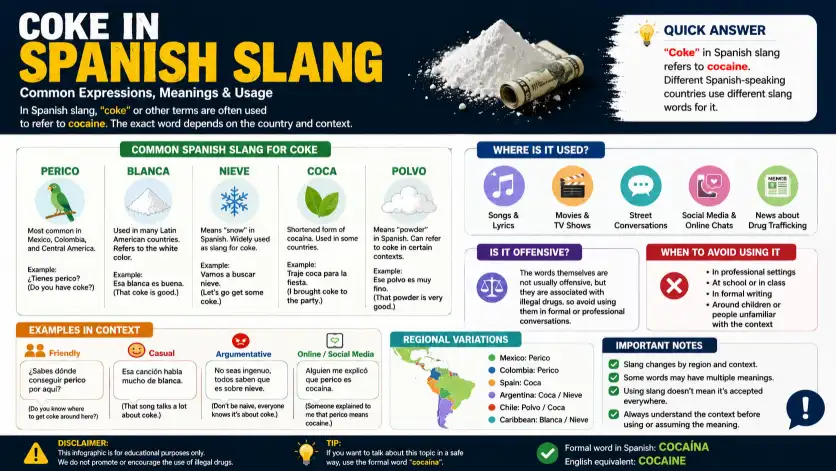
Coke in Spanish slang refers to informal or street names used for cocaine. The exact slang word depends on the Spanish-speaking country, and these expressions are most common in music, movies, and informal conversations.
What Does Coke in Spanish Slang Mean in Text?
In standard Spanish, the correct word is cocaína. In informal speech, people sometimes replace it with slang terms.
These slang words all refer to cocaine, but they are not universal. A term commonly used in one country may be unknown or have another meaning in another region.
People usually encounter these words in:
- Rap and reggaeton lyrics
- Crime series and films
- Social media discussions
- Online forums
- Informal conversations
Understanding the context is important because some slang words have multiple meanings.
Coke in Spanish Slang Full Form
Unlike abbreviations such as LOL or BRB, coke does not have a full form.
It is simply a shortened version of cocaine in English. Spanish speakers sometimes use the English word “coke,” especially in entertainment or bilingual conversations, but the formal Spanish word remains cocaína.
Definition
Coke in Spanish slang means an informal word or nickname used to refer to cocaine instead of saying cocaína directly.
Common Spanish Slang Words for Cocaine
Spanish slang differs across countries. Here are some commonly recognized terms.
| Slang | Common Region | Meaning |
| Perico | Mexico, Colombia, Central America | Common slang for cocaine |
| Blanca | Various Latin American countries | Refers to the white color |
| Nieve | Some regions | Literally means “snow” |
| Coca | Several countries | Shortened form of cocaína |
| Polvo | Limited regional use | Meaning depends on context |
Note: Regional usage varies. Some words may have completely different meanings outside drug-related conversations.
Is Coke in Spanish Slang Rude, Offensive, or Neutral?
The slang itself is not considered profanity.
However, because it refers to an illegal drug, it may be inappropriate in many situations.
Generally, it is:
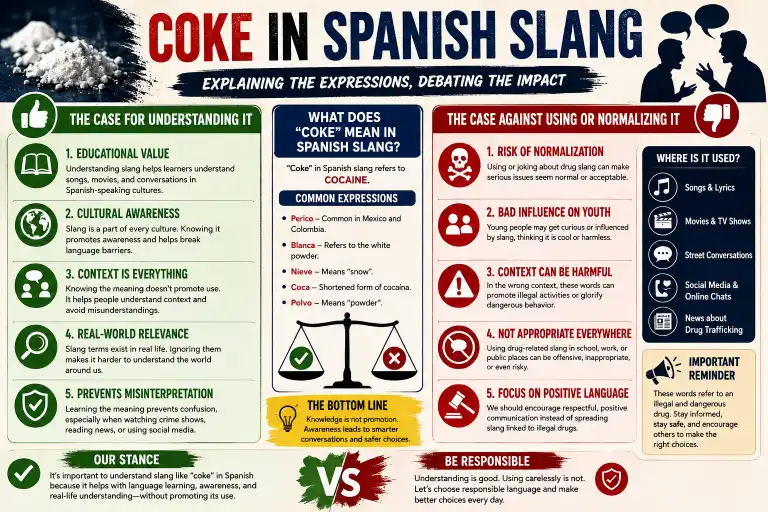
- Appropriate for educational discussions
- Common in music and movies
- Found in crime reporting
- Inappropriate for workplace conversations
- Unsuitable for classroom discussions unless the topic is educational
The tone depends on how the word is being used.
Where Is Coke in Spanish Slang Commonly Used?
You are most likely to hear Spanish slang for cocaine in entertainment or informal conversations rather than in professional settings.
Common places include:
- Rap and reggaeton songs
- Crime movies and TV series
- Social media posts
- Reddit discussions
- Online forums
- Street conversations
- News stories about drug trafficking
Formal news reports usually use the standard word cocaína instead of slang.
Why Do People Use Coke Slang?
People use slang for different reasons.
- To sound more casual.
- To match local speech.
- To avoid saying the formal word.
- To fit the style of music or entertainment.
- To communicate within certain social groups.
Some slang terms also act as coded language, although their meaning often becomes widely recognized over time.
Origin and Background
Most Spanish slang for cocaine developed naturally within local communities. Many nicknames describe the drug’s appearance, while others come from street culture or popular music.
Since Spanish is spoken in more than 20 countries, slang continues to evolve. New expressions appear, older ones disappear, and some words spread through songs, films, and the internet.
Because of these regional differences, there is no single slang term that every Spanish speaker uses.
Is Coke in Spanish Slang the Same Everywhere?
No. Spanish slang changes from country to country.
For example:
| Country | Common Slang |
| Mexico | Perico |
| Colombia | Perico |
| Spain | Coca and other local expressions |
| Argentina | Regional variations |
| Chile | Local slang differs by area |
Someone from Spain may not recognize every slang term used in Mexico, and the opposite is also true.
Real-Life Examples of Usage
Friendly
- “I finally learned that perico can mean cocaine in some Spanish-speaking countries.”
- “That song uses Spanish slang instead of the formal word.”
Casual
- “The movie used several slang terms that I had never heard before.”
- “My Spanish teacher explained why different countries use different nicknames.”
Argumentative
- “That lyric is clearly referring to cocaine.”
- “Context matters because some slang words have more than one meaning.”
Social Media
- “Someone on Reddit explained what perico means.”
- “I searched the slang after watching a Spanish crime series.”
Tone and Context
Context is the key to understanding slang.
The same word may be:
- An educational example in a classroom.
- A lyric in a song.
- A reference in a crime drama.
- A discussion in a news article.
Avoid assuming that every appearance of a slang word has the same meaning. Always consider the conversation and the country where it is being used.
Comparison With Similar Slang
| Term | Meaning | Language |
| Coke | Cocaine | English |
| Cocaína | Cocaine | Standard Spanish |
| Perico | Cocaine slang | Spanish |
| Blanca | Cocaine slang | Spanish |
| Snow | Cocaine slang | English |
Each term refers to the same drug, but the preferred word depends on the language, region, and context.
When Should You Avoid Using It?
Avoid using drug-related slang in situations such as:
- Business meetings
- School assignments
- Professional emails
- Family conversations
- Public presentations
If you need to discuss the topic, using the formal word cocaína is usually the clearest and most appropriate choice.
Polite Alternatives
If you’re discussing the topic for educational, medical, or news purposes, it’s better to use formal language instead of slang.
Some appropriate alternatives include:
- Cocaína (formal Spanish)
- Cocaine (English)
- Illegal drugs
- Narcotics
- Controlled substances
Using formal terms makes your message clearer and avoids misunderstandings.
Why People Search for Coke in Spanish Slang
People often search for coke in spanish slang because they come across unfamiliar words while consuming Spanish-language content.
Common reasons include:
- Watching Spanish TV shows or movies
- Listening to Latin rap or reggaeton
- Reading social media comments
- Learning Spanish
- Understanding subtitles
- Reading crime or news reports
Knowing these slang terms helps learners understand conversations without encouraging their use.
Impact of Using Slang in Communication
Slang can make conversations sound more natural among people who share the same cultural background.
However, it also has drawbacks.
Advantages
- Helps understand local conversations.
- Improves comprehension of songs and movies.
- Gives insight into regional culture.
Disadvantages
- Meanings vary by country.
- Can sound inappropriate in formal settings.
- May confuse people unfamiliar with the slang.
- Could create the wrong impression if used carelessly.
For most situations, standard Spanish remains the safest choice.
Is It Safe for Social Media?
Discussing slang for educational purposes is generally acceptable.
However, avoid using drug slang to:
- Promote illegal drug use.
- Encourage harmful behavior.
- Glorify criminal activity.
If you’re explaining the meaning of a slang word, make it clear that you’re providing information rather than endorsing its use.
Examples in Different Situations
| Situation | Example |
| Music | “The rapper used perico as a slang reference to cocaine.” |
| Movie | “The detective recognized the street slang immediately.” |
| Classroom | “Our Spanish lesson covered regional slang terms.” |
| Social Media | “Someone explained the meaning of blanca in the comments.” |
| News | “The report used the formal word cocaína instead of slang.” |
Frequently Asked Questions
Q1. What does coke in Spanish slang mean?
It refers to informal words people use instead of cocaína, the standard Spanish word for cocaine.
Q2. Is there one universal Spanish slang word for cocaine?
No. Different Spanish-speaking countries use different slang terms.
Q3. Does perico always mean cocaine?
Not always. In many regions it is slang for cocaine, but it can also literally mean a parakeet. The context determines the meaning.
Q4. Is coke in Spanish slang offensive?
It is not a swear word, but it refers to an illegal drug, so it may be inappropriate in formal or professional conversations.
Q5. Why do musicians use Spanish drug slang?
Artists may use slang to reflect real-life speech, tell stories, or match a particular cultural style. It should not be taken as an endorsement of illegal drug use.
Q6. Should Spanish learners know these slang terms?
Yes. Recognizing common slang can help you understand songs, movies, and conversations, but formal vocabulary is better for everyday communication.
Conclusion
Coke in Spanish slang refers to informal names used for cocaine, and the exact term depends on the country and local culture. Words such as perico, blanca, and coca may appear in music, films, social media, or casual conversations. Understanding these expressions can improve your Spanish comprehension and help you interpret regional language correctly. When discussing the topic in professional, educational, or formal settings, using the standard word cocaína is the safest and most appropriate choice.
Read More About !
- German Slang Phrases: Meaning, Common Expressions
- B2B Meaning Slang: What It Means in Text and Online
- IDR Slang Meaning: What Does IDR Mean in Text?

My name is Olivia Bennett.I am a language enthusiast and educational writer with a strong interest in contemporary English and digital communication. I enjoys making language learning engaging and accessible.