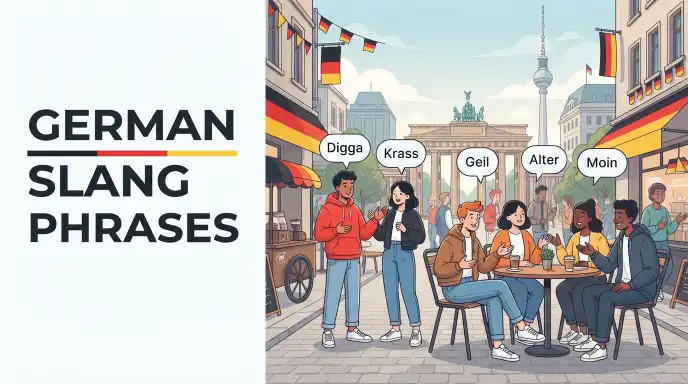
German slang phrases are informal words and expressions that people use in everyday conversations instead of formal German. They help speakers sound more natural, friendly, and relaxed.
Many German slang phrases are popular among young people, friends, classmates, and online communities, while others have been used for many years in daily life.
Many people search for German slang phrases because they want to understand German movies, social media posts, songs, travel conversations, or chats with native speakers.
Some phrases are common across Germany, while others are more popular in certain regions. This guide explains their meanings, where they are used, when to avoid them, and how to use them correctly in real conversations.
Quick Answer: German Slang Phrases
German slang phrases are casual expressions used in everyday German instead of formal language. They often make conversations sound more natural, friendly, or humorous. Most are suitable for informal settings like texting, chatting with friends, social media, or casual conversations, but many should not be used in formal business or academic situations.
What Do German Slang Phrases Mean?
German slang phrases are everyday expressions that native speakers use to communicate naturally. They often replace longer or more formal sentences.
Unlike textbook German, slang changes over time. New phrases appear through youth culture, music, television, and social media, while older expressions may become less common.
Some slang is understood throughout Germany. Other phrases may be more common in cities such as Berlin, Hamburg, Munich, or Cologne.
Main features of German slang phrases
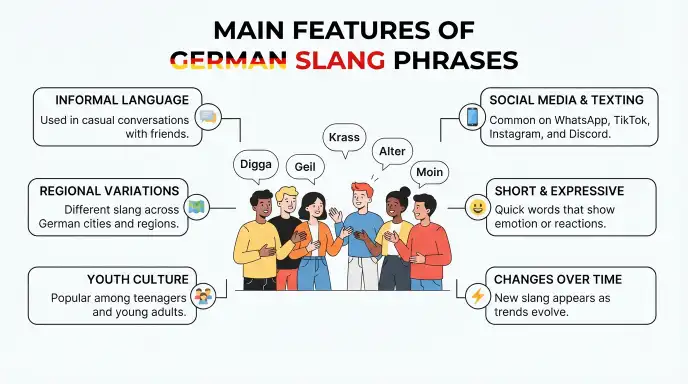
- Short and easy to say
- Often humorous
- Used in casual conversations
- Popular among friends and younger speakers
- Common in text messages and online chats
- Sometimes regional in meaning
Most Common German Slang Phrases
The table below introduces some of the best-known German slang phrases and their everyday meanings.
| German Slang Phrase | English Meaning | Tone |
| Alter! | Dude! / Bro! | Friendly |
| Krass | Wow! / Wild! | Informal |
| Geil | Awesome / Cool | Casual |
| Bock haben | Feel like doing something | Casual |
| Kein Ding | No problem | Friendly |
| Na? | Hi / What’s up? | Casual greeting |
| Läuft | It’s going well | Relaxed |
| Chill mal | Relax | Informal |
| Passt | That’s fine | Neutral |
| Quatsch | Nonsense | Casual |
These expressions are heard every day in Germany and are useful for understanding real conversations.
What Does “Alter!” Mean?
Alter! is one of the most common German slang phrases.
It literally means “old one,” but people usually use it like:
- Dude!
- Bro!
- Man!
Examples
- Alter, das war unglaublich!
Dude, that was amazing! - Alter, was machst du da?
Bro, what are you doing?
The phrase is friendly when used with friends, but it may sound rude if said to strangers.
What Does “Krass” Mean?
Krass is used to express surprise.
Depending on the situation, it can mean:
- Wild
- Wow
- Incredible
- Extreme
Examples
- Krass! Das Auto ist riesig.
Wow! That car is huge. - Das ist krass.
That’s Wild.
The tone depends on context. It can describe something positive or negative.
What Does “Geil” Mean?
Geil is a very common German slang word.
Today it usually means:
- Awesome
- Cool
- Great
Years ago, it had a stronger sexual meaning. Today, most people use it simply to praise something in casual conversation.
Examples
- Das Konzert war geil.
The concert was awesome. - Der Film war richtig geil.
The movie was really great.
Because of its history, some people may avoid using it in formal settings.
What Does “Bock haben” Mean?
Bock haben means to feel like doing something.
Examples
- Ich habe Bock auf Pizza.
I feel like eating pizza. - Hast du Bock mitzukommen?
Do you want to come along?
This phrase is very common among friends.
What Does “Kein Ding” Mean?
Kein Ding is an easy way to say:
- No problem
- You’re welcome
- It’s okay
Examples
- Danke!
Kein Ding! - Sorry, ich komme später.
Kein Ding.
It creates a relaxed and friendly tone.
Where Are German Slang Phrases Commonly Used?
German slang appears in many everyday situations. Some places use it more often than others.
| Place | How Common? | Notes |
| Friends | Very Common | Everyday conversations |
| Text Messages | Very Common | Short and casual |
| WhatsApp Chats | Very Common | Popular among all ages |
| Common | Captions and comments | |
| TikTok | Very Common | Youth slang appears often |
| YouTube | Common | Vlogs and entertainment |
| Common | Informal discussions | |
| Discord | Common | Gaming and community chats |
| Gaming | Common | Team conversations |
| School | Common | Students speaking casually |
| Workplace | Limited | Only with close coworkers |
| Business Emails | Not Recommended | Use standard German instead |
Why Do People Use German Slang Phrases?
People use slang because it makes conversations feel more natural and relaxed.
Common reasons include:
- To sound like a native speaker
- To fit into casual conversations
- To express emotions quickly
- To make conversations more friendly
- To communicate naturally online
- To understand German media and entertainment
- To connect with younger speakers
Using the right slang at the right time helps learners understand everyday German much better than studying formal language alone.
Origin and History of German Slang Phrases
German slang has developed over many generations. Some expressions have been part of everyday speech for decades, while others became popular through music, television, youth culture, and the internet.
Modern social media platforms such as TikTok, Instagram, YouTube, Reddit, and Discord have helped new slang spread much faster than in the past. A phrase that starts in one city can become popular across Germany within a short time.
Regional dialects also influence slang. Berlin, Hamburg, Cologne, Munich, and other areas each have their own local expressions. Some stay regional, while others become widely understood.
The meaning of slang can also change over time. For example, “geil” once had a mainly sexual meaning, but today it is commonly used to mean “awesome” or “great” in casual speech. Context still matters, especially with older speakers.
Are German Slang Phrases Rude or Harmless?
Most German slang phrases are harmless when used with friends or people of a similar age. The tone depends on the expression, the situation, and the relationship between the speakers.
| Slang Phrase | Usually Harmless? | Suitable for Work? |
| Alter | Yes | No |
| Krass | Yes | Usually No |
| Geil | Mostly Yes | Better Avoid |
| Kein Ding | Yes | Sometimes |
| Bock haben | Yes | Casual Only |
| Chill mal | Yes | No |
| Läuft | Yes | Casual Only |
| Passt | Yes | Sometimes |
Even harmless slang may sound too informal during:
- Job interviews
- Business meetings
- Academic presentations
- Speaking with teachers
- Formal customer service
Choose standard German when you want to sound professional or respectful.
Real-Life Examples of German Slang Phrases
Friends
Anna: Hast du heute Abend Bock auf einen Film?
Lena: Klar!
Text Message
Tom: Danke fürs Helfen!
Max: Kein Ding.
School
Ben: Alter, die Matheprüfung war schwer.
Paul: Ja, total krass.
Social Media
Comment: Das Outfit ist echt geil!
Gaming
Player 1: Das Match war krass.
Player 2: Läuft!
Travel
Tourist: Danke für Ihre Hilfe.
Local: Kein Ding.
German Slang Phrases by Situation
| Situation | Good Choice | Better Avoid |
| Friends | Alter | Very formal German |
| Family | Kein Ding | Offensive slang |
| School | Krass | Insults |
| Gaming | Läuft | Formal expressions |
| Social Media | Geil | Offensive language |
| Workplace Chat | Passt | Alter, Chill mal |
| Business Email | Standard German | Most slang phrases |
Similar German Slang Words and Phrases
If you understand these expressions, everyday German becomes much easier to follow.
| Slang | Meaning |
| Moin | Hello |
| Servus | Hi / Bye |
| Jo | Yes |
| Nö | No |
| Digga | Dude |
| Mega | Very good |
| Nice | Cool |
| Hammer | Amazing |
| Klar | Of course |
| Easy | No problem |
Some of these words come from regional speech or English influence. Their popularity can vary by age and location.
Why Do German Slang Phrases Change So Often?
Slang reflects how people speak in real life. New words appear as culture changes.
Common influences include:
- Young people creating new expressions
- Music and rap culture
- Television and streaming shows
- Online gaming
- TikTok trends
- Instagram creators
- Internet memes
- English loanwords
Some phrases become popular for only a few years. Others remain part of everyday German for decades.
When Should You Avoid Using German Slang Phrases?
German slang is not suitable for every situation.
Avoid it when speaking:
- During job interviews
- In formal business meetings
- In professional emails
- With government offices
- During academic presentations
- With people who expect formal language
- When you are unsure of the phrase’s meaning
If you are still learning German, it is better to understand slang before trying to use it. Native speakers appreciate correct timing more than using many slang words.
Polite Alternatives to German Slang
Sometimes standard German is a better choice.
| Instead of Slang | Use This |
| Alter | Entschuldigung or the person’s name |
| Geil | Sehr gut |
| Krass | Wirklich erstaunlich |
| Chill mal | Bitte beruhige dich |
| Kein Ding | Gern geschehen |
| Jo | Ja |
| Nö | Nein |
These alternatives sound more appropriate in professional, academic, or formal settings.
Common Misunderstandings About German Slang Phrases
All Germans use the same slang
No. Many expressions differ by region, city, and age group.
Slang is always rude
No. Most slang is simply informal and friendly.
Slang should be used everywhere
No. Formal situations usually require standard German.
Every slang word is new
No. Some expressions have been part of spoken German for many years, while others are recent additions driven by social media and youth culture.
German slang is difficult to learn
Not really. Learning a few common phrases and understanding when to use them is enough to follow many everyday conversations.
(FAQs)
Q1. What are German slang phrases?
German slang phrases are informal expressions that native speakers use in everyday conversations. They make speech sound more natural and relaxed than formal German.
Q2. Are German slang phrases used on social media?
Yes. Many German slang phrases are common on TikTok, Instagram, Reddit, Discord, YouTube, WhatsApp, and other messaging platforms. Younger users often introduce new expressions that spread quickly online.
Q3. Can I use German slang at work?
It depends on the workplace. Casual slang may be acceptable with close coworkers, but formal German is the better choice for meetings, emails, presentations, and conversations with clients.
Q4. Is “geil” considered offensive?
Usually no. Today, many people use geil to mean “awesome” or “great.” However, because the word originally had a sexual meaning, some older speakers or formal settings may view it as inappropriate.
Q5. What is the most common German slang phrase?
There is no single answer, but expressions such as Alter, Krass, Kein Ding, Bock haben, and Geil are among the most widely recognized across Germany.
Q6. Do German slang phrases change over time?
Yes. Slang evolves as people create new expressions and old ones become less popular. Music, films, gaming, and social media all influence how German slang develops.
Q7. Are German slang phrases the same in every region?
No. Germany has many regional dialects, so some slang is local while other expressions are understood nationwide.
Q8. Should beginners learn German slang?
Yes. Learning common slang helps you understand real conversations, movies, podcasts, and online content. It is still important to learn standard German first and use slang only in appropriate situations.
Conclusion
German slang phrases make everyday conversations sound natural, friendly, and authentic. They are widely used in chats, social media, gaming, travel, and conversations with friends. Knowing common expressions like Alter, Krass, Kein Ding, and Bock haben can help you understand native speakers with greater confidence.
Remember that slang depends on context. A phrase that sounds normal among friends may not be suitable in a workplace or formal setting. When in doubt, choose standard German. As you become more familiar with the language, you will naturally learn which slang expressions fit different situations and which ones are best avoided.
Read More About !
- Work in Spanish Slang: Informal Ways to Say Work in Spanish
- What Is Yachting Slang? Meaning, Uses, and Examples
- What Is Yachting Slang? Meaning, Uses, and Examples

Michael Brooks is a language writer at SlangPath with 7+ years of experience creating simple, practical content on English slang and everyday expressions.