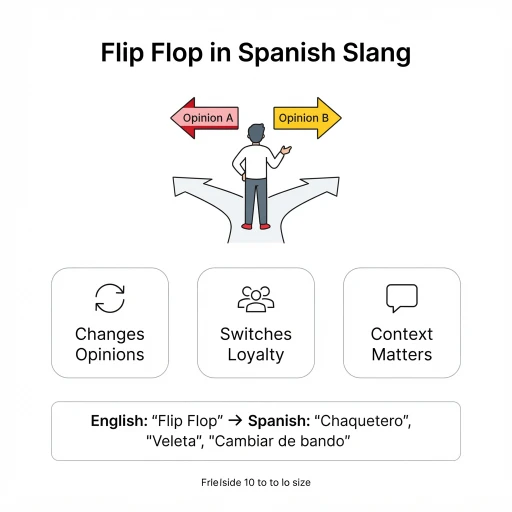
Flip flop in Spanish slang usually refers to someone who frequently changes their opinion, loyalty, or position. Depending on the country, different slang words are used to describe this behavior, and the tone can range from playful teasing to serious criticism.
If you’ve seen someone called a “flip flop” in English and wondered how to say it in Spanish, the answer isn’t always a direct translation. Spanish speakers often use different expressions depending on the situation and the region.
In this guide, you’ll learn what flip flop in Spanish slang means, common Spanish equivalents, where they’re used, whether they’re offensive, and how to use them naturally in conversations.
Quick Answer: Flip Flop in Spanish Slang
A flip flop is a person who constantly changes sides, opinions, or decisions.
Common Spanish slang equivalents include:
| English | Spanish Slang | Meaning |
| Flip flop | Chaquetero / Chaquetera | Someone who changes loyalty easily |
| Flip flop | Veleta | A person who changes opinions depending on circumstances |
| Flip flop | Cambia de bando | Someone who switches sides |
| Flip flop | Doble cara (context-specific) | Two-faced person (not exactly the same) |
The best expression depends on the country and the context.
What Does Flip Flop in Spanish Slang Mean?
In slang, calling someone a flip flop means they are inconsistent. They may support one person today and someone else tomorrow, or change their opinions whenever it benefits them.
Spanish doesn’t have one universal slang word that matches “flip flop.” Instead, speakers choose different expressions based on the situation.
Examples include:
- Politics
- Sports teams
- Friend groups
- Online debates
- School discussions
- Workplace conversations
The common idea is that the person keeps changing sides instead of staying consistent.
Different Meanings Depending on Context
Someone Who Changes Opinions
This is the most common meaning.
Example:
“Yesterday he supported the idea. Today he hates it.”
People may jokingly call that person a flip flop.
Someone Who Changes Loyalty
A person who suddenly supports another sports club, political party, or group may be described using Spanish slang like chaquetero.
Example:
“He supported one team for years but switched after they started losing.”
Someone Who Cannot Make Decisions
Sometimes “flip flop” simply means an indecisive person.
Example:
“She changes her mind every five minutes.”
This meaning is less insulting and more playful.
Common Spanish Slang Words for Flip Flop
1. Chaquetero / Chaquetera
This is one of the closest slang equivalents.
Meaning:
A person who changes loyalty whenever it benefits them.
Tone:
- Informal
- Mildly negative
- Common in Spain
Example:
“Everyone says he’s a chaquetero because he always supports the winning side.”
2. Veleta
Literally, a weather vane.
In slang, it describes someone who changes opinions depending on the situation.
Example:
“Don’t trust him—he’s a veleta.”
This metaphor is similar to saying someone “goes whichever way the wind blows.”
3. Cambia de Bando
Meaning:
Someone who changes sides.
Often used in politics, sports, or arguments.
Example:
“She changed teams again.”
4. Doble Cara
This does not mean flip flop exactly.
Instead, it means:
- Two-faced
- Fake
- Pretending to support different people
Use it only if the person is being dishonest, not simply changing opinions.
Where Is Flip Flop in Spanish Slang Commonly Used?
The idea of a “flip flop” appears in many everyday conversations across Spanish-speaking countries, although the exact slang word changes by region.
Social Media
People use it when someone suddenly changes their opinion after a trend becomes popular.
Example:
“Last week you hated that singer. Now you’re their biggest fan!”
Sports
Fans sometimes tease people who switch to whichever team is winning.
Example:
“You’re such a chaquetero—you only support champions.”
Politics
The term is often used for politicians or voters who frequently change political positions.
Friend Groups
Friends may jokingly call someone a flip flop when they constantly change plans or opinions.
Online Discussions
On platforms like TikTok, Instagram, Reddit, Discord, and X (formerly Twitter), users may accuse someone of “flip-flopping” if they contradict earlier posts.
Is Flip Flop in Spanish Slang Rude?
Usually, yes—but only mildly.
Its tone depends on how it’s used.
| Situation | Tone |
| Friendly joke | Light-hearted |
| Sports rivalry | Mild teasing |
| Political debate | Negative |
| Serious accusation | Offensive |
| Online arguments | Often insulting |
Using words like chaquetero or veleta among close friends may be harmless. However, saying them during a heated argument can sound disrespectful.
Real-Life Examples
Example 1 – Friends
Carlos: You loved that movie yesterday.
Luis: Not anymore.
Carlos: Wow, you’re such a flip flop!
Example 2 – Soccer
“He always supports whichever club wins the league.”
Example 3 – School
“You said math was your favorite subject last week.”
Example 4 – Workplace
“Our manager keeps changing the plan every meeting.”
Example 5 – Politics
“Many voters criticized the candidate for changing positions too often.”
Origin and History
The English phrase flip-flop originally described the sound made by rubber sandals while walking. Over time, it became a metaphor for someone who quickly changes direction or opinions.
Spanish developed its own expressions instead of borrowing the English slang directly.
Examples include:
- Chaquetero – especially common in Spain.
- Veleta – compares a person to a weather vane that turns with the wind.
- Cambiar de bando – literally “to change sides.”
There is no single official Spanish slang translation, which is why different countries prefer different words.
Similar Slang and Related Terms
| Spanish Term | English Meaning | Same as Flip Flop? |
| Chaquetero | Turncoat | ✔ Very close |
| Veleta | Weather vane | ✔ Close |
| Cambia de bando | Switches sides | ✔ Yes |
| Doble cara | Two-faced | ✖ Not exactly |
| Inconstante | Inconsistent | ✔ Formal |
| Cambiante | Changeable | ✔ Neutral |
Why Do People Use This Slang?
People use flip-flop slang to describe someone who:
- Changes opinions often.
- Follows popular trends.
- Switches favorite teams.
- Changes political views frequently.
- Cannot make decisions.
- Adapts their opinion to fit the crowd.
Sometimes it’s meant as a joke, but in serious situations it can criticize someone’s lack of consistency.
When Should You Avoid Using It?
Avoid calling someone a flip flop or chaquetero when:
- You’re speaking with teachers or professors.
- You’re writing formal emails.
- You’re at work.
- You’re talking to someone you don’t know well.
- You’re discussing sensitive political topics.
In these situations, choose neutral words like:
- Inconsistent
- Changes opinions often
- Undecided
- Frequently changes position
Common Misunderstandings
People sometimes misunderstand the phrase flip flop in Spanish slang because there isn’t one perfect Spanish translation. Here are some common mistakes:
“Flip Flop” Doesn’t Mean Sandals Here
In English, flip-flops are also rubber sandals. When discussing slang, however, the meaning is completely different. It refers to changing opinions or loyalty, not footwear.
It Doesn’t Always Mean Someone Is Fake
A flip flop may simply be someone who changes their mind often. That doesn’t necessarily mean they’re dishonest or two-faced.
“Doble Cara” Is Not Always the Best Translation
While doble cara means “two-faced,” it implies deception. A person who flip-flops may simply be indecisive rather than intentionally misleading others.
Different Countries Use Different Expressions
Spanish speakers in Spain, Mexico, Argentina, Colombia, and other countries may prefer different slang words. There is no single universal equivalent.
Frequently Asked Questions
Q1:What does flip flop mean in Spanish slang?
It usually refers to someone who frequently changes opinions, loyalty, or decisions. Common Spanish expressions include chaquetero, veleta, or cambiar de bando, depending on the country.
Q2:Is there a direct Spanish translation for flip flop?
No. Spanish uses several different words and phrases instead of one exact translation.
Q3:Is “chaquetero” offensive?
It can be mildly insulting because it suggests someone changes sides whenever it’s convenient. Among friends, it is often used jokingly.
Q4:Is flip flop used on social media?
Yes. People often use the idea of “flip-flopping” on platforms like TikTok, Instagram, Reddit, Discord, and X to criticize users who suddenly change their opinions or support different trends.
Q5:Can I use flip flop in professional conversations?
It’s better to avoid slang in formal settings. Instead, use neutral phrases like:
- Changes opinions frequently
- Is inconsistent
- Frequently changes position
- Undecided
Q6:Is flip flop always negative?
Not always. Friends may use it playfully, but in debates about politics, sports, or serious issues, it can sound critical or insulting.
Q7:What’s the difference between “veleta” and “chaquetero”?
Veleta compares someone to a weather vane that turns with the wind, emphasizing changing opinions. Chaquetero focuses more on switching loyalty or support, especially when it benefits the person.
Conclusion
Flip flop in Spanish slang describes someone who frequently changes opinions, loyalties, or decisions. While English uses the single phrase “flip flop,” Spanish relies on several expressions such as chaquetero, veleta, and cambiar de bando, each with slightly different meanings and regional usage.
The best word depends on the country and the situation. Understanding these differences helps you communicate more naturally with Spanish speakers and avoid using a term that doesn’t fit the context.
Whether you’re reading social media posts, watching Spanish-language content, or chatting with native speakers, knowing the meaning of flip flop in Spanish slang will make conversations much easier to understand.
Read More About!

Michael Brooks is a language writer at SlangPath with 7+ years of experience creating simple, practical content on English slang and everyday expressions.