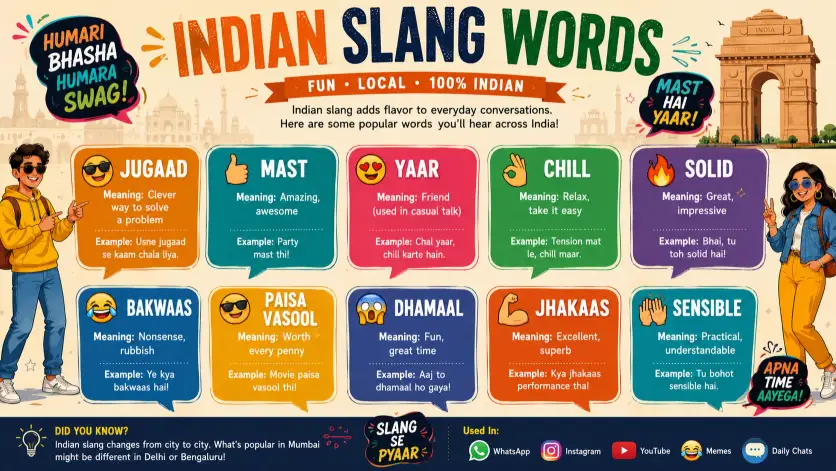
Indian slang words are informal words and phrases that people in India use in everyday conversations, texting, social media, and online communities.
These expressions often come from Hindi, English, or regional Indian languages, making communication more fun, natural, and expressive. Some slang words are understood across the country, while others are popular only in certain cities or states.
People search for Indian slang words to understand movie dialogues, chat with Indian friends, follow social media trends, or learn how locals communicate in casual settings. In this guide, you’ll discover the meanings of popular Indian slang words, where they are commonly used, whether they are friendly or offensive, and how to use them correctly with real-life examples.
Whether you’re a student, traveler, content creator, or simply curious about Indian culture, this article will help you understand Indian slang with confidence.
Indian slang words are informal words and phrases commonly used in India during everyday conversations, texting, social media, gaming, and online chats. They often come from Hindi, English, or other Indian languages and may have different meanings depending on the situation, region, or tone.
What Are Indian Slang Words?
Indian slang words are casual expressions that people in India use with friends, classmates, coworkers, and online communities. Many of these words mix English with Hindi, while others come from regional languages such as Punjabi, Tamil, Bengali, Marathi, Telugu, or Gujarati.
Unlike formal English, slang changes quickly. A word that is popular on Instagram today may become outdated in a few years. Some slang is friendly and funny, while other terms can sound rude or offensive depending on how they are used.
People often search for Indian slang words because they:
- Want to understand conversations with Indian friends.
- Watch Indian movies or web series.
- Use Indian social media pages.
- Play online games with Indian players.
- Travel to India.
- Learn Indian English and local expressions.
Understanding the meaning and context helps you avoid confusion and communicate more naturally.
Different Types of Indian Slang Words
Indian slang is not one single language. It includes words from different cultures, regions, and generations.
| Type | Description | Example |
| Hindi Slang | Everyday words borrowed from Hindi. | Yaar, Jugaad |
| Hinglish Slang | A mix of Hindi and English. | Timepass, Bakchod |
| Regional Slang | Words from local Indian languages. | Varies by state |
| College Slang | Popular among students. | Fattu, Scene |
| Internet Slang | Common on social media and chats. | OP, Lit, Amazing |
| Gaming Slang | Used by Indian gamers. | Noob, Clutch, Carry |
Many people also create new slang by combining English with local languages. This makes Indian slang rich, creative, and constantly changing.
Where Are Indian Slang Words Commonly Used?
Indian slang appears in many everyday situations. The meaning often depends on who is speaking and where the conversation happens.
Social Media
Platforms like Instagram, Facebook, Snapchat, and X are full of Indian slang. Short expressions make posts sound casual and relatable.
Example:
“Bro, that reel is total timepass!”
WhatsApp and Text Messages
Friends and family often use slang in quick chats instead of formal language.
Example:
“Kya scene hai tonight?”
College and School
Students frequently use slang while talking with classmates. Some expressions become popular on one campus before spreading online.
Example:
“Don’t be such a fattu.”
Gaming Communities
Indian gamers use both international gaming slang and local expressions while playing multiplayer games.
Example:
“Carry the team, yaar!”
Movies and Web Series
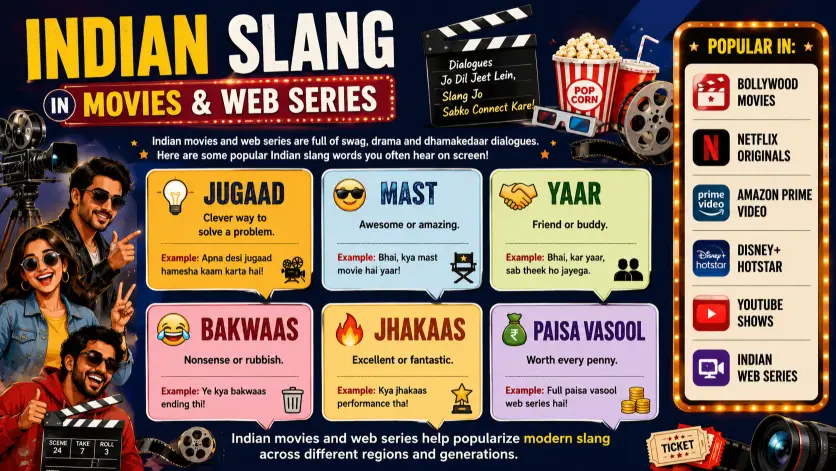
Bollywood films and Indian streaming shows introduce many slang words to a wider audience. Some expressions become popular across the country after appearing in hit movies or viral scenes.
Why Do People Use Indian Slang Words?
People use slang because it feels more natural than formal language in casual conversations.
Some common reasons include:
- To sound friendly.
- To express emotions quickly.
- To make conversations more humorous.
- To fit into a social group.
- To reflect local culture.
- To communicate naturally online.
- To make texting faster and more expressive.
Slang also helps people show their personality. Young people especially enjoy using trendy expressions that feel modern and relatable.
Are Indian Slang Words the Same Across India?
No. India is home to hundreds of languages and dialects, so slang varies from one region to another.
For example:
- A slang word popular in Delhi may be uncommon in Chennai.
- Mumbai has many expressions influenced by Hindi, Marathi, and Bollywood.
- Punjabi slang is common in North India and on social media.
- Southern states often use slang from Tamil, Telugu, Kannada, or Malayalam.
Because of these regional differences, the same word may have different meanings—or may not be understood at all—in another part of the country.
Popular Indian Slang Words and Their Meanings
The table below explains some of the most common Indian slang words. Most are used in casual conversations, texting, memes, and social media. Their meaning can change slightly depending on tone and context.
| Slang Word | Meaning | Tone | Common Use |
| Yaar | Friend, buddy | Friendly | Everyday conversation |
| Jugaad | A clever solution using limited resources | Positive | Work, business, daily life |
| Bakchod | Someone who talks nonsense or jokes a lot | Informal | Friends |
| Fattu | A coward or someone who gets scared easily | Teasing | College slang |
| Timepass | Something done just to pass time | Neutral | Social media, daily talk |
| Bindaas | Relaxed, carefree, confident | Positive | Everyday conversation |
| Jhakaas | Awesome, amazing | Positive | Mumbai slang |
| Scene Kya Hai? | What’s the plan? | Casual | Friends, texting |
| Panga | Trouble or conflict | Informal | Daily speech |
| Chindi | Cheap or stingy person | Negative | Casual conversation |
Yaar
Meaning
Yaar means friend, buddy, or someone close to you. It is one of the most popular slang words in India and is used by people of all ages.
Tone
Friendly and casual.
Examples
- “Yaar, let’s go for dinner.”
- “Thanks, yaar. You really helped me.”
Where It’s Used
- Text messages
- College
- Family and friends
- Social media
Jugaad
Meaning
Jugaad describes a smart, creative solution to a problem using whatever resources are available.
Tone
Positive and admiring.
Examples
- “He fixed the bike with pure jugaad.”
- “That was an amazing jugaad to save money.”
Where It’s Used
- Business
- Daily life
- Workplaces
- Startups
- Social media
Bakchod
Meaning
Bakchod usually describes someone who talks too much, jokes constantly, or says silly things.
Tone
Playful among friends but can sound rude if used with strangers.
Examples
- “Stop being such a bakchod.”
- “Our whole group is full of bakchods.”
Should You Use It?
Use it only with friends who understand the joke. Avoid using it in professional or formal settings.
Fattu
Meaning
Fattu refers to someone who is easily frightened or lacks confidence.
Tone
Usually teasing.
Examples
- “Don’t be a fattu. Try it once.”
- “He backed out because he was acting like a fattu.”
Is It Offensive?
It can hurt someone’s feelings if used seriously, so avoid saying it to people you do not know well.
Timepass
Meaning
Timepass describes an activity that is done only to avoid boredom.
Tone
Neutral.
Examples
- “We’re just watching videos for timepass.”
- “That movie was okay for timepass.”
Common Platforms
- YouTube comments
Bindaas
Meaning
Bindaas means carefree, confident, or fearless.
Tone
Positive.
Examples
- “She has a bindaas personality.”
- “Just stay bindaas and enjoy yourself.”
Jhakaas
Meaning
Jhakaas means excellent, fantastic, or very impressive.
Tone
Excited and positive.
Examples
- “That bike looks jhakaas!”
- “Your performance was absolutely jhakaas.”
Scene Kya Hai?
Meaning
This popular phrase simply means “What’s the plan?” or “What’s happening?”
Examples
- “Scene kya hai tonight?”
- “Bro, scene kya hai after class?”
Common Use
- Group chats
- College friends
- Weekend planning
Panga
Meaning
Panga means getting into trouble, conflict, or an argument.
Examples
- “Don’t take panga with him.”
- “I don’t want any panga today.”
Tone
Usually informal and slightly serious.
Chindi
Meaning
Chindi describes someone who is very cheap, stingy, or unwilling to spend money.
Examples
- “Don’t be so chindi.”
- “He’s acting chindi over a few dollars.”
Tone
Negative and teasing.
Are Indian Slang Words Rude, Offensive, or Harmless?
Most Indian slang words are harmless when used among friends. However, some expressions become offensive depending on the speaker, tone, and situation.
| Category | Examples | Safe to Use? |
| Friendly | Yaar, Bindaas, Timepass | ✅ Yes |
| Casual | Scene Kya Hai, Jugaad, Jhakaas | ✅ Yes |
| Teasing | Fattu, Chindi | ⚠️ Use carefully |
| Potentially Offensive | Bakchod | ❌ Avoid in formal settings |
Always consider:
- Your relationship with the listener.
- The setting.
- The tone of the conversation.
- Local cultural differences.
Indian Slang Words on Social Media
Many Indian slang words are now used online as often as they are spoken.
| Platform | Popular Slang |
| Yaar, Bindaas, Timepass | |
| Scene Kya Hai, Yaar | |
| Jugaad, Timepass | |
| Bakchod, Panga | |
| Discord | Yaar, Scene Kya Hai |
| Gaming Chats | Yaar, Panga, Jugaad |
These words help conversations feel relaxed, humorous, and relatable.
Origin and History of Indian Slang Words
Quick Answer
Most Indian slang words come from everyday speech, regional languages, Bollywood, college culture, and the internet. Many are older local expressions, while others became popular through memes, social media, and online gaming. The exact origin of every slang word is not always known, and some meanings have changed over time.
Indian slang reflects the country’s linguistic diversity. Hindi has influenced many commonly used slang words, but English, Punjabi, Marathi, Tamil, Bengali, Telugu, Gujarati, and other languages have also contributed. In recent years, platforms like Instagram, YouTube, WhatsApp, and online games have helped slang spread across different regions much faster than before.
Why Do People Use Indian Slang Words?
Quick Answer
People use Indian slang words because they make conversations sound more relaxed, expressive, and natural.
Common reasons include:
- Showing friendship
- Expressing emotions quickly
- Making conversations funny
- Saving time while texting
- Following online trends
- Feeling connected to local culture
- Sounding casual instead of formal
Slang also helps people communicate personality. Younger generations often adopt new expressions from social media, while older slang may continue to be used in families or local communities.
When Should You Avoid Using Indian Slang Words?
Quick Answer
Avoid Indian slang words in situations where professionalism, respect, or clarity is important.
It is best not to use slang when speaking with:
- Teachers
- Professors
- Employers
- Clients
- Government officials
- Job interviewers
- People who may not understand the expression
Some slang words, such as Bakchod, Fattu, or Chindi, may sound insulting if used with strangers or in serious conversations. Even friendly slang like Yaar may feel too casual in formal emails or workplace meetings.
Always consider:
- Who you are talking to.
- Whether the setting is formal or informal.
- Whether the listener understands Indian slang.
Polite Alternatives to Indian Slang Words
| Indian Slang | Polite Alternative |
| Yaar | Friend |
| Fattu | Nervous person |
| Bakchod | Funny person |
| Chindi | Careful with money |
| Panga | Problem |
| Timepass | Casual entertainment |
| Jhakaas | Excellent |
| Bindaas | Confident |
Using polite alternatives is a better choice in schools, workplaces, or professional communication.
Common Misunderstandings About Indian Slang Words
Many people misunderstand Indian slang because the same word can have different meanings depending on the speaker, region, or tone.
Some common misconceptions include:
- Not every Indian slang word is Hindi. Many come from regional languages.
- The same slang may have different meanings in different cities.
- Some words are playful among friends but rude with strangers.
- Internet popularity does not make every slang word appropriate for all situations.
- Older slang may sound outdated to younger speakers.
Learning the context is just as important as learning the definition.
Indian Slang Words vs Standard English
| Feature | Indian Slang | Standard English |
| Style | Casual | Formal |
| Usage | Friends, texting, social media | School, work, official writing |
| Tone | Relaxed | Professional |
| Changes Over Time | Frequently | Slowly |
| Regional Differences | High | Low |
Frequently Asked Questions
Q1. What are Indian slang words?
Indian slang words are informal expressions commonly used in India during conversations, texting, gaming, and social media.
Q2. Are Indian slang words only used in Hindi?
No. Indian slang comes from many languages, including Hindi, Punjabi, Marathi, Tamil, Bengali, Telugu, Gujarati, and English.
Q3. Are Indian slang words rude?
Most are harmless, but some can sound offensive depending on the situation and tone.
Q4. Can I use Indian slang at work?
Usually no. Formal workplaces are better suited to standard English unless you know your audience well.
Q5. Which Indian slang word means “friend”?
Yaar is one of the most common slang words for “friend” or “buddy.”
Q6. Is Indian slang popular on social media?
Yes. Many Indian slang words are widely used on Instagram, WhatsApp, Facebook, YouTube, Reddit, Discord, and gaming platforms.
Q7. Why does Indian slang change so quickly?
New movies, music, memes, influencers, and internet trends regularly introduce fresh slang while older expressions become less common.
Q8. Can tourists use Indian slang?
Yes, but only after understanding the meaning and context. Using friendly slang correctly can make conversations feel more natural.
Conclusion
Indian slang words make everyday conversations more lively, expressive, and culturally rich. They come from many Indian languages and continue to evolve through regional speech, Bollywood, social media, and online communities
. While many slang words are friendly and fun, others should be used carefully because their meaning depends on context and tone.
If you are learning Indian English, chatting with friends, traveling to India, or simply exploring internet culture, understanding Indian slang words will help you communicate with greater confidence and avoid common misunderstandings.
Read More About!
- Mafia Slang Terms: Meanings, Origins, and Real-Life Examples
- Purr Meaning in Text: What Does Purr Slang Mean?
- Names for Money Slang: Popular Words and Their Meanings

Michael Brooks is a language writer at SlangPath with 7+ years of experience creating simple, practical content on English slang and everyday expressions.