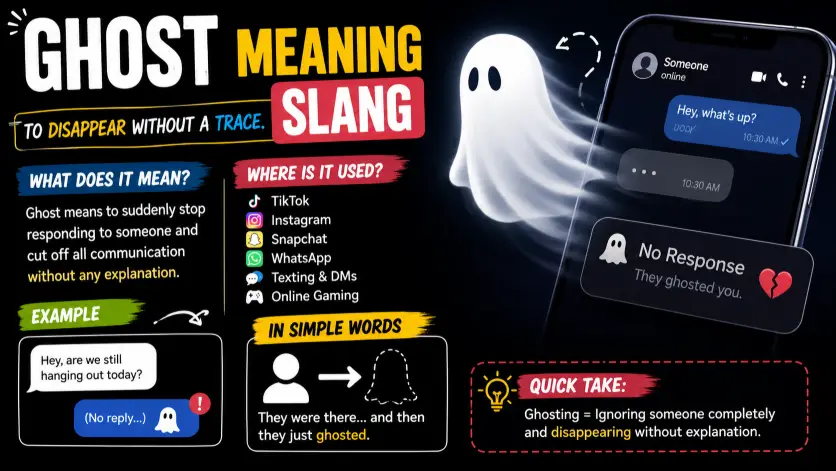
Ghost meaning slang is one of the most searched internet terms because people often see it in text messages, dating apps, social media, and online conversations. If someone suddenly stops replying without giving a reason, you may hear people say they were “ghosted.
” The term has become common on platforms like TikTok, Instagram, Snapchat, Reddit, Discord, and messaging apps because it describes a situation many people experience.
Although ghosting is often connected with dating, it can also happen between friends, family members, coworkers, or even online gaming communities.
Understanding what this slang means helps you recognize the context and avoid misunderstanding conversations. In this guide, you’ll learn the meaning of ghost in slang, where it came from, how people use it, and when it may or may not be appropriate to use.
Quick Answer:mafia slang terms
Ghost meaning slang refers to suddenly cutting off communication with someone without any explanation. A person who “ghosts” stops replying to messages, calls, or social media interactions and disappears from the conversation.
What Does Ghost Mean in Text?
In texting and online conversations, ghost means to suddenly stop communicating with someone without explaining why. Instead of saying goodbye or ending the conversation honestly, the person simply disappears.
For example, someone may stop replying to texts, ignore calls, leave messages on “read,” or even block another person without warning.
Ghosting is most often associated with dating, but it also happens in friendships, workplace communication, gaming groups, and social media conversations.
Simple Definition
Ghost (slang): To completely stop communicating with someone without giving any reason.
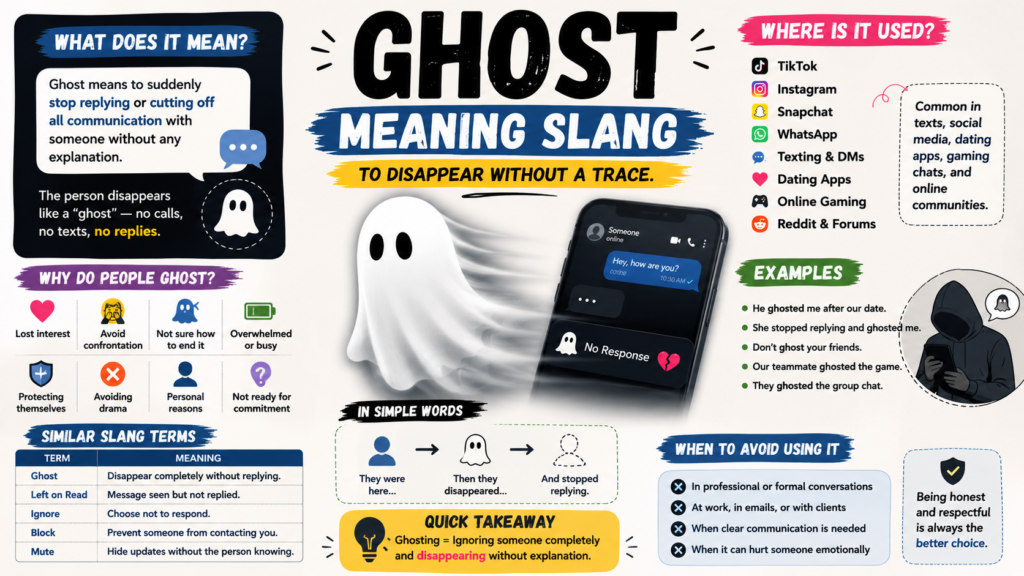
What does ghost mean in slang?
In slang, ghost means to suddenly disappear from someone’s life by ignoring messages, calls, or communication without offering an explanation.
Ghost Full Form / Definition
Unlike abbreviations such as LOL or BRB, ghost does not have a full form.
It is a regular English word that has gained a new slang meaning in digital communication.
In internet slang, ghost means:
- Suddenly disappearing from communication
- Ignoring texts or messages
- Ending contact without explanation
- Leaving someone wondering what happened
The person who disappears is said to have ghosted someone.
Example:
- “He ghosted me after our second date.”
- “She completely ghosted our group chat.”
Is Ghost Rude, Offensive, or Neutral?
The word ghost itself is neutral. However, the action of ghosting is usually considered rude because it leaves the other person confused and without closure.
Whether it feels offensive depends on the situation.
| Situation | Is It Rude? | Explanation |
| Dating | Usually Yes | Leaving without explanation often hurts feelings. |
| Friendship | Often Yes | Friends generally expect honest communication. |
| Workplace | Yes | Professional communication should not involve ghosting. |
| Online Gaming | Sometimes | Players may leave unexpectedly without serious consequences. |
| Safety Situations | Not Always | Cutting contact may be necessary for personal safety. |
There are situations where ghosting may be understandable, such as avoiding harassment, abuse, or unsafe interactions.
Where Is Ghost Commonly Used?
The slang ghost appears across many online platforms because digital communication makes disappearing easy.
Common places include:
- Text messaging
- Instagram DMs
- Snapchat chats
- TikTok comments
- Reddit discussions
- Discord servers
- Facebook Messenger
- Dating apps like Tinder, Bumble, and Hinge
- Online gaming chats
People also use the word in casual face-to-face conversations.
Example:
“I thought everything was fine, then she ghosted me.”
Why Do People Ghost Others?
People ghost for many different reasons. Sometimes it is intentional, while other times it happens because someone feels uncomfortable or doesn’t know how to end a conversation.
Common reasons include:
- Losing interest
- Avoiding awkward conversations
- Fear of confrontation
- Feeling overwhelmed
- Wanting personal space
- Ending an online relationship quietly
- Avoiding conflict
- Protecting personal safety
Not everyone who stops replying is intentionally ghosting. Sometimes people are genuinely busy, dealing with personal issues, or taking a break from social media.
Ghost Meaning Slang in Different Contexts
Dating
Ghosting is most common in online dating.
Example:
“We talked every day for a week, then he ghosted me.”
Friendships
Friends may ghost each other by suddenly ending communication.
Example:
“My old friend ghosted me after moving to another city.”
Social Media
Someone may stop responding to messages while remaining active online.
Example:
“She posts on Instagram every day but still ghosts my messages.”
Gaming
In gaming communities, ghosting may mean suddenly leaving a team, party, or voice chat without saying anything.
Example:
“Our teammate ghosted the match halfway through.”
Workplace
Although less common, ghosting can happen during hiring or professional communication.
Examples include:
- A job applicant stops responding.
- A recruiter never replies after interviews.
- A client suddenly disappears.
This behavior is generally viewed as unprofessional.
Origin and Background of Ghost Meaning Slang
The word ghost has existed in English for centuries to describe the spirit of a dead person. However, its modern slang meaning is much newer.
The slang became popular during the early 2010s as online dating apps and social media grew. People needed a simple word to describe someone who disappeared from a conversation without warning. Instead of saying, “They stopped replying,” users began saying, “They ghosted me.”
Today, the term is widely used across dating apps, messaging platforms, and social media. It has become part of everyday internet language and is understood by millions of people around the world.
Why People Use the Word “Ghost”
People use this slang because it quickly describes a situation that many have experienced.
Common reasons include:
- It is short and easy to understand.
- It describes disappearing without explanation.
- It is commonly recognized online.
- It expresses frustration or disappointment.
- It fits modern texting and social media culture.
Instead of saying:
“He suddenly stopped replying to every message without telling me why.”
People simply say:
“He ghosted me.”
Real-Life Examples of Ghost Meaning Slang
Friendly Tone
- I thought you ghosted me, but your phone was broken.
- Don’t ghost the group chat. We still need your opinion.
- My cousin ghosted everyone during exam week.
- She disappeared for a few days, but she wasn’t trying to ghost us.
Casual Conversation
- He ghosted me after our first date.
- She has been ghosting my texts all week.
- I think they ghosted our gaming group.
- My online friend suddenly ghosted everyone.
Argumentative Tone
- If you wanted to leave, you could have just said so instead of ghosting me.
- Ghosting people is unfair and confusing.
- Don’t ghost someone when an honest conversation would solve the problem.
- I deserved an explanation, not silence.
Social Media Context
- She watched all my stories but still ghosted my messages.
- He disappeared from Instagram after the argument.
- People joked that the influencer ghosted their followers.
- My friend ghosted every DM this weekend.
Gaming Context
- Our teammate ghosted the match before the final round.
- Please don’t ghost the squad during ranked games.
- He left voice chat and never came back.
- The clan leader ghosted the entire server.
Workplace Context
- The company ghosted applicants after the interviews.
- The client stopped replying to every email.
- Several freelancers complained about being ghosted.
- Professional communication should not involve ghosting.
Comparison with Similar Slang
Many internet slang terms describe ignoring or ending communication. However, they are not exactly the same.
| Slang Term | Meaning | Difference from Ghost |
| Ghost | Completely disappears without explanation | Ends communication entirely |
| Left on Read | Message is seen but not answered | Communication may continue later |
| Ignore | Chooses not to respond | Can happen once or occasionally |
| Block | Prevents someone from contacting you | A direct action instead of disappearing |
| Unfollow | Stops following someone on social media | Doesn’t always end communication |
| Mute | Hides notifications or posts | The other person usually doesn’t know |
Ghost vs Ghosted
People often confuse these forms.
| Word | Meaning |
| Ghost | The action or verb |
| Ghosted | Past tense of ghost |
| Ghosting | The act of disappearing without explanation |
| Ghoster | Informal word for someone who ghosts others |
Example:
- She ghosted me.
- He keeps ghosting people.
- Don’t ghost your friends.
When Should You Avoid Using Ghost?
Although this slang is common, it is not suitable for every situation.
Avoid using it:
- In formal business emails.
- In academic writing.
- During professional presentations.
- In legal documents.
- When speaking with people unfamiliar with internet slang.
Instead, use clearer phrases such as:
- Stopped responding
- Ended communication
- Discontinued contact
- Became unresponsive
Polite Alternatives to Ghost
If you want to describe the situation more professionally, try these alternatives.
| Casual Slang | Polite Alternative |
| Ghosted me | Stopped responding |
| Ghosted the team | Left the conversation |
| Ghosted the client | Ended communication |
| Ghosted everyone | Became unavailable |
| Ghosted my texts | Didn’t reply to my messages |
Impact of Using Ghost in Communication
Like many slang words, ghost can make conversations feel natural and relatable. However, it also depends on your audience.
Positive Effects
- Easy to understand online.
- Saves time while texting.
- Common among younger internet users.
- Expresses a familiar situation quickly.
Possible Drawbacks
- Older audiences may not know the meaning.
- It sounds informal.
- It may seem unprofessional in business settings.
- Some people misunderstand it as referring to actual ghosts.
Is Ghost Safe for Social Media?
Yes. The word ghost is safe to use on social media platforms.
It is commonly seen on:
- TikTok
- Snapchat
- Discord
- X (formerly Twitter)
The slang itself is not offensive. However, discussions about ghosting may involve emotional or relationship-related topics, so using respectful language is always a good idea.
Common Phrases Using Ghost
Here are some expressions you may see online.
- Ghosted me
- Stop ghosting me
- Don’t ghost people
- Ghosted after one date
- Got ghosted
- Ghosted again
- Ghosting my texts
- Professional ghosting
- Ghosting culture
- Why did you ghost me?
Each phrase refers to someone suddenly ending communication without explaining why.
(FAQs)
Q1. What does ghost mean in slang?
In slang, ghost means to suddenly stop communicating with someone without giving any explanation. It usually refers to ignoring texts, calls, or messages and disappearing from the conversation.
Q2. What does ghost mean in text messages?
In text messages, ghost means someone has stopped replying or responding without saying why. The person may leave messages unread or simply disappear from the chat.
Q3. Does ghost have a full form?
No. Ghost is not an abbreviation, so it does not have a full form. It is a regular English word that has developed a new slang meaning in online communication.
Q4. Is ghosting considered rude?
In most situations, yes. Ghosting is generally seen as rude because it ends communication without explanation, which can leave the other person confused or hurt. However, in situations involving harassment, abuse, or personal safety, ending contact without responding may be the safest choice.
Q5. Where is ghost slang commonly used?
The slang is commonly used on:
- TikTok
- Snapchat
- Discord
- Facebook Messenger
- Dating apps
- Text messaging
- Online gaming communities
Q6. Is ghost a negative slang word?
The word itself is neutral, but it usually describes a negative action. Whether it is viewed positively or negatively depends on the situation and the reason someone stopped communicating.
Conclusion
The phrase ghost meaning slang describes one of the most common behaviors in today’s digital world. When someone ghosts another person, they suddenly stop replying to messages, calls, or online conversations without offering an explanation. While the term is most often associated with dating, it also appears in friendships, workplaces, gaming communities, and social media.
Understanding ghost meaning in text helps you interpret online conversations more accurately and use the term in the right context. Although ghosting has become a familiar part of internet culture, clear and respectful communication is usually the better choice whenever possible.
Whether you see the word on TikTok, Reddit, Instagram, Discord, or in a text message, you’ll now know exactly what it means, why people use it, and when it may or may not be appropriate.
Read More About !

Michael Brooks is a language writer at SlangPath with 7+ years of experience creating simple, practical content on English slang and everyday expressions.