Uruguay slang refers to the informal words, phrases, and expressions commonly used by people in Uruguay. Many of these terms come from Rioplatense Spanish, the regional variety of Spanish spoken in Uruguay and neighboring Argentina. While some slang is shared across the region, many expressions are uniquely Uruguayan or have different meanings depending on context.
If you’ve heard words like bo, ta, or gurí, you may wonder what they mean. In this guide, you’ll learn the most common Uruguay slang terms, where they come from, when to use them, and when it’s better to avoid them.
Quick Answer: What Is Uruguay Slang?
Uruguay slang is a collection of informal words and expressions used in everyday conversations throughout Uruguay. It reflects the country’s culture, history, and local way of speaking. Most slang is friendly and harmless, but some expressions can sound rude depending on the situation and tone.
What Does Uruguay Slang Mean?
Uruguay slang includes everyday vocabulary that local people use instead of formal Spanish.
These expressions help speakers sound natural and relaxed with friends, family, classmates, and coworkers.
Many visitors notice that Uruguayans speak differently from Spanish speakers in other countries because they often use:
- Regional vocabulary
- Informal greetings
- Shortened words
- Italian-influenced pronunciation
- Rioplatense Spanish expressions
Learning a few common slang terms makes conversations much easier when visiting Uruguay.
What Are Some Common Uruguay Slang Words and Phrases?
- Uruguay slang words
- Uruguay slang phrases
- common Uruguay slang
- Uruguayan slang words
- Uruguayan Spanish slang
- Uruguay Spanish slang
- slang words in Uruguay
- popular Uruguay slang
Where Is Uruguay Slang Commonly Used?
You’ll hear Uruguay slang almost everywhere in daily life, including:
| Place | How Common? |
| Friends chatting | Very common |
| Family conversations | Very common |
| Schools and universities | Common |
| Cafés and restaurants | Common |
| Football matches | Very common |
| Social media | Very common |
| Text messages | Very common |
| Workplaces | Sometimes, depending on formality |
Formal business meetings usually use standard Spanish instead of heavy slang.
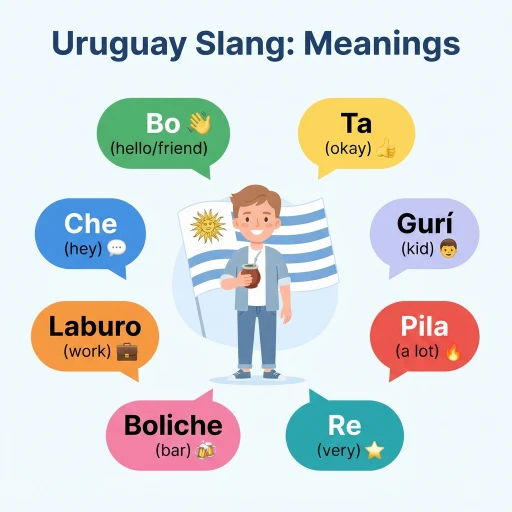
Most Common Uruguay Slang Words
Here are some expressions you’ll hear regularly across Uruguay.
| Slang | Meaning | Tone |
| Bo | Hey, mate, friend | Friendly |
| Ta | OK, alright | Casual |
| Gurí / Gurisa | Boy or girl | Friendly |
| Che | Hey, listen | Informal |
| Pila | A lot, many | Casual |
| Laburo | Work or job | Informal |
| Bondi | Bus | Casual |
| Manya | Supporter of Peñarol football club | Sports |
| Boliche | Bar, club, or small store depending on context | Informal |
| Fiaca | Laziness | Casual |
These words are widely understood throughout Uruguay.
H3: “Bo”
One of Uruguay’s most recognizable slang words.
It is similar to saying:
- Hey
- Buddy
- Mate
- Friend
Examples
- “Bo, are you coming tonight?”
- “Thanks, bo!”
It is friendly rather than rude.
H3: “Ta”
“Ta” is a shortened form of está or está bien.
It usually means:
- OK
- Sure
- Fine
- Got it
Examples
- “Ta, I’ll see you later.”
- “Ta, no problem.”
You’ll hear this word many times every day in Uruguay.
H3: “Gurí”
“Gurí” means:
- Child
- Kid
- Young boy
The feminine form is gurisa.
The word has historical roots connected with Indigenous languages in the region and has been part of local vocabulary for generations.
Examples
- “That gurí loves football.”
- “The gurisa is starting school.”
H3: “Laburo”
“Laburo” simply means work or employment.
It comes from Italian influence, which has shaped much of Uruguay’s everyday speech.
Examples
- “I’m going to laburo.”
- “He found a new laburo.”
It is common in everyday conversations but less common in formal writing.
What Does “Bo” and “Ta” Mean in Uruguay Slang?
- bo meaning Uruguay
- what does bo mean in Uruguay
- ta meaning Uruguay
- what does ta mean in Uruguay
- Uruguay Spanish bo
- Uruguay slang ta
- Uruguayan Spanish expressions
Is Uruguay Slang Rude, Offensive, or Harmless?
Most Uruguay slang is harmless.
However, context always matters.
| Type | Safe to Use? |
| Friendly greetings | Yes |
| Everyday expressions | Yes |
| Football rivalry slang | Usually |
| Insults | No |
| Profanity | Only with close friends |
Some words become offensive only depending on tone or the relationship between speakers.
When speaking with teachers, employers, or older people you don’t know well, standard Spanish is usually the safer choice.
Real-Life Examples
Friends
Person A: Bo, what are you doing tonight?
Person B: Ta, let’s watch the football match.
At School
“I’m meeting my gurí after class.”
At Work
“I have a lot of laburo this week.”
On Social Media
“Ta, that meme was hilarious.”
Family Conversation
“The gurisa starts kindergarten tomorrow.”
These examples reflect natural everyday speech rather than textbook Spanish.
Origin and History of Uruguay Slang
Uruguay slang has developed over hundreds of years through a mix of cultures and languages. The country’s everyday speech is based on Rioplatense Spanish, the variety of Spanish spoken in Uruguay and much of Argentina.
Several influences helped shape modern Uruguayan slang:
- Spanish colonists introduced the base language.
- Italian immigrants added words and pronunciation that are still common today.
- Indigenous languages, especially Guaraní, contributed terms like gurí.
- African cultural influences also played a role in music, traditions, and some vocabulary.
- Modern slang continues to evolve through social media, music, television, and sports.
Because Uruguay shares close cultural ties with Argentina, some slang is nearly identical. However, pronunciation, popularity, and local usage can differ.
Uruguay Slang vs. Argentinian Slang: What Is the Difference?
- Uruguay slang vs Argentina slang
- Uruguayan Spanish vs Argentinian Spanish
- Uruguay and Argentina slang
- Rioplatense Spanish slang
- slang in Uruguay and Argentina
- Uruguayan expressions
- Argentine expressions
Similar Uruguay Slang Terms
If you’re learning Uruguayan Spanish, these related expressions are also useful.
| Word | Meaning |
| Bo | Friend, mate |
| Che | Hey |
| Ta | Okay |
| Dale | Let’s go / Sure |
| Gurí | Child |
| Laburo | Work |
| Pila | A lot |
| Bondi | Bus |
| Boliche | Bar, club, or small shop |
| Fiaca | Laziness |
Many of these words appear in casual conversations every day.
Why Do People Use Uruguay Slang?
People use slang because it makes conversations sound:
- More natural
- More relaxed
- Friendlier
- Faster
- More expressive
Slang also creates a sense of local identity. Hearing someone say bo or ta immediately signals a familiar, everyday style of speaking common in Uruguay.
Platform Usage

Different online platforms use Uruguay slang in slightly different ways.
| Platform | Common Usage |
| Very common | |
| Common | |
| TikTok | Common among younger users |
| Common | |
| X (Twitter) | Common |
| Discord | Sometimes |
| Occasionally | |
| Gaming chats | Sometimes |
Unlike internet abbreviations such as “LOL” or “BRB,” Uruguay slang is based on spoken regional Spanish rather than online-only language.
Can You Use Uruguay Slang at Work?
It depends on the situation.
Appropriate
- Casual conversations with coworkers
- Friendly office chats
- Team lunches
- Informal messages
Better to Avoid
- Job interviews
- Business presentations
- Official emails
- Academic papers
- Legal documents
Using standard Spanish in formal settings is usually the best choice.
When Should You Avoid Using Uruguay Slang?
Although most expressions are harmless, avoid heavy slang when:
- Speaking with people unfamiliar with Uruguayan Spanish
- Writing formal documents
- Giving professional presentations
- Talking to international clients
- Communicating in official government settings
If you’re unsure whether someone understands the slang, choose standard Spanish instead.
Common Misunderstandings
Uruguay slang is not the same as Spanish slang everywhere.
Every Spanish-speaking country has its own expressions.
All Uruguay slang is not shared with Argentina.
Many words overlap, but others are uniquely Uruguayan or used differently.
Slang is not bad language.
Most slang simply replaces formal vocabulary. Only certain words become offensive depending on context and tone.
Younger people do not use all the same slang.
Some older expressions are becoming less common, while new slang appears through social media and younger generations.
Like slang in any language, popularity changes over time.
Uruguay Slang vs Standard Spanish
| Uruguay Slang | Standard Spanish | English Meaning |
| Bo | Amigo | Friend |
| Ta | Está bien | Okay |
| Laburo | Trabajo | Work |
| Bondi | Autobús | Bus |
| Gurí | Niño | Child |
| Pila | Mucho | A lot |
Knowing both versions helps you understand conversations across different Spanish-speaking countries.
Tips for Learning Uruguay Slang
If you’re visiting Uruguay or learning Spanish, these tips can help:
- Listen to local conversations.
- Watch Uruguayan TV shows or interviews.
- Follow Uruguayan creators on social media.
- Practice common expressions naturally.
- Learn when to switch between slang and formal Spanish.
Don’t try to memorize every word at once. Start with the most common expressions like bo, ta, and gurí, then build your vocabulary over time.
Frequently Asked Questions
Q1:Is Uruguay slang the same as Argentinian slang?
No. Uruguay and Argentina share many expressions because both use Rioplatense Spanish, but they are not identical. Some words are more common in one country, and pronunciation or meaning can vary.
Q2:What does “bo” mean in Uruguay?
Bo is a friendly way to say “hey,” “mate,” or “friend.” It is one of the most recognizable words in Uruguayan Spanish and is commonly used in casual conversations.
Q3:What does “ta” mean?
Ta is a shortened form of “está bien.” It usually means “okay,” “sure,” or “all right.”
Q4:Is Uruguay slang offensive?
Most Uruguay slang is not offensive. However, like slang in any language, some expressions can become rude depending on the speaker, tone, and situation.
Q5:Can tourists use Uruguay slang?
Yes. Using a few common words like bo or ta can make conversations feel more natural. Just avoid using unfamiliar slang until you understand its context.
Q6:Is Uruguay slang used on social media?
Yes. Many Uruguayan users include local slang in posts, comments, text messages, and chats on platforms like WhatsApp, Instagram, TikTok, and X (formerly Twitter).
Q7:What language is spoken in Uruguay?
The official language is Spanish, but the variety spoken is known as Rioplatense Spanish, which has its own pronunciation, vocabulary, and regional slang.
Q8:What is the most common Uruguay slang word?
Many people consider bo the most iconic Uruguayan slang word because it is used so often in everyday speech.
Key Takeaways
- Uruguay slang refers to informal words and expressions used in everyday Uruguayan Spanish.
- Most slang comes from Rioplatense Spanish and has influences from Italian and Indigenous languages.
- Popular words include bo, ta, gurí, laburo, bondi, and fiaca.
- Most expressions are friendly and safe, but context always matters.
- Slang is common in conversations, text messages, social media, and casual workplaces.
- Formal situations usually call for standard Spanish instead of regional slang.
Conclusion
Uruguay slang is an important part of the country’s everyday communication. Words such as bo, ta, gurí, and laburo help conversations sound natural, friendly, and uniquely Uruguayan. While many expressions are shared with neighboring Argentina, Uruguay has its own distinct vocabulary, pronunciation, and cultural style.
If you’re traveling to Uruguay, learning Spanish, or simply curious about Latin American culture, understanding these slang terms will make conversations easier and more enjoyable. Start with a few common expressions, pay attention to context, and remember that slang is best used in informal situations. As you become more familiar with local speech, you’ll gain a deeper appreciation for the warmth and personality of Uruguayan Spanish.
Read More About!
British Slang for Food Meaning in Text: A

Michael Brooks is a language writer at SlangPath with 7+ years of experience creating simple, practical content on English slang and everyday expressions.