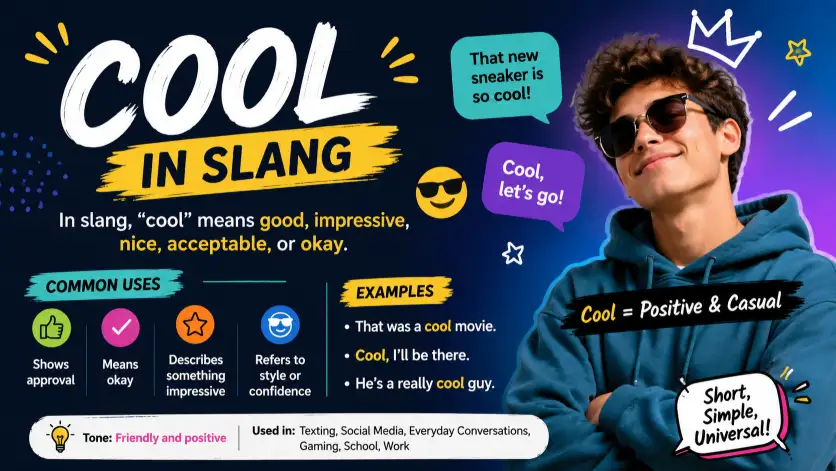
Cool in slang is a positive expression used to describe someone or something as good, stylish, impressive, acceptable, or worthy of approval.
Cool in slang is one of the most popular expressions in English. People search for this phrase because they want to understand what it means in text messages, social media posts, gaming chats, or everyday conversations.
While the word has existed for decades, its slang meaning has changed over time and now covers approval, confidence, style, and agreement.
You may see someone reply with “Cool!” after making plans or describe a person as “cool” because they are fashionable or relaxed. The exact meaning depends on the conversation, but it almost always carries a positive tone. Understanding how people use this slang helps you communicate more naturally and avoid confusion in online and offline conversations.
Quick Answer:cool in slang
Cool is a slang word that means good, impressive, stylish, acceptable, or okay. It is usually a positive and friendly expression used in texting, social media, and everyday speech.
What Does Cool Mean in Text?
In texting, cool usually shows agreement, approval, or satisfaction. It tells the other person that something is acceptable or sounds good.
For example:
- “Let’s meet at 7.” — “Cool!”
- “I finished the project.” — “Cool, great job!”
- “I found the tickets.” — “Cool, thanks.”
The meaning changes slightly depending on the situation.
- It can mean I agree.
- It can mean That sounds good.
- It can mean I’m impressed.
- It can simply mean Okay.
Because it is simple and positive, it is one of the most commonly used slang words in English.
Cool Full Form or Definition
Cool does not have a full form.
It is a regular English word that developed a slang meaning over time.
As slang, it commonly means:
- Excellent
- Nice
- Impressive
- Fashionable
- Calm
- Acceptable
- Relaxed
Unlike internet abbreviations such as LOL or BRB, cool is not an acronym.
Is Cool Rude, Offensive, or Neutral?
Cool is considered neutral and polite.
People of different ages use it comfortably in casual conversations.
It is appropriate for:
- Friends
- Family
- Classmates
- Coworkers
- Online communities
- Text messages
However, replying with only “Cool.” in serious conversations can sometimes sound short or uninterested depending on your tone.
For example:
Friend: “I got promoted.”
Response: “Cool.”
This may sound less enthusiastic than:
“That’s cool! Congratulations!”
Tone always matters.
Where Is Cool Commonly Used?
People use cool almost everywhere.
Common places include:
- Text messages
- Instagram comments
- TikTok captions
- Snapchat chats
- Discord servers
- Reddit discussions
- Gaming chats
- Everyday conversations
- School
- Work conversations
- Movies and television
Its popularity comes from being easy to understand across different age groups.
Different Meanings of Cool in Slang
1. Something Is Good
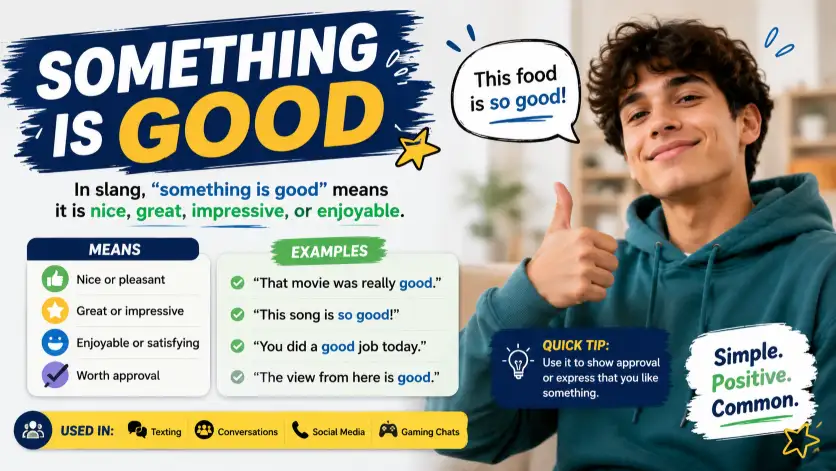
This is the most common meaning.
Example:
“That movie was really cool.”
Meaning:
The movie was enjoyable or impressive.
2. Agreement
People often use cool instead of saying okay.
Example:
“I’ll call you tomorrow.”
“Cool.”
Meaning:
That plan works.
3. Someone Is Stylish
A person may be described as cool because they seem confident or fashionable.
Example:
“She’s one of the coolest people at school.”
Meaning:
She is popular, confident, or admired.
4. Calm Under Pressure
Cool can also describe someone who stays relaxed.
Example:
“He stayed cool during the emergency.”
Meaning:
He remained calm.
Although this meaning is close to the original English definition, people still use it naturally in casual speech.
Why People Use Cool
People like using cool because it is short, friendly, and flexible.
Reasons include:
- Shows agreement quickly
- Expresses approval
- Sounds natural
- Fits almost every casual conversation
- Works in speech and writing
- Easy for all age groups to understand
Instead of writing a long reply, people often simply say:
“Cool.”
Origin and Background of Cool
The slang meaning of cool became popular in the United States during the 1940s and 1950s.
Jazz musicians often used it to describe someone who was calm, confident, or stylish.
Later, movies, television, and youth culture spread the word around the world.
Today, people use cool in many countries, even where English is not the first language.
It remains one of the longest-lasting slang words in modern English.
Is Cool Safe for Social Media?
Yes.
Cool is considered safe on all major platforms.
People commonly use it on:
- TikTok
- Discord
- Snapchat
- X
- YouTube comments
It has no offensive meaning in normal conversations.
Real-Life Examples
Friendly
“Your new bike looks cool.”
Casual
“Cool, I’ll see you tomorrow.”
Text Message
A: “I’m outside.”
B: “Cool, coming now.”
Gaming
“Cool teamwork everyone.”
Social Media
“That outfit is so cool.”
Workplace Chat
“Cool, I’ll finish the report this afternoon.”
Conversation
A: “We got free tickets.”
B: “That’s really cool!”
Similar Slang Terms
| Slang | Meaning | Difference |
| Awesome | Excellent | Stronger praise |
| Nice | Pleasant | Slightly softer |
| Dope | Very impressive | More modern slang |
| Sick | Extremely impressive | Informal slang |
| Fire | Outstanding | Popular online slang |
| Lit | Exciting | Often describes events |
| Sweet | Great | Friendly expression |
| Chill | Relaxed | Focuses on calmness |
When to Avoid Using Cool
Although cool is usually safe, there are situations where another word sounds more appropriate.
Avoid using it:
- During formal business presentations
- In academic writing
- In legal documents
- During sensitive conversations
- When someone shares serious news
Instead of saying:
“Cool.”
You could say:
- Thank you.
- I appreciate it.
- That’s excellent.
- Congratulations.
- I’m happy to hear that.
Polite Alternatives
Depending on the situation, you can replace cool with:
- Great
- Excellent
- Wonderful
- Sounds good
- Perfect
- Fantastic
- That’s impressive
- I agree
- Looks good
- Nice work
Impact of Using Cool in Communication
Using cool makes conversations feel relaxed and friendly.
Benefits include:
- Builds casual relationships
- Shows quick agreement
- Keeps conversations natural
- Makes texting faster
- Sounds approachable
The downside is that overusing it may make responses seem repetitive or less enthusiastic.
Cool Meaning Slang vs Literal Meaning
| Literal Meaning | Slang Meaning |
| Low temperature | Good |
| Calm personality | Stylish |
| Relaxed | Impressive |
| Not warm | Acceptable |
| Composed | Okay or agreed |
What Does Cool Stand For?
Many people search for “what does cool stand for.”
The answer is simple.
Cool does not stand for anything.
It is not an abbreviation or acronym.
It is simply a word that gained additional slang meanings through everyday use.
Frequently Asked Questions
Q1. What does cool mean in slang?
It usually means good, impressive, stylish, acceptable, or okay.
Q2. Is cool an acronym?
No. Cool is not an acronym and has no full form.
Q3. Is cool still popular?
Yes. It remains one of the most commonly used slang words worldwide.
Q4. Can I use cool at work?
Yes, in casual workplace conversations. For formal communication, words like “excellent” or “sounds good” may be more appropriate.
Q5. Is cool offensive?
No. It is generally considered neutral and polite.
Q6. Why do people say cool instead of okay?
Because it sounds friendlier and also expresses approval, not just agreement.
Conclusion
Cool in slang is a versatile word that expresses approval, agreement, admiration, or style. It does not have a full form and is not an internet acronym. Instead, it has become one of the most widely used slang words in English through decades of everyday conversation.
Whether you see it in a text message, on TikTok, during a gaming session, or in a chat with friends, cool almost always carries a positive meaning. Understanding the context helps you use it naturally and communicate more confidently in both online and real-life conversations.
Read More About!
- What Is Crop Dusting Slang? Meaning, Origin, and Examples
- What Is SML Slang? Meaning, Uses, and Online Examples
- FTW Slang: Meaning, Examples, and How to Use It Correctly

My name is Olivia Bennett.I am a language enthusiast and educational writer with a strong interest in contemporary English and digital communication. I enjoys making language learning engaging and accessible.