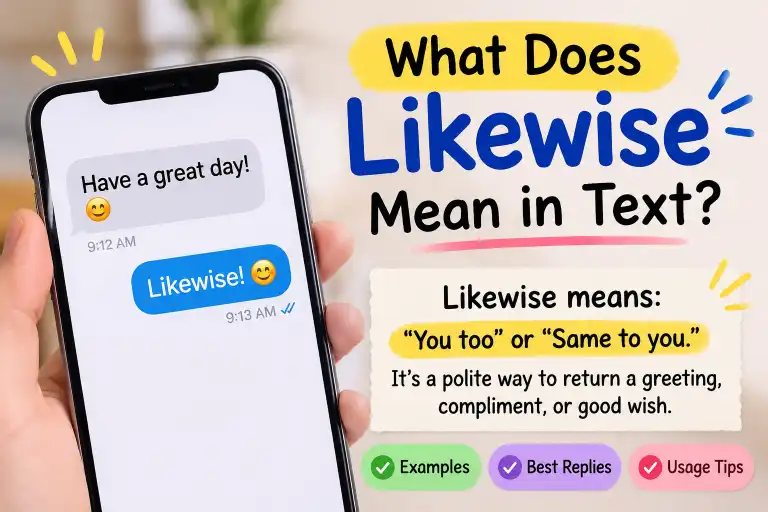
Likewise in text means “you too,” “same to you,” or “I feel the same way.” People use it when they want to return someone’s greeting, compliment, good wishes, or feelings. It is a polite expression commonly seen in everyday texting, WhatsApp, Instagram, Snapchat, and TikTok conversations.
For example, if someone sends you a message saying, “It was really nice talking to you,” you can reply with “Likewise!” This means you also enjoyed the conversation. It is a simple way to show that the feeling is mutual without repeating the entire sentence.
Many people come across this word while chatting online and wonder if it has a special meaning in texting. Some even think it is a modern internet abbreviation because it is often used as a short reply. However, likewise is actually a regular English word that has been around for a long time.
Understanding how people use it can help you recognize the meaning behind different messages and choose a natural response. if you are talking to a friend, replying to a compliment, or ending a friendly conversation, knowing when to use likewise can make your communication clearer.
Likewise Meaning in Text
Likewise means “the same to you,” “you too,” or “I feel the same way.” It is used when someone wants to express a similar feeling, return a positive statement, or show agreement with another person.
In simple words, when someone says something nice to you and you respond with likewise, you are telling them that you feel the same way.
For example:
A: It was wonderful meeting you today!
B: Likewise! I really enjoyed talking to you.
Here, the second person is saying that meeting the other person was wonderful for them too. They are returning the positive feeling rather than introducing a completely new idea.
The word can be used in several situations. Someone might say it after receiving a greeting, a compliment, a good wish, or a statement about a shared experience.
For instance, imagine that a classmate tells you, “I hope you do well in your exams.” You can respond with “Likewise” if you also want to wish them success.
Similarly, if someone says, “I really appreciate your help,” replying with likewise can communicate that you appreciate their kindness too.
The Simple Meaning Behind Likewise
The easiest way to understand this word is to think of it as a way of saying that something is mutual.
When two people share the same feeling, opinion, or positive experience, likewise can connect their responses.
Here are some simple explanations:
- You too: You are returning someone’s greeting or good wishes.
- Same here: You have a similar feeling or experience.
- I feel the same: You are expressing mutual appreciation or interest.
- In the same way: You are agreeing with something or showing similarity.
- Similarly: You are saying that the same situation applies to you.
For example:
A: I love spending time with my family.
B: Likewise!
The reply suggests that the second person also enjoys spending time with their family.
Another example:
A: Have a peaceful weekend!
B: Likewise! Enjoy yours.
Here, the second person is returning the good wishes.
Although these examples use the same word, the exact meaning depends on what the other person said first. This is why understanding the full conversation is more helpful than looking at the word alone.
Is Likewise Slang, an Acronym, or an Abbreviation?
Likewise is not traditional internet slang, an acronym, or a texting abbreviation. It is a standard English word used in both spoken and written communication.
An acronym is usually formed from the first letters of several words. For example, IDK stands for “I Don’t Know,” while BRB means “Be Right Back.”
Likewise does not work that way. It is already a complete word and does not stand for a longer phrase.
However, people sometimes mistake it for internet slang because they frequently see it in short online replies.
For example:
A: Have a great day!
B: Likewise!
The second person does not need to write, “I hope you have a great day too.” The single word communicates almost the same idea.
This makes it convenient for texting, but its meaning is not limited to digital communication.
You can use it while speaking face,to,face, writing an email, responding to a professional message, or chatting with someone online.
What Does Likewise Mean in Different Conversations?
The meaning can become clearer when you look at the type of message in which it appears.
Although the main idea remains similarity or mutual feelings, the word can serve different purposes.
1. Returning Good Wishes
When someone wishes you something positive, likewise can be used to return the same wish.
Example:
A: Hope you have a fantastic day!
B: Likewise!
Meaning: The second person also wishes the first person a fantastic day.
2. Returning a Compliment
People can use the word when someone says something nice about them.
Example:
A: You’re always so helpful.
B: Likewise! You’re very thoughtful too.
Meaning: The second person is returning the compliment.
3. Showing Similar Feelings
Sometimes someone shares a personal feeling, and the other person wants to communicate that they feel the same.
Example:
A: I really enjoy our conversations.
B: Likewise.
Meaning: Both people enjoy talking to each other.
4. Expressing Agreement
Likewise can also show that a statement or opinion applies to you.
Example:
A: I believe everyone deserves a fair chance.
B: Likewise. Everyone should be treated equally.
Meaning: The second person agrees with the first person’s view.
5. Responding Politely
It can also help end a conversation in a respectful way.
Example:
A: It was a pleasure speaking with you.
B: Likewise. Take care!
Meaning: The second person also appreciated the conversation.
Is Likewise a Formal or Casual Word?
One useful thing about likewise is that it works in both formal and casual communication.
Some English expressions are mostly used between friends, while others sound more appropriate in professional situations. Likewise is flexible enough to fit both.
In a casual conversation, it can sound friendly and relaxed.
For example:
A: Have fun at the party!
B: Likewise! Enjoy your evening.
In a professional conversation, it can sound polite and respectful.
For example:
A: It was a pleasure working with you on this project.
B: Likewise. I appreciated your support.
Both examples are natural because the word is suitable for different communication styles.
However, the tone of the message still matters. If someone sends you a long and emotional message, replying with only likewise might feel a little distant.
For that reason, it is helpful to consider the other person’s message before choosing your response.
Why Do People Use Likewise Instead of You Too?
People often choose likewise because it allows them to return a statement without repeating the same words.
Consider this conversation:
A: I hope you have a wonderful holiday.
B: I hope you have a wonderful holiday too.
The reply is perfectly correct, but it repeats the original sentence.
Now look at another version:
A: I hope you have a wonderful holiday.
B: Likewise!
The meaning is still clear, but the response is shorter.
This is one reason people use the word in messaging. It saves time while keeping the conversation polite.
It can also make a reply sound slightly more polished than a very short response such as “same.”
However, this does not mean likewise is always better. In conversations with close friends, “you too” or “same here” may sound more natural.
The best choice depends on your relationship with the other person and the tone you want to create.
Is Likewise Positive or Negative?
Likewise is generally positive or neutral. It does not contain an insulting or negative meaning on its own.
Most people use it to return something friendly or express a shared opinion.
For example:
A: I appreciate everything you’ve done.
B: Likewise!
This is a positive exchange.
However, the word can also be used when discussing neutral or negative situations if the speaker wants to communicate similarity.
For example:
A: I don’t enjoy waking up early.
B: Likewise!
Here, the second person is saying that they also dislike waking up early.
Therefore, the word itself is not always positive. Its meaning depends on the statement it responds to.
The important point is that likewise communicates similarity rather than a particular emotion.
Where Do People Use Likewise?
Likewise is used in many types of digital communication. You may see it in private messages, social media comments, online discussions, and professional conversations.
It is not connected to one specific platform. Its basic meaning stays the same if someone uses it on a mobile messaging app or a social networking website.
Likewise on TikTok
TikTok users may use likewise in comments, direct messages, and conversations with other creators.
For example:
A: Your videos always make my day!
B: Likewise! I enjoy watching your content too.
Here, the second person is returning the compliment and showing appreciation.
Another situation might involve two users discussing their interests.
A: I love watching travel videos.
B: Likewise! They give me so many ideas.
In this example, both users share a similar interest.
TikTok conversations often contain short expressions because people want to respond quickly. Likewise fits naturally when someone wants to agree with another user or return a positive comment.
It is not a special TikTok abbreviation, though. It carries the same English meaning that it has in ordinary conversations.
Likewise on Snapchat
On Snapchat, likewise can appear in private chats between friends, classmates, and people who have recently started communicating.
For example:
A: I had so much fun chatting with you today.
B: Likewise! Let’s talk again soon.
The reply tells the other person that the conversation was enjoyable for both of them.
It may also appear after someone sends a friendly wish.
A: Stay safe and take care!
B: Likewise!
Snapchat conversations are often informal, so users may also choose alternatives such as “you too,” “same here,” or “right back at you.”
The choice depends on how close the people are and how they normally communicate.
Likewise on Instagram
Instagram users may write likewise in direct messages, story replies, and comment sections.
For example:
A: Your photography is amazing!
B: Likewise! Your pictures are beautiful too.
The second person is returning the compliment.
It can also be used when someone expresses appreciation after a conversation.
A: Glad we connected here!
B: Likewise! It’s nice meeting new people.
This reply communicates that both users are happy about connecting.
The expression works in both friendly and slightly professional Instagram conversations, especially when people are communicating with creators, customers, or new contacts.
Likewise on WhatsApp
WhatsApp is another place where people use this word in everyday communication.
It can appear in personal chats, family groups, work conversations, and messages between classmates.
For example:
A: Hope everything goes well with your new job!
B: Thank you! Likewise.
The second person is returning the good wishes.
Another example:
A: It was great catching up after so long.
B: Likewise! We should meet again soon.
Here, both people enjoyed reconnecting.
Because WhatsApp is used for many different types of conversations, likewise can fit both casual and respectful messages.
Likewise in SMS Text Messages
In regular SMS messages, likewise has the same meaning as it does on social media.
For example:
A: Enjoy your weekend!
B: Likewise!
It is a short way to return someone’s good wishes.
You might also receive it after sending a message such as:
“Nice talking to you today.”
The other person may simply reply, “Likewise,” to show that they also enjoyed the conversation.
Unlike internet abbreviations, this word does not require special knowledge of texting culture. It is a familiar English expression that can be understood outside the internet as well.
10 Real Chat Examples of Likewise
The best way to understand how likewise works in everyday texting is to look at realistic conversations. The word can appear after a compliment, a friendly greeting, a good wish, or a statement about shared feelings.
Here are ten examples showing how people use it in different situations.
Example 1: Returning a Greeting
A: Good morning! Hope you have a wonderful day.
B: Likewise! Hope everything goes well for you too.
Meaning: The second person is returning the greeting and wishing the other person a good day as well.
Example 2: After Meeting Someone
A: It was really nice meeting you yesterday.
B: Likewise! I enjoyed talking with you.
Meaning: Both people enjoyed meeting each other. The reply shows that the feeling is mutual.
Example 3: Returning a Compliment
A: You always know how to make people smile.
B: Likewise! You’re such a positive person.
Meaning: The second person appreciates the compliment and returns a similar kind remark.
Example 4: Sharing Good Wishes
A: Good luck with your exams!
B: Thank you! Likewise, if you have any coming up.
Meaning: The second person is also wishing the other person success.
Example 5: Ending a Conversation
A: Take care and stay safe!
B: Likewise! Talk to you soon.
Meaning: The reply returns the kind wishes and ends the conversation politely.
Example 6: Showing Mutual Interest
A: I really enjoy talking to you.
B: Likewise. Our conversations are always fun.
Meaning: Both people enjoy communicating with each other. The word expresses shared interest.
Example 7: Talking About Work
A: It was a pleasure working with you on this project.
B: Likewise! I learned a lot from you.
Meaning: The second person also appreciated the professional experience.
Example 8: Responding to a Friendly Message
A: You’re always welcome here!
B: Likewise! You can visit anytime.
Meaning: Both people are expressing a welcoming attitude toward each other.
Example 9: Agreeing With an Opinion
A: I think honesty is important in every relationship.
B: Likewise. Trust makes everything better.
Meaning: The second person agrees with the first person’s opinion and shares a similar belief.
Example 10: Online Friendship
A: I’m glad we connected on Instagram.
B: Likewise! It’s nice meeting new people here.
Meaning: Both users are happy that they connected and started communicating.
These examples show that likewise is not limited to one type of conversation. It can express appreciation, agreement, shared interests, and positive feelings.
The main thing to remember is that it usually refers back to something the other person has already said.
How to Reply When Someone Says Likewise
When someone sends you likewise, you do not always need to write a long response. In many situations, a simple and friendly reply is enough.
However, the best response depends on the conversation.
For example, if someone says “Likewise” after you wish them a good day, you can simply say “Thanks!” If they use it after a compliment, you might continue the conversation with another friendly message.
Here are different ways to respond naturally.
Funny Replies to Likewise
If you are talking to a close friend or someone who enjoys joking, you can use a playful response.
Funny replies can make a conversation more entertaining without changing the original meaning.
Try these examples:
- Same energy, same feelings!
- Great minds think alike!
- Looks like we’re on the same page!
- Mutual feelings confirmed!
- Haha, right back at you!
- Copy that!
- We’re officially agreeing on everything!
- Double the good wishes!
- Agreement level: 100%.
- Well, that’s a perfect match!
Example conversation:
A: You’re the funniest person I know.
B: Likewise!
A: Haha, great minds think alike!
This type of response works best when both people are comfortable with casual humor.
Casual Replies to Likewise
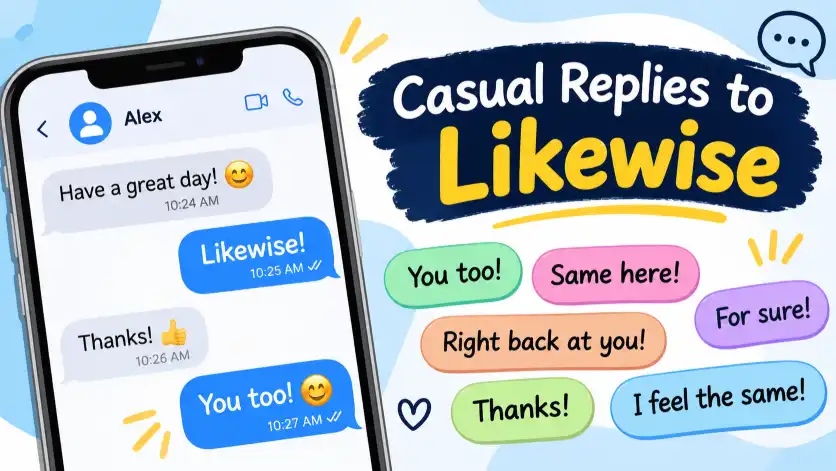
Casual replies are useful for everyday conversations with friends, classmates, relatives, and people you know online.
They sound natural and do not make a simple exchange feel too formal.
Here are some options:
- You too!
- Same here!
- Absolutely!
- For sure!
- Right back at you!
- I feel the same!
- Definitely!
- Thanks, you too!
- That’s true!
- Same to you!
Example conversation:
A: Hope you have a relaxing weekend!
B: Likewise!
A: Thanks! Enjoy yours.
These replies keep the conversation short and friendly.
Friendly Replies to Likewise
Sometimes you may want to sound a little warmer, especially when someone is being thoughtful or expressing appreciation.
Friendly responses help show that you value the conversation.
You can use:
- That’s so kind of you!
- Thank you, I appreciate it.
- Glad we feel the same!
- Always nice talking to you too.
- You’re very thoughtful.
- That means a lot!
- I appreciate your kindness.
- Looking forward to talking again!
- You’re always welcome!
- Hope we stay in touch!
Example conversation:
A: It was really nice getting to know you.
B: Likewise!
A: I’m glad we had the chance to talk.
This kind of exchange feels natural when two people are building a friendship or getting to know each other.
Neutral Replies to Likewise
Not every conversation needs an emotional or funny response. Sometimes you may simply want to acknowledge the other person’s message.
Neutral replies are useful when talking to acquaintances, colleagues, customers, or people you do not know very well.
Here are some suitable options:
- Thanks!
- I appreciate it.
- Same to you.
- Thank you.
- That’s nice of you.
- Certainly.
- Much appreciated.
- Thanks for saying that.
- Understood.
- Thank you, likewise.
Example conversation:
A: It was a pleasure discussing the project with you.
B: Likewise.
A: Thank you for your time.
This exchange is polite and appropriate for a professional conversation.
What Is the Best Reply to Likewise?
There is no single reply that works in every situation.
If someone is returning your good wishes, “Thanks!” or “You too!” is usually enough.
If the conversation is about mutual feelings, you can say “Same here” or “I feel the same.”
If someone uses the word after a compliment, a simple “I appreciate that” can keep the exchange friendly.
The important thing is to respond according to the original message rather than choosing a reply just because it sounds popular online.
Is Likewise Rude or Offensive?
No, likewise is generally not rude, offensive, or inappropriate. It is a polite English expression that people use to return greetings, compliments, good wishes, and similar feelings.
You can use it in everyday conversations without worrying that it has a hidden insulting meaning.
However, the tone of a message depends on the situation, the relationship between the people, and the words that come before it.
For example, replying with likewise after someone wishes you a happy birthday sounds perfectly normal.
But using the same one,word response after a deeply emotional message may sometimes feel less personal.
Understanding these differences helps you use the expression more naturally.
Is Likewise Safe to Use in Conversations?
Yes. Likewise is generally safe to use in personal, social, academic, and professional communication.
It does not contain inappropriate language or an offensive meaning.
For example:
A: Have a wonderful holiday!
B: Likewise!
This is a completely normal exchange.
You can also use it when talking to someone you have recently met, responding to a teacher, or communicating with a colleague.
The word is especially useful when you want to sound polite without writing a lengthy response.
Can Likewise Sound Cold or Distant?
Sometimes a short reply can feel less warm than the message it receives.
This does not mean likewise is a rude word. It simply means that a single,word response may not always communicate enough emotion.
Consider this example:
A: I really appreciate everything you’ve done for me. Your support means so much.
B: Likewise.
The response is not offensive, but it may sound a little distant because the original message expresses strong appreciation.
A warmer response would be:
“That means a lot to me. I’m always happy to support you.”
Another example:
A: I have really enjoyed getting to know you.
B: Likewise!
In this situation, likewise sounds natural because both people are sharing a positive feeling.
The difference comes from the emotional importance of the conversation.
Is Likewise Appropriate at School?
Yes. Students can use likewise when communicating with classmates, teachers, and other school staff.
It is a standard English word, so there is no problem using it in an appropriate school conversation.
For example:
Teacher: I hope everyone has a productive week.
Student: Likewise, thank you!
Students can also use it with classmates.
A: Good luck with your presentation!
B: Likewise! Hope yours goes well too.
It is a simple and respectful way to return someone’s good wishes.
Is Likewise Appropriate at Work?
Yes. Likewise is suitable for professional communication, including workplace messages, business emails, meetings, and conversations with colleagues.
For example:
A: It was a pleasure working with your team.
B: Likewise. We appreciate your cooperation.
This sounds professional and respectful.
It can also be used when responding to a colleague who says something positive about a shared project.
However, if the conversation involves detailed information or an important question, likewise alone may not be enough.
For instance, if a manager asks you if you agree with a specific decision, you should provide a clear answer rather than simply replying with this word.
When Should You Avoid Using Likewise?
Although the word is generally appropriate, there are situations where another response may communicate your feelings more clearly.
Consider avoiding a one,word reply in these situations:
- Serious conversations: Someone is discussing an important personal problem and needs a thoughtful response.
- Emotional messages: A person is expressing deep appreciation or affection.
- Direct questions: Someone needs specific information rather than a similar statement.
- Sensitive situations: A detailed and understanding response may be more suitable.
- Disagreements: Using likewise without explaining your position can create confusion.
For example, if someone tells you that they are going through a difficult time, simply replying “Likewise” would not make sense.
A more thoughtful response would be, “I’m sorry you’re dealing with that. I hope things get better soon.”
The word is useful, but choosing the right response matters more than using a short expression in every conversation.
Who Uses the Term Likewise?
Likewise is used by people from different age groups and backgrounds. It is not limited to teenagers, young adults, or people who spend a lot of time on social media.
Because it is a standard English word, people use it in everyday conversations, professional communication, and online messaging.
Its popularity in a particular conversation often depends on the person’s communication style and the situation.
Do Gen Z Users Say Likewise?
Yes, Gen Z users sometimes use likewise in their messages, comments, and online conversations.
Although younger people often prefer shorter expressions such as “same,” “you too,” and “same here,” likewise is another option when they want to return a compliment or express a similar feeling.
For example:
A: Your playlist has such good songs!
B: Likewise! I love your music taste too.
In this conversation, the second person is returning the compliment.
However, likewise is not exclusive to Gen Z. It is a regular English word that people of many ages understand and use.
Do Millennials and Older Adults Use Likewise?
Yes. Millennials and older adults commonly recognize and use this expression in both spoken and written communication.
They may use it when responding to good wishes, professional messages, compliments, or friendly conversations.
For example:
A: It was lovely catching up with you.
B: Likewise! We should do it again sometime.
The reply communicates that both people enjoyed reconnecting.
Older users may also use it in emails and workplace communication because it sounds polite and appropriate.
Which Platforms Are Commonly Associated With Likewise?
You may come across the word on several digital platforms.
Some common places include:
- WhatsApp: Used in personal messages and group conversations.
- Instagram: Appears in comments, direct messages, and story replies.
- Snapchat: Used when returning friendly messages or good wishes.
- TikTok: Appears in comments and conversations between users.
- Facebook: Used in posts, replies, and private messages.
- SMS: Appears in ordinary mobile text conversations.
- Email: Used in professional and personal communication.
The platform does not change the basic definition. Likewise generally communicates similarity, agreement, or mutual feelings.
How Often Does Likewise Appear Online?
Likewise is a familiar English expression, but there is no reliable universal measurement that shows how frequently it appears across every social media platform.
Its use can vary depending on the audience, type of conversation, and communication style.
For example, someone who prefers complete English words may use likewise regularly. Another person who enjoys very short messages may prefer “you too” or “same.”
It is therefore better to understand the word as a common everyday expression rather than a trending internet abbreviation.
Origin of the Term Likewise
Unlike many modern texting expressions, likewise did not originate on social media or through mobile messaging.
It is an established English word with a long history. People used it in writing and speech long before smartphones, messaging apps, and social networking websites existed.
The word is formed from two familiar parts: “like” and “wise.”
The word “like” relates to similarity, while the ending “,wise” can indicate a manner, respect, or way in which something happens.
Together, they developed into an expression meaning “in the same way” or “similarly.”
Where Did the Word Likewise Come From?
The history of likewise goes back to earlier forms of English.
It developed from the combination of “like” and the suffix “,wise.” Over time, it became an established word used to express similarity between actions, situations, or feelings.
It has appeared in traditional writing, literature, and ordinary conversation for centuries.
Unlike modern internet expressions, its development was not connected to a particular website, social media trend, or online community.
How Did Likewise Become Common in Everyday Communication?
People have always needed ways to express agreement and return positive statements.
Instead of repeating an entire sentence, they can use a short expression that communicates a similar idea.
For example:
A: I hope everything goes well for you.
B: Likewise!
This type of response is simple and understandable.
The word became useful in different forms of communication, including letters, books, face,to,face conversations, and professional discussions.
Its flexibility helped it remain part of everyday English.
Did Internet Culture Create the Modern Use of Likewise?
No. Internet culture did not create the word or its original meaning.
However, digital communication gave people another place to use it.
As texting and social media became part of daily life, people started using familiar English expressions in their online conversations.
Likewise fits naturally into short messages because it can replace a longer response.
For example:
A: Nice talking to you!
B: Likewise!
This exchange works in a face,to,face conversation just as naturally as it does in a messaging app.
The internet helped maintain its use in modern communication, but the word itself is much older than online culture.
Is the Origin of Likewise Clear?
Yes. Unlike many internet abbreviations with uncertain beginnings, the linguistic formation of likewise is well established.
Its meaning comes from the combination of “like” and “,wise.”
There is no reason to connect its origin to TikTok, Snapchat, WhatsApp, or any particular online trend.
Understanding this history also explains why the word can be used in formal writing as well as casual texting.
Likewise vs. IDK, IDC, IMO, and BRB
People sometimes search for likewise alongside common texting terms because they want to understand the meaning of short online replies.
However, these expressions do not all serve the same purpose.
Likewise returns a statement or expresses similarity, while IDK, IDC, IMO, and BRB communicate different things.
Here is a simple comparison.
| Term | Meaning | Type | Usage | Popularity |
| Likewise | Same to you; similarly | Standard English word | Returning wishes, feelings, or agreement | Common |
| IDK | I Don’t Know | Texting abbreviation | Expressing uncertainty | Very common |
| IDC | I Don’t Care | Texting abbreviation | Showing indifference | Very common |
| IMO | In My Opinion | Texting abbreviation | Sharing a personal opinion | Common |
| BRB | Be Right Back | Texting abbreviation | Saying you will return shortly | Common |
Likewise vs. IDK
Likewise and IDK have completely different meanings.
Likewise expresses a similar feeling or returns someone’s statement.
IDK stands for “I Don’t Know” and is used when someone does not have an answer.
For example:
A: I really enjoyed the concert.
B: Likewise!
The second person is saying that they also enjoyed the concert.
Another conversation:
A: What time does the concert start?
B: IDK. I haven’t checked yet.
Here, the second person is expressing uncertainty.
The difference is simple: likewise communicates similarity, while IDK communicates a lack of knowledge.
Likewise vs. IDC
Likewise means “the same to you” or “I feel the same way.”
IDC stands for “I Don’t Care.”
For example:
A: I love spending time outdoors.
B: Likewise!
The second person shares the same interest.
Now consider this conversation:
A: Which movie should we watch tonight?
B: IDC. You can choose.
Here, the second person is saying that they do not have a strong preference.
These expressions should not be confused because their meanings are very different.
Likewise vs. IMO
Likewise is used to express similarity or return a statement.
IMO stands for “In My Opinion.” People use it when they want to introduce a personal opinion.
For example:
A: I think this is the best restaurant in town.
B: Likewise. I really enjoy eating here.
The second person is expressing a similar opinion.
Another example:
A: This restaurant is too expensive.
B: IMO, the food is worth the price.
Here, IMO introduces a personal viewpoint.
Likewise vs. BRB
Likewise is a response that communicates similar feelings or agreement.
BRB stands for “Be Right Back.” It is used when someone needs to leave a conversation temporarily.
For example:
A: Have a nice evening!
B: Likewise!
The second person returns the good wishes.
Another conversation:
A: I need to answer the door.
B: Okay, BRB!
Here, the person is saying they will return shortly.
Both expressions are common in digital communication, but they are used for completely different reasons.
Real,World Usage Example
Imagine that you attend a school event, a workplace meeting, or a social gathering where you meet someone for the first time.
During the event, you talk about your interests, studies, work, or everyday experiences.
Before leaving, the other person says:
“It was really nice meeting you. I hope we get to talk again.”
You respond:
“Likewise! I enjoyed our conversation.”
In this situation, likewise communicates that you also enjoyed meeting the person.
You do not need to repeat the entire statement. One word is enough to express the same positive feeling.
Another Example Between Friends
Imagine that one of your friends sends you a message on WhatsApp:
“Hope you have a relaxing weekend!”
You reply:
“Likewise! Enjoy your time off.”
Your response returns the good wishes.
Both messages are friendly, and neither person needs to explain what they mean.
Example in a Professional Situation
Suppose you finish a project with a colleague.
Before ending the conversation, your colleague says:
“It was a pleasure working with you. I appreciate your help.”
You respond:
“Likewise. It was a great experience working together.”
Here, the word expresses mutual appreciation.
It sounds professional without being overly formal.
These examples demonstrate that likewise is useful in many areas of everyday life. You can use it with friends, colleagues, classmates, and people you have recently met.
Frequently Asked Questions
Q1. What Does Likewise Mean in Text Messages?
Likewise means “you too,” “same to you,” or “I feel the same way.” People use it to return greetings, compliments, good wishes, and positive feelings in text conversations.
Q2. What Does Likewise Mean on TikTok?
On TikTok, likewise usually means that someone shares the same feeling or is returning a compliment. It can appear in comments, replies, and direct messages.
Q3. Is Likewise Slang?
No. Likewise is a standard English word, not traditional internet slang or an abbreviation. However, people frequently use it in casual online conversations.
Q4. Is Likewise Rude or Offensive?
No. It is generally polite and safe to use. However, replying with only one word may sometimes sound distant when someone sends a deeply personal or emotional message.
Q5. How Should You Reply to Likewise?
You can reply with “You too,” “Same here,” “Thanks,” or “Right back at you.” Choose a response that matches the original conversation.
Q6. Does Likewise Mean the Same as You Too?
Yes, in many conversations, likewise has the same meaning as “you too.” Both expressions can return greetings, good wishes, and positive statements. However, likewise can also mean “similarly” in other contexts.
Q7. Can I Use Likewise With Friends?
Yes. You can comfortably use likewise with friends when returning compliments, sharing similar feelings, or exchanging good wishes. It is suitable for both casual and friendly conversations.
Q8. What Does Likewise Mean When a Girl Says It?
When a girl says likewise, she generally means “you too” or “I feel the same way.” For example, if you say that you enjoyed talking to her and she replies with likewise, she is saying that she also enjoyed the conversation. The exact meaning depends on the context.
Q9. What Does Likewise Mean When a Guy Says It?
When a guy uses likewise, it usually means that he shares your feeling or wants to return your statement. It does not automatically indicate romantic interest. The surrounding conversation helps explain his intention.
Q10. Is Likewise Professional to Use in Emails?
Yes. Likewise is appropriate in professional emails when returning greetings, appreciation, or positive statements. For example, if someone writes, “It was a pleasure working with you,” you can respond with, “Likewise, I appreciated the opportunity.”
Conclusion
Likewise is a simple and useful English word that means “you too,” “same to you,” or “I feel the same way.” People use it when returning compliments, greetings, good wishes, and positive feelings.
Although it frequently appears in text messages and social media conversations, it is not a modern internet abbreviation or traditional slang term. It is a standard English expression that has been used for centuries.
You can use it on WhatsApp, Snapchat, Instagram, TikTok, SMS, and even in professional emails. It works well with friends, classmates, colleagues, and new acquaintances.
Just remember that context matters. A short likewise is perfect for many everyday exchanges, but a more thoughtful response may be better when someone shares something personal or emotional.
Understanding the meaning and knowing when to use it will help you communicate more naturally in both online and offline conversations.
Read More About !

Michael Brooks is a language writer at SlangPath with 7+ years of experience creating simple, practical content on English slang and everyday expressions.