LIK in text usually means “like.” It is an informal shortened spelling that people may use when expressing enjoyment, sharing an opinion, or asking someone about their preferences. Its exact meaning depends on the conversation.
You may see LIK in text messages, TikTok comments, Snapchat chats, Instagram messages, and WhatsApp conversations. Some people type it intentionally, while others may simply forget the final letter.
Unlike popular abbreviations such as LOL, IDK, and BRB, LIK does not have one widely established meaning across online platforms. It is generally understood as a casual spelling of an everyday English word.
If someone sends you LIK, look at the complete message before deciding what they mean. In most ordinary conversations, they are simply referring to something they enjoy, prefer, or find interesting.
LIK Meaning in Text
LIK is generally used as an informal spelling of “like.” People may write it when talking about something they enjoy, asking for an opinion, or showing that they prefer one thing over another.
For example, someone might send:
- “I lik this song.”
- “Do you lik my new picture?”
- “I lik your idea.”
- “I lik this one better.”
In these messages, LIK has the same intended meaning as LIKE. The sender is communicating a feeling or preference without using the complete standard spelling.
However, LIK is not a universally recognized texting abbreviation. It does not have the same established status as expressions such as LOL (Laughing Out Loud), IDK (I Don’t Know), or BRB (Be Right Back).
This distinction matters because not every unusual spelling is a separate slang term. Sometimes people simply type words differently when chatting online.
What Does LIK Stand For?
LIK does not normally stand for a group of separate words. It is not a traditional acronym.
Instead, it is commonly understood as a shortened or misspelled version of the English word “like.”
The word “like” has several everyday uses. It can describe enjoyment, preference, similarity, or interest.
For example:
- “I lik coffee.” — Expressing enjoyment.
- “I lik your style.” — Giving a compliment.
- “I lik the blue one.” — Showing a preference.
- “Would you lik some tea?” — Offering something.
In each sentence, the intended word is “like.”
Is LIK Slang, an Acronym, or an Abbreviation?
LIK is best described as an informal spelling rather than a standard acronym.
People sometimes use it in casual digital communication because online conversations do not always follow formal grammar and spelling rules.
Here is the difference:
- Slang: Informal language used within particular groups or communities.
- Acronym: A word formed from the initial letters of other words, such as LOL.
- Abbreviation: A shortened form of a word or phrase.
- LIK: An informal spelling commonly intended to mean “like.”
Although people may call it texting slang, it is not a widely established abbreviation with one fixed definition.
Why Do People Type LIK Instead of LIKE?
There are several possible reasons someone might leave out the final letter.
1. Quick typing
Some people send messages quickly and do not pay much attention to spelling. They may accidentally leave out a letter while typing on a phone.
2. Personal writing habits
Everyone develops different texting habits. A person who regularly shortens words may use LIK without thinking about it.
3. Casual communication
Online conversations are usually less formal than emails or school assignments. People often use relaxed spelling when chatting with friends.
4. Typing mistakes
LIK may simply be a spelling error. The sender might have intended to type LIKE but pressed send before checking the message.
5. Playful writing
Some people deliberately change ordinary words to make their messages look different, funny, or informal.
The important thing is not to assume that every person using LIK is following a particular internet trend. Sometimes the simplest explanation is that they are just typing casually.
LIK Meaning in Different Conversations
The meaning becomes easier to understand when you consider what people are discussing.
For example, imagine someone sends you:
“I lik your new haircut.”
They are probably giving you a compliment.
Now consider another message:
“Do you lik watching football?”
Here, the sender is asking about your interests.
A third example might be:
“I lik the first option better.”
This expresses a preference between two choices.
Although the sentences cover different subjects, the intended word remains the same.
Where Do People Use LIK?
LIK may appear across different messaging services and social media platforms. It is not limited to one particular application.
People use informal spellings when commenting on pictures, discussing videos, sharing opinions, and chatting with others.
Here is how you might encounter it on popular platforms.
LIK on TikTok
TikTok is known for short videos, trending sounds, creative challenges, and quick comment exchanges.
Users often express their opinions in a few words rather than writing long comments. LIK may appear when someone wants to say they enjoy a video, sound, or trend.
For example:
- “I lik this video so much.”
- “I lik this sound.”
- “Do you lik this trend?”
- “I lik your editing style.”
In these examples, LIK is intended to mean “like.”
It may also appear in comments where someone asks viewers to interact with a video. However, LIK is not an official TikTok abbreviation or a special platform feature.
The complete comment provides the best clue about what the person wants to communicate.
LIK on Snapchat
Snapchat conversations are usually short and personal. People send pictures, videos, reactions, and messages throughout the day.
Someone might use LIK when reacting to a photo or asking for an opinion.
For example:
- “Do u lik my new snap?”
- “I lik this filter.”
- “I lik ur picture.”
- “U lik this outfit?”
The spelling does not change the basic meaning of the sentences.
If someone sends you “I lik your snap,” they are most likely complimenting the picture or saying they enjoyed seeing it.
Snapchat users do not need to understand a special slang definition to follow this message. Knowing the ordinary word “like” is usually enough.
LIK on Instagram
Instagram users communicate through comments, stories, captions, reels, and direct messages.
LIK might appear when someone reacts to a photograph, shares an opinion about a reel, or talks about another person’s content.
For example:
- “I lik your new post.”
- “I lik this outfit.”
- “Do you lik my story?”
- “I really lik this picture.”
These messages express appreciation or interest.
It is important to distinguish between writing LIK in a comment and using Instagram’s actual like feature. The first is a written expression, while the second is an interaction with a post.
LIK on WhatsApp
WhatsApp is commonly used for family conversations, personal messages, school groups, and everyday communication.
People often type informally when talking with someone they know. Because of this, shortened or unusual spellings may appear in messages.
For example:
- “I lik the first option.”
- “Do u lik this restaurant?”
- “I lik your suggestion.”
- “You lik watching cricket?”
In these situations, the sender is expressing an opinion or asking about someone’s preferences.
The spelling is informal, but the intended message is usually easy to understand.
LIK in SMS Text Messages
LIK can also appear in traditional SMS conversations.
Some people developed informal typing habits during the early days of mobile,phone messaging. Others simply prefer shorter words when sending quick replies.
For example:
- “I lik that song.”
- “U lik this one?”
- “I lik your idea.”
- “Would u lik to come?”
The intended spelling in these examples is “like.”
If you receive LIK in an SMS, read the words around it before deciding if it is an intentional shortcut or an accidental spelling mistake.
10 Real Chat Examples of LIK
Real conversations make informal texting expressions easier to understand. LIK is generally intended to mean “like,” so its meaning changes according to what two people are discussing.
Here are 10 realistic examples showing how someone might use this spelling in everyday messages.
Example 1: Talking About Music
A: Have you listened to that new song?
B: Yes, I lik it so much.
A: The beat is really good.
Meaning: B is saying that they enjoy the song. The spelling LIK represents “like.”
Example 2: Discussing a New Outfit
A: What do you think about my new outfit?
B: I lik it. The colors look amazing.
A: Thanks! I wasn’t sure about the combination.
Meaning: B is giving a positive opinion about the outfit.
Example 3: Sharing an Instagram Picture
A: Did you see the picture I uploaded?
B: Yes, I lik it.
A: Thank you! I thought you might enjoy it.
Meaning: B is expressing appreciation for the picture.
Example 4: Choosing a Movie
A: Should we watch the comedy or the action movie?
B: I lik the action movie better.
A: Okay, let’s go with that one.
Meaning: B prefers the action movie over the comedy.
Example 5: Talking About Food
A: Do you lik chocolate cake?
B: Of course! It’s my favorite dessert.
A: I’ll bring some tomorrow.
Meaning: A wants to know if B enjoys chocolate cake.
Example 6: Discussing a New Phone
A: What do you think about this phone?
B: I lik the design, but it’s a little expensive.
A: That’s true. We should check another model.
Meaning: B likes the phone’s appearance but is concerned about its price.
Example 7: Talking About a TikTok Trend
A: Have you tried that new dance trend?
B: Yes, I lik it. It’s actually pretty funny.
A: We should make a video together.
Meaning: B enjoys the trend and thinks it is entertaining.
Example 8: Asking About a Profile Picture
A: Do you lik my new profile picture?
B: Yeah, it looks really nice.
A: Should I keep it?
B: Definitely!
Meaning: A is asking for an opinion about their profile picture.
Example 9: Planning a Weekend Trip
A: Would you lik to visit the mountains this weekend?
B: That sounds amazing!
A: Great. I’ll check the travel options.
Meaning: Here, LIK represents “like” in the expression “would you like.” The sender is inviting someone on a trip.
Example 10: Sharing a New Idea
A: I’m thinking about starting a photography page.
B: I lik that idea.
A: Maybe I’ll upload my first pictures tomorrow.
B: You should definitely try it!
Meaning: B approves of the idea and encourages the other person.
These conversations demonstrate how LIK can appear in different situations. The important thing is to understand the complete message rather than focusing only on the unusual spelling.
How to Reply When Someone Says LIK?
Your reply depends on the situation and your relationship with the sender.
If someone uses LIK to express that they enjoy something, you can respond naturally. There is no need to use the same spelling in your reply.
For example, if someone says “I lik your picture,” a simple “Thank you!” is enough.
Here are some responses you can use in different conversations.
Funny Replies to LIK
If you are chatting with someone who enjoys humor, a playful response can make the conversation more entertaining.
Try these replies:
- “Only lik it? I expected a five,star review!”
- “Your approval means everything!”
- “Finally, someone with excellent taste!”
- “Glad it passed your lik test!”
- “Okay, official fan detected!”
- “Should I celebrate this important moment?”
- “I knew you would approve!”
- “That’s the reaction I was waiting for!”
These replies are suitable for relaxed conversations where both people enjoy joking around.
Casual Replies to LIK
Sometimes you do not need a funny or detailed response. A short message can keep the conversation moving.
Here are some casual options:
- “Same here!”
- “Yeah, me too.”
- “Absolutely!”
- “I think so too.”
- “It’s pretty good.”
- “I agree with you.”
- “That’s what I thought.”
- “Definitely!”
These expressions work well when discussing music, movies, food, clothes, and other everyday interests.
Friendly Replies to LIK
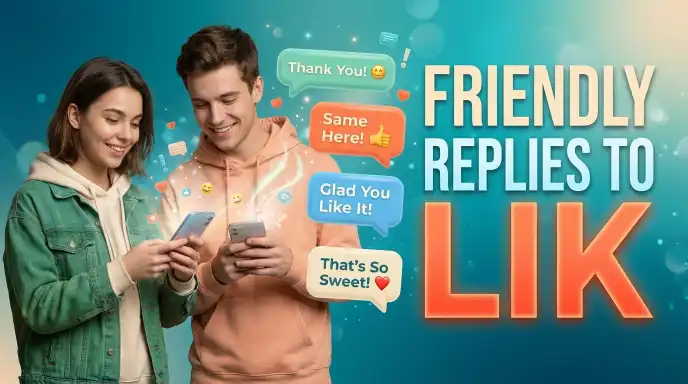
When someone compliments something you shared, a friendly response helps show appreciation.
You can reply with:
- “Thank you! That’s so sweet.”
- “I’m glad you like it.”
- “Happy you enjoyed it!”
- “Thanks for sharing your opinion.”
- “That means a lot!”
- “You’re so kind!”
- “I’m happy you noticed.”
- “Thanks! I really appreciate it.”
These replies are useful for positive conversations with friends, classmates, relatives, and online followers.
Neutral Replies to LIK
Not every conversation requires excitement or agreement. Sometimes you simply want to acknowledge someone’s opinion.
Consider these neutral responses:
- “I see what you mean.”
- “That’s interesting.”
- “Fair enough.”
- “Good to know.”
- “Everyone has different preferences.”
- “I understand your point.”
- “That makes sense.”
- “Thanks for letting me know.”
These responses are helpful when discussing personal choices or subjects where people may have different opinions.
Is LIK Rude or Offensive?
No, LIK is generally not rude or offensive when someone uses it as an informal spelling of “like.”
It does not normally contain an insult, inappropriate expression, or disrespectful message. Most of the time, it simply communicates enjoyment, interest, or preference.
However, the meaning of any message can depend on the situation. A friendly sentence and a sarcastic comment may communicate completely different feelings, even when they contain the same word.
Is LIK Safe to Use in Everyday Conversations?
Yes, using LIK in a casual conversation is generally harmless.
You might see it when someone discusses a favorite song, compliments a photograph, or asks another person about their preferences.
There is no special reason to avoid it in friendly messages.
However, using the complete spelling “like” is a better choice when communicating with someone who may not understand informal internet expressions.
Is LIK Appropriate at School?
In casual conversations with classmates, LIK is unlikely to cause confusion when the intended meaning is clear.
However, students should use standard English in formal assignments and academic writing.
For example:
- Informal: “I lik this topic.”
- Standard: “I like this topic.”
The second sentence is more appropriate for an essay, examination, or classroom presentation.
Can You Use LIK at Work?
The answer depends on the type of communication.
Some workplaces allow relaxed conversations between colleagues, especially in informal group chats. In these situations, unusual spellings may not be a problem.
However, professional communication should prioritize clarity.
Consider these examples:
- Casual message: “I lik the first design.”
- Professional message: “I like the first design.”
The second version looks more polished and is suitable for business emails, reports, and client communication.
When in doubt, use standard spelling. It helps prevent misunderstandings and keeps your writing professional.
Who Uses LIK?
LIK is not limited to a particular age group or online community.
People with different communication styles may use it when sending quick messages, commenting on social media, or expressing personal opinions.
However, it is important to understand that LIK is not a major standardized internet abbreviation. Its appearance does not necessarily indicate membership in a particular generation or online trend.
Do Gen Z Users Use LIK?
Gen Z users often communicate through short messages, memes, comments, and social media conversations.
They may use informal spellings to make their messages feel relaxed and conversational.
LIK can fit into this writing style when someone intends to write “like.”
However, it would be inaccurate to describe LIK as a defining Gen Z expression. More widely recognized terms such as LOL, TBH, IDK, and IMO have much clearer established meanings.
Do Teenagers Use LIK?
Some teenagers may type LIK while messaging classmates or commenting on social media content.
Others prefer standard spelling because modern smartphones provide automatic spelling suggestions.
There is no reliable evidence that teenagers use this particular spelling regularly as a separate slang expression.
Its appearance is more likely to depend on individual typing habits.
Do Adults Use LIK?
Adults can also use informal spellings when communicating through messaging applications.
For example, someone might write a short reply while discussing a new restaurant, sharing a photograph, or talking about a television show.
Age alone does not determine if someone understands LIK.
Personal writing habits and familiarity with digital communication are more important factors.
Where Is LIK Most Likely to Appear?
You may encounter this spelling in several online spaces:
- TikTok: Video comments and private messages.
- Snapchat: Casual conversations and picture reactions.
- Instagram: Captions, comments, and direct messages.
- WhatsApp: Personal chats and group discussions.
- SMS: Traditional mobile,phone messages.
- Gaming chats: Informal conversations between players.
Its appearance on these platforms does not mean it has a different official definition on each application.
How Popular Is LIK Online?
LIK is recognizable as an informal spelling of “like,” but it is not as established as common texting abbreviations.
Expressions such as IDK, LOL, BRB, and OMG have widely understood definitions.
LIK is different because many people may interpret it as a typing mistake instead of intentional slang.
That is why context is especially important when reading it in an online conversation.
Origin of LIK
The exact origin of LIK as an informal texting spelling is unclear. There is no confirmed record identifying the first person who used it or the precise year it became part of online conversations.
Its likely development is connected to the way people communicate through mobile phones, chat rooms, and social media. As digital communication became more common, users developed different ways to shorten ordinary words.
Early Mobile Texting Habits
Before smartphones became popular, sending text messages could take longer because mobile phones had small keypads.
People often shortened words to save time and make typing easier. Some removed letters, while others created entirely new abbreviations.
Common examples include:
- U for You.
- UR for Your or You’re.
- THX for Thanks.
- PLZ for Please.
- LUV for Love.
LIK fits into the broader pattern of informal spelling, although it is not necessarily a widely adopted shortcut.
Influence of Internet Culture

Online communication gradually made informal spelling more familiar.
People began using creative language in chat rooms, discussion forums, gaming communities, and social media comments. Some spellings became popular, while others remained limited to individual users or small online groups.
LIK may appear in this environment as a casual alternative to “like.”
For example, someone might write:
“I lik this new song. The beat is amazing!”
The message remains understandable even though the spelling is not standard English.
Does LIK Have a Confirmed Historical Meaning?
No single historical explanation establishes LIK as a major internet slang term.
It is best understood as an informal spelling that may also appear through accidental typing.
Some abbreviation references assign LIK other meanings in specialized contexts. Therefore, the intended definition should always be considered alongside the complete message.
LIK vs. IDK, IDC, IMO, and BRB
Understanding the difference between LIK and other texting expressions can make online conversations easier to follow.
Some abbreviations communicate feelings, others express opinions, and some tell people what someone is doing.
The following table compares five commonly encountered terms.
| Term | Meaning | Type | Usage | Popularity |
| LIK | Like | Informal spelling | Expressing enjoyment or preference | Limited |
| IDK | I Don’t Know | Acronym | Showing uncertainty | Very high |
| IDC | I Don’t Care | Acronym | Showing indifference | High |
| IMO | In My Opinion | Acronym | Sharing a personal opinion | High |
| BRB | Be Right Back | Acronym | Temporarily leaving a conversation | High |
LIK vs. IDK
LIK usually represents “like,” whereas IDK stands for “I Don’t Know.”
For example:
- “I lik this movie.” — The sender enjoys the movie.
- “IDK this movie.” — The sender is saying they do not know the movie.
The two expressions communicate different ideas.
LIK vs. IDC
IDC means “I Don’t Care.”
People use it when they do not have a strong preference or are not interested in a particular subject.
For example:
- “I lik the blue dress.” — Expressing a preference.
- “IDC which dress you choose.” — Showing that the choice does not matter to the sender.
The difference is between having a preference and expressing indifference.
LIK vs. IMO
IMO stands for “In My Opinion.”
It introduces a personal viewpoint or judgment.
For example:
- “IMO, this is the best restaurant.”
- “I lik this restaurant.”
The first sentence introduces an opinion, while the second directly expresses enjoyment.
LIK vs. BRB
BRB means “Be Right Back.”
Someone might use it when temporarily leaving a conversation but planning to return.
For example:
A: Are you still there?
B: BRB, someone is at the door.
LIK does not communicate anything about leaving or returning. It is generally connected to expressing a preference or enjoyment.
Real,World Usage Example
Imagine that two classmates are discussing a new restaurant that recently opened near their school.
One student shares a picture of the restaurant’s food through WhatsApp.
The other student replies:
“I lik the look of that pizza. We should try it sometime.”
The first student understands that the message expresses a positive opinion about the pizza.
They respond:
“Yeah! Let’s go there after class on Friday.”
In this situation, LIK simply represents “like.” There is no hidden message or complicated internet slang involved.
Another example could happen on Instagram. Someone uploads a photograph of a new outfit, and another user comments:
“I lik your style!”
The comment is a casual compliment.
These examples show why context matters. The spelling may look unusual, but the complete sentence usually makes the intended meaning clear.
Frequently Asked Questions
1. What does LIK mean in text messages?
LIK usually means “like” in text messages. It is an informal spelling that people may use to express enjoyment, preference, or appreciation.
2. What does LIK mean on TikTok?
On TikTok, LIK can mean “like” when someone comments on a video, discusses a trend, or expresses appreciation for content.
3. Is LIK slang?
LIK is an informal texting spelling rather than a widely established acronym. People may describe it as internet slang because it can appear in casual online conversations.
4. Is LIK rude or offensive?
No. When used to mean “like,” it is generally harmless. Its tone depends on the complete message and the situation.
5. How should you reply to LIK?
You can respond with “Same here,” “Glad you like it,” or “Thanks!” Choose a reply that matches the conversation.
6. Does LIK mean the same as LIKE?
Yes, in ordinary texting, LIK is generally intended as a shortened or misspelled version of LIKE. The surrounding sentence helps confirm the meaning.
7. Is LIK an acronym?
No, LIK is not normally an acronym because its letters do not stand for separate words. It is better understood as an informal spelling of “like.”
8. Can LIK have another meaning?
Yes. Some specialized abbreviation references may list other meanings. However, in ordinary conversations about preferences, “like” is usually the more natural interpretation.
9. Should I use LIK in professional messages?
It is better to avoid informal spellings in professional communication. Write “like” instead to keep your messages clear and polished.
10. What is the difference between LIK and LYK?
LIK is generally intended to mean “like.” LYK commonly means “let you know,” as in “I’ll lyk later.” The surrounding sentence helps identify the intended meaning.
Conclusion
LIK usually means “like” in text messages and online conversations. It is an informal spelling that people may use when expressing enjoyment, sharing opinions, or asking about someone’s preferences.
You might encounter it on TikTok, Snapchat, Instagram, WhatsApp, and through traditional SMS messages. However, it is not a widely established texting acronym like IDK, LOL, or BRB.
Although LIK is generally harmless in casual conversations, using the complete word “like” is better for school assignments, professional emails, and formal writing.
Whenever you see this spelling, consider the surrounding words before interpreting it. In most everyday conversations, the intended meaning is simple: someone is talking about something they like.
Read More About !

My name is Olivia Bennett.I am a language enthusiast and educational writer with a strong interest in contemporary English and digital communication. I enjoys making language learning engaging and accessible.