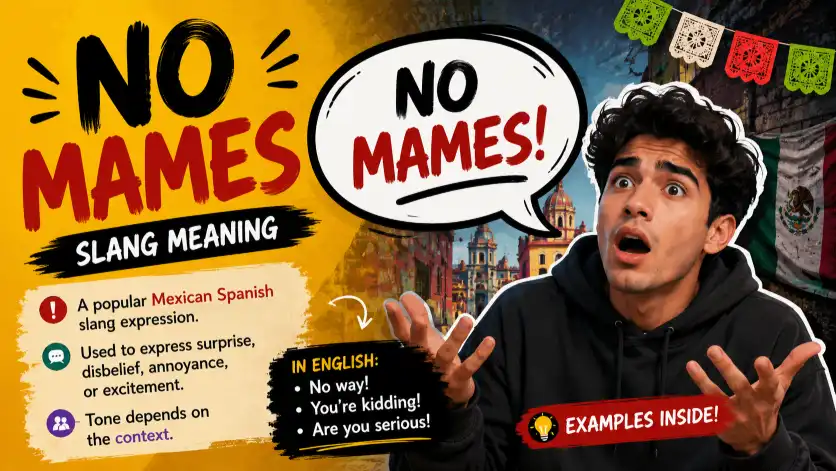
No mames slang is a common Mexican Spanish expression that English speakers often see in texts, memes, TikTok comments, social media posts, and casual conversations.
If someone sends you “¡No mames!” and you are not familiar with Mexican Spanish, the phrase can be confusing because its literal wording is much stronger than its everyday conversational meaning.
In real-world use, no mames can express surprise, disbelief, annoyance, shock, or even excitement. The intended meaning depends heavily on the situation and the speaker’s tone. Among friends, it can sound funny and casual. In other situations, it can be considered vulgar or disrespectful.
Quick Answer:No Mames Slang
No mames is Mexican Spanish slang commonly used to mean “no way,” “you’re kidding,” “are you serious?” or “you’ve got to be kidding me.” It is informal and somewhat vulgar, so context matters.
What Does No Mames Mean in Text?
In texting, no mames is usually an emotional reaction.
Someone may write it after hearing surprising news:
“No mames, you actually won?”
Here, it means something like:
“No way, you actually won?”
Someone might also use it after hearing something unbelievable:
“No mames! That really happened?”
In this case, the phrase communicates disbelief.
The expression does not have one perfect English translation. Depending on the conversation, it can mean:
- No way!
- You’re kidding!
- Are you serious?
- You’ve got to be kidding me!
- Come on!
- Seriously?
- What the heck?
- “I can’t believe this actually happened!”
The emotional tone determines which English translation sounds most natural.
No Mames Slang Definition
A simple definition is:
No mames is informal Mexican Spanish slang used to show surprise, disbelief, frustration, shock, or strong reaction.
It is commonly used among friends and in casual settings.
For example:
“No mames, that was expensive!”
This could mean:
“Seriously? That was expensive!”
Another example:
“No mames, you look amazing!”
Here, the speaker may be expressing enthusiastic surprise rather than anger.
This flexibility is one reason the expression can be difficult for beginners to translate literally.
What Does “No Mames” Stand For?
No mames is not normally an acronym, so it does not have a traditional “full form” like many texting abbreviations.
It is a Spanish phrase.
The expression comes from the verb mamar, which has literal and vulgar meanings in Spanish. In everyday Mexican slang, however, no mames is often used idiomatically rather than being understood literally.
That distinction is important.
A literal word-for-word translation can sound strange in English and may fail to communicate what a Mexican Spanish speaker actually means.
For language learners, understanding the pragmatic meaning is more useful than translating each individual word.
What Does No Mames Literally Mean?
The phrase has a vulgar literal meaning related to the verb mamar.
However, native speakers commonly use no mames as an idiomatic expression.
In many conversations, the listener is not thinking about the literal meaning at all.
Instead, they understand the emotional message.
For example:
“No mames, that’s incredible!”
The speaker is not making a literal statement about the verb. They are reacting strongly to something surprising or impressive.
This is similar to how English speakers use expressions such as:
“What the hell?”
The individual words may not explain the exact conversational meaning.
Is No Mames a Bad Word?
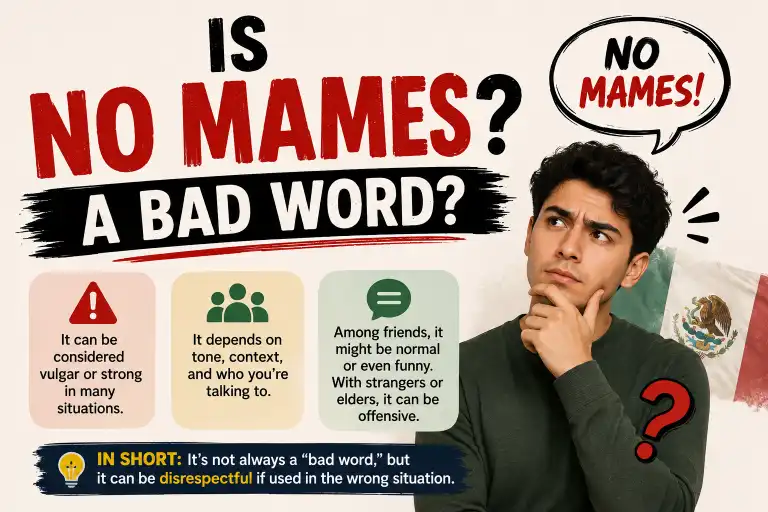
No mames is considered vulgar or profane Mexican Spanish slang.
It is not usually appropriate for formal situations.
Among close friends, however, it is extremely common and can be used casually.
The level of offensiveness depends on:
- Who is speaking
- Who is listening
- The relationship between them
- The situation
- The speaker’s tone
- The surrounding words
A friend might say:
“No mames 😂”
and everyone laughs.
A student saying the same thing to a teacher may sound disrespectful.
Therefore, learners should understand the expression before using it.
Is No Mames Offensive?
It can be.
The phrase is generally considered vulgar, but it is not necessarily intended as a personal insult.
This distinction is important.
For example:
““No mames, I can’t believe this actually happened!”
is a reaction.
The speaker is not necessarily insulting anyone.
However:
“No mames, you’re so folish.”
contains an additional insult.
The expression itself can therefore be emotionally strong without directly attacking a person.
When No Mames Means “No Way”
One of the most common uses is to express disbelief.
Example:
“I got tickets to the concert.”
“No mames! Really?”
Natural English equivalents include:
- No way!
- Seriously?
- You’re kidding!
- For real?
The speaker is surprised by the information.
This use is especially common in casual conversations.
When No Mames Means “You’re Kidding”
Suppose someone tells a friend:
“I met my favorite actor yesterday.”
The friend responds:
“No mames, you’re kidding!”
Here, the expression shows disbelief.
The speaker may genuinely want confirmation because the information sounds unbelievable.
In English, “You’re kidding!” is often a good translation.
When No Mames Means “Are You Serious?”
The phrase can also express frustration.
For example:
“They canceled the game again.”
“No mames, seriously?”
Here, the speaker is annoyed.
A natural English translation could be:
“Are you serious?”
The emotional meaning is different from the excited version.
This shows why direct translation is not enough.
When No Mames Means “Come On!”
Sometimes the phrase is used when someone is annoyed by another person’s behavior.
For example:
“You forgot the tickets again? No mames.”
The speaker might mean:
“Come on!”
or:
“Seriously?”
This use can sound irritated.
The tone can range from mild frustration among friends to genuine anger.
When No Mames Shows Excitement
Although the expression can be negative, it can also communicate excitement.
For example:
“No mames, this food is amazing!”
The speaker may mean:
“Wow, this food is incredible!”
Another example:
“No mames! We actually won!”
Here, the expression shows excitement and disbelief.
This is one reason it is inaccurate to translate no mames as only “that’s bad” or “you’re kidding.”
No Mames as a Reaction to Something Funny
The expression can also appear after something hilarious happens.
For example:
“He walked into the wrong classroom and sat there for ten minutes.”
“No mames 😂”
The speaker is reacting to the funny situation.
The meaning could be:
“No way 😂”
or:
“You’ve got to be kidding me 😂”
The laughing emoji makes the humorous interpretation even clearer.
No Mames in Texting
Texting is one of the most common places English speakers encounter this expression.
Mexican Spanish speakers may write:
“no mames”
or:
“No mames 😂”
or:
“NO MAMES”
Capital letters can make the reaction look stronger.
For example:
“NO MAMES YOU DID IT”
suggests intense excitement or disbelief.
Lowercase:
“no mames lol”
may feel more relaxed.
Texting style can therefore add emotional information.
No Mames on TikTok
No mames is commonly visible in Mexican and Mexican-American online spaces, including social media comments and short-form video content.
You may see it in reaction comments such as:
“No mames 😭”
This could express shock, amusement, disbelief, or excitement.
Another comment might say:
““No mames, I can’t believe we actually won!”
The expression is not limited to one specific TikTok meaning.
The video and comment section provide the context.
No Mames on Instagram
On Instagram, the phrase can appear in:
- Comments
- Direct messages
- Memes
- Captions
- Stories
- Reactions
For example:
“No mames, you look amazing!”
This can be an enthusiastic compliment.
Another example:
“No mames, what happened here?”
This expresses surprise.
Because Instagram conversations are often informal, the expression may feel natural among friends.
No Mames on Reddit
Reddit contains many Spanish-speaking and bilingual communities.
A user may write:
“No mames, I didn’t expect that ending.”
The phrase may be used for emphasis even within an otherwise English sentence.
This is especially common among bilingual speakers who naturally switch between languages.
The exact tone still depends on the community.
No Mames on Discord
Discord conversations are usually informal, particularly in gaming communities.
A player might write:
“No mames, I can’t believe we actually won!”
after an unexpected play.
Another player might say:
“No mames, I forgot to save.”
Here, the phrase expresses frustration.
Discord users may combine Spanish and English naturally:
““No mames, I can’t believe you actually did that!”
This kind of code-switching is common in multilingual online spaces.
No Mames in Gaming
Gaming provides many situations where strong reactions are common.
Players may use no mames after:
- Losing unexpectedly
- Winning at the last second
- Seeing an unbelievable play
- Getting a rare item
- Experiencing an unfair result
- Making a ridiculous mistake
For example:
“No mames, we won with one second left!”
This expresses excitement and disbelief.
Another example:
“No mames, I just lost all my progress.”
This expresses frustration.
The phrase is therefore highly dependent on the emotional event.
No Mames vs. No Way
“No way!” is one of the closest everyday English equivalents.
Compare:
“No mames, you got the job?”
with:
“No way, you got the job?”
Both express surprise.
The difference is tone.
“No mames” is a Mexican Spanish slang phrase used to show surprise, disbelief, annoyance, or excitement. Its tone depends on the context.
“Seriously?” or “You’re kidding!” can be softer English alternatives in many situations.
No Mames vs. Seriously?
“Seriously?” can also translate the expression in some situations.
For example:
“They raised the price again.”
“No mames.”
Natural English:
“Seriously?”
This translation works when the speaker is annoyed or surprised.
However, it does not capture the full vulgar intensity of the Spanish expression.
No Mames vs. No Way Bro
In casual bilingual conversation, “no way bro” can sometimes capture the relaxed feeling.
For example:
“No mames bro, you actually did it.”
could naturally become:
“No way, bro. You actually did it.”
The emotional effect is similar, but the Spanish phrase remains more vulgar.
No Mames vs. No Te Creo
These expressions can overlap, but they are not identical.
No te creo literally means:
“I don’t believe you.”
It directly focuses on believing someone’s statement.
No mames can express disbelief, but it can also show frustration, shock, excitement, or amazement.
Therefore, no mames has a broader emotional range.
Comparison Table
| Expression | General Meaning | Tone | Formal? |
| No mames | No way / Seriously? / You’re kidding | Vulgar, emotional | No |
| No way | Strong surprise | Casual | Usually safe |
| Seriously? | Surprise or frustration | Casual | Mostly neutral |
| You’re kidding | Disbelief | Casual | Yes, in casual settings |
| I don’t believe you | Disbelief | Neutral | Yes |
| Come on! | Frustration | Casual | Generally safe |
Why Do People Use No Mames?
People use no mames because it communicates strong emotion quickly.
Instead of explaining:
“I am very surprised by what you just told me.”
someone can simply say:
“No mames!”
The phrase carries emotional intensity.
It can also make a conversation feel:
- Casual
- Familiar
- Emotional
- Funny
- Expressive
- More natural among friends
For native speakers, this kind of slang can feel more natural than a formal expression.
Can No Mames Be Friendly?
Yes.
Among friends, no mames can be completely conversational.
For example:
“No mames, bro! You actually did it!”
The speaker may be celebrating with the friend.
Another example:
“No mames 😂 That was hilarious.”
This is clearly a casual reaction.
Being vulgar does not automatically mean the speaker is being hostile.
However, learners should still recognize that it is profanity.
When Should You Avoid Saying No Mames?
Avoid using no mames when speaking in formal or professional situations.
It is better to avoid it with:
- Teachers
- Employers
- Clients
- Customers
- Formal audiences
- People you do not know well
- Professional emails
- Academic writing
Instead, use more neutral expressions.
For example:
“Really?”
“Seriously?”
“I can’t believe it.”
“That’s surprising.”
These alternatives communicate the reaction without profanity.
Polite Alternatives to No Mames
If you want a safer expression, consider:
“¿En serio?”
This means:
“Seriously?”
It is much more neutral.
“¿De verdad?”
This means:
“Really?”
It can express surprise without sounding vulgar.
“No puede ser.”
This can mean:
“It can’t be!”
It is useful for strong surprise.
“¡Qué sorpresa!”
This means:
“What a surprise!”
It is polite and straightforward.
“¡Wow!”
This works in many casual situations.
These alternatives are better choices when speaking with people you do not know well.
Can No Mames Be Used by English Speakers?
Yes, but pronunciation and context matter.
English speakers sometimes learn the phrase from Mexican friends, movies, music, memes, or social media.
However, using slang from another language without understanding its level of vulgarity can lead to awkward situations.
If you decide to use no mames, understand that it is not a formal expression.
Knowing the meaning is not the same as knowing when it is appropriate.
Is No Mames Safe for Social Media?
The phrase can appear on social media without automatically being inappropriate.
It is common in informal online communication.
However, whether you should use it depends on your audience.
A casual personal account may use it naturally.
A professional business account may want a more neutral expression.
You should also remember that social media posts can be viewed by people from different cultures.
A phrase that sounds funny to one audience may sound offensive to another.
Is No Mames the Same as a Curse Word?
It is generally considered vulgar slang, but it does not always function as a direct insult.
It can be used as an emotional reaction.
For example:
“No mames, that’s amazing!”
The speaker is not cursing at another person in a direct way.
Still, the phrase comes from vulgar language and should be treated accordingly.
This is why dictionaries and language-learning resources often label it as vulgar or informal.
Common Mistakes English Speakers Make
Mistake 1: Translating It Literally
A word-for-word translation can sound strange and miss the real conversational meaning.
Mistake 2: Assuming It Always Means “You’re Kidding”
The expression can also mean “seriously?”, “come on,” “no way,” or “that’s wild.”
Mistake 3: Thinking It Is Always Angry
It can express excitement, amusement, or surprise.
Mistake 4: Using It in Formal Situations
It is slang and vulgar, so formal settings are not appropriate.
Mistake 5: Ignoring Tone
The same phrase can be funny in one conversation and rude in another.
How to Understand No Mames From Context
When you encounter no mames, ask:
- What happened immediately before it?
- Is the speaker surprised?
- Are they angry?
- Are they laughing?
- Is the conversation between close friends?
- Is there an emoji?
- Is the message in Spanish or bilingual?
- Is the speaker reacting to something impressive?
These clues can help you choose the right English interpretation.
Frequently Asked Questions
Q.1. What does no mames mean in slang?
No mames is Mexican Spanish slang that can mean “no way,” “seriously?”, “you’re kidding,” “come on,” or “you’ve got to be kidding me,” depending on context.
Q.2. Is no mames a bad word?
It is considered vulgar or profane slang. It is common in casual speech but should generally be avoided in formal situations.
Q.3. Is no mames Mexican slang?
Yes. No mames is strongly associated with Mexican Spanish and is widely recognized as a Mexican informal expression.
Q.4. What is a polite alternative to no mames?
You can use ¿En serio? (“Seriously?”), ¿De verdad? (“Really?”), or ¡No puede ser! (“It can’t be!”) when you want a more neutral expression.
Q.5. Does no mames always mean “no way”?
No. Depending on context, it can express disbelief, frustration, excitement, shock, amusement, or annoyance.
Q.6. Can I use no mames with friends?
Yes, if you and your friends are comfortable with vulgar slang. It is still important to understand that the phrase is informal and somewhat profane.
Conclusion
No mames slang is a versatile Mexican Spanish expression used to show strong emotion. In English, it can often be translated as “no way,” “seriously?”, “you’re kidding,” “come on,” or “you’ve got to be kidding me.”
Its meaning changes with the situation. Someone can use it after receiving shocking news, seeing something hilarious, winning a game, becoming frustrated, or hearing something unbelievable.
The phrase is widely used in casual Mexican Spanish and can appear in texting, memes, gaming chats, TikTok comments, Instagram, Reddit, and other informal online spaces. However, it is considered vulgar, so it is not a good choice for formal communication.
If you understand the tone, relationship, and context, you can usually determine what the speaker really means.
Read More About !

Michael Brooks is a language writer at SlangPath with 7+ years of experience creating simple, practical content on English slang and everyday expressions.