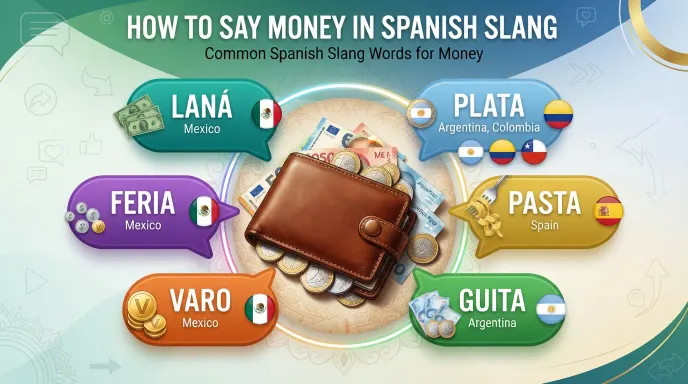
How to say money in Spanish slang refers to informal Spanish words like lana, plata, pasta, and guita that native speakers use instead of dinero in everyday conversations.
How to say money in Spanish slang is a common question for travelers, language learners, and anyone watching Spanish-language movies, TikTok videos, or chatting with native speakers online.
While the standard Spanish word for money is dinero, many countries use their own slang terms. These words can sound confusing if you only know textbook Spanish.
Learning money slang helps you understand real conversations, social media posts, songs, and everyday jokes. However, it’s also important to know that some slang words are regional. A term that’s common in Mexico might not be used in Spain or Argentina.
Quick Answer
The most common Spanish slang word for money is “lana” in Mexico, but other countries use words like “plata,” “pasta,” “guita,” “varo,” and “feria.” The correct slang depends on the country and context.
What Does How to Say Money in Spanish Slang Mean in Text?
When people search for how to say money in Spanish slang, they’re usually looking for informal words instead of the standard word dinero.
Spanish speakers often replace dinero with regional slang when texting, chatting with friends, posting on social media, or speaking casually.
For example:
- “No tengo lana.”
- “Necesito plata.”
- “Me falta feria.”
All three sentences simply mean “I don’t have money,” but each uses a different slang word depending on the country.
Full Form / Definition of the Slang
Unlike abbreviations, money slang in Spanish does not have a full form.
Instead, these are informal words that developed naturally over time in different Spanish-speaking regions.
Here are some of the most common ones:
| Slang Word | Meaning | Common Countries |
| Lana | Money | Mexico |
| Plata | Money | Argentina, Colombia, Chile, Spain |
| Guita | Money | Argentina |
| Varo | Cash, money | Mexico |
| Feria | Cash, change, money | Mexico |
| Pasta | Money | Spain |
| Mosca | Money | Peru, some Latin American regions |
Is It Rude, Offensive, or Neutral?
Most Spanish money slang is neutral.
People regularly use these words with:
- Friends
- Family
- Classmates
- Coworkers
- Online conversations
However, they are usually not appropriate for:
- Business meetings
- Academic writing
- Government documents
- Professional emails
- Formal speeches
In formal situations, it’s better to say dinero.
Where Is Money Slang Commonly Used?
Money slang appears in many everyday situations.
Text Messages
Friends often shorten conversations using slang.
Example:
“¿Traes lana?”
Translation:
“Do you have money?”
Social Media
You’ll frequently see these words on:
- TikTok
- X (Twitter)
- YouTube comments
Creators often use slang because it sounds more natural and relatable.
Music
Latin music, especially:
- Reggaeton
- Regional Mexican
- Trap
- Hip-hop
- Rap
often includes money slang.
Daily Conversations
Native speakers commonly use slang while talking with friends instead of saying dinero every time.
Most Popular Spanish Slang Words for Money
Lana
Lana is one of Mexico’s most common slang words for money.
Example:
“No tengo lana para salir.”
Meaning:
“I don’t have money to go out.”
Plata
Originally meaning silver, plata is widely used to mean money.
Example:
“Necesito más plata.”
Meaning:
“I need more money.”
Guita
Very common in Argentina.
Example:
“No tengo guita.”
Meaning:
“I don’t have any money.”
Pasta
In Spain, pasta is a popular informal word for money.
Example:
“Eso cuesta mucha pasta.”
Meaning:
“That costs a lot of money.”
Varo
Another popular Mexican slang term.
Example:
“¿Tienes varo?”
Meaning:
“Do you have cash?”
Feria

Originally referring to small change, feria can also mean money.
Example:
“No traigo feria.”
Meaning:
“I don’t have any cash.”
Why Do Spanish Speakers Use Money Slang?
People use slang because it feels:
- More natural
- Less formal
- Friendly
- Relaxed
- Easier in conversation
Using regional slang also helps speakers connect with people from the same culture.
Origin and Background of Spanish Money Slang
Most money slang developed over many years through local culture.
Some words come from:
- Old expressions
- Precious metals
- Trade
- Markets
- Local traditions
- Popular sayings
Because Spanish is spoken across more than 20 countries, every region has created its own informal vocabulary.
That’s why you may hear completely different slang words for money depending on where you are.
Real-Life Examples of Usage
Friendly Conversation
Friend A:
“¿Tienes lana?”
Friend B:
“Sí, un poco.”
Casual Text
“I’m saving all my plata for vacation.”
Social Media Caption
“No guita, no shopping today.”
Family Conversation
“Necesitamos más varo para este mes.”
Shopping
“No me alcanza la pasta.”
Meaning:
“I don’t have enough money.”
Examples in Different Contexts
Friendly
“I finally have enough lana to buy that game.”
Casual
“I spent all my plata this weekend.”
Argumentative
“You always say you don’t have guita, but you’re shopping every day.”
Gaming or Social Media
“I need more varo before buying that new skin.”
Comparison Table
| Standard Word | Slang Word | Meaning | Region | Formal? |
| Dinero | Lana | Money | Mexico | No |
| Dinero | Plata | Money | Argentina, Colombia, Chile | No |
| Dinero | Pasta | Money | Spain | No |
| Dinero | Guita | Money | Argentina | No |
| Dinero | Varo | Cash | Mexico | No |
| Dinero | Feria | Money, change | Mexico | No |
When Should You Avoid Using These Slang Words?
Avoid money slang when:
- Writing business emails
- Talking to government officials
- Applying for jobs
- Giving presentations
- Writing school assignments
- Speaking with people who may not know regional slang
In these cases, simply use dinero.
Polite Alternatives
If you’re unsure which slang is appropriate, use one of these:
- Dinero
- Efectivo (cash)
- Fondos (funds)
- Recursos económicos (financial resources)
These are understood throughout the Spanish-speaking world.
Why People Search for Money Slang
Many learners want to:
- Understand native speakers
- Watch Spanish movies without confusion
- Read social media naturally
- Travel more confidently
- Learn authentic conversational Spanish
- Understand Latin music lyrics
Learning slang makes conversations feel much more natural than relying only on textbook vocabulary.
Impact of Using Slang in Communication
Using money slang correctly can:
- Make conversations sound natural
- Improve listening skills
- Help you understand native speakers
- Increase cultural awareness
- Build confidence in casual conversations
However, using the wrong regional slang may confuse people, so it’s useful to know which country a term belongs to.
Is It Safe for Social Media?
Yes.
Most Spanish slang words for money are safe to use on:
- TikTok
- Snapchat
- Discord
Just remember that not every Spanish-speaking audience will recognize every regional slang term.
Common Mistakes to Avoid
- Assuming every country uses the same slang.
- Using slang in formal documents.
- Replacing dinero everywhere without considering context.
- Thinking one slang word is universal across all Spanish-speaking regions.
Frequently Asked Questions
Q1. What is the most common slang word for money in Spanish?
Lana is very common in Mexico, while plata is widely used in several South American countries.
Q2. Does “plata” really mean money?
Yes. Although plata literally means “silver,” it is commonly used to mean money in many Spanish-speaking countries.
Q3. Is “lana” used in Spain?
Not commonly. In Spain, people are more likely to say pasta when using slang for money.
Q4. Can I use these slang words in formal conversations?
No. In formal settings, it’s better to use dinero or another standard term.
Q5. What does “varo” mean in Spanish slang?
Varo is Mexican slang for cash or money and is often used in casual conversations.
Q6. Which Spanish word for money is understood everywhere?
Dinero is the standard word and is understood across all Spanish-speaking countries.
Q7. Is it okay to use Spanish money slang in formal situations?
No. In formal settings like business meetings, school assignments, or official documents, it’s better to use the standard word dinero instead of slang.
Q8. Is Spanish money slang common on social media?
Yes. Words like lana, plata, guita, and pasta are often used on TikTok, Instagram, Reddit, WhatsApp, and other social media platforms.
Q9. Which Spanish slang word for money is used in Spain?
Pasta is one of the most common slang words for money in Spain, while other countries often use different terms.
Q10. Which Spanish word for money is understood everywhere?
Dinero is the standard Spanish word for money and is understood in all Spanish-speaking countries, making it the safest choice in any situation.
Conclusion
Learning how to say money in Spanish slang helps you understand real conversations, social media, music, and everyday speech across the Spanish-speaking world. While dinero is the universal standard, regional slang such as lana, plata, guita, pasta, varo, and feria makes casual conversations sound more authentic.
The key is remembering that Spanish slang changes from country to country. If you’re unsure which slang to use, stick with dinero in formal situations and learn regional expressions as you become more familiar with native speakers.
Read More About!

Michael Brooks is a language writer at SlangPath with 7+ years of experience creating simple, practical content on English slang and everyday expressions.