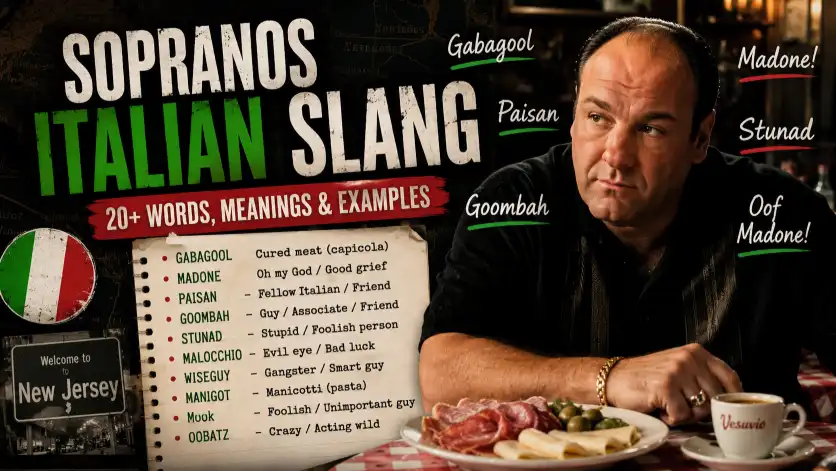
If you have watched The Sopranos, you have probably heard words like gabagool, goombah, madone, paisan, stunad, and mook. These words help give the show its strong Italian-American voice.
Some come from Italian, while others come from Italian-American speech, regional pronunciation, or American slang. That difference is important because the language in The Sopranos is not the same as standard Italian.
For viewers, these expressions can make the show’s jokes, conversations, and cultural references much easier to understand.
What Does “Sopranos Italian Slang” Mean?
Sopranos Italian slang refers to Italian, Italian-American, and related slang expressions heard in The Sopranos. The words can describe people, food, emotions, friendships, insults, family life, and everyday situations.
For example, gabagool is a famous Italian-American pronunciation associated with capicola, a cured meat. Madone is an Italian-American expression related to Madonna and can show surprise, frustration, or disbelief.
These expressions became strongly connected with the show’s characters and its New Jersey setting.
Why Does The Sopranos Use Italian Slang?
The language is an important part of the show’s world. The characters often speak English but mix in Italian-American words and expressions.
A Sign of Culture
Slang can show a character’s cultural background and connection to their family or community.
A Sign of Familiarity
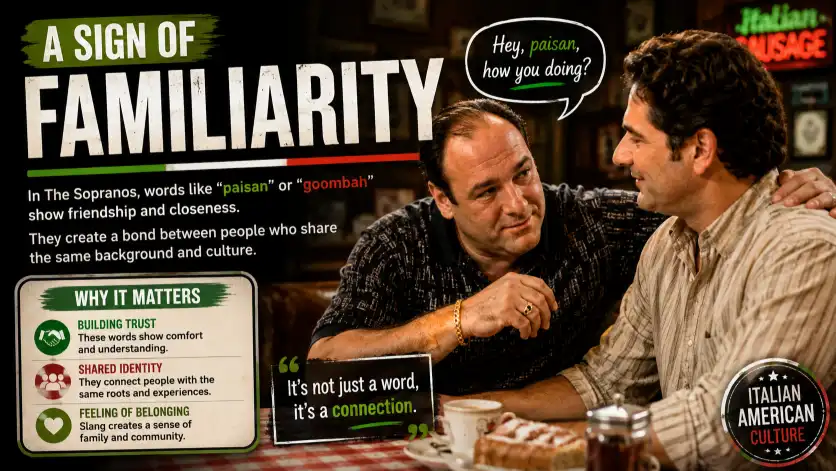
Words such as paisan can create a sense of closeness between people who share a similar background.
A Way to Show Emotion
Expressions such as madone can make a character’s reaction sound stronger and more natural.
The result is dialogue that feels different from ordinary American English.
10 Famous Sopranos Italian Slang Words
1. Gabagool
Gabagool is an Italian-American pronunciation associated with capicola, a type of cured pork.
It became one of the most famous food-related words connected with The Sopranos.
Example:
“Get some gabagool from the deli.”
Simple meaning: Italian cured meat, especially capicola.
2. Madone
Madone is related to the Italian Madonna. In Italian-American speech, it can be used as an emotional reaction.
A person may say it when they feel surprised, frustrated, shocked, or overwhelmed.
Example:
“Madone, look at the size of that bill!”
Simple meaning: An expression like “Oh my God!” or “Good grief!”
3. Paisan
Paisan comes from Italian-American usage related to paesano, meaning a fellow countryman or someone from the same community.
It can be friendly and familiar.
Example:
“Hey, paisan, how you doing?”
Simple meaning: A fellow Italian or Italian-American.
4. Goombah
Goombah is an Italian-American slang term that can refer to a male friend, associate, or fellow Italian-American.
Its meaning depends on the situation and tone.
Example:
“He’s an old goombah from the neighborhood.”
Simple meaning: A male friend or associate.
5. Stunad
Stunad is an Italian-American insult used for someone who is , reckless or clueless.
Example:
“Don’t be a stunad.”
Simple meaning: A foolish or person.
6. Mook
Mook is American slang for a foolish, unpleasant, or low-status person. It appears naturally within the street-style language of The Sopranos.
Example:
“Some mook was causing trouble outside.”
Simple meaning: A foolish or undesirable guy.
7. Marone
Marone is a spelling often used for the Italian-American pronunciation madone.
It can express frustration, surprise, or disbelief.
Example:
“Marone, what a mess!”
Simple meaning: An emotional reaction like “Oh my God!”
8. Commendatore
Commendatore is a real Italian title connected with a commander or a person who has received a particular honor.
It is not ordinary slang, but it is memorable because of its use in The Sopranos.
Example:
“Commendatore!”
Simple meaning: A formal Italian title related to commander or an honor.
9. Oobatz
Oobatz is Italian-American slang used to describe someone who is confused or acting irrationally.
The spelling can vary because the word comes from spoken language.
Example:
“Are you oobatz? What are you doing?”
Simple meaning: inexplicable , or acting shocked.
10. Putz
Putz is not Italian. It comes from Yiddish and became part of the wider New York and New Jersey slang environment.
It can describe someone who is foolish or annoying.
Example:
“Don’t be such a putz.”
Simple meaning: A foolish or annoying person.
Italian vs. Italian-American Slang
One of the easiest mistakes to make is assuming that every Italian-sounding word in The Sopranos is standard Italian.
It is not.
The show combines Italian-American speech, Italian words, regional pronunciation, American slang, and other New York-area expressions.
| Word | Type | Simple Meaning |
| Gabagool | Italian-American pronunciation | Capicola |
| Paisan | Italian-American usage | Fellow Italian |
| Stunad | Italian-American slang | Foolish person |
| Madone | Italian-American expression | Emotional reaction |
| Commendatore | Italian | Formal title |
| Mook | American slang | Foolish person |
| Putz | Yiddish/American slang | Foolish or annoying person |
This difference matters because a word that sounds natural in The Sopranos may sound unusual or unfamiliar in Italy.
Are These Words Actually Italian?
Some have Italian roots, but many are not standard modern Italian expressions.
Italian-American communities developed their own ways of speaking over generations. Families brought words and expressions from Italy, then those words changed while living in an English-speaking environment.
Why Did the Words Change?
Several factors influenced Italian-American speech:
- Regional Italian dialects
- English pronunciation
- Family traditions
- New York and New Jersey accents
- Generational changes
- Everyday community speech
This helps explain why a word such as gabagool can sound very different from the Italian word a learner might find in a dictionary.
If you are learning Italian, The Sopranos can help you understand culture and slang, but it should not be treated as a standard Italian language course.
Why Gabagool Became So Famous
Among all the expressions associated with The Sopranos, gabagool stands out.
The word became a popular cultural reference because the characters use Italian-American pronunciation when talking about food. It is now widely recognized even by people who have never watched the entire series.
What Does Gabagool Mean?
In simple terms, gabagool refers to capicola, an Italian cured meat.
Why Does It Sound So Different?
Italian-American pronunciation can change words over time. Family speech patterns and regional accents can also influence how Italian words sound when spoken in English-speaking communities.
That is why gabagool has become an easy example of Italian-American language.
More Sopranos Italian Slang and Expressions
The slang in The Sopranos goes beyond a few famous food words. Characters use different expressions to talk about friends, enemies, family members, food, emotions, and people who behave badly.
Some words have Italian roots, while others developed through Italian-American communities or come from the wider New York and New Jersey slang world.
Words Used to Describe People
Wiseguy
Wiseguy is an American slang term strongly connected with gangster culture. In The Sopranos, it can refer to someone involved with organized crime, but it can also describe someone who is acting too clever or disrespectful.
Example:
“Don’t get smart with me, wiseguy.”
Simple meaning: A gangster or someone acting too clever.
Goombata
Goombata is related to goombah and can describe a male friend, associate, or someone connected to a particular group.
The meaning depends on the speaker and situation.
Example:
“He’s one of the old goombatas.”
Simple meaning: A male friend or associate.
Malocchio
Malocchio means the evil eye. It refers to a traditional belief that a person’s jealous or harmful look can bring bad luck.
The idea has a long history in Italian and other Mediterranean cultures.
Example:
“She thinks someone gave her the malocchio.”
Simple meaning: The evil eye or a belief in harmful bad luck.
Food Words From Italian-American Speech
Food is an important part of The Sopranos. Meals, restaurants, family gatherings, and delis appear throughout the show’s world, so food vocabulary naturally becomes part of the dialogue.
Manigot
Manigot is an Italian-American pronunciation of manicotti, a pasta dish usually filled with cheese and served with sauce.
Example:
“We’re having manigot for Sunday dinner.”
Simple meaning: Manicotti pasta.
Mozzarell
Mozzarell is an Italian-American shortened pronunciation of mozzarella.
It is an example of how familiar food words can change in everyday speech.
Example:
“Put some mozzarell on the sandwich.”
Simple meaning: Mozzarella cheese.
Prosciutt
Prosciutt is an Italian-American pronunciation of prosciutto, the well-known Italian cured ham.
Example:
“Add some prosciutt to the antipasto.”
Simple meaning: Italian cured ham.
Expressions That Show Strong Emotion
“Madone!”
Madone is one of the expressions most strongly associated with Italian-American speech in The Sopranos.
It is related to Madonna and can express several emotions.
A character may use it when they are:
- Surprised
- Frustrated
- Shocked
- Annoyed
- Overwhelmed
Example:
“Madone, look at this place!”
The English equivalent changes with the situation. It might feel like “Oh my God!”, “Good grief!”, or “Wow!”
“Oof, madone!”
Adding “oof” makes the reaction sound even stronger.
Example:
“Oof, madone, what a day.”
The speaker could be expressing frustration, exhaustion, pain, or disbelief.
Why Pronunciation Matters
One of the most interesting things about The Sopranos is that many words do not sound like the Italian words found in a modern dictionary.
Italian-American speech developed through generations of contact between Italian languages and American English.
Family Speech
Families often passed words from one generation to another. Pronunciation could change naturally over time.
Regional Influence
Italian immigrants came from different parts of Italy, bringing different dialects and speech patterns with them.
English Influence
Living in an English-speaking environment also affected pronunciation and vocabulary.
This helps explain why words such as gabagool and manigot can sound so different from the forms used in standard Italian.
Slang Can Change With the Relationship
The same slang word can feel friendly, humorous, insulting, or aggressive depending on who says it.
Friendly Example
“Hey, paisan, good to see you.”
Here, paisan creates a feeling of familiarity.
Insulting Example
“You stunad!”
Here, stunad is clearly being used as an insult.
Emotional Example
“Madone!”
Here, the speaker is not describing another person. They are simply expressing an emotion.
This is why tone and context are important when understanding Sopranos slang.
Is Sopranos Italian Slang Still Used Today?
Some Italian-American expressions are still used, but their popularity varies by community and generation.
Gabagool Remains Popular
Gabagool has become especially recognizable because of The Sopranos. People outside Italian-American communities may even use it as a humorous reference to the show.
Older Expressions Can Be More Regional
Some expressions are more common among older speakers or in particular Italian-American communities.
A word appearing repeatedly on television does not mean that every Italian-American person uses it in everyday conversation.
How The Sopranos Changed Popular Culture
The Sopranos introduced many Italian-American expressions to viewers around the world.
Words such as gabagool, madone, paisan, stunad, goombah, and manigot became strongly associated with the show’s characters.
The expressions were memorable because viewers could often understand them from context even when they had never heard the words before.
The show also helped make Italian-American pronunciation a recognizable part of American television culture.
Sopranos Slang vs. Modern Internet Slang
Sopranos slang and internet slang come from very different sources.
This slang often reflects family history, community speech, regional pronunciation, and cultural identity.
Internet slang usually spreads through social media, texting, gaming, memes, and online communities.
| Type | Example | Main Source |
| Italian-American slang | Gabagool | Community speech |
| Italian expression | Madonna | Italian language |
| Italian-American insult | Stunad | Italian-American usage |
| American slang | Wiseguy | American urban speech |
| Internet slang | LOL | Online communication |
This difference shows that slang does not have one single source. It can grow from culture, geography, generations, and technology.
When Should You Avoid Using Sopranos Slang?
Not every expression from The Sopranos is suitable for everyday conversation.
Some terms may be:
- Offensive
- Insulting
- Outdated
- Strongly regional
- Connected with gangster stereotypes
- Unfamiliar to Italian speakers
You should also avoid copying an Italian-American accent simply because you learned a few words from the show.
Understanding slang is different from imitating a community’s way of speaking.
If you are learning Italian, standard Italian is a better choice for school, travel, work, and formal situations.
A Quick Way to Remember the Most Famous Terms
If you only want to remember a few expressions from The Sopranos, start with these:
- Gabagool — capicola
- Madone — emotional exclamation
- Paisan — fellow Italian or Italian-American
- Goombah — male friend or associate
- Stunad — foolish person
- Manigot — manicotti
- Malocchio — evil eye
- Wiseguy — gangster or smart-acting person
- Oobatz — shocking or irrational
- Mook — foolish or undesirable person
These words cover some of the most recognizable vocabulary connected with the show’s Italian-American speech.
Understanding Sopranos Italian Slang in Context
The Italian-American slang in The Sopranos is easier to understand when you look at the situation around each word. A single expression can have a different feeling depending on the speaker’s tone, the people involved, and what is happening at the time.
Some words are friendly. Some are insults. Others are simply used to show emotion or talk about food.
How to Understand Sopranos Slang Without Speaking Italian
You do not need to speak Italian to understand most of the slang in The Sopranos. Start by looking at context, tone, and the relationship between the characters.
Listen to the Tone
If someone says “Madone!” after hearing bad news, the word probably expresses frustration or disbelief.
Look at the Situation
If someone asks for gabagool, they are talking about food rather than making a cultural reference.
Notice the Relationship
A word such as paisan can sound friendly between people who share a cultural background, while another word can become insulting when used aggressively.
Context often tells you more than a direct dictionary translation.
Sopranos Slang in Everyday-Style Examples
Talking About Food
“You want some gabagool on your sandwich?”
Here, gabagool refers to capicola or a similar Italian cured meat.
Greeting Someone
“Hey, paisan, how you doing?”
Here, paisan creates a familiar and friendly feeling.
Calling Someone Foolish
“Don’t be a stunad.”
Here, stunad means the person is behaving foolishly.
Showing Frustration
“Madone, this traffic is terrible!”
Here, madone is an emotional reaction.
These examples show why slang should not always be translated word for word.
Why Sopranos Slang Sounds Different From Standard Italian
The language heard in The Sopranos reflects Italian-American speech, not simply modern Italian.
Italian immigrants came to the United States from different regions, and many brought their own dialects and vocabulary. Over time, these forms mixed with English and developed within American communities.
Italian Dialects
Italy has many regional speech varieties. Words brought from different areas could have different pronunciations.
American English
English became the main language for many Italian-American families. Italian words could change as they were used inside English sentences.
Generational Change
Parents, children, and grandchildren may pronounce the same word differently. This can create new forms that become familiar within a community.
This helps explain why expressions such as gabagool sound so different from standard Italian vocabulary.
What Makes The Sopranos Language Memorable?
The show’s language does more than communicate information. It helps create the identity of its characters.
It Shows Background
A character’s vocabulary can hint at their family and community background.
It Shows Personality
Some characters use slang to sound tough, funny, friendly, or intimidating.
It Creates Humor
Unusual pronunciations and repeated expressions became memorable parts of the show’s dialogue.
It Builds the Setting
The mix of Italian-American expressions and New York/New Jersey English helps create the show’s distinctive atmosphere.
Are All Sopranos Slang Words Italian?
No. This is one of the most important things to remember.
The show uses a mixture of:
- Italian words
- Italian-American expressions
- Regional pronunciations
- American slang
- New York and New Jersey speech
- Yiddish-influenced slang
For example, putz is not Italian. It comes from Yiddish and became part of broader American slang.
Likewise, wiseguy is American slang rather than an Italian word.
So the phrase “Sopranos Italian slang” covers a wider group of expressions than standard Italian alone.
Should You Use Sopranos Slang in Italy?
Not necessarily.
Someone learning Italian may hear these expressions in the show and assume they are normal words to use in Italy. That can lead to confusion.
For Travel
Use standard Italian phrases when speaking with people in Italy.
For School or Work
Standard Italian is more appropriate than Italian-American slang.
For Watching The Sopranos
The slang is very useful because it helps you understand the characters and cultural references.
The main point is simple: learn these words to understand the show and Italian-American culture, but do not assume they are standard Italian.
Why Gabagool Became a Cultural Reference
Few words are as closely associated with The Sopranos as gabagool.
The pronunciation became widely recognized outside Italian-American communities. It is now often used online and in popular culture as a humorous reference to the show or Italian-American food.
What Does Gabagool Refer To?
It refers to capicola, an Italian cured meat.
Why Is the Pronunciation Different?
Italian-American speech can change the sound of words through regional accents, dialect influence, and generations of English-language use.
That makes gabagool a good example of how language can evolve inside a cultural community.
Sopranos Slang and Cultural Identity
Language can help people maintain a connection with their family and cultural history.
Italian-American communities developed expressions that may not appear in a standard Italian textbook. These words can carry memories of family, food, neighborhoods, and traditions.
This is why slang should not always be dismissed as “incorrect language.”
Slang Can Preserve History
Older expressions can survive because families continue using them at home.
Slang Can Create Community
Shared words can make people feel connected to others with similar backgrounds.
Slang Can Change Over Time
Younger generations may use fewer traditional expressions or give old words new meanings.
Is Sopranos Italian Slang Still Popular?
Some expressions remain recognizable today, especially because the show continues to influence popular culture.
Gabagool is perhaps the clearest example. It is widely recognized by people who may not even know much Italian-American slang.
Other terms are less common outside particular communities or older generations.
It is also important to remember that television can exaggerate how often people use certain expressions. A word being common in a TV series does not mean every Italian-American speaker uses it regularly.
Frequently Asked Questions
Q1:What is the most famous Sopranos Italian slang word?
Gabagool is probably the most recognizable. It is an Italian-American pronunciation associated with capicola.
Q2:What does “Madone” mean in The Sopranos?
Madone is an emotional expression related to Madonna. It can express surprise, frustration, disbelief, or shock.
Q3:What does “paisan” mean?
Paisan is an Italian-American form related to paesano. It can refer to a fellow Italian, Italian-American, or someone from the same community.
Q4:What does “stunad” mean?
Stunad is an Italian-American slang insult for someone who is foolish or clueless.
Q5:Is gabagool real Italian?
Gabagool is an Italian-American pronunciation associated with capicola. It is not the standard Italian form you would normally learn from an Italian textbook.
Q6:Is Sopranos slang the same as Italian?
No. The Sopranos uses a mixture of Italian, Italian-American speech, American slang, regional pronunciation, and other New York-area expressions.
Q7:What does goombah mean?
Goombah is Italian-American slang that can refer to a male friend, associate, or fellow Italian-American, depending on context.
Q8:What does malocchio mean?
Malocchio refers to the evil eye, a traditional belief involving a harmful or jealous look that can bring bad luck.
Q9:Can I use Sopranos slang when learning Italian?
You can learn it for cultural understanding, but it should not replace standard Italian. Many expressions are specific to Italian-American speech.
Q10:Why is Sopranos slang important?
It shows how language can change through immigration, generations, regional communities, and contact between different languages.
Conclusion
Sopranos Italian slang is a fascinating mix of Italian-American culture, regional speech, English, Italian words, and local slang. Words such as gabagool, madone, paisan, goombah, and stunad help give the show its distinctive voice.
The most important thing to remember is that these expressions are not all standard Italian. Some have Italian roots, while others developed within Italian-American communities or come from the wider New York and New Jersey speech environment.
Understanding the context behind the words makes The Sopranos easier to follow and gives you a better look at how language changes across cultures and generations.
Read More About !

Michael Brooks is a language writer at SlangPath with 7+ years of experience creating simple, practical content on English slang and everyday expressions.