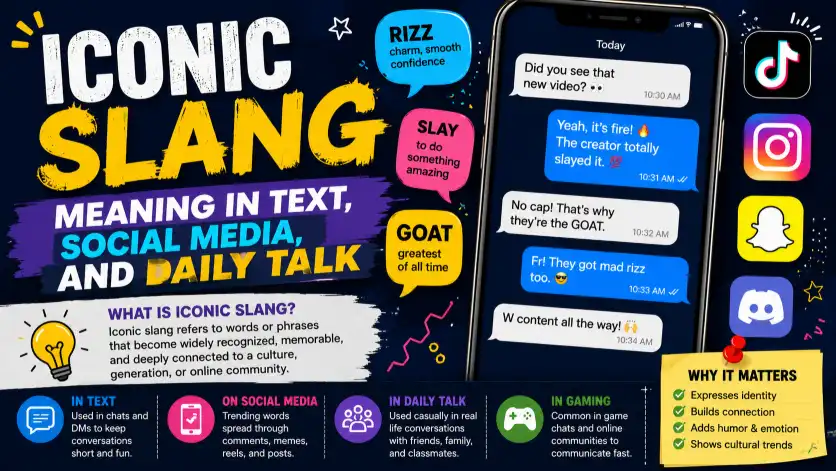
Iconic slang refers to slang words or phrases that become widely recognized, memorable, or strongly linked with a certain time, culture, group, or online trend. These expressions often stand out because people use them again and again in everyday speech, texting, memes, and social media.
People search for iconic slang when they want to understand popular expressions they have seen online or heard from friends. Some terms become closely linked with Gen Z, gaming, music, movies, or older generations.
Others become famous because they spread across platforms such as TikTok, Instagram, Reddit, Snapchat, and Discord.
This guide explains what iconic slang means, how these expressions become popular, where people use them, and how context can change their tone.
Quick Answer: What Does Iconic Slang Mean?
Iconic slang means a slang word or phrase that is especially famous, memorable, or strongly associated with a particular culture, generation, trend, or period. Examples can include expressions such as “rizz,” “GOAT,” “lit,” or “spill the tea,” depending on the context.
The word iconic means something that is widely recognized or strongly represents a person, group, style, or period. When it describes slang, it points to expressions that have made a noticeable mark on popular communication.
What Does Iconic Slang Mean?
The phrase iconic slang is not one specific slang word.
Instead, it describes slang that has become especially well-known or memorable.
A slang term may become iconic because millions of people recognize it. A phrase may also become iconic within a smaller community, such as gamers, music fans, or a particular generation.
For example, “GOAT” became a widely recognized expression for someone considered the “greatest of all time.” “Rizz” became strongly associated with modern internet culture and was widely discussed after gaining popularity online.
The word “iconic” does not mean that every person uses the expression. It usually means that the slang has a strong cultural presence or is easily recognized by many people.
Is “Iconic Slang” a Slang Term?
Not exactly.
Iconic slang is better understood as a description of certain slang expressions rather than one fixed slang term.
For example:
- “Rizz” can be described as iconic internet slang.
- “YOLO” became iconic among many younger internet users.
- “Lit” became a well-known informal expression.
- “Spill the tea” became widely recognized online.
- “GOAT” became a common way to praise exceptional people.
These expressions have different meanings, but they can all be described as iconic slang because of their cultural visibility.
What Makes Slang Iconic?
A slang expression usually becomes iconic when it has more than simple popularity.
Several factors can help a term stand out.
Wide Recognition
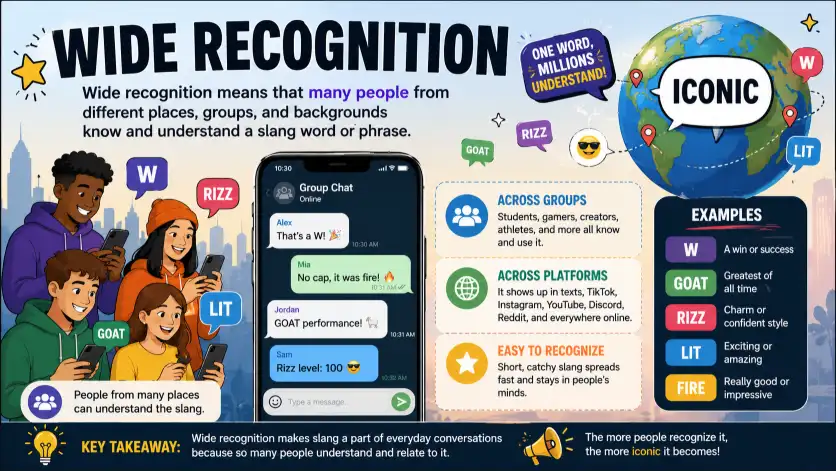
People from different online or social groups may recognize the expression even if they do not use it regularly.
Strong Cultural Connection
Some slang becomes closely linked with a generation, music scene, online community, or period.
Long-Lasting Use
A term that remains recognizable for years may become more iconic than a phrase that disappears after a short trend.
Memes and Social Media
Memes can help slang spread quickly. TikTok, Instagram, Reddit, YouTube, and other platforms can expose an expression to huge audiences.
Easy to Remember
Short and catchy expressions often spread more easily than complicated phrases.
Popular Examples of Iconic Slang
There is no official list of words that qualify as “iconic slang.” The label depends on culture, audience, and time.
Some widely recognized examples include:
| Slang | Common Meaning |
| GOAT | Greatest of all time |
| Rizz | Charm or romantic appeal |
| Lit | Exciting or excellent |
| YOLO | You only live once |
| FOMO | Fear of missing out |
| Slay | To do something very well |
| Tea | Gossip or interesting information |
| Flex | To show off |
| Ghosting | Suddenly stopping communication |
| W | A win or success |
These terms do not all come from the same period or community. Their popularity also differs by age group and platform.
Where Is Iconic Slang Used?
Iconic slang can appear almost anywhere informal communication happens.
Common places include:
- Text messages
- TikTok
- Snapchat
- Discord
- YouTube comments
- Gaming chats
- Group chats
- Online forums
- Casual conversations
The exact slang used can change from one platform to another.
Gaming communities may favor terms connected with wins, losses, teamwork, or gameplay. TikTok users may spread expressions through videos and memes. Reddit communities can develop slang that is specific to a particular topic.
Iconic Slang in Texting
Texting is one of the easiest places for slang to spread.
People often choose short expressions because they make messages quick and casual.
For example:
“That outfit is fire.”
Here, fire can mean something impressive or very good.
Another message might say:
“That was a huge W.”
In this case, W means a win or successful result.
The tone is usually relaxed. These expressions are better suited to casual communication than formal writing.
Iconic Slang on TikTok
TikTok can play a major role in making slang widely recognizable.
A phrase may appear repeatedly in videos, comments, captions, and memes. Users then repeat the expression in their own posts.
Not every TikTok expression becomes long-term slang. Some phrases remain tied to one trend and quickly fade.
A term becomes more culturally significant when people continue recognizing or using it after the original trend becomes less popular.
Iconic Slang on Discord
Discord slang often depends on the server or community.
Gaming servers may use expressions such as W, L, GG, or other gaming-related terms.
A different server may have its own inside jokes and abbreviations.
This means that a slang word can be iconic within one online community without being widely known outside it.
Iconic Slang in Gaming
Gaming has produced many expressions that became common outside gaming.
Terms such as GG, AFK, noob, and W are recognized by many internet users.
Some gaming expressions also change meaning when people use them in everyday conversations.
For example:
“That presentation was a W.”
The speaker is not talking about a video game. They are using gaming-style slang to describe a successful real-life event.
Is Iconic Slang Always Modern?
No.
A slang expression can become iconic even after it is no longer new.
Older expressions can remain culturally recognizable for decades. Some become strongly associated with a particular generation or historical period.
This is why “iconic” and “new” should not be treated as synonyms.
A phrase can be old but still iconic.
A phrase can also be extremely popular for a few months without becoming culturally lasting.
Does Iconic Slang Change Over Time?
Yes.
Slang has a natural lifecycle.
A term may begin as niche language, become popular, reach mainstream audiences, and later become less common.
Some expressions disappear almost completely. Others stay in everyday language.
A once-popular term may also become humorous or “dated” when younger users stop using it seriously.
This is one reason slang dictionaries need regular updates.
Key Takeaway
Iconic slang describes slang expressions that become especially recognizable, memorable, or culturally important. The term does not refer to one specific word.
The expressions considered iconic can change by generation, platform, region, and community. Context also matters because a phrase that sounds normal to one group may sound old-fashioned or unusual to another.
Origin and History of Iconic Slang
There is no single starting point for iconic slang because different expressions come from different communities and periods.
Some slang develops in local speech. Other terms grow through music, sports, television, gaming, or online communities. Social media can then spread these expressions to a much larger audience.
For example, “GOAT” became widely popular through sports and entertainment conversations. “Rizz” became strongly linked with recent internet culture and was later recognized far beyond the communities where it first gained attention.
The history of each slang term should therefore be studied separately. Calling every popular expression “internet slang” can hide its real background.
How Slang Becomes Iconic
A slang word does not become iconic simply because it goes viral for a few days.
Several things can help it become widely recognized.
Repeated Use
People need to keep using a term after its first appearance. Repeated use gives an expression a stronger place in everyday communication.
Popular Culture
Music, movies, television, sports, celebrities, and online creators can make certain phrases widely known.
Social Media
Platforms such as TikTok, Instagram, Reddit, and YouTube can spread expressions very quickly.
Community Adoption
A term can begin inside a small group and later move into mainstream conversations.
Cultural Recognition
Some slang becomes strongly associated with a particular generation or period. Even people who do not use the word may still recognize it.
Iconic Slang Across Different Generations
Different generations have their own well-known expressions.
Older slang may be connected with music, television, local communities, or youth culture from an earlier period.
Millennials grew up with expressions that spread through early internet forums, instant messaging, blogs, music, and television.
Gen Z has seen slang spread at a much faster rate through TikTok, Instagram, Discord, gaming communities, and other digital platforms.
This does not mean every person in a generation uses the same slang. Age groups are broad, and individual language habits vary.
Gen Z and Iconic Slang
Gen Z slang often spreads through online communities and social platforms.
Expressions such as rizz, slay, sus, no cap, and W have become recognizable far beyond their original communities.
Some of these terms remain common, while others become less popular after a trend ends.
This fast cycle creates an important difference between popular slang and iconic slang.
A phrase can become popular very quickly without having lasting cultural importance.
Millennial Iconic Slang
Millennial-era slang includes expressions that became popular through early social media, texting, forums, television, and popular culture.
Terms such as YOLO, FOMO, and LOL became widely recognized during periods when digital communication was rapidly expanding.
Some expressions remain useful today. Others may sound dated when used seriously by younger speakers.
That does not make them meaningless. It simply shows how slang changes with time.
Is Iconic Slang Rude or Offensive?
Iconic slang is not automatically rude or offensive.
The phrase describes how recognizable a slang expression is. The actual tone depends on the individual slang word.
For example, a harmless expression such as W can be used to celebrate success.
Other slang terms can be insulting, sexual, aggressive, or disrespectful.
The safest approach is to judge the specific expression rather than assuming that all iconic slang has the same tone.
Can Iconic Slang Be Used at Work?
Some slang can work in casual workplace communication, especially when coworkers already use informal language.
That does not mean every slang expression belongs in professional communication.
For formal situations, clear standard English is usually safer.
Avoid slang when writing:
- Job applications
- Formal business emails
- Reports
- Academic documents
- Client communications
- Official announcements
- Professional proposals
A casual team chat may allow more flexibility than a formal email to a customer.
Iconic Slang in School
Students may use slang naturally when talking with friends.
School assignments are different.
Academic writing usually requires clear and standard language unless the teacher specifically asks students to analyze slang or informal speech.
For example, a student writing about internet culture may discuss rizz or GOAT as examples of modern language.
The term can be appropriate as a subject of study even when it would not fit a formal essay sentence.
Iconic Slang on Reddit
Reddit has thousands of communities, and each community can develop its own language.
A gaming subreddit may use gaming slang. A sports subreddit may use team-specific terms. A meme community may create phrases that outsiders do not immediately understand.
This makes Reddit a good example of how slang can become iconic within a niche group.
A term does not need to be known by everyone to be important within its community.
Iconic Slang on Snapchat
Snapchat is strongly associated with casual communication between friends.
Users may use short slang expressions, abbreviations, emojis, and inside jokes.
The meaning often depends on the relationship between the people communicating.
A phrase that sounds confusing to an outsider may be completely clear to two friends who regularly use it.
Iconic Slang on Instagram
Instagram slang can appear in captions, comments, direct messages, memes, and short-form videos.
Popular expressions can spread when users repeatedly see them in posts from creators and friends.
The same slang may have a serious meaning in one conversation and a joking meaning in another.
Tone is often shaped by punctuation, emojis, images, and the surrounding post.
Iconic Slang in Discord Communities
Discord provides a strong example of community-based language.
A server can develop its own terms, jokes, abbreviations, and expressions.
Some may remain inside that server. Others can spread to other online communities.
Gaming Discord servers often use short expressions because fast communication is useful during gameplay.
A term that seems unusual outside gaming may feel completely normal inside a gaming community.
Iconic Slang vs. Popular Slang
These phrases are related, but they are not exactly the same.
| Term | Meaning |
| Popular slang | Slang that many people currently use |
| Iconic slang | Slang that is especially recognizable or culturally memorable |
| Trending slang | Slang receiving attention during a current trend |
| Outdated slang | Slang that was popular but is now less common |
| Niche slang | Slang mainly understood by a specific group |
A trending term may become iconic if it remains culturally important over time.
A popular expression may also disappear quickly.
Iconic Slang vs. Internet Slang
Internet slang is a broad category.
It includes words, abbreviations, phrases, memes, and expressions used online.
Iconic slang focuses more on recognition and cultural importance.
An expression can be both internet slang and iconic slang.
For example, rizz became strongly associated with online culture while also becoming widely recognized.
Not every internet abbreviation becomes iconic.
Real-Life Examples of Iconic Slang
Friendly Conversation
“That new song is fire.”
Here, fire is used positively to describe something impressive or exciting.
Text Message
“You got the job? W!”
The W celebrates a success.
Gaming
“GG, that was a close match.”
GG means “good game” and is common in gaming conversations.
Social Media
“She absolutely slayed that performance.”
Slayed is being used as praise.
Casual Conversation
“I have serious FOMO after seeing their photos.”
FOMO means fear of missing out.
Online Discussion
“No cap, that was the best episode.”
No cap is commonly used to mean that the speaker is being honest or serious.
Why Do People Use Iconic Slang?
People use slang because it can communicate an idea quickly.
It can also show familiarity with a particular community.
Someone may use slang to:
- Sound casual
- Show humor
- Express emotion
- Fit into a social group
- Make a message shorter
- Refer to online culture
- Add personality to a conversation
Slang can make communication feel more natural between people who share the same vocabulary.
Common Misunderstandings About Iconic Slang
Not All Iconic Slang Is New
Some expressions have been around for years.
Not Everyone Uses the Same Slang
A word can be common in one group and unknown in another.
Popularity Does Not Equal Permanence
A viral expression may disappear quickly.
Slang Can Change Meaning
The same word can develop a new meaning over time.
Tone Depends on Context
A slang expression can sound funny among friends but inappropriate in a formal setting.
Is Iconic Slang Becoming Outdated?
Some expressions eventually become dated.
A slang term may start as fresh and exciting. Heavy use can make it feel overused. Younger speakers may then stop using it seriously.
Sometimes older slang returns through memes, music, movies, or nostalgia.
This means slang does not always move in one direction. Words can fade, return, change meaning, or gain a new audience.
How to Know If Slang Is Still Popular
If you want to know whether a slang term is still commonly used, look at recent conversations rather than relying only on old slang lists.
Useful clues include:
- Recent social-media posts
- Current online communities
- Recent videos and comments
- Current dictionaries
- Recent news or cultural coverage
- How younger speakers use the term
A word appearing on an old slang website does not necessarily mean it is still common today.
Key Point About Iconic Slang
Iconic slang is best understood as slang that has become especially recognizable or culturally memorable.
Its popularity can come from social media, music, sports, gaming, television, online communities, or everyday speech.
The term itself does not describe one fixed group of words. What counts as iconic can change by generation, region, community, and time.
When Should You Avoid Using Iconic Slang?
You should avoid slang when the audience may not understand it or when the situation requires formal language.
Casual slang can work well between friends, but the same expression may sound unprofessional in a workplace or academic setting.
Avoid slang when writing:
- Formal emails
- Job applications
- School assignments
- Academic papers
- Business reports
- Client messages
- Official documents
- Professional announcements
The main issue is not always that slang is rude. The problem can simply be unclear communication.
Can You Use Iconic Slang at Work?
Some mild slang may be acceptable in relaxed workplace chats.
For example, coworkers who regularly communicate informally may understand expressions such as “W” or “no cap.”
Formal communication requires more care.
A message to a manager, client, or business partner should usually use clear and professional language. The relationship, company culture, and purpose of the message all matter.
Better Approach
Use slang when:
- The conversation is clearly casual.
- Everyone understands the expression.
- The workplace culture allows informal language.
- The message is not official.
Avoid it when:
- You are communicating with a client.
- You are writing a formal document.
- The meaning could be misunderstood.
- The topic is serious or sensitive.
Polite Alternatives to Iconic Slang
There is no single polite alternative because iconic slang covers many different expressions.
The best replacement depends on the specific slang word.
| Slang | More Neutral Alternative |
| W | Success / Great result |
| Fire | Excellent / Impressive |
| Slay | Did very well |
| No cap | Honestly / Truly |
| Flex | Show off |
| FOMO | Fear of missing out |
| Ghosting | Suddenly stopped responding |
| Tea | Gossip / Information |
You do not always need to replace slang. In a friendly conversation, using the original expression can make your message sound natural.
The important part is matching your language to your audience.
Why Do People Use Iconic Slang?
People often use slang because it makes communication feel more natural and expressive.
A short slang expression can communicate an emotion that would take several formal words to explain.
For example:
“That was a W!”
can express excitement about a successful result.
A person could instead say:
“That was a great success.”
Both sentences communicate a positive idea, but the first sounds more casual and internet-friendly.
Slang also helps people show that they understand a particular community or culture.
How Iconic Slang Shows Identity
Language can help people show who they are and which communities they feel connected to.
Gamers may use gaming slang. Sports fans may use sports terms. Online communities may develop their own expressions.
Using shared slang can create a feeling of belonging.
This does not mean that everyone in a generation or community uses the same words. Personal language habits vary widely.
Does Iconic Slang Have a Specific Age Group?
No single age group owns iconic slang.
Some terms become associated with Gen Z, while others are strongly connected with Millennials, older generations, gamers, sports fans, or specific online communities.
Age can influence which expressions a person recognizes or uses, but it is not a reliable rule.
A younger person may use older slang because of family, media, music, or online culture. An older person may use newer internet slang because they spend time on social platforms.
Can Iconic Slang Change Meaning?
Yes.
Slang meanings can shift as people use them in new situations.
A word may begin with one meaning and later develop another. Its tone can also change.
A term that once sounded serious may become humorous. A phrase that started online may later become normal in everyday speech.
This is one reason context is so important when reading slang.
Common Misunderstandings About Iconic Slang
“Iconic” Means Everyone Uses It
Not necessarily.
A term can be highly recognizable without being used by everyone.
All Iconic Slang Comes From TikTok
No.
Slang can come from music, sports, local speech, television, gaming, online forums, movies, and many other sources.
Iconic Slang Is Always New
It can be old or new.
Some expressions remain recognizable long after their peak popularity.
Slang Is Always Informal and Rude
Slang is usually informal, but it is not automatically offensive.
The specific word and context determine the tone.
A Slang Dictionary Makes a Term Current
Not necessarily.
A slang dictionary may preserve older expressions. Current usage should be considered when deciding whether a term is still common.
How to Use Iconic Slang Correctly
The easiest rule is to consider context, audience, and purpose.
Before using a slang expression, ask:
- Does my audience understand it?
- Is this a casual conversation?
- Could the expression sound rude?
- Could someone misunderstand it?
- Is this a professional or academic setting?
- Does the slang still sound natural today?
If the answer to these questions is clear, using slang is usually easier.
Iconic Slang in Formal vs. Informal Communication
| Situation | Slang Use |
| Close friends | Usually fine |
| Group chat | Usually fine |
| Gaming chat | Common |
| Social media | Common |
| Discord | Community-dependent |
| School conversation | Usually acceptable informally |
| School assignment | Usually avoid unless relevant |
| Workplace chat | Depends on company culture |
| Formal email | Usually avoid |
| Academic paper | Avoid unless analyzing slang |
The same person may use slang in a group chat and completely different language in a business email.
That is normal communication.
Why Slang Can Be Useful
Slang is not simply a collection of incorrect words.
It can help speakers express humor, emotion, identity, and social connection.
It can also show cultural change.
Researchers, teachers, writers, and journalists may study slang to understand how people communicate within a particular period or community.
For everyday users, slang can make casual conversations shorter and more expressive.
Why Slang Can Cause Problems
Slang can also create confusion.
A reader may know a different meaning for the same word. An older expression may be unfamiliar to a younger audience. A phrase that sounds funny to one person may sound disrespectful to another.
Professional communication creates an additional concern.
A slang-heavy message can make the writer appear less formal when a formal tone is expected.
Clear language is therefore the safer choice when the audience is uncertain.
Frequently Asked Questions
Q.1 What does iconic slang mean?
Iconic slang refers to slang words or phrases that become especially recognizable, memorable, or strongly connected with a culture, generation, community, or period.
Q.2 Is iconic slang a specific type of slang?
Not exactly. Iconic slang is a descriptive term for slang that has gained strong cultural recognition. It is not one fixed category with a single official list.
Q.3 What are some examples of iconic slang?
Examples can include GOAT, rizz, lit, YOLO, FOMO, slay, tea, flex, W, and other expressions that have become widely recognized.
Q.4 Is iconic slang rude?
Not automatically. Some slang is harmless and positive, while other expressions can be rude, offensive, or inappropriate. The individual term and context matter.
Q.5 Can I use iconic slang at work?
Mild slang may be acceptable in some informal workplace chats, but formal emails, reports, client messages, and official documents usually require clearer language.
Q.6 Does iconic slang come from Gen Z?
Some modern slang is strongly associated with Gen Z, but iconic slang is not limited to one generation. Older generations and different communities have their own well-known expressions.
Q.7 Is iconic slang still popular?
Some iconic slang remains popular for years, while other expressions become dated. Popularity changes over time, so a term’s current use should be checked rather than assumed.
Q.8 Where can I see iconic slang?
You may encounter slang in texting, social media, gaming, Discord, Reddit, TikTok, Instagram, Snapchat, online forums, music, and casual conversations.
Conclusion
Iconic slang describes expressions that have become especially recognizable or memorable within popular culture, online communities, generations, or specific periods. It can come from many places, including music, sports, gaming, television, texting, and social media.
Not every popular phrase becomes iconic, and not every iconic expression remains popular forever. Slang can spread, change meaning, become dated, or return years later.
The best way to use iconic slang is to consider the audience, setting, tone, and current meaning. Casual conversations often allow more freedom, while professional and academic situations usually benefit from clear standard English.
Understanding slang is not only about knowing definitions. It is also about knowing when a word fits, who is likely to understand it, and how the expression may sound to someone else.
Read More About !
- Watersports Meaning Slang: What Does Watersports Mean in Text?
- JFK Meaning Slang: Definition and Texting Examples
- PhD Slang: Meaning, Full Form, and Common Uses in Text

My name is Olivia Bennett.I am a language enthusiast and educational writer with a strong interest in contemporary English and digital communication. I enjoys making language learning engaging and accessible.