Spanish to English slang means translating informal Spanish words and phrases into natural English while considering their context, tone, and regional usage.
Spanish to English slang is useful when you see casual Spanish words on social media, in text messages, or during online conversations. Many Spanish expressions have meanings that are different from their direct dictionary translations.
This can make slang confusing for English speakers who are learning Spanish or simply trying to understand a Spanish post.
Spanish slang also changes between countries. A word that sounds natural in Mexico may not be common in Spain, Argentina, Colombia, or Peru. Social media has made these differences easier to notice because people from different Spanish-speaking communities interact online every day.
This guide explains common Spanish slang in simple English and shows how these expressions work in real conversations.
Quick Answer:spanish to english slang
Spanish to English slang means translating informal Spanish words and expressions into natural English. The best translation depends on the region, situation, relationship between speakers, and tone.
What Does Spanish to English Slang Mean in Text?
Meaning of Spanish Slang
Spanish slang refers to informal language used in relaxed conversations. People may use it with friends, family members, classmates, online followers, or gaming partners.
In text messages, slang can make a conversation feel shorter and more natural. It can also show friendship, humor, excitement, frustration, or familiarity.
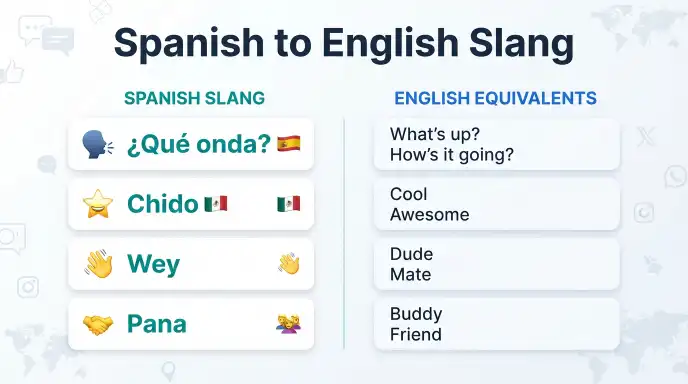
For example, a Spanish speaker may write “¿Qué onda?” instead of using a more formal greeting. In natural English, this can mean “What’s up?” or “How’s it going?”
Why Literal Translation Can Be Confusing
A literal translation does not always communicate the real meaning of slang.
The Spanish word “plata” literally refers to silver, but it is also commonly used to mean money in many Spanish-speaking contexts.
Similarly, “chido” does not simply need to be translated word for word. In Mexican Spanish, it commonly expresses the idea of something being cool, great, or awesome.
The goal of slang translation is therefore to understand the intended message rather than translate every individual word.
Spanish Slang Full Form and Definition
Does Spanish Slang Have a Full Form?
Most Spanish slang does not have a traditional full form. Unlike English abbreviations such as LOL or BRB, many slang expressions are complete Spanish words or phrases.
Some expressions developed from everyday speech, while others became popular through regional culture, music, television, and internet communication.
Common Spanish Slang Terms
| Spanish slang | Natural English meaning | Common region |
| Wey / güey | Dude / bro | Mexico |
| Qué onda | What’s up? | Mexico and Latin America |
| Chido | Cool / awesome | Mexico |
| Guay | Cool / great | Spain |
| Pana | Friend / buddy | Several Latin American regions |
| Tío | Dude / man | Spain |
| Chamba | Job / work | Several Latin American regions |
| Plata | Money / cash | Many Spanish-speaking regions |
These meanings are general. Spanish slang can change depending on the country and local community.
Common Spanish Slang Translated Into English
Wey / Güey
Wey, also written güey, is strongly associated with Mexican Spanish. In casual conversations, it can mean dude, bro, man, or buddy.
The word is often used between friends and people who have a relaxed relationship.
Example:
“Wey, ¿vamos al cine?”
Natural English: “Dude, are we going to the movies?”
The tone matters. Among close friends, it can sound friendly and relaxed. In a tense conversation, the same word can sound impatient or disrespectful.
Qué Onda
Qué onda is a casual Spanish expression used to ask what is happening or how someone is doing.
Natural English translations include:
- “What’s up?”
- “What’s going on?”
- “How’s it going?”
Example:
“¡Qué onda! ¿Cómo estás?”
Natural English: “What’s up! How are you?”
It is much more informal than a formal greeting.
Chido
Chido is common Mexican slang for something that is cool, enjoyable, impressive, or good.
It can describe a person’s clothes, a car, a song, a video, an idea, or an experience.
Example:
“Tu carro está muy chido.”
Natural English: “Your car is really cool.”
The word is strongly connected with informal Mexican Spanish, so it should not be treated as universal Spanish slang.
Guay
Guay is widely associated with casual Spanish from Spain. It can mean cool, nice, great, or awesome, depending on context.
Example:
“Tu idea está guay.”
Natural English: “Your idea is cool.”
This is a useful example of regional variation. Chido and guay can both express approval, but they belong to different Spanish-speaking environments.
Pana
Pana can refer to a friend, buddy, or close companion in several Latin American varieties of Spanish.
Example:
“Ese es mi pana.”
Natural English: “That’s my buddy.”
Its exact popularity and meaning can vary from one country to another.
Is Spanish Slang Rude, Offensive, or Neutral?
Friendly and Neutral Slang
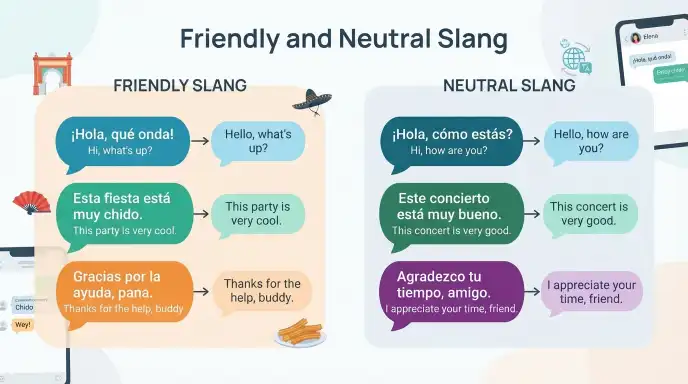
Not all Spanish slang is rude. Many expressions are simply informal ways to communicate with friends.
Words such as chido and guay are generally casual and can be used to express approval or enthusiasm.
A speaker may choose slang because it sounds more natural in a relaxed conversation.
Context-Dependent Slang
Some expressions can change tone depending on the relationship between speakers.
Wey/güey is a good example. Friends in Mexico may use it casually when talking to each other. The same expression can sound disrespectful when used aggressively or toward someone who expects formal language.
This is why knowing the dictionary meaning is not enough.
Offensive Slang
Spanish also contains vulgar expressions and insults. Some can be highly offensive, while others may be used jokingly between close friends.
English speakers should avoid repeating unfamiliar slang simply because they see it frequently online.
Understanding the social context is important before using an expression yourself.
Where Is Spanish Slang Commonly Used?
TikTok and Instagram
Spanish slang is common in TikTok videos, Instagram captions, comments, memes, and short-form content.
Users may use slang to make a caption shorter or give it a more natural conversational style.
For example, a Mexican creator might use chido when reacting positively to a video or trend.
Texting and Messaging
Friends often use informal Spanish when sending text messages.
Short expressions can make conversations feel more relaxed. A person may use slang instead of a longer formal sentence because the relationship already feels familiar.
Reddit and Online Communities
Spanish slang can appear naturally in Spanish-language Reddit discussions and other online communities.
The country of the person writing the post can affect the vocabulary they use. This means readers should avoid assuming that every Spanish-speaking user understands the same slang.
Discord and Gaming
Spanish-speaking gamers may combine Spanish slang with English gaming terms.
A message can contain regional Spanish expressions alongside words such as game, rank, lobby, team, or bro.
This mixture is especially common in international gaming communities.
Real-Life Examples of Spanish Slang
Friendly Example
Spanish: “Qué onda, wey?”
English: “What’s up, dude?”
This sounds casual and familiar in a Mexican Spanish context.
Social Media Example
Spanish: “Ese video está chido.”
English: “That video is cool.”
The speaker is showing approval of the video.
Talking About Work
Spanish: “Mañana tengo que ir a la chamba.”
English: “I have to go to work tomorrow.”
Here, chamba is an informal word for work or a job.
Talking About Money
Spanish: “No tengo plata.”
English: “I don’t have any money.”
In many Spanish-speaking communities, plata can be used informally to mean money.
Spain Example
Spanish: “Tío, esa película está guay.”
English: “Dude, that movie is cool.”
The combination of tío and guay gives the sentence a casual Spanish-from-Spain feel.
Why Context Matters in Spanish Slang
Regional Differences
Spanish is spoken across many countries, and each region has developed its own informal vocabulary.
Mexican slang may differ from Spanish slang used in Madrid. Argentine slang can also have expressions that are unfamiliar to someone from Colombia or Peru.
For this reason, a slang translation should ideally identify the region when the information is known.
Tone and Relationship
The relationship between two people can change how a slang expression sounds.
A word used between close friends may sound warm and humorous. The same word used toward a stranger can feel overly familiar.
Tone can also change when an argument is taking place.
Literal Meaning vs Natural Meaning
A useful way to understand slang is to move through four steps:
Literal meaning → Regional meaning → Context → Natural English meaning
This approach helps explain why a word sometimes has an English translation that looks completely different from its dictionary definition.
Spanish Slang by Region
Mexican Spanish Slang
Mexican Spanish has a large collection of informal expressions that are widely recognized through movies, music, TikTok, YouTube, and other online platforms. Words such as wey, chido, and qué onda are common examples.
A phrase may sound very natural in Mexico but less familiar in another Spanish-speaking country. This is why regional context matters when translating slang into English.
Spanish Slang From Spain
Spanish spoken in Spain has its own casual vocabulary. Words such as tío and guay are common examples.
In casual conversation, tío can mean “dude” or “man,” while guay can mean “cool” or “great.” These meanings are different from the literal meanings you might find in a basic Spanish dictionary.
Latin American Spanish Slang
Latin America includes many different countries, so there is no single set of slang words that everyone uses.
Expressions such as pana, chamba, and plata can appear in different Latin American communities, although their popularity and exact use can vary.
Spanish Slang and English Equivalents
Words for Friends
Spanish speakers use different informal words to refer to friends or people they know well.
| Spanish expression | Natural English meaning |
| Wey / güey | Dude / bro |
| Pana | Buddy / friend |
| Tío | Dude / man |
| Amigo | Friend / buddy |
The best choice depends on the country and relationship between speakers.
Words for Something Cool
Several Spanish expressions can communicate approval or excitement.
Chido is commonly associated with Mexico, while guay is strongly associated with Spain.
Both can sometimes be translated as cool, but they do not belong to exactly the same regional variety.
Words Related to Money
Plata is an informal word for money in many Spanish-speaking contexts.
For example:
“Necesito plata.”
Natural English:
“I need money.”
The expression is casual and should be understood from the surrounding conversation.
When Should You Avoid Spanish Slang?
Formal Situations
Spanish slang is usually not the best choice for formal communication.
Avoid unfamiliar slang in:
- Job applications
- Business emails
- Academic writing
- Official documents
- Formal presentations
- Professional meetings
Standard Spanish is usually a safer choice in these situations.
Conversations With Strangers
Some slang expressions can sound overly familiar when used with someone you do not know.
If you are unsure about a word, use a neutral Spanish expression until you understand how the other person communicates.
When You Do Not Know the Meaning
Do not repeat slang simply because you saw it in a viral video or comment.
Some expressions can have vulgar or insulting meanings. A quick understanding of the context can prevent an embarrassing mistake.
Polite Alternatives to Spanish Slang
Casual vs Neutral Spanish
| Casual expression | Neutral alternative | English meaning |
| Qué onda | ¿Cómo estás? | How are you? |
| Pana | Amigo | Friend |
| Chamba | Trabajo | Work / job |
| Plata | Dinero | Money |
| Chido | Genial | Great |
| Guay | Genial | Great / cool |
Neutral vocabulary is useful when speaking with teachers, employers, customers, or people you have just met.
Why Neutral Spanish Is Safer
Neutral language reduces the chance of misunderstanding.
This is especially useful for Spanish learners who are still learning regional differences. Once you understand how an expression works, you can decide whether it fits the conversation.
Why People Use Spanish Slang
Slang Creates a Casual Feeling
People often use slang because it makes communication feel relaxed.
A short informal expression can sound more natural between friends than a formal sentence.
Slang Shows Regional Identity
Certain words can reveal where a speaker is from or which Spanish-speaking community they identify with.
For example, chido can immediately suggest Mexican Spanish, while guay is strongly associated with Spain.
Slang Builds Social Connection
Friends may use slang to create a sense of closeness.
Informal vocabulary can make a conversation feel personal rather than distant or formal.
Slang Works Well Online
Social media encourages short, expressive communication.
Slang can fit naturally into:
- Captions
- Comments
- Memes
- Direct messages
- Gaming chats
- Short videos
- Group conversations
Impact of Spanish Slang on Communication
Slang Can Make Communication More Natural
When used correctly, slang can make a message sound more like everyday speech.
A learner who understands slang can often understand the personality and tone behind a message better than someone who only knows formal Spanish.
Slang Can Cause Confusion
Regional differences can make slang difficult for learners.
A word that is common in one country may be unfamiliar somewhere else. A literal translation can create even more confusion.
Slang Can Change Tone
The same expression may sound friendly, humorous, sarcastic, or aggressive depending on the situation.
That is why translation should consider both the words and the context.
Is Spanish Slang Safe for Social Media?
Generally Safe Expressions
Many everyday slang words are harmless when used appropriately.
Expressions such as chido, guay, and qué onda are generally casual rather than offensive.
Still, their suitability depends on the audience and regional context.
Slang That Needs Caution
Some Spanish slang contains insults, profanity, sexual references, or culturally sensitive language.
These expressions should not be copied without understanding their meaning.
Social media also removes some context because readers cannot always hear the speaker’s voice or see their facial expression.
Check the Audience
Before using Spanish slang publicly, consider who will read it.
A phrase that works perfectly in a private conversation with friends may not be suitable for a professional account or public post.
Common Mistakes When Translating Spanish Slang
Mistake 1: Translating Every Word Literally
Literal translation can miss the actual message.
For example, plata may literally relate to silver, but in everyday slang it can mean money.
Mistake 2: Assuming All Spanish Is the Same
Spanish varies across countries and regions.
A translation should not automatically treat Mexican, Spanish, Argentine, Colombian, and Caribbean slang as identical.
Mistake 3: Ignoring Tone
Tone can completely change the meaning of an expression.
A friendly word between close friends may sound rude when directed at a stranger.
Mistake 4: Copying Viral Slang
Internet popularity does not mean an expression is safe or appropriate everywhere.
Always understand a slang word before using it yourself.
How to Translate Spanish Slang Naturally
Step 1: Identify the Expression
First, determine the exact Spanish word or phrase.
Look at the words immediately before and after it because surrounding language can provide important clues.
Step 2: Identify the Region
Try to determine whether the speaker is from Mexico, Spain, Argentina, Colombia, Peru, or another Spanish-speaking region.
Regional information can dramatically improve the translation.
Step 3: Understand the Tone
Ask whether the message is:
- Friendly
- Humorous
- Casual
- Sarcastic
- Angry
- Flirtatious
- Offensive
Tone can be just as important as vocabulary.
Step 4: Find the Natural English Equivalent
The final translation should sound natural in English.
For example:
“¿Qué onda?” → “What’s up?”
This is better than forcing a literal translation that does not sound natural in English.
Spanish Slang vs Standard Spanish
Everyday Comparison
| Standard Spanish | Slang or informal Spanish | Natural English |
| ¿Cómo estás? | ¿Qué onda? | What’s up? |
| Amigo | Pana | Buddy |
| Trabajo | Chamba | Job / work |
| Dinero | Plata | Money |
| Genial | Chido | Cool |
| Genial | Guay | Cool / great |
The informal version usually creates a more relaxed feeling.
Which Version Should Learners Use?
Beginners should learn standard Spanish first because it works in a wider range of situations.
After building a strong foundation, learning regional slang can make conversations, social media posts, and entertainment much easier to understand.
Spanish Slang in Texting and Online Chats
Short and Informal Messages
Texting encourages casual language because people usually want to communicate quickly.
Spanish speakers may use slang alongside abbreviations, emojis, English internet terms, and regional expressions.
The resulting message can be very different from formal written Spanish.
Mixed Spanish and English
Online conversations sometimes combine Spanish and English.
A user might write a Spanish sentence and include English internet words such as bro, random, cringe, or DM.
This type of language mixing is especially common among younger internet users and bilingual communities.
Spanish Slang in Gaming
Communication Between Players
Gaming communities often develop their own informal vocabulary.
Spanish-speaking players may combine regional slang with common gaming words.
A message could contain a Spanish slang term for a friend while discussing a lobby, rank, team, match, or game.
Why Gaming Slang Spreads
Online games connect players from different countries.
As players communicate regularly, slang can spread beyond its original region. Social media clips and gaming streams can spread these expressions even faster.
Comparison With Similar English Slang
“Wey” vs “Bro”
Wey/güey and bro can both be used as casual ways to address a friend.
However, wey belongs to Mexican Spanish, while bro is an English slang term that has also become common in many international online communities.
“Chido” vs “Cool”
Chido can often be translated as cool in Mexican Spanish.
The difference is that chido carries Spanish and regional cultural context, while cool is a standard English slang adjective with much wider international use.
“Pana” vs “Buddy”
Pana can mean buddy or friend.
Both expressions can communicate familiarity, but pana is associated with particular Spanish-speaking communities, while buddy belongs to English.
Frequently Asked Questions
Q.1. What does Spanish slang mean in English?
Spanish slang means informal Spanish vocabulary translated according to its natural meaning in English. Context and region are important.
Q.2. What is Spanish slang for “bro”?
Wey/güey can mean “bro” or “dude” in Mexican Spanish. Pana can also mean “buddy” or “friend” in several Latin American contexts.
Q.3. What does “chido” mean in English?
Chido commonly means “cool,” “great,” or “awesome” in Mexican Spanish.
Q.4. What does “guay” mean?
Guay is casual Spanish from Spain and commonly means “cool,” “nice,” or “great.”
Q.5. Is Spanish slang the same everywhere?
No. Spanish slang differs between countries and regions, so the same concept can have different informal expressions.
Q.6. Can Spanish slang be offensive?
Yes. Some expressions are harmless, while others can be vulgar, insulting, or culturally sensitive. Context is important.
Conclusion
Understanding Spanish Slang Correctly
Spanish to English slang is more than a simple word-for-word translation. Expressions such as wey, qué onda, chido, guay, pana, chamba, and plata show how regional language can create different meanings in everyday communication.
Using Slang With Confidence
Social media users can understand Spanish posts more easily by considering the country, context, relationship, and tone behind an expression. If you are unsure about a slang term, use a neutral translation and avoid repeating it until you understand its meaning.
Learning slang can make Spanish content easier to follow while also giving you a better understanding of how Spanish-speaking communities communicate online and in everyday life.
Spanish Slang in Different Social Situations
Talking With Friends
Spanish slang is most natural when people are speaking with close friends. Informal words can make conversations feel relaxed and personal.
A friend might use wey, pana, or another regional expression when greeting someone. The English equivalent could be “bro,” “dude,” or “buddy,” depending on the situation.
The relationship between speakers matters. A word that feels friendly between friends may sound too familiar when used with someone you have just met.
Talking Online
Social media has made Spanish slang easier to encounter outside Spanish-speaking countries.
A person learning Spanish may see slang in comments, memes, captions, videos, or direct messages. The expression may come from Mexico, Spain, Argentina, Colombia, or another Spanish-speaking community.
This is why identifying the speaker’s region can make translation much easier.
Talking in Professional Situations
Informal slang is usually not appropriate for professional communication.
A business email, job interview, academic assignment, or formal presentation normally requires standard Spanish.
For example, “chamba” may sound natural in a conversation between friends, but “trabajo” is a safer choice in formal writing.
How Spanish Slang Changes Across Countries
Mexico
Mexican Spanish has many widely recognized slang expressions.
Words such as wey, chido, and qué onda are common examples. Mexican slang has also become familiar internationally through music, movies, television, and social media.
Spain
Spanish from Spain has its own informal vocabulary.
Tío can mean “dude” or “man” in casual speech, while guay can mean “cool” or “great.”
These words may be perfectly natural in Spain but less common in Latin American Spanish.
Argentina
Argentina has distinctive informal expressions that may be unfamiliar to Spanish learners from other countries.
Argentine Spanish also has noticeable differences in pronunciation and vocabulary, so context is especially important when translating slang from Argentine speakers.
Colombia
Colombian Spanish contains its own regional vocabulary and expressions.
Some Colombian slang has spread through music, television, and social media, allowing people outside Colombia to encounter these terms more often.
Peru and Other Latin American Regions
Peru and other Latin American countries also have local slang.
A word such as jato, for example, can be used informally for “home” in Peruvian contexts.
This illustrates why the phrase “Spanish slang” should not be treated as one universal vocabulary list.
Spanish Slang Translation Examples
Example 1: Friendly Greeting
Spanish: “¿Qué onda, wey?”
English: “What’s up, dude?”
The sentence is casual and friendly in an appropriate Mexican context.
Example 2: Compliment
Spanish: “Tu outfit está chido.”
English: “Your outfit is cool.”
Here, chido expresses approval.
Example 3: Talking About Work
Spanish: “Estoy buscando chamba.”
English: “I’m looking for a job.”
The word chamba makes the sentence informal.
Example 4: Talking About Money
Spanish: “Necesito plata.”
English: “I need money.”
Here, plata is being used as an informal word for money.
Example 5: Talking About a Friend
Spanish: “Él es mi pana.”
English: “He’s my buddy.”
The expression communicates familiarity.
Example 6: Casual Spanish From Spain
Spanish: “Tío, eso está guay.”
English: “Dude, that’s cool.”
Both tío and guay are associated with casual Spanish from Spain.
Friendly, Casual, and Argumentative Tones
Friendly Tone
Slang often sounds warm when used between close friends.
Spanish: “Wey, qué chido verte.”
English: “Dude, it’s great to see you.”
The relationship makes the informal language feel natural.
Casual Tone
A casual message may simply use slang to make everyday communication less formal.
Spanish: “Voy a la chamba.”
English: “I’m going to work.”
The meaning is straightforward, but the word choice is informal.
Argumentative Tone
The same slang can sound very different during an argument.
A word such as wey may be used aggressively when someone is frustrated.
The English translation might still use “dude” or “man,” but the tone could be closer to “Seriously, dude?” Context determines the intended feeling.
Humorous Tone
Slang is also common in jokes, memes, and funny social media posts.
A person may intentionally use exaggerated or regional slang to make a post sound more entertaining.
Why Social Media Users Learn Spanish Slang
Understanding Comments
Knowing common slang makes Spanish comments easier to understand.
A learner who knows only formal Spanish may recognize the individual words but still miss the meaning of the entire comment.
Understanding Memes
Memes often rely on short informal expressions.
A literal translation can remove the humor, while understanding the slang can reveal why the phrase is funny.
Communicating With Spanish Speakers
Learning a small amount of appropriate slang can make casual communication feel more natural.
However, learners should avoid forcing slang into every sentence. Using too much unfamiliar slang can sound unnatural.
Is Spanish Slang Safe to Use?
Safe Does Not Mean Universal
An expression can be harmless but still inappropriate for a particular audience.
For example, a casual term may be fine in a private conversation but unsuitable in a formal workplace.
The issue is often not whether the word is “bad.” The issue is whether it fits the situation.
Check Regional Meaning
Before using a slang word, check which Spanish-speaking community commonly uses it.
This is especially important when communicating with people from different countries.
Avoid Sensitive Expressions
Some slang terms relate to insults, sexuality, body parts, drugs, or other sensitive subjects.
These expressions require extra caution because their meanings and offensiveness can vary significantly.
Practical Tips for Learning Spanish Slang
Learn the Standard Word First
Start by learning the standard Spanish word for a concept.
Once you know the standard form, learn the slang version and understand where it is used.
For example:
Trabajo → chamba
Dinero → plata
This makes the difference between formal and informal Spanish easier to recognize.
Learn Slang in Sentences
Do not memorize slang as isolated vocabulary.
Learn how people actually use the expression in a sentence.
This helps you understand its grammar, tone, and natural placement.
Pay Attention to the Country
Always check the region when learning slang.
A term may be common in Mexico but uncommon in Spain. Another expression may be popular in Argentina but unfamiliar in Colombia.
Listen to Native Speakers
Movies, interviews, podcasts, videos, and social media can help learners hear how slang is actually used.
Listening to native speakers also helps reveal tone, pronunciation, and context.
Do Not Overuse Slang
Using one or two natural expressions is better than filling every sentence with slang.
Too much slang can make your Spanish sound forced, especially if you are still learning the language.
Spanish Slang and Cultural Understanding
Slang Reflects Local Culture
Language is closely connected to culture.
Regional slang can reflect humor, history, social relationships, and local identity. Learning these expressions can therefore provide more than vocabulary knowledge.
Slang Creates a Sense of Belonging
People often use familiar slang to show that they belong to a particular community.
This can happen among friends, gamers, students, music fans, and online communities.
Slang Changes Over Time
Internet culture can make expressions popular very quickly.
A word may become common among younger users and later lose popularity. Other expressions can remain part of everyday speech for decades.
This means modern slang should be understood as changing language rather than a fixed dictionary list.
Spanish Slang vs English Internet Slang
Similar Purpose
Spanish and English slang often serve similar communication purposes.
Both languages use informal expressions to show friendship, humor, excitement, frustration, and group identity.
The main difference is the vocabulary and cultural context.
Examples
| Spanish slang | English equivalent | Purpose |
| Wey | Bro / dude | Addressing a friend |
| Pana | Buddy | Referring to a friend |
| Chido | Cool | Showing approval |
| Qué onda | What’s up? | Casual greeting |
| Chamba | Job / work | Talking about employment |
| Plata | Money / cash | Talking about money |
These are approximate equivalents rather than exact replacements.
What Does Spanish Slang Stand For?
Slang Is Not Always an Abbreviation
When people search for “what does Spanish slang stand for,” they may expect a full form.
Most Spanish slang terms do not work that way. They are usually informal words or expressions rather than abbreviations.
For example, chido does not have a hidden full form. It is a slang adjective associated with Mexican Spanish.
Similarly, qué onda is an informal expression rather than an acronym.
Why This Matters
Understanding this difference prevents confusion when researching Spanish slang online.
Some search results may describe a phrase as slang even though it is not technically an abbreviation.
Frequently Asked Questions
Q.1. What is Spanish to English slang?
Spanish to English slang refers to informal Spanish words and expressions explained through their natural English meanings.
Q.2. What does “wey” mean in English?
In Mexican Spanish, wey or güey can mean “dude,” “bro,” “man,” or “buddy.” Its tone depends on context.
Q.3. What does “chido” mean in English?
Chido commonly means “cool,” “great,” or “awesome” in Mexican Spanish.
Q.4. What does “pana” mean?
Pana can mean “friend,” “buddy,” or “close companion” in several Latin American varieties of Spanish.
Q.5. What does “chamba” mean?
Chamba is an informal word for “work” or “job” in several Spanish-speaking regions.
Q.6. Can Spanish slang be different by country?
Yes. Spanish slang can vary significantly between Mexico, Spain, Argentina, Colombia, Peru, and other Spanish-speaking regions.
Conclusion
The Main Idea
Spanish to English slang is best understood through context rather than direct word-for-word translation. Expressions such as wey, qué onda, chido, guay, pana, chamba, and plata can make casual Spanish sound very different from formal Spanish.
Use Slang Carefully
Social media users can benefit from learning slang because it makes TikTok comments, Instagram posts, Reddit discussions, gaming chats, and text messages easier to understand.
The safest approach is to check the region, tone, and audience before using an unfamiliar expression. Once you understand those details, Spanish slang becomes much easier to recognize and translate naturally.
Read More About !
- Iconic Slang Meaning in Text, Social Media, and Daily Talk
- Watersports Meaning Slang: What Does Watersports Mean in Text?
- JFK Meaning Slang: Definition and Texting Examples

My name is Olivia Bennett.I am a language enthusiast and educational writer with a strong interest in contemporary English and digital communication. I enjoys making language learning engaging and accessible.