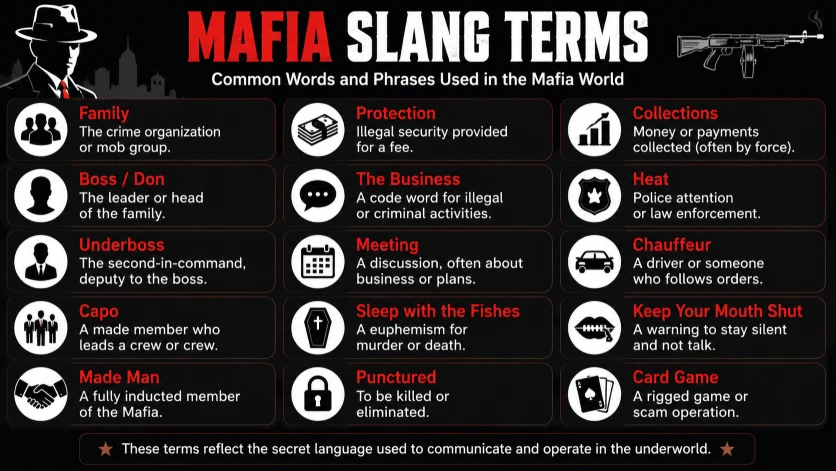
Mafia slang terms are words and phrases commonly linked to organized crime groups, especially the Italian-American Mafia, but they have also become popular through movies, TV shows, books, and internet culture. Many people search for these terms after hearing them in films like The Godfather, crime documentaries, or social media discussions.
Today, many mafia expressions are used jokingly or metaphorically rather than literally. Someone might call a strict family member “the boss” or refer to a close friend as a “made guy” without any connection to organized crime. Understanding these expressions helps you recognize their meaning, tone, and cultural background while avoiding misunderstandings.
Quick Answer
Mafia slang terms are informal words and expressions associated with organized crime culture. Most are now used in entertainment, pop culture, and casual conversation rather than referring to actual criminal organizations.
What Does Mafia Slang Terms Mean in Text?
In texting and online conversations, mafia slang terms usually refer to:
- Loyalty
- Power
- Leadership
- Respect
- Secretive behavior
- Criminal organizations (often jokingly)
Most people use them figuratively rather than literally.
For example:
“He’s the boss of our gaming squad.”
This doesn’t mean the person belongs to a mafia—it simply means they’re the leader.
Mafia Slang Terms Full Form / Definition
Unlike abbreviations, mafia slang terms do not have a full form. Instead, they are nicknames, titles, and expressions that developed within organized crime communities before spreading into popular culture.
They often describe:
- Members
- Leaders
- Family relationships
- Criminal activities
- Codes of loyalty
- Trust and betrayal
Common Mafia Slang Terms and Their Meanings
| Mafia Slang | Meaning | Common Usage |
| Boss | Leader of a crime family | Leadership |
| Don | Head of the organization | Respectful title |
| Capo | Captain managing crew members | Mafia hierarchy |
| Made Man | Official member of the mafia | Membership |
| Associate | Works with the mafia but isn’t an official member | Crime discussions |
| Consigliere | Trusted advisor | Advice or leadership |
| Soldier | Lower-ranking member | Organization |
| Hit | Planned murder or attack | Crime stories |
| Whack | To kill someone (slang) | Movies and TV |
| Rat | Informant who cooperates with police | Betrayal |
| Snitch | Person who tells authorities | Everyday slang |
| Omertà | Code of silence | Loyalty |
| Family | Mafia organization | Crime culture |
| Crew | Small working group | Criminal teams or casual groups |
| Wiseguy | Mafia member or someone acting overly confident | Pop culture |
What Does “Boss” Mean?
The Boss is the highest-ranking leader of a mafia family.
Outside organized crime, people casually say:
- “You’re the boss.”
- “She’s the boss of this project.”
Here it simply means leader.
What Does “Don” Mean?
“Don” is an honorific title showing respect to the head of a mafia family.
Popular movies helped make this one of the most recognized mafia terms.
Example:
“Everyone waited for the Don’s decision.”
What Does “Capo” Mean?
A Capo (captain) supervises soldiers and reports to the boss.
Today people sometimes joke:
“He’s the capo of our football team.”
what does capo mean in mafia slang
What does capo mean in mafia slang? In Mafia terminology, a capo is a lower-level leader who supervises a crew of members and reports to a higher-ranking boss. The word comes from Italian capo, meaning “head” or “chief,” and is commonly used when describing Mafia hierarchy and organized crime.
A capo is sometimes described as a captain or crew leader. The exact structure can vary between different Mafia organizations, historical periods, and fictional portrayals.
What Does a Capo Do?
A capo typically sits between senior leadership and lower-ranking members within the organization.
In descriptions of traditional Mafia structure, a capo may:
- Supervise a group or crew
- Report to a higher-ranking leader
- Pass instructions between levels
- Help manage the group’s activities
- Represent the interests of the crew to senior leadership
The term therefore describes a position within a hierarchy, rather than simply meaning “Mafia member.”
Capo vs. Boss
These two terms are not exactly the same.
| Term | General meaning |
|---|---|
| Boss | Senior leader of a Mafia family |
| Capo | Leader who supervises a smaller crew |
| Soldier | Lower-ranking member |
| Associate | Person connected to the organization without being formally inducted |
This distinction is useful when reading Mafia terminology in books, watching crime dramas, or researching organized crime history.
Is Capo Used Outside Mafia Discussions?
Yes. Because the Italian word capo broadly relates to a head, chief, or leader, it can appear in other contexts too.
Modern popular culture sometimes uses capo jokingly to describe someone who is in charge of a group.
For example:
“He’s the capo of our gaming group.”
Here, the speaker is using the word humorously to mean leader. It does not necessarily suggest any connection to organized crime.
Capo in Movies and TV Shows
The word capo is especially recognizable because crime movies and television shows have popularized Mafia terminology.
When a character is called a capo, the term usually helps explain their position in the fictional criminal hierarchy. However, entertainment can simplify or dramatize real Mafia structures, so fictional dialogue should not automatically be treated as a historical source.
What Does “Made Man” Mean?
A Made Man is an officially accepted member of a mafia family after completing initiation requirements.
In casual conversations, someone may jokingly say:
“After five years in the company, he’s finally a made man.”
This simply means they’ve become an accepted member of the group.
What Does “Associate” Mean?
An associate works with the organization but isn’t officially inducted.
Business teams sometimes jokingly use it:
“He’s just an associate—not part of management.”
What Does “Consigliere” Mean?
A Consigliere serves as the trusted advisor to the boss.
Modern use:
“She’s basically my consigliere whenever I make big decisions.”
What Does “Rat” or “Snitch” Mean?
These are among the most widely used mafia-related slang words.
A Rat or Snitch is someone who gives information to authorities or betrays a group.
Today they’re common in schools, gaming, and social media.
Example:
“Don’t be a snitch.”
The phrase is usually negative.
What Does “Omertà” Mean?
Omertà refers to the traditional code of silence where members refuse to cooperate with law enforcement.
Outside crime discussions, people jokingly say:
“We’ve got omertà about tonight’s surprise party.”
Here it simply means keeping a secret.
what is omertà in mafia slang
What is omertà in mafia slang? Omertà refers to a traditional code of silence associated with Mafia and other organized crime cultures, especially the refusal to cooperate with authorities or provide information about criminal activity. The term is strongly connected with discussions of Sicilian and Italian-American organized crime.
Unlike a simple slang nickname, omertà describes a cultural idea or code of silence.
What Does Omertà Mean?
The basic idea behind omertà is silence and non-cooperation.
In Mafia-related contexts, it can involve refusing to:
- Inform authorities
- Reveal information about other members
- Cooperate with investigations
- Discuss internal activities with outsiders
- Break the group’s expectation of loyalty
Because of this history, the word often carries a serious meaning when used in its original organized-crime context.
Is Omertà Still Used Today?
The word is still recognized, but its use is not limited to discussions of real organized crime.
It frequently appears in:
- Crime movies
- TV dramas
- Books
- Documentaries
- Historical discussions
- News writing about organized crime
- Popular culture
People may also use it figuratively when joking about keeping a secret.
For example:
“Everyone agreed to keep omertà about the surprise party.”
In this example, the speaker is using the word humorously to mean a shared promise to stay silent.
Omertà vs. Ordinary Secrecy
These ideas are related but not identical.
Keeping a secret can happen for many harmless reasons. Omertà, however, has a specific historical and cultural association with a code of silence connected to organized crime.
That difference matters when interpreting the word.
Calling a surprise-party secret “omertà” is playful. Using the term while discussing an actual criminal investigation has a much more serious meaning.
Why Does Omertà Appear So Often in Popular Culture?
Crime films and television shows often use the concept because silence and loyalty are major themes in stories about organized crime.
The idea can help writers explore:
- Loyalty
- Fear
- Betrayal
- Trust
- Family
- Power
- Secrecy
As a result, people who have never encountered real Mafia culture may still recognize omertà from entertainment.
Is Omertà a Slang Word?
Not exactly.
It is better described as a term associated with a cultural code of silence rather than ordinary internet slang.
That distinction makes the word different from casual expressions such as boss, snitch, or crew.
Is Mafia Slang Offensive, Rude, or Neutral?
It depends on the specific word.
| Slang | Tone |
| Boss | Neutral |
| Don | Neutral |
| Capo | Neutral |
| Consigliere | Neutral |
| Crew | Neutral |
| Family | Neutral |
| Rat | Offensive |
| Snitch | Often offensive |
| Whack | Violent expression |
| Hit | Violent expression |
Words like Rat and Snitch can insult someone, while leadership titles like Boss or Capo are usually harmless depending on context.
Where Is Mafia Slang Commonly Used?
Today these expressions appear in many places:
Movies
Crime films popularized many mafia expressions.
Examples include:
- The Godfather
- Goodfellas
- Casino
Television

Crime dramas regularly use mafia vocabulary.
Video Games
Games involving gangs or organized crime often include these terms.
Social Media
People sometimes jokingly call their friend group a “family” or jokingly refer to someone as the “boss.”
Reddit and Online Forums
Crime history discussions often explain authentic mafia terminology.
Origin and Background of Mafia Slang
Many mafia slang words originated from:
- Italian language
- Sicilian dialects
- Italian-American communities
- Organized crime culture during the 1900s
As Italian immigrants settled in America, some words blended with English and became recognizable worldwide through books, films, and television.
Today, most people know these expressions from entertainment rather than real organized crime.
Why People Use Mafia Slang
People use mafia slang because it can:
- Sound humorous
- Add dramatic effect
- Show leadership
- Create memorable nicknames
- Reference famous movies
- Express loyalty among friends
Most modern use is playful rather than literal.
mafia phrases
Mafia phrases are expressions associated with organized crime culture, Mafia movies, television, books, and popular culture. Some have historical connections to real organized crime, while others became widely known because of fictional crime stories.
Common examples include:
- “Keep your mouth shut” : a warning about staying silent.
- “You’re family” : a phrase suggesting loyalty or close connection.
- “He’s the boss” : describes someone who is in charge.
- “Don’t be a rat” : tells someone not to betray or report others.
- “We have an understanding” : can suggest an informal agreement.
- “It’s business, nothing personal” : often used in crime fiction to separate personal feelings from a decision.
- “Show some respect” :emphasizes status or authority.
- “We take care of our own” : suggests loyalty toward members of a group.
Mafia Phrases in Movies vs. Real Life
Many mafia phrases people recognize today come from entertainment rather than everyday speech. Crime movies and television often use dramatic expressions to show loyalty, power, secrecy, or conflict.
For example, a character saying “You’re family” in a crime movie may refer to a criminal organization. In everyday conversation, however, the same phrase can simply describe close friends or relatives.
This difference is important when interpreting Mafia-related language online.
Are Mafia Phrases Always Serious?
No. People sometimes use them humorously in gaming, social media, memes, or conversations about movies.
The tone depends on the situation. A phrase used while discussing The Godfather is very different from the same wording being directed at a real person during an argument.
mafia code words
Mafia code words generally refers to coded language, nicknames, or indirect expressions associated with organized crime discussions. In historical accounts and crime fiction, such language may be used to hide meaning, identify people or roles, or communicate without speaking directly.
Some terms commonly connected with Mafia culture include:
- Made man — an inducted member in traditional Mafia terminology.
- Associate — someone connected to a criminal organization without being a formal member.
- Capo — a crew leader within a Mafia hierarchy.
- Boss — a senior leader.
- Consigliere — a trusted adviser to a leader.
- Family — a term sometimes used for a Mafia organization.
- Omertà — a code of silence associated with organized crime.
Are Mafia Code Words Secret Language?
Not necessarily. Many expressions described online as “code words” are actually Mafia terminology or slang that has become widely known through books, movies, television, and historical reporting.
The exact meaning can also change depending on the time period and organization being discussed.
For example, “family” can simply mean relatives in ordinary conversation. In Mafia-related writing, however, it can refer to an organized crime group.
Mafia Code Words in Movies and Online Culture
Crime films and TV shows often make Mafia terminology appear more secretive than it really is. Writers may use coded expressions to create suspense or show that characters belong to the same group.
Online, people may also use these terms jokingly when talking about:
- Crime movies
- Gaming groups
- Memes
- Fictional characters
- Friend groups
So, context is essential when interpreting a mafia code word.
Real-Life Examples of Mafia Slang
Friendly
“You’re the boss today pick the restaurant.”
Casual
“Mike is basically our crew leader.”
Argumentative
“Don’t be a snitch.”
Gaming
“Our squad needs a real boss to organize everyone.”
Social Media
“The family is finally together again.”
Movie Discussion
“The Don never trusted the new associate.”
Comparison with Similar Slang
| Term | Meaning | Tone |
| Boss | Leader | Neutral |
| Don | Respected leader | Formal/Respectful |
| Capo | Captain | Neutral |
| Chief | Leader | Neutral |
| Kingpin | Criminal leader | Serious |
| Godfather | Powerful mentor or mafia leader | Depends on context |
| Rat | Informant | Negative |
| Snitch | Informant | Negative |
When Should You Avoid Mafia Slang?
Avoid these expressions when:
- Writing professional emails
- Speaking in formal business meetings
- Academic papers
- Legal discussions unless directly relevant
- Talking with people who may misunderstand the reference
- Conversations about real crime victims
Using violent terms jokingly may also seem insensitive depending on the audience.
Polite Alternatives
Instead of saying:
- Boss → Leader
- Don → Manager
- Crew → Team
- Rat → Informant
- Snitch → Witness (when appropriate)
- Hit → Attack
- Whack → Defeat or Remove (depending on context)
These alternatives sound more professional.
Impact of Using Mafia Slang in Communication
Like many slang expressions, mafia terms can:
Positive Effects
- Make conversations entertaining
- Reference popular culture
- Add humor
- Create memorable storytelling
Negative Effects
- Cause confusion
- Sound unprofessional
- Glorify criminal culture if used carelessly
- Offend some audiences
Always consider your audience before using slang.
Is Mafia Slang Safe for Social Media?
Generally, yes—when used to discuss movies, history, fiction, or popular culture.
However, avoid using mafia slang to:
- Threaten others
- Encourage criminal behavior
- Harass people
- Glorify violence
Context matters. Friendly jokes are very different from abusive or threatening language.
Frequently Asked Questions
Q1:What are mafia slang terms?
They are informal words and expressions associated with organized crime culture that are now widely used in movies, television, books, and casual conversation.
Q2:What does mafia slang stand for?
Mafia slang does not stand for anything. It consists of titles, nicknames, and expressions rather than abbreviations.
Q3:Is calling someone “Boss” mafia slang?
Originally it referred to the leader of a mafia family, but today it commonly means any leader and is usually harmless.
Q4:Is “Snitch” considered mafia slang?
Yes. It became popular through criminal culture but is now widely used in everyday English to describe someone who reports others.
Q5:Are mafia slang terms still used today?
Yes. They frequently appear in entertainment, gaming, online discussions, and casual conversations, usually without any connection to organized crime.
Q6:Can I use mafia slang professionally?
Generally, no. Professional communication is usually clearer and more appropriate when you use standard language instead of slang.
Conclusion
Mafia slang terms have evolved from the language of organized crime into widely recognized expressions found in movies, television, gaming, and everyday conversations. While words like Boss, Don, Capo, and Consigliere are often used playfully, terms such as Rat and Snitch can carry negative or offensive meanings depending on the situation.
Understanding the context behind these expressions helps you communicate more effectively and avoid misunderstandings. Whether you’re watching a classic crime film, reading online discussions, or simply curious about internet language, knowing the meaning and tone of mafia slang terms allows you to recognize when they’re appropriate—and when it’s better to choose more neutral language.
Read More About!

My name is Olivia Bennett.I am a language enthusiast and educational writer with a strong interest in contemporary English and digital communication. I enjoys making language learning engaging and accessible.