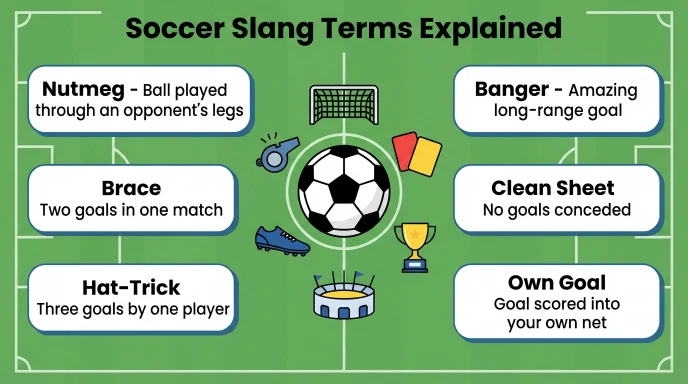
Soccer slang terms are informal words and phrases that players, fans, and commentators use to describe actions, positions, and situations in soccer.
Soccer slang terms are informal words and phrases used by players, coaches, fans, commentators, and online communities to describe actions, positions, skills, and moments in a soccer match.
Some are traditional football expressions that have been used for decades, while others have become popular through social media, gaming, and fan culture.
People search for soccer slang terms because they hear them during matches, see them in group chats, watch them on TikTok clips, or read them on Reddit and want to understand what they really mean.
Some expressions are used worldwide, while others are more common in certain countries or leagues.
In this guide, you’ll learn the most common soccer slang terms, what they mean, when people use them, If
they’re appropriate in different situations, and how their meaning can change depending on context.
Quick Answer
Soccer slang terms are informal expressions used to describe players, skills, goals, tactics, referees, and match situations. Most are harmless and commonly used by fans, commentators, and players during games and online discussions.
What Are Soccer Slang Terms?
Soccer slang terms are everyday words or nicknames that make conversations about soccer faster, more colorful, and easier to understand.
Instead of using formal football language, fans often say things like:
- “He bagged a brace.”
- “That was a screamer.”
- “The keeper had no chance.”
- “They parked the bus.”
If you’re new to soccer, these phrases can sound confusing because they often mean something completely different from their everyday definitions.
Do Soccer Slang Terms Have a Full Form?
No. Unlike internet abbreviations such as “LOL” or “BRB,” soccer slang terms are phrases, nicknames, and informal expressions. They do not have a full form.
For example:
| Slang Term | Full Form |
| Brace | None |
| Nutmeg | None |
| Screamer | None |
| Park the Bus | None |
| Clean Sheet | None |
Their meanings come from soccer culture rather than abbreviations.
Most Common Soccer Slang Terms and Their Meanings
1. Brace
A brace means a player scores two goals in one match.
Example
“Haaland scored a brace against Arsenal.”
2. Hat Trick
A hat trick means scoring three goals in one game.
Example
“She completed her hat trick before halftime.”
3. Screamer
A screamer is an amazing goal, usually scored from long distance.
Fans often use this term when the goal is powerful or spectacular.
Example
“That volley was an absolute screamer.”
4. Nutmeg
A nutmeg happens when a player kicks the ball between an opponent’s legs and gets it back on the other side.
It’s considered a skill move and often excites fans.
Example
“He nutmegged the defender with ease.”
5. Keeper
“Keeper” is simply a shorter, informal way to say goalkeeper.
Example
“The keeper made three incredible saves.”
6. Clean Sheet
A clean sheet means a team finishes the match without conceding a goal.
Example:
“Liverpool kept another clean sheet.”
7. Park the Bus
This phrase describes a team that defends with nearly every player instead of attacking.
It’s often used when a team wants to protect a lead.
Example
“They scored early and parked the bus.”
8. Bicycle Kick
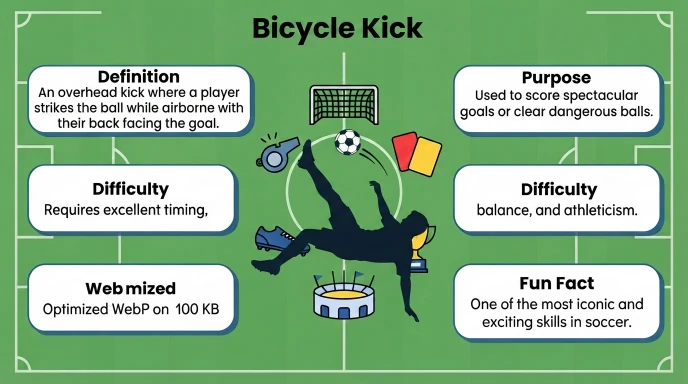
A bicycle kick is an acrobatic shot where the player kicks the ball while falling backward.
These goals are rare and usually become highlight videos.
Example
“That bicycle kick was unbelievable.”
9. Through Ball
A through ball is a pass played into open space for a teammate to run onto.
Example
“The midfielder delivered a perfect through ball.”
10. Tap-In
A tap-in is an easy goal scored from very close range.
Although simple, players still need good positioning.
Example
“He scored an easy tap-in.”
11. Banger
A banger is another word for an outstanding goal, especially one struck from outside the penalty area.
Fans frequently post comments like:
“What a banger!”
12. Own Goal
An own goal happens when a player accidentally scores against their own team.
Example
“The defender’s own goal changed the match.”
13. Derby
A derby is a match between local rival clubs.
These games usually have extra excitement and passionate supporters.
Example:
“The Manchester derby always delivers drama.”
14. Extra Time
Extra time is played when a knockout match remains tied after regular time.
It consists of two additional periods.
15. Stoppage Time
Stoppage time (also called added time) is extra time added because of injuries, substitutions, or delays.
Example:
“The winning goal came in stoppage time.”
Where Are Soccer Slang Terms Commonly Used?
Soccer slang appears in many places beyond the stadium.
During Live Matches
Commentators often use expressions like:
- Brace
- Screamer
- Clean sheet
- Through ball
- Clinical finish
These phrases help describe the action quickly.
Among Fans
Supporters use slang while watching matches together.
Example:
“That keeper is having a world-class game.”
Social Media
Soccer slang is common on:
- TikTok
- X (formerly Twitter)
- Facebook fan groups
- YouTube comments
Fans often react with short comments such as:
- “Absolute banger.”
- “What a screamer!”
- “Parked the bus again.”
Gaming
Players of soccer video games like EA Sports FC (formerly FIFA) often use the same slang while chatting online.
Examples include:
- “Nice nutmeg.”
- “Great through ball.”
- “Clean sheet again!”
Because these terms describe real soccer actions, they’re widely understood in gaming communities as well.
Sports News and Commentary
Sports journalists frequently use soccer slang in headlines to make stories more engaging.
For example:
- “Late Screamer Secures Victory”
- “Star Striker Bags Brace”
- “Keeper Saves the Day”
These phrases are familiar to regular soccer fans but may confuse new viewers without an explanation.
Is Soccer Slang Offensive, Rude, or Harmless?
Most soccer slang terms are harmless. They describe skills, positions, tactics, or moments in a match rather than insulting people. However, a few expressions can become rude depending on how they’re used and the speaker’s tone.
| Slang Term | Tone | Notes |
| Brace | Harmless | Describes two goals in one game. |
| Hat trick | Harmless | Three goals in one match. |
| Screamer | Harmless | A spectacular goal. |
| Nutmeg | Harmless | A skill move through an opponent’s legs. |
| Clean sheet | Harmless | No goals conceded. |
| Park the bus | Neutral | Tactical phrase; sometimes used as criticism. |
| Diving | Often Negative | Suggests a player exaggerated contact to win a foul. |
| Bottled it | Negative | Means a team or player lost confidence or failed under pressure. |
| Choked | Negative | Similar to “bottled it”; commonly used by fans. |
Workplace tip: Soccer slang is perfectly fine when chatting with fellow fans. In professional emails or formal presentations, it’s usually better to use standard language unless the discussion is specifically about soccer.
Real-Life Examples of Soccer Slang Terms
Friendly Conversation
Alex: “Did you watch the match last night?”
Sam: “Yes! That long-range shot was an absolute banger.”
Family
Dad: “Who scored?”
Son: “Our striker got a brace before halftime.”
School
“Our team kept a clean sheet in the final.”
Gaming Chat
“Nice through ball! I was wide open.”
Reddit Discussion
“That bicycle kick deserves Goal of the Season.”
TikTok Comment
“What a screamer! I could watch that goal all day.”
Instagram Caption
“Three points, clean sheet, and another great team performance.”
Match Commentary
“The keeper made a world-class save before the striker completed his hat trick.”
Origin and History of Soccer Slang Terms
Many soccer slang terms developed naturally over decades through players, coaches, supporters, and sports journalists. Unlike internet slang, most of these expressions existed long before social media.
Some have roots in British English, while others became popular internationally as televised soccer spread around the world.
Here are a few examples:
| Term | Approximate Origin | Notes |
| Hat trick | 19th-century British sport | Originally used in cricket before becoming common in soccer and hockey. |
| Nutmeg | Origin uncertain | Several explanations exist, but there is no universally accepted history. |
| Brace | Traditional British football language | Refers to scoring two goals in one match. |
| Clean sheet | British football reporting | Refers to preventing the opposition from scoring. |
| Park the bus | Popularized in modern football | Often linked with defensive tactics, especially in the 2000s. |
Important: Some origin stories differ across sources. For example, the exact history of nutmeg is debated, so it’s best not to treat any single explanation as a confirmed fact.
Why Do People Use Soccer Slang Terms?
Soccer slang makes conversations quicker, more expressive, and more enjoyable.
People use these terms because they:
- Describe match events efficiently.
- Create excitement while watching games.
- Help fans connect with one another.
- Reflect soccer culture and tradition.
- Make commentary more engaging.
- Add personality to online discussions.
Instead of saying:
“He scored an impressive long-distance goal.”
Most fans simply say:
“What a screamer!”
Soccer Slang Across Different Platforms
The same expression may feel different depending on where it’s used.
| Platform | Common Usage | Tone |
| Text Messages | Match reactions | Casual |
| Tactical discussions | Informative | |
| TikTok | Goal highlights | Excited |
| Captions and reels | Enthusiastic | |
| Discord | Live match chats | Casual |
| Gaming Voice Chat | EA Sports FC matches | Competitive |
| Workplace Chat | Office football discussions | Informal but acceptable |
Unlike many internet slang terms, soccer slang usually keeps the same meaning across platforms.
Similar Soccer Slang Terms
| Soccer Slang | Similar Expression | Difference |
| Brace | Double | “Brace” is the standard soccer term. |
| Screamer | Banger | Both describe amazing goals. |
| Keeper | Goalkeeper | Same meaning; “keeper” is shorter. |
| Tap-in | Easy finish | Tap-in specifically means a very close-range goal. |
| Clean sheet | Shutout | “Shutout” is more common in North American sports. |
| Nutmeg | Meg | Shortened version used by many fans. |
Common Misunderstandings
“Brace” Doesn’t Mean Equipment
Outside soccer, a brace might refer to dental braces or a support device. In soccer, it simply means two goals scored by one player in the same match.
“Hat Trick” Isn’t Limited to Soccer
Although many people associate it with soccer, the term is also used in sports like hockey and cricket.
“Park the Bus” Doesn’t Mean Literally Parking a Vehicle
It’s a tactical expression describing an extremely defensive style of play.
“Keeper” Isn’t Always the Best Player
It simply refers to the goalkeeper, regardless of skill level.
When Should You Avoid Using Soccer Slang?
Soccer slang is widely understood among fans, but it isn’t suitable everywhere.
Avoid it when:
- Writing academic papers unless you’re explaining the term.
- Preparing formal business documents.
- Speaking to people unfamiliar with soccer.
- Translating sports news for beginners without explanations.
- Communicating in legal or official reports.
For example:
Instead of writing:
“The company parked the bus.”
Use:
“The company adopted a highly defensive strategy.”
Clear language is usually better in formal settings.
Are Soccer Slang Terms Safe for Social Media?
Yes. Most soccer slang terms are safe and family-friendly.
They’re commonly used in:
- Match highlights
- Fan pages
- Sports news
- Team discussions
- YouTube comments
- Instagram captions
- TikTok videos
- Reddit communities
However, avoid using insulting phrases like “bottled it” or “diver” to target individuals in a way that encourages harassment. Friendly banter is common in sports, but respectful communication is always the better choice.
Frequently Asked Questions
Q1:What are soccer slang terms?
Soccer slang terms are informal words and phrases used to describe players, goals, skills, tactics, and match situations in an easy, conversational way.
Q2:Do soccer slang terms have a full form?
No. Most are ordinary words or phrases rather than abbreviations, so they do not have a full form.
Q3:What does “brace” mean in soccer?
A brace means one player scores two goals in the same match.
Q4:What is a “banger” in soccer?
A banger is an outstanding goal, usually struck with great power or from long range.
Q5:Is “park the bus” an insult?
Not necessarily. It describes a very defensive tactic, although fans sometimes use it critically when they dislike defensive football.
Q6:Is soccer slang the same around the world?
Not always. Many soccer slang terms are understood internationally, such as hat trick, brace, and clean sheet. However, some expressions are more common in certain regions.
For example:
- Football is the preferred name in most countries.
- Soccer is commonly used in the United States and Canada.
- British commentators may use phrases that American fans hear less often.
The core meanings usually remain the same, but vocabulary can vary by country.
Q7:Is “nutmeg” considered rude?
No. A nutmeg is simply a skill move where the ball is played through an opponent’s legs. While it can embarrass the defender, it is not offensive language.
Q8:Can beginners learn soccer by knowing these slang terms?
Yes. Learning common soccer slang makes it much easier to:
- Understand live commentary.
- Follow match discussions.
- Read sports news.
- Enjoy conversations with other fans.
- Watch soccer videos without confusion.
Q9:Are soccer slang terms used by professional commentators?
Yes. Television commentators, sports journalists, former players, and coaches regularly use soccer slang because it is widely understood by fans.
Examples include:
- “The striker completed his hat trick.”
- “What a brilliant through ball.”
- “Another clean sheet for the goalkeeper.”
Q10:Are soccer slang terms appropriate for children?
Yes. Most soccer slang is family-friendly and simply describes the game. Parents, teachers, and coaches often use these terms when explaining soccer to young players.
Q11:Can I use soccer slang in school or at work?
It depends on the situation.
- Yes when talking about sports with classmates or coworkers.
- No when writing formal reports, business emails, or academic assignments unless the terms are being explained.
Knowing your audience is always important.
Quick Reference Table
| Slang Term | Meaning | Tone |
| Brace | Two goals in one match | Neutral |
| Hat Trick | Three goals in one match | Neutral |
| Screamer | Spectacular goal | Positive |
| Banger | Amazing goal | Positive |
| Keeper | Goalkeeper | Neutral |
| Clean Sheet | No goals conceded | Neutral |
| Nutmeg | Ball played through an opponent’s legs | Positive |
| Through Ball | Pass into open space | Neutral |
| Tap-in | Easy close-range goal | Neutral |
| Park the Bus | Very defensive tactics | Neutral/Negative |
| Derby | Match between local rivals | Neutral |
| Own Goal | Goal accidentally scored against your own team | Neutral |
| Bottled It | Failed under pressure | Negative |
| Diving | Exaggerating contact to win a foul | Negative |
Key Takeaways
- Soccer slang helps fans describe matches quickly and naturally.
- Most soccer slang terms are harmless and commonly heard during games.
- Some expressions, such as bottled it or diving, may sound critical depending on context.
- A few terms have regional differences, but many are recognized by fans around the world.
- Understanding these expressions makes it easier to enjoy broadcasts, sports news, online discussions, and conversations with other supporters.
Conclusion
Soccer slang terms are an important part of the sport’s culture. They make match commentary more exciting, help fans communicate quickly, and add personality to conversations about the game. If you’re watching a professional league, playing with friends, or chatting online, you’ll regularly hear phrases like brace, hat trick, clean sheet, nutmeg, and banger.
Most of these expressions are friendly and easy to use once you know their meanings. By understanding the context behind each term, you’ll be able to follow live commentary, join soccer discussions with confidence, and avoid common misunderstandings.
As the sport continues to grow worldwide, soccer slang remains a fun and practical way for fans to share their passion for the beautiful game.
Read More About!
Star Meaning in Slang: Full Guide with Examples
ILY Slang Meaning: What It Means in Text, Social Media & Chat
Mafia Slang Terms: Meanings, Origins, and Common Examples

Michael Brooks is a language writer at SlangPath with 7+ years of experience creating simple, practical content on English slang and everyday expressions.