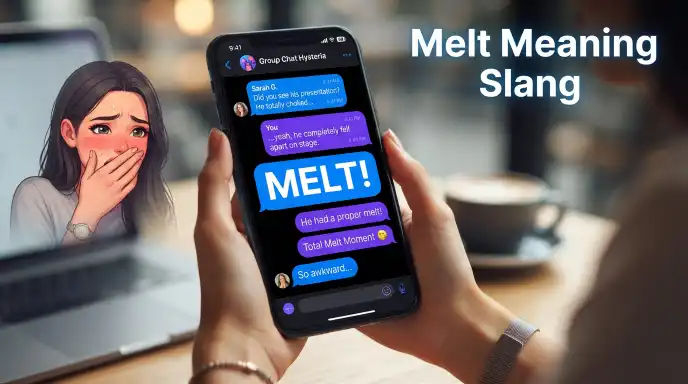
If you are searching for melt meaning slang, the word usually describes a person who seems overly emotional, weak, foolish, or easily embarrassed. In some contexts, especially British slang, calling someone a “melt” can be a mild insult.
The exact meaning depends on the situation and the speaker’s tone. Someone might call a friend a “melt” after they act awkwardly, become too emotional, or do something that seems silly.
You may see melt meaning slang in text messages, social media comments, online conversations, and casual speech. It is not usually a serious or highly offensive insult, but it can still sound rude when used toward someone you do not know well.
This guide explains melt meaning slang, how people use the word, what it means in different situations, and when you should avoid saying it.
Quick Answer: Melt Meaning Slang
In slang, “melt” usually means a person who is acting foolish, weak, overly emotional, or embarrassing. It is especially common in British and Irish informal speech and can be used as a mild insult.
For example:
“You’re such a melt. Why did you send that message?”
Here, “melt” means the person did something silly or embarrassing.
What Does Melt Mean in Slang?
Melt is an informal word that people use to describe someone whose behavior seems silly, weak, awkward, or overly emotional.
The word does not have one fixed slang meaning in every conversation. Its meaning can change with the situation.
For example, a person might say:
“He started crying over the movie. What a melt.”
In this sentence, melt suggests that the person is being overly emotional.
But someone could also say:
“I forgot my own password again. I’m such a melt.”
Here, the speaker is using the word about themselves in a joking way. They are admitting that they did something foolish.
This makes melt a flexible slang term. It can be insulting, but friends may also use it playfully.
Different Meanings of Melt in Slang
The slang word melt can describe different types of behavior. The context usually tells you which meaning the speaker intends.
Melt as an Insult
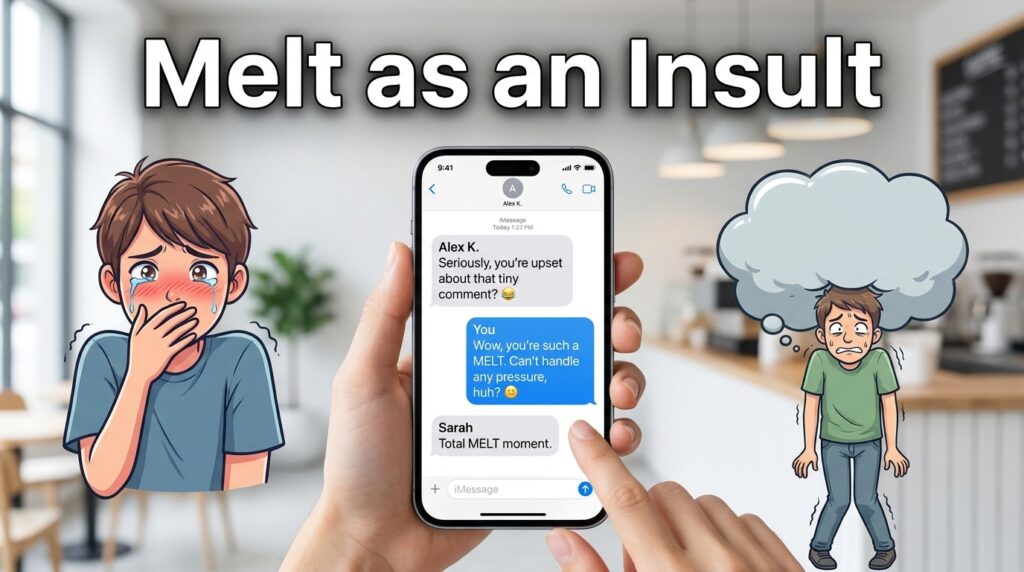
One common use of melt is as a mild insult for someone who is acting foolish or embarrassing.
If someone makes a silly decision, behaves awkwardly, or does something that makes others cringe, another person might call them a “melt.”
For example:
“He tried to impress everyone and fell over. What a melt.”
The speaker is calling the person foolish or embarrassing.
This use is often casual rather than aggressive. However, the tone matters. A friend saying it while laughing may be joking, while a stranger saying it angrily may be insulting you.
Melt for Someone Who Is Too Emotional
Melt can also describe someone who becomes very emotional or soft-hearted.
For example:
“She became a complete melt when she saw the puppy.”
Here, “melt” suggests that the person became emotionally soft or easily affected.
This use can sometimes be affectionate rather than insulting. Someone may call their friend a “melt” because they know the friend has a soft side.
For example:
“You always turn into a melt around cute animals.”
The sentence sounds more playful than hostile.
Melt for Someone Who Is Weak or Easily Affected
In some informal British usage, melt can suggest that someone is weak, soft, or unable to handle a situation.
For example:
“Don’t be a melt. Just ask him what happened.”
The speaker is telling the person to stop acting nervous or weak and deal with the situation.
This meaning can sound more insulting than the affectionate use, so the relationship between the speakers matters.
Is “Melt” British Slang?
Yes. Melt is strongly associated with British informal slang, although people outside the UK may also understand or use it.
The word has appeared in British speech and popular culture for years, and its use is not limited to one single online platform.
In British-style casual conversation, calling someone a “melt” can mean that they are being foolish, pathetic, overly emotional, or embarrassing.
The exact sense still depends on context.
For example:
“Stop being a melt and come with us.”
This could mean “stop being silly” or “stop acting weak,” depending on the situation.
A British speaker might also use it jokingly between friends:
“Mate, you’re a proper melt.”
The word proper adds emphasis and makes the phrase sound more strongly British and informal.
Melt Meaning in Text Messages
In texting, melt usually keeps the same basic meaning as spoken slang.
People may use it when a friend does something embarrassing, overly emotional, or silly.
Examples include:
“Bro, you’re such a melt 😂”
“Why did you actually believe him? Melt.”
“I’m a melt for agreeing to that.”
The emoji and surrounding message can change the tone. A laughing emoji can make the word feel playful, while a short message with no friendly context may sound harsher.
When you see “melt” in a text, look at the whole conversation, not just the word itself.
Melt Meaning on Social Media
On social media, melt can appear in comments, captions, replies, and memes.
People often use it as a quick reaction when someone behaves in a way that seems foolish, dramatic, or overly sensitive.
For example, someone might comment:
“What a melt 😂”
under a funny video where someone makes an obvious mistake.
On platforms such as TikTok, Instagram, Reddit, or Discord, the meaning is usually understood from the content around it.
However, social media users do not always use slang in exactly the same way. A word that sounds funny between friends can sound insulting when directed at a stranger.
Is Melt Rude or Offensive?
Melt can be rude, but it is usually a mild insult rather than a highly offensive word.
The level of rudeness depends on who says it, who receives it, and why they say it.
| Situation | Likely tone |
| Close friend joking with you | Playful |
| Comment on a funny mistake | Light or teasing |
| Argument with a stranger | Rude |
| Talking about someone behind their back | Insulting |
| Professional conversation | Usually inappropriate |
If someone calls you a “melt,” they may simply be teasing you. But if the conversation is hostile, they may genuinely be calling you foolish or weak.
That is why context matters more than the word alone.
Can You Use “Melt” at Work or School?
Melt is best kept for casual conversations.
It may be understood in informal workplaces where coworkers joke with each other, but it is not a good choice for formal emails, professional meetings, or serious discussions.
It is also better to avoid using it with a teacher, manager, customer, or someone you have just met.
Instead of saying:
“You’re such a melt.”
you could say:
“That was a bit silly.”
The second version is clearer and more polite.
For school or professional writing, avoid slang unless you are specifically discussing slang itself.
When Does “Melt” Sound Friendly?
“Melt” can sound friendly when people already have a joking relationship.
Friends often use mild insults without intending real harm. The speaker’s voice, facial expression, emojis, and the situation can make the difference.
For example:
“You bought another game you won’t play? You’re a melt 😂”
This is likely playful teasing between friends.
The same words from an angry stranger could feel insulting.
So, if you are unsure if the person will understand your humor, choose a more neutral word.
Origin and History of “Melt” as Slang
The slang use of melt is linked mainly to British and Irish informal speech. It is not a modern abbreviation or an internet acronym.
The ordinary English word melt is much older and normally describes something becoming soft or liquid because of heat. The slang use developed as a figurative description of a person who seems emotionally soft, weak, foolish, or easily affected.
There is no reliable reason to claim that one specific social media platform created this slang meaning. The word was already used in informal speech before platforms such as TikTok and Instagram became popular.
Over time, British television, entertainment, online communities, and social media helped expose the term to a wider audience.
Because slang changes by region, melt does not have exactly the same strength or meaning for every English speaker. Someone familiar with British slang may understand it immediately, while another English speaker may know only the normal meaning of “melt.”
Is “Melt” Old or New Slang?
“Melt” is better described as established informal slang, rather than a brand-new internet word.
You may still see it online, but it does not belong to the same category as newer viral expressions that suddenly become popular on TikTok.
Its use can also depend on age, location, and social group. Younger users may encounter it through online content, while British speakers may already know it from everyday informal speech.
How Is “Melt” Used on Different Platforms?
The meaning of melt usually stays similar online, but the tone can change depending on the platform and conversation.
| Platform | Common use | Typical tone |
| Text messages | Teasing a friend | Casual |
| TikTok | Reacting to someone’s behavior | Funny or mocking |
| Comments and replies | Casual | |
| Discord | Gaming or group chats | Teasing |
| Commenting on someone’s actions | Can be sarcastic | |
| Workplace chat | Informal joking | Riskier |
The platform does not create a completely new definition. Instead, the surrounding conversation helps show if “melt” is meant as friendly teasing or an actual insult.
Melt in Gaming and Discord
You may see melt in gaming chats or Discord conversations when players tease someone for making a bad decision, panicking, or behaving foolishly.
For example:
“You ran straight into them. What a melt.”
The speaker is criticizing the player’s decision.
Friends may also use it jokingly after a harmless mistake:
“I forgot to reload again. I’m such a melt.”
Here, the person is making fun of themselves.
The word is therefore not automatically aggressive in gaming communities. The relationship between the players matters.
Real-Life Examples of “Melt”
Seeing the word in different sentences makes its meaning easier to understand.
Example 1: A Silly Mistake
“I left my keys inside the house again. I’m a complete melt.”
The speaker is joking about their own mistake.
Example 2: Friendly Teasing
“You believed that fake story? You’re such a melt.”
A friend may say this while joking with someone.
Example 3: Someone Acting Emotional
“He turned into a melt when his team lost.”
Here, the word points to an overly emotional reaction.
Example 4: Online Comment
“Bro is a melt for taking that comment seriously.”
The commenter thinks the person reacted too strongly.
Example 5: Gaming
“Don’t be a melt. It’s only one lost round.”
The speaker is telling someone not to become upset or nervous.
Example 6: Self-Deprecating Use
“I sent the message to the wrong person. What a melt I am.”
The person uses the slang about themselves rather than insulting someone else.
Melt vs. Similar Slang Words
Several informal words can overlap with melt, but they are not perfect replacements.
| Slang word | Basic idea | How it differs from “melt” |
| Fool | Someone who acts unwisely | More general |
| Idiot | Someone acting very foolishly | Usually harsher |
| Softie | Someone easily moved emotionally | Can be affectionate |
| Wimp | Someone seen as weak | More focused on weakness |
| Clown | Someone behaving foolishly | Often mocking |
| Muppet | Someone acting foolishly | Common in British informal speech |
| Melt | Someone acting foolish, weak, or overly emotional | Meaning depends strongly on context |
For example, softie is often friendly and affectionate, while idiot is usually more direct and insulting.
“Melt” sits somewhere in the middle. It can be playful among friends but rude when used toward someone in a serious argument.
Why Do People Call Someone a “Melt”?
People often use melt because it is short, expressive, and casual.
Instead of saying:
“You are behaving in a foolish and overly emotional way.”
someone can simply say:
“You’re a melt.”
The slang version communicates the attitude quickly.
It can also add humor to a conversation. Friends may use mild insults to tease each other without intending to cause offense.
Another reason is self-mockery. A person may call themselves a “melt” after making an embarrassing mistake.
This makes the word useful in both teasing and self-deprecating humor.
Common Misunderstandings About “Melt”
The most common mistake is assuming that melt always means the same thing.
It does not.
Misunderstanding 1: It Always Means “Emotional”
Not necessarily.
“Melt” can refer to emotional behavior, but it can also describe someone who is acting foolish, weak, awkward, or embarrassing.
The surrounding sentence tells you which meaning fits.
Misunderstanding 2: It Is Always a Serious Insult
Not always.
Friends may use “melt” playfully. A person can even use it about themselves.
However, the word can still be insulting if someone uses it aggressively.
Misunderstanding 3: It Is Only Internet Slang
No.
The slang meaning existed in informal speech and is strongly associated with British and Irish usage. Social media simply gives people more opportunities to encounter it.
Misunderstanding 4: “Melt” Means the Same Thing as “Loser”
Not exactly.
A “loser” is a broader insult. “Melt” often focuses more on someone’s behavior in a particular moment, such as acting foolish, soft, emotional, or embarrassing.
Is “Melt” Used by Young People?
Yes, young people can use and understand melt, especially when they spend time around British slang or online communities where British English is common.
However, it would be inaccurate to say that every young person uses it.
Slang depends on location, social group, age, and online exposure. Some people may use “melt” regularly, while others may rarely hear it.
It is also not necessary to be a teenager to understand or use the word.
Is “Melt” Still Common?
Melt is still recognizable as informal slang, particularly in British English, but its popularity can vary by community.
It should not be treated as a universal internet expression.
Some users may see it often in British online communities, while others may mainly know melt as the ordinary verb for turning solid food or another substance into liquid.
This difference is important when reading comments from people in different countries.
When Should You Avoid Using “Melt”?
Avoid using melt when you are unsure how the other person will take it.
It is better to choose a neutral expression in situations such as:
- Formal emails
- Job interviews
- Professional meetings
- Messages to customers
- Academic writing
- Talking to someone you do not know
- Serious conversations
- Situations where an insult could cause conflict
You should also avoid using it simply because you saw it online. Understanding the tone is more important than copying the slang.
If you need to communicate clearly, words such as silly, emotional, awkward, or foolish may be safer depending on what you mean.
Polite Alternatives to “Melt”
If you want to express the same general idea without sounding insulting, choose a word that describes the actual behavior.
For example:
- Silly — for a harmless mistake
- Emotional — when someone is reacting strongly
- Awkward — when someone’s behavior feels uncomfortable
- Nervous — when someone seems worried
- Soft-hearted — when someone is easily moved
- Mistaken — when someone has made an error
These alternatives are clearer because they explain the behavior without directly labeling the person.
How to Tell What “Melt” Means in a Conversation
The easiest way to understand melt meaning slang is to look at what happened before and after the word.
Ask yourself three simple questions:
- What did the person do?
- What is the speaker’s tone?
- Are the people joking or arguing?
If someone makes a silly mistake, “melt” may mean foolish or silly.
If someone becomes very emotional, it may mean soft or overly emotional.
If someone is nervous or unable to deal with a situation, it may suggest weak or easily affected.
This context-based approach helps you understand the intended meaning without assuming that every use has the same definition.
Can You Call Yourself a Melt?
Yes. People sometimes use melt about themselves after doing something silly or embarrassing.
This is called self-deprecating humor. Instead of insulting another person, the speaker makes fun of their own mistake.
For example:
“I walked into the wrong classroom. I’m such a melt.”
The speaker is not making a serious statement about themselves. They are joking about an awkward mistake.
This type of use is generally less confrontational than calling another person a melt.
Does “Melt” Mean Something Different in Normal English?
Yes.
Outside slang, melt is a normal English word with several literal uses.
For example:
“The ice will melt in the sun.”
Here, melt means to change from a solid into a liquid because of heat.
It can also describe something gradually becoming softer or disappearing because of heat.
The slang noun melt is different. In slang, it describes a person’s behavior or personality rather than a physical substance.
So, when you see the word, check if the sentence is talking about a physical object or a person.
Is “Melt” a Bad Word?
No. Melt is not generally considered a swear word.
It is an informal slang insult that can sound rude depending on the situation.
Calling a stranger a “melt” may come across as disrespectful, while saying it jokingly to a close friend may be harmless.
The word itself is not highly offensive, but that does not mean it is suitable for every situation.
Can Teachers or Parents Use the Word “Melt”?
They can understand or use it when discussing slang, but it is not a formal word.
For example, a teacher explaining British slang might say:
“In this context, ‘melt’ means someone who is acting foolishly.”
That is different from using the word to insult a student.
Parents may also encounter the term in texts, comments, or online conversations. Understanding the context can help them decide if it was used as a joke or an insult.
Is “Melt” Appropriate for Professional Communication?
Usually, no.
Melt is casual slang and is better avoided in formal workplace communication.
A coworker might use it jokingly in a private chat, but it would not be a good choice for a formal email, report, presentation, or message to a customer.
For professional communication, use a precise word such as:
- careless
- mistaken
- emotional
- nervous
- confused
- inexperienced
The best alternative depends on the behavior you want to describe.
Frequently Asked Questions
Q1:What does melt mean in slang?
Melt usually means a person who is acting foolish, weak, overly emotional, or embarrassing. The exact meaning depends on the context and tone.
Q2:Is melt British slang?
Yes. Melt is strongly associated with British informal slang and can also be understood in Irish and other English-speaking communities.
Q3:Is calling someone a melt an insult?
It can be. “Melt” is often used as a mild insult, but friends may also use it as playful teasing.
Q4:Is melt a swear word?
No. Melt is not normally considered a swear word. It is informal slang that can sound rude depending on how you use it.
Q5:What does melt mean in a text?
In a text, melt can mean someone is being silly, foolish, overly emotional, weak, or embarrassing. The surrounding messages show which meaning is intended.
Q6:What does melt mean on social media?
On social media, people may use “melt” to tease someone who behaves foolishly, reacts emotionally, or does something embarrassing.
Q7:Can I use melt with my friends?
Yes, if your friends understand the slang and are comfortable with that kind of teasing. It is still wise to consider the person’s feelings.
Q8:Can I use melt at work?
It is usually better not to. Melt is casual slang, so a neutral word is safer in professional communication.
Q9:Is melt offensive?
It is generally a mild insult rather than a highly offensive term. However, it can still hurt someone if used seriously or aggressively.
10:Does melt mean uninformed,?
Sometimes it can suggest that someone is acting inconsiderate or foolish, but “melt” has a wider meaning. It may also describe someone as weak, emotional, soft, or embarrassing.
11:Can melt be used for yourself?
Yes. Someone may call themselves a “melt” after making a silly or embarrassing mistake.
Q12:Is melt still used today?
Yes. The slang is still recognizable, particularly in British informal English and online conversations. Its popularity varies between regions and social groups.
Q13:What is a polite alternative to melt?
Depending on the situation, you can use silly, awkward, emotional, nervous, foolish, or soft-hearted. These words are usually clearer and less insulting.
Melt Meaning Slang: Quick Usage Guide
| Question | Answer |
| Basic slang meaning | Foolish, weak, emotional, or embarrassing person |
| Main association | British informal slang |
| Tone | Usually casual or teasing |
| Can it be insulting? | Yes |
| Is it a swear word? | No |
| Safe with close friends? | Usually, if they accept the joke |
| Good for formal writing? | No |
| Good for professional emails? | No |
| Can you use it about yourself? | Yes |
| Meaning depends on context? | Yes |
Conclusion
Understanding melt meaning slang comes down to context. The word can describe someone who is acting foolish, weak, overly emotional, soft, or embarrassing. It is strongly linked with British informal speech and is also seen in online conversations.
“Melt” is not a swear word, but it can still be insulting. Among close friends, it may work as playful teasing or self-mockery. In professional, academic, or unfamiliar situations, a clearer and more polite word is a better choice.
The safest rule is simple: look at the situation, the relationship between the speakers, and the tone before deciding what “melt” means.
Read More About !

My name is Olivia Bennett.I am a language enthusiast and educational writer with a strong interest in contemporary English and digital communication. I enjoys making language learning engaging and accessible.