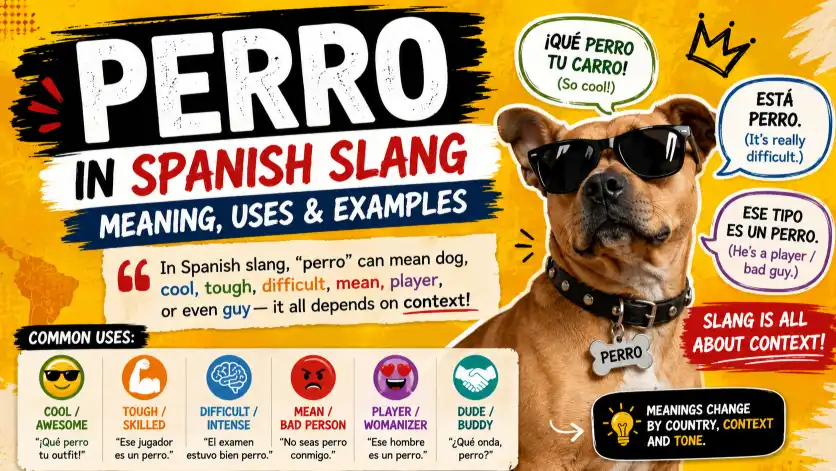
Perro in Spanish slang can mean “tough,” “cool,” “difficult,” “mean,” or “player,” depending on the country, context, and tone.
perro in spanish slang can be confusing because the word does not always mean an actual dog. In standard Spanish, perro means “dog,” but in informal speech it can describe a person, a difficult situation, something impressive, or even someone who behaves badly. The meaning depends heavily on the country, sentence, relationship between speakers, and tone.
This is especially noticeable in Mexican Spanish, where perro can be used in several casual expressions. For example, está perro may describe something as very difficult, while qué perro can express admiration in certain contexts. Dictionaries of Mexican Spanish also record uses of perro for someone who is persistent or tough.
Quick Answer:perro in spanish slang
Perro in Spanish slang usually means “dog” literally, but informally it can mean “tough,” “cool,” “difficult,” “mean,” “player,” or “guy,” depending on the region and context. In Mexican Spanish, its slang meaning can change significantly with the sentence.
What Does Perro in Spanish Slang Mean in Text?
When you see perro in Spanish slang in a text, social media comment, or conversation, do not automatically translate it as “dog.”
The surrounding words are important.
Here are some common informal meanings:
- Dog — the normal literal meaning.
- Tough or skilled person — someone who is strong, persistent, or capable.
- Cool or impressive — used positively in some Mexican contexts.
- Difficult or intense — something that is hard to deal with.
- Mean or unpleasant person — a negative description.
- Player or womanizer — in some Central American and regional uses.
- Guy, buddy, or dude — in some informal speech, depending on the country and relationship.
The Diccionario del Español de México records the popular expression ser alguien un perro for a person who is persistent and tough at something. It also records perro/perra as an adjective for something very bad or difficult.
So, one English translation cannot cover every use.
Perro in Spanish Slang Full Form
There is no “full form” of perro because it is not an abbreviation or acronym.
The Spanish word perro literally means “dog.”
It is a normal Spanish noun rather than internet shorthand. Its slang meanings developed from informal and regional uses of the same word.
If someone searches for “what does perro stand for?”, the simple answer is that it does not stand for a longer phrase. Instead, its meaning changes according to context.
For example:
Tengo un perro.
“I have a dog.”
Here, perro has its ordinary meaning.
But:
Ese hombre es un perro para los negocios.
The meaning is closer to saying that the man is extremely capable, persistent, or tough in business.
Perro Meaning Slang in Mexican Spanish
Mexican Spanish is one of the places where perro has many recognizable informal uses.
One important example is:
Está perro.
Depending on context, this can mean something like:
- It is really difficult.
- It is intense.
- It is tough.
- It is awesome or impressive.
The exact English translation depends on what is being discussed.
For example:
El examen estuvo bien perro.
This could mean:
“The exam was really hard.”
The Diccionario del Español de México gives perrísimo for something very difficult, such as an extremely hard exam. SpanishDictionary also identifies perro as a Mexican colloquial expression meaning “difficult.”
However, qué perro can have a more positive sense in some Mexican slang contexts.
¡Qué perro tu carro!
Depending on the speaker and situation, this may mean:
“Your car is so cool!”
This positive use is informal. It should not be treated as a universal meaning across every Spanish-speaking country.
Can Perro Mean “Cool” or “Badass”?
Yes, in some Mexican slang contexts, perro can express admiration for someone or something.
For example:
Ese jugador está perro.
A natural interpretation could be:
“That player is really good.”
Or:
Qué perro ese truco.
This could express:
“That trick is awesome.”
Some informal Mexican-language resources describe this positive use, while dictionary evidence also supports broader meanings such as being tough, persistent, or difficult.
Still, learners should be careful. A word that sounds positive in one group can sound insulting in another.
Can Perro Mean “Difficult”?
Yes.
This is one of the useful meanings to understand when watching Mexican Spanish videos or conversations.
The expression estar perro can describe something challenging.
For example:
La tarea está bien perra.
A natural English interpretation is:
“The homework is really hard.”
Similarly:
El partido estuvo perro.
Depending on context, this could describe a match as very intense, difficult, or demanding.
SpanishDictionary lists perro as a Mexican colloquial adjective meaning “difficult,” with an example involving a very difficult exam.
Can Perro Be an Insult?
Yes.
Calling a person perro can be insulting depending on the situation.
Spanish dictionaries document negative uses of perro for an unpleasant, contemptible, or morally questionable person. Cambridge, for example, includes an offensive sense in which perro can describe a person who is viewed with contempt.
SpanishDictionary also records meanings such as “pig,” “womanizer,” “player,” and “lowlife” in particular regional or colloquial contexts.
For example:
Ese tipo es un perro.
Depending on the country and context, this could mean:
- “That guy is a jerk.”
- “That guy is a player.”
- “That guy is a bad person.”
Because the word can be offensive, it is better not to use it toward strangers unless you understand the local usage.
Is Perro Rude, Offensive, or Neutral?
Perro can be neutral, friendly, humorous, complimentary, or offensive.
The context decides the tone.
| Context | Possible Meaning | Tone |
| Talking about a pet | Dog | Neutral |
| Praising someone’s skill | Tough / skilled / badass | Positive |
| Describing a hard exam | Difficult | Informal |
| Insulting someone | Bad person / jerk | Offensive |
| Describing a womanizer | Player | Negative |
| Talking casually with friends | Dude / buddy in some regions | Informal |
| Describing a bad situation | Lousy / awful | Negative |
This is why translating the word alone can be misleading.
Where Is Perro Commonly Used?
The literal word perro is used throughout the Spanish-speaking world.
Its slang meanings, however, are more regional.
You may encounter informal uses in:
- Mexico
- Central America
- Colombia
- Spain
- Other Spanish-speaking communities
The meaning is not identical everywhere.
SpanishDictionary identifies some meanings as regional to Central America, including Guatemala, El Salvador, Honduras, Nicaragua, Costa Rica, and Panama. It also records particular uses in Colombia and Mexico.
In online spaces, regional Spanish speakers may bring these expressions into:
- TikTok comments
- YouTube
- Discord
- Text messages
- Gaming chats
- Casual conversations
However, seeing a word online does not automatically mean that every Spanish-speaking country uses it in the same way.
Perro in Texting and Social Media
On social media, perro can appear as part of short reactions.
For example:
Qué perro 🔥
The speaker may be expressing admiration.
Another person might write:
Está perro 😭
This could mean that something is extremely difficult, intense, or challenging.
In a gaming conversation:
Ese boss está perro.
The likely meaning is:
“That boss is really tough.”
In a friendly conversation:
Perro, ¿ya llegaste?
Depending on the speaker’s regional variety, perro may function informally like “dude” or “bro.” This use is not universal, so context and regional background matter.
Real-Life Examples of Perro in Spanish Slang
1. Friendly Usage
Qué perro eres, siempre ayudas a todos.
Possible meaning:
“You’re awesome; you always help everyone.”
Here, the word can carry admiration rather than hostility.
2. Describing a Difficult Situation

Este trabajo está perro.
Meaning:
“This work is really difficult.”
The speaker is describing the challenge.
3. Praising a Skill
Ese jugador es un perro.
Possible meaning:
“That player is seriously tough or skilled.”
The intended meaning depends on the community and context.
4. Negative Usage
No seas perro con tus amigos.
Possible meaning:
“Don’t be so mean to your friends.”
Here, perro has a negative sense.
5. Describing a Player
In some Central American varieties, perro can describe a womanizer or player.
Ese hombre es un perro; nunca quiere una relación seria.
Possible meaning:
“That man is a player; he never wants a serious relationship.”
6. Gaming Context
Ese nivel está perro.
Possible meaning:
“That level is wild hard.”
The context makes the meaning much easier to understand.
7. Social Media Compliment
Qué perro 🔥
Possible meaning:
“That’s awesome.”
This is highly informal and regional.
Perro vs. Perra
The masculine form is perro, while perra is the feminine form when referring literally to a female dog.
However, perra can also have slang meanings.
This distinction matters because perra may be used as an insult toward a woman. Some Mexican-language references specifically document negative or insulting uses of perra.
For that reason, learners should not assume that changing perro to perra simply creates an equivalent feminine slang term.
The social meaning can change.
Perro vs. Similar Spanish Slang
Several informal words can overlap with meanings such as “dude,” “tough,” “cool,” or “jerk.”
| Term | Possible English Meaning | Main Difference |
| Perro | Dog, tough, cool, difficult, player | Highly context-dependent |
| Güey / wey | Dude, bro, guy | Strongly associated with Mexican informal speech |
| Pendejo | Idiot, dumbass | Usually more directly insulting |
| Cabron | Tough guy, bastard, dude | Can be positive or offensive depending on context |
| Compadre | Buddy, friend | Often friendlier and less insulting |
| Amigo | Friend | Neutral and safer |
These are not perfect substitutes. A native speaker may choose one based on region, age, relationship, and tone.
Origin and Background of Perro as Slang
The ordinary Spanish noun perro has the literal meaning “dog.” Its slang meanings are connected to the negative and positive qualities culturally associated with dogs, toughness, persistence, behavior, and social attitudes.
Over time, informal expressions developed different meanings in different Spanish-speaking communities.
For example, Mexican Spanish uses ser un perro in the sense of being persistent or tough at something. The Diccionario del Español de México gives this as a popular usage.
Other expressions use the word negatively to describe something lousy, difficult, or unpleasant.
This helps explain why the same word can move between praise and insult.
“Está Pa’l Perro” Meaning
Another expression learners may encounter is:
Está pa’l perro.
This is a colloquial contraction of está para el perro in Mexican usage.
It can describe something as terrible, unpleasant, or in very bad shape.
For example:
El tráfico está pa’l perro.
A natural translation might be:
“The traffic is awful.”
The expression is highly informal. Community explanations of the phrase connect it with something being poor-quality, horrible, or undesirable.
Do not confuse this with the simple adjective perro. The complete expression carries its own meaning.
Why Do People Use Perro as Slang?
People use slang because everyday speech is more flexible than formal dictionary language.
Using perro informally can make a sentence:
- More expressive
- More humorous
- More emotional
- More casual
- More connected to a local culture
- More natural among friends
For example, saying:
El examen estuvo difícil.
is straightforward.
Saying:
El examen estuvo bien perro.
in a Mexican informal context can sound much more conversational.
The slang version can communicate not only difficulty but also the speaker’s emotional reaction to the experience.
When Should You Avoid Using Perro?
Avoid slang uses of perro when you are not sure how the listener will interpret them.
Be especially careful in:
- Job interviews
- Business meetings
- Academic writing
- Formal emails
- Speaking to strangers
- Professional presentations
- Customer-service situations
If you are learning Spanish, the safest approach is to understand the expression before trying to reproduce it.
A phrase that sounds funny between close friends may sound disrespectful when directed at someone you barely know.
Polite Alternatives to Perro
If you want to express the same general idea without slang, use clearer words.
Haan, aap bilkul sahi keh rahe hain. Aapne sirf line change karne ko bola tha, picture banane ko nahi. Meri mistake thi.
Aapki line:
“Instead of saying something is difficult:”
Iska better replacement:
“Instead of calling something difficult:”
- difícil — difficult
- complicado — complicated
- duro — tough
Haan, aap bilkul sahi keh rahe hain. Aapne sirf line change karne ko bola tha, picture banane ko nahi. Meri mistake thi.
Aapki line:
“Instead of saying something is difficult:”
Iska better replacement:
“Instead of calling something difficult:”
- excelente — excellent
- increíble — incredible
- genial — great
- impresionante — impressive
Instead of calling someone a friend:
- amigo — friend
- compañero — companion/classmate/coworker
- colega — colleague
These options are much safer in formal communication.
Is Perro Safe for Social Media?
The literal word is completely normal. The slang versions require more care.
Using perro in a casual post is not automatically offensive. However, a person can interpret it negatively if the word is aimed at them.
Social media also removes important context. A joking comment can look serious when readers cannot hear the speaker’s voice.
For example:
Eres un perro 😂
Among close friends, this might be playful.
To someone unfamiliar with the expression, it could sound insulting.
Emojis can help communicate tone, but they do not guarantee that everyone will interpret slang correctly.
Perro in Gaming Conversations
Gaming communities often use exaggerated language to describe difficulty.
A Mexican Spanish-speaking gamer might say:
Este jefe está perro.
The likely idea is:
“This boss is really hard.”
Another player could say:
Ese jugador es un perro.
This might praise the player’s skill or toughness.
The gaming context makes the intended meaning easier to identify because players often use informal expressions for difficulty, skill, and intensity.
Still, regional differences remain important.
How Tone Changes the Meaning
Tone is one of the biggest clues.
Compare these examples:
¡Qué perro! 🔥
This may be enthusiastic praise.
Ese perro me mintió.
This sounds much more negative.
El examen está perro.
This describes difficulty.
Tengo un perro.
This simply means:
“I have a dog.”
The spelling is almost identical. The context completely changes the meaning.
Common Mistakes English Speakers Make
Mistake 1: Always translating it as “dog”
This works for literal Spanish but fails with slang.
Mistake 2: Assuming it always means “cool”
Some online explanations focus heavily on the positive Mexican meaning. However, dictionaries also document negative and difficult-related meanings.
Mistake 3: Using it with strangers
A slang expression that works with friends may sound rude in a formal setting.
Mistake 4: Treating Mexican Spanish as universal Spanish
Spanish varies across countries and communities. A slang meaning common in Mexico may not carry the same meaning in Argentina, Spain, Colombia, or Central America.
Mistake 5: Ignoring the sentence
Always look at the words around perro. They often reveal whether the speaker means “dog,” “tough,” “difficult,” “cool,” or something negative.
Frequently Asked Questions
Q.1 What does perro mean in Spanish slang?
Perro can mean several things in slang, including “tough,” “cool,” “difficult,” “mean,” “player,” or “guy,” depending on region and context. Its literal meaning is “dog.”
Q.2 Is perro a bad word in Spanish?
Not always. Perro is an ordinary Spanish word meaning “dog.” Some slang uses can be insulting, while others can be friendly or complimentary.
Q.3 What does “está perro” mean?
In Mexican informal Spanish, está perro can mean that something is very difficult, intense, or tough. In some contexts, related uses can also express admiration.
Q.4 Does perro mean “cool” in Mexican Spanish?
It can. In certain Mexican slang contexts, perro or expressions such as qué perro can express admiration or describe something as cool or impressive. The meaning depends on context.
Q.5 Can perro mean “player”?
Yes. SpanishDictionary records regional uses in Central America and Colombia where perro can refer to a womanizer or player.
Q.6 Is perro used in texting?
Yes. Spanish speakers may use perro in informal texts, chats, comments, gaming conversations, and social media. However, its slang meaning varies by region.
Conclusion
Perro in Spanish slang is a good example of why slang cannot always be translated word for word. The basic meaning is “dog,” but informal usage can describe someone as tough, skilled, cool, persistent, mean, or a player. It can also describe something as difficult or intense, especially in Mexican Spanish.
The safest way to understand perro meaning slang is to examine the entire sentence, the speaker’s country, and the tone. If you are speaking Spanish yourself, remember that perro is perfectly normal in literal contexts but can become informal or offensive when applied to people. Context is what makes the difference.
Read More About !
- Cheesing Slang Meaning: Definition, Uses, and Examples
- Berlin Meaning Slang: What Does Berlin Mean?
- Spanish Slang for White Person: Meanings and Usage

Michael Brooks is a language writer at SlangPath with 7+ years of experience creating simple, practical content on English slang and everyday expressions.