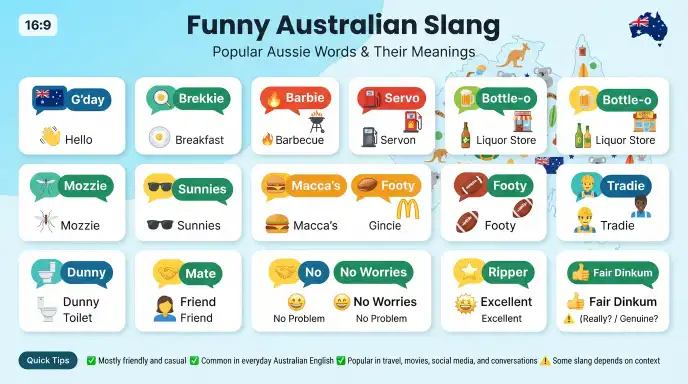
Funny Australian slang is one of the most interesting parts of Australian English. People around the world search for these expressions because they sound unusual, humorous, and sometimes completely different from standard English.
If you’ve ever heard someone say “No worries,” “Arvo,” or “Fair dinkum,” you may have wondered what they actually mean.
Australians are known for speaking in a relaxed and friendly way. They often shorten words, create funny nicknames, and use expressions that make everyday conversations more enjoyable. These slang terms are common in daily life, movies, TV shows, sports, workplaces, and casual chats.
Understanding funny Australian slang helps you communicate more naturally, enjoy Australian humor, and avoid confusion when talking with locals or visiting Australia.
Quick Answer:funny australian slang
Funny Australian slang refers to humorous informal words and expressions Australians use in everyday conversations. Most are friendly, casual, and designed to make speech shorter, funnier, and more relaxed.
What Does Funny Australian Slang Mean in Text?
Funny Australian slang includes informal words, phrases, and nicknames that Australians use instead of formal English. Many of these expressions sound funny because they shorten words, add playful endings, or have meanings that are not obvious to outsiders.
For example:
- Arvo means afternoon.
- Servo means gas station.
- Bottle-o means liquor store.
- Brekkie means breakfast.
Someone unfamiliar with Australian English might think these words are completely different languages, but they are simply informal Australian expressions.
Funny Australian Slang Full Form / Definition
Unlike internet abbreviations, funny Australian slang does not usually have a full form. Instead, it consists of shortened words, rhyming phrases, and creative nicknames.
Examples include:
| Australian Slang | Meaning |
| Brekkie | Breakfast |
| Barbie | Barbecue |
| Macca’s | McDonald’s |
| Arvo | Afternoon |
| Mozzie | Mosquito |
| Tradie | Tradesperson |
| Footy | Football |
| Sunnies | Sunglasses |
| Bottle-o | Liquor store |
| Servo | Service station |
Many Australian slang words end in -ie, -y, or -o, making them sound more friendly and casual.
Is Funny Australian Slang Rude, Offensive, or Neutral?
Most funny Australian slang is completely neutral and friendly. Australians often use these expressions with family, friends, coworkers, and neighbors.
However, context always matters.
Neutral Examples
- Brekkie
- Barbie
- Arvo
- Cheers
- No worries
These expressions are polite and commonly used.
Potentially Offensive Examples
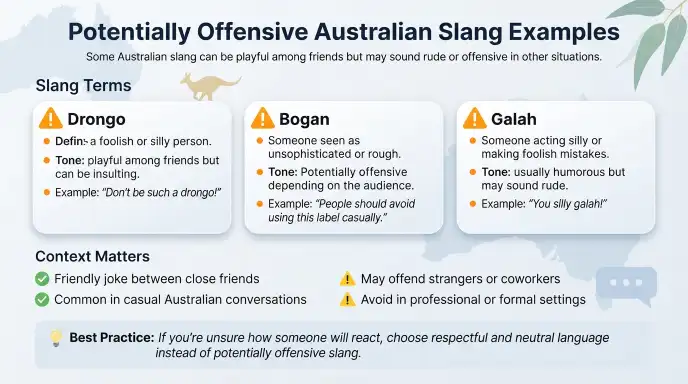
Some Australian slang can become offensive depending on tone or audience.
Examples include:
- Calling someone a drongo (fool)
- Saying someone is a bogan (rough or unsophisticated person)
- Calling someone a galah (silly person)
These words may be playful among friends but rude when spoken to strangers.
Where Is Funny Australian Slang Commonly Used?
Australian slang is most common in everyday face-to-face conversations, but it also appears in many modern settings.
You’ll often hear it in:
- Family conversations
- Friend groups
- Cafes
- Sports events
- Workplaces
- Schools
- Australian television
- Movies
- Podcasts
- Radio shows
Online, it frequently appears on:
- TikTok
- YouTube comments
- Snapchat
- Text messages
People also use it in memes and humorous social media posts because the expressions often sound entertaining to non-Australians.
Why Australians Use Funny Slang
Australian culture values friendliness and informality. Slang helps make conversations feel more relaxed.
People use funny Australian slang because it:
- Makes conversations shorter
- Sounds more natural
- Creates a friendly atmosphere
- Reflects Australian identity
- Adds humor to everyday speech
- Builds connection between speakers
Many Australians use slang without even realizing it because it has become part of everyday language.
Common Features of Funny Australian Slang
Australian slang has several unique characteristics.
Shortened Words
Australians love shortening long words.
Examples:
- Afternoon → Arvo
- Breakfast → Brekkie
- Mosquito → Mozzie
Nicknames
People often receive friendly nicknames.
Examples:
- Sharon → Shazza
- Darren → Dazza
- Barry → Bazza
Playful Endings
Many slang words end in:
- -ie
- -y
- -o
These endings make words sound casual and friendly.
20 Popular Funny Australian Slang Words
| Slang | Meaning | Example |
| Arvo | Afternoon | See you this arvo. |
| Brekkie | Breakfast | Let’s grab brekkie. |
| Barbie | Barbecue | We’re having a barbie tonight. |
| Servo | Gas station | Stop at the servo. |
| Bottle-o | Liquor store | I’ll visit the bottle-o. |
| Mozzie | Mosquito | The mozzies are everywhere. |
| Sunnies | Sunglasses | Don’t forget your sunnies. |
| Footy | Football | Watching footy tonight? |
| Macca’s | McDonald’s | Let’s eat at Macca’s. |
| Tradie | Tradesperson | The tradie fixed the roof. |
| Dunny | Toilet | Where’s the dunny? |
| Mate | Friend | Thanks, mate. |
| No worries | You’re welcome | No worries at all. |
| Fair dinkum | Really? Genuine? | Fair dinkum? |
| Chuck a sickie | Fake being sick | He chucked a sickie today. |
| Ripper | Excellent | That’s a ripper idea. |
| Beauty | Great | Beauty! We won. |
| G’day | Hello | G’day, mate! |
| Cuppa | Cup of tea | Want a cuppa? |
| Snag | Sausage | Grab another snag. |
Real-Life Examples of Funny Australian Slang
Australian slang changes depending on the situation. The same word can sound friendly, humorous, or even slightly sarcastic based on the speaker’s tone.
Friendly Examples
These expressions are warm and welcoming.
- G’day, mate! How’s it going?
- Let’s grab brekkie tomorrow morning.
- Thanks for helping me, mate.
- We’ll have a barbie this weekend.
- No worries! Happy to help.
Casual Conversation Examples
These are common in everyday Australian English.
- I’ll meet you this arvo.
- Stop by the servo before we leave.
- I forgot my sunnies at home.
- The mozzies are terrible tonight.
- Let’s get some food from Macca’s.
Argumentative or Humorous Examples
Some slang can be teasing between friends.
- Don’t be such a drongo.
- You’re acting like a galah today.
- That idea is completely bonkers, mate.
- You forgot your keys again? Classic!
These expressions are usually playful among friends but may sound rude to strangers.
Social Media and Texting Examples
Funny Australian slang often appears online because it is short and easy to type.
Amazing beach today! 🌞 No worries!
TikTok
POV: You forgot your sunnies on the hottest day.
Having a barbie with the family tonight.
Text Message
Meet me at Macca’s this arvo.
Fair dinkum, that’s the funniest story I’ve heard all week.
Origin and Background of Funny Australian Slang
Australian slang developed over many generations.
Early settlers, workers, miners, farmers, and soldiers often created shorter, easier ways to speak. Over time, these expressions became part of everyday Australian English.
Several cultures also influenced Australian slang, including:
- British English
- Irish English
- Aboriginal Australian languages
- Military vocabulary
- Rural farming communities
Today, Australian slang continues to evolve through television, sports, music, and social media.
Comparison with Similar English Slang
Many Australian expressions have similar meanings to slang used in other English-speaking countries.
| Australian Slang | American English | British English | Meaning |
| Brekkie | Breakfast | Breakfast | Morning meal |
| Barbie | BBQ | Barbecue | Outdoor cooking |
| Servo | Gas station | Petrol station | Fuel station |
| Sunnies | Sunglasses | Sunglasses | Eye protection |
| Macca’s | McDonald’s | McDonald’s | Fast-food restaurant |
| Mate | Buddy | Mate | Friend |
| Footy | Football | Football | Popular sport |
| No worries | No problem | No problem | It’s okay |
Although the meanings are similar, Australians use these words much more naturally in everyday speech.
When Should You Avoid Funny Australian Slang?
Even friendly slang is not suitable everywhere.
Avoid using Australian slang in:
- Academic essays
- Business reports
- Legal documents
- Job interviews
- Professional presentations
- Formal emails
- Official government communication
Using too much slang in professional settings may make your writing seem informal or unclear.
Polite Alternatives
If you’re unsure whether slang is appropriate, choose these standard English alternatives.
| Funny Australian Slang | Polite Alternative |
| G’day | Hello |
| Mate | Friend |
| No worries | You’re welcome |
| Brekkie | Breakfast |
| Arvo | Afternoon |
| Barbie | Barbecue |
| Servo | Service station |
| Sunnies | Sunglasses |
| Drongo | Foolish person |
| Galah | Silly person |
These alternatives work well in formal conversations and international communication.
Why People Love Funny Australian Slang
Australian slang is more than just funny words. It reflects the country’s relaxed lifestyle and friendly culture.
People enjoy using it because it:
- Makes conversations feel casual.
- Creates a sense of belonging.
- Shows Australian identity.
- Adds humor to everyday speech.
- Makes stories more entertaining.
- Helps friends connect naturally.
Many Australians grow up hearing these expressions every day, so they become a normal part of speech.
Impact of Funny Australian Slang in Communication
Using slang can make conversations feel warm and personal.
Positive Effects
- Builds friendships.
- Makes speech sound natural.
- Adds personality.
- Creates humor.
- Helps people fit into local culture.
Possible Challenges
- Visitors may not understand the meaning.
- Some expressions vary by region.
- Certain words may confuse non-native English speakers.
- Informal slang may not suit professional situations.
Understanding the context helps you use Australian slang confidently and appropriately.
Is Funny Australian Slang Safe for Social Media?
Yes, funny Australian slang is generally safe to use on social media because most expressions are friendly and lighthearted. However, you should still understand the meaning before using unfamiliar slang. Some words that sound harmless may be jokes, regional expressions, or playful insults.
These slang terms are commonly seen on:
- TikTok
- Snapchat
- X (Twitter)
- YouTube comments
- WhatsApp and text messages
If you’re posting for an international audience, remember that many people outside Australia may not understand the slang. When necessary, add a little context so everyone can follow the conversation.
More Real-Life Examples of Funny Australian Slang
Friendly Conversation
Alex: G’day, mate! Fancy a barbie this weekend?
Ben: Sounds great! I’ll bring some snags.
At Work
Emma: Let’s grab a cuppa before the meeting.
Jake: Good idea. I’ll be back in a minute.
While Traveling
Tourist: Excuse me, where’s the servo?
Local: Just down the road on the left.
At the Beach
Friend 1: Don’t forget your sunnies.
Friend 2: Thanks! The sun is really strong today.
On Social Media
Instagram Caption
Beach, barbie, and good mates. Perfect Aussie weekend! 🇦🇺
TikTok Caption
When you finally understand what “arvo” means. 😂
Facebook Post
Had brekkie by the beach this morning. What a ripper day!
Common Mistakes to Avoid
Many people misuse Australian slang because they hear it in movies or online without understanding the context.
Avoid these common mistakes:
Using Slang in Formal Writing
Australian slang is best for casual conversations, not business emails or academic papers.
Assuming Every Australian Uses Every Slang Word
Australia has regional differences. Some expressions are common nationwide, while others are more local.
Overusing Slang
Using too many slang words in one conversation can sound unnatural, especially if you are not Australian.
Misunderstanding Playful Insults
Words like drongo, galah, or bogan may be friendly jokes between close friends but can sound offensive in other situations.
Copying Internet Slang Without Knowing the Meaning
Some online posts exaggerate or invent Australian slang for humor. Check the meaning before using unfamiliar expressions.
Quick Tips for Using Funny Australian Slang
- Listen to how native Australians use the words.
- Start with common expressions like G’day, Mate, and No worries.
- Use slang naturally instead of forcing it into every sentence.
- Consider your audience before using informal language.
- Avoid slang in professional or academic settings.
Comparison of Popular Funny Australian Slang
| Slang | Meaning | Tone | Safe to Use? |
| G’day | Hello | Friendly | ✅ Yes |
| Mate | Friend | Friendly | ✅ Yes |
| No worries | No problem | Polite | ✅ Yes |
| Brekkie | Breakfast | Casual | ✅ Yes |
| Arvo | Afternoon | Casual | ✅ Yes |
| Barbie | Barbecue | Casual | ✅ Yes |
| Ripper | Excellent | Positive | ✅ Yes |
| Beauty | Great | Positive | ✅ Yes |
| Drongo | Foolish person | Playful | ⚠️ Depends on context |
| Galah | Silly person | Playful | ⚠️ Depends on context |
| Bogan | Unsophisticated person | Informal | ⚠️ Use carefully |
Frequently Asked Questions
Q1. What does funny Australian slang mean?
Funny Australian slang refers to informal words and humorous expressions commonly used by Australians in everyday conversations.
Q2. Does funny Australian slang have a full form?
No. Funny Australian slang is not an abbreviation or acronym. It is a collection of informal words, shortened expressions, and nicknames used in Australian English.
Q3. Is Australian slang rude?
Most Australian slang is friendly and harmless. However, a few expressions can sound rude or insulting depending on the speaker, tone, and situation.
Q4. Why do Australians shorten so many words?
Australians often shorten words because it makes conversations quicker, friendlier, and more relaxed. It has become an important part of Australian culture.
Q5. Can tourists use Australian slang?
Yes. Locals usually appreciate visitors who use common slang naturally. It is still a good idea to understand the meaning before using unfamiliar expressions.
Q6. Is funny Australian slang popular on social media?
Yes. Many Australians use slang on TikTok, Instagram, Facebook, Reddit, YouTube, and in text messages because it feels casual and authentic.
Conclusion
Funny Australian slang is one of the most entertaining features of Australian English. From brekkie and arvo to mate, barbie, and no worries, these expressions make everyday conversations feel friendly, relaxed, and full of personality.
Understanding the meaning, tone, and context behind Australian slang helps you communicate more naturally, appreciate Australian culture, and avoid misunderstandings. While most expressions are informal and suitable for casual conversations or social media, they are generally best avoided in professional or formal situations.
Whether you’re traveling to Australia, chatting with Australian friends, or simply curious about Aussie English, learning these funny slang terms is a fun way to connect with the language and the people who speak it.
Read More About !
- German Slang Phrases: Meaning, Common Expressions
- Work in Spanish Slang: Informal Ways to Say Work in Spanish
- What Is Yachting Slang? Meaning, Uses, and Examples

Michael Brooks is a language writer at SlangPath with 7+ years of experience creating simple, practical content on English slang and everyday expressions.