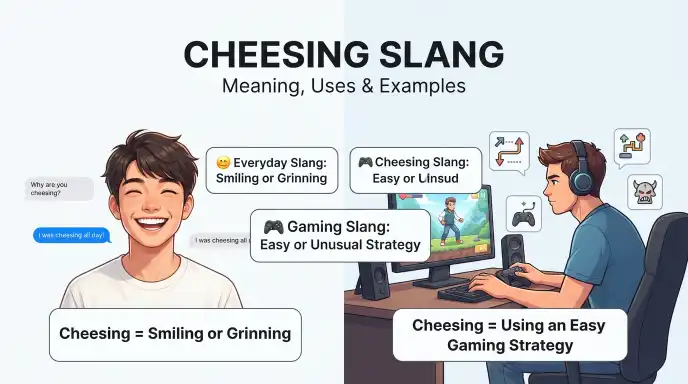
Cheesing slang usually means smiling or grinning widely, especially because someone is very happy, amused, excited, or pleased. In some contexts, however, cheesing can have other meanings, including using an easy or unfair strategy in gaming.
Cheesing slang can be confusing because the word “cheesing” has more than one informal meaning. In everyday conversation, especially in phrases like “I was cheesing,” it often means grinning or smiling a lot. Someone may use it when they are excited, embarrassed, amused, or happy about something. Online, you may see this meaning in texts, captions, TikTok comments, Instagram posts, and casual conversations.
There is also a separate meaning in gaming, where “cheesing” can mean winning or completing something by using an unusually easy, cheap, or unintended strategy. The meaning depends on the context.
This guide explains both uses clearly, including where the slang appears, how its tone changes, examples from real conversations, its background, and when you should avoid using it.
Quick Answer: What Does Cheesing Slang Mean?
Cheesing slang commonly means smiling or grinning widely because you are happy, amused, excited, or pleased. In gaming, cheesing can instead mean using a simple, low-effort, or unconventional strategy to beat a challenge.
What Does Cheesing Mean in Slang?
The most common casual meaning of cheesing is smiling broadly or grinning from happiness or amusement.
For example:
“I was cheesing when I saw the surprise.”
This means the person was smiling a lot because they were happy or excited.
Another example:
“She was cheesing after getting the good news.”
Here, cheesing describes a big, noticeable smile.
The expression is especially useful when an ordinary word like “smiling” does not fully capture the person’s reaction. Saying someone was “cheesing” often suggests that the smile was obvious, wide, or difficult to hide.
Cheesing Slang Meaning in Text
In texting, cheesing usually refers to a person who is smiling or grinning.
For example:
“I’ve been cheesing all morning.”
The person means they have been smiling because something made them happy.
A friend might text:
“Why are you cheesing?”
That could mean:
“Why are you smiling so much?”
The expression can also be used playfully when someone is clearly enjoying attention.
Example
Friend 1: “Guess who finally texted me back?”
Friend 2: “You’re cheesing so hard right now 😂”
The second friend notices that the first person is obviously happy.
Different Meanings of Cheesing Slang
Because cheesing has multiple informal uses, it is important not to mix them together.
1. Cheesing = Smiling or Grinning
This is the everyday social meaning.
“I couldn’t stop cheesing during the photo.”
Meaning:
“I couldn’t stop smiling.”
The tone is usually positive and playful.
2. Cheesing = Using an Easy Gaming Strategy
In gaming, cheesing can mean defeating an opponent, boss, level, or challenge by using a simple, unusual, or sometimes unintended strategy.
For example:
“He cheesed the boss by staying in one safe spot.”
The player did not necessarily use the intended approach.
Depending on the gaming community, cheesing may be viewed as clever, funny, cheap, or unfair.
These two meanings are separate. The surrounding context tells you which one is intended.
Cheesing in Gaming
The gaming meaning deserves special attention because it is very common in online communities.
A player may “cheese” a difficult challenge by finding a way around the intended difficulty.
This could involve:
- Finding a safe location
- Repeating an easy attack
- Exploiting a weakness
- Using an unusually simple tactic
- Avoiding the normal strategy
- Taking advantage of game mechanics
For example:
“I couldn’t beat the boss normally, so I cheesed the fight.”
The player means they found an easier method
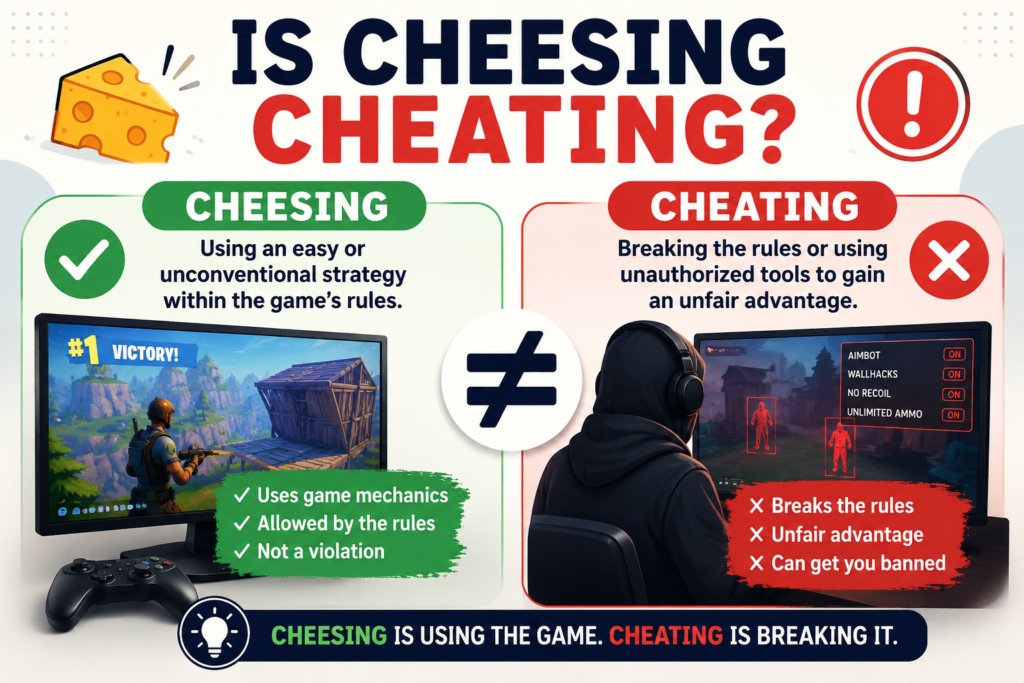
Is Cheesing Cheating?
Not always.
Cheesing and cheating are not automatically the same thing.
Cheating usually involves breaking rules or using unauthorized tools. Cheesing can simply mean finding an easy or unconventional way to succeed within the game’s available mechanics.
However, some players dislike cheesing because they believe it avoids the challenge the game was designed to provide.
Cheesing in Competitive Gaming
In competitive games, the word can carry a more negative tone.
A player might complain:
“They cheesed us with the same strategy every round.”
Here, the speaker may feel that the opponent used a cheap or repetitive tactic.
Another player might admire the same strategy:
“That cheese was actually brilliant.”
So the word does not automatically mean “bad.”
Its emotional meaning depends on the speaker’s opinion.
Cheesing on Discord
On Discord, the meaning depends heavily on the channel.
In a casual social channel:
“Bro, why are you cheesing?”
probably means:
“Why are you smiling so much?”
In a gaming channel:
“I cheesed the final boss.”
probably refers to an easy or unconventional strategy.
Discord is therefore a good example of why context matters.
The same word can have completely different meanings within the same platform.
Cheesing on TikTok
On TikTok, cheesing can appear in captions and comments describing someone’s smile.
For example:
“I’ve been cheesing since I saw this.”
The speaker is saying that the video or situation made them smile.
Gaming TikTok content may use the term differently:
“How I cheesed this boss.”
In that context, it refers to a strategy rather than a facial expression.
Cheesing on Instagram
Instagram users may use cheesing when talking about photos, relationships, celebrations, or exciting news.
For example:
“Couldn’t stop cheesing during the whole trip.”
This suggests the person was extremely happy.
A friend might comment:
“Look at you cheesing!”
That is usually playful teasing about a big smile.
Cheesing on Snapchat
In Snapchat conversations, the word can be used casually to describe someone’s expression.
For example:
“Why are you cheesing in every picture? 😂”
The speaker is joking that the person is smiling in every photo.
Because Snapchat conversations are generally informal, slang like this can fit naturally.
Cheesing on Reddit
Reddit uses both meanings.
In a relationship or personal discussion, someone might write:
“I was cheesing after reading her message.”
That means they were smiling.
In a gaming subreddit, someone might say:
“Is there a way to cheese this boss?”
That means they are looking for an easy or unconventional strategy.
The subreddit topic usually makes the intended meaning obvious.
Is Cheesing Slang Rude or Offensive?
Cheesing is generally harmless when it means smiling or grinning.
For example:
“You were cheesing the whole time.”
This is normally playful.
The gaming meaning is also not inherently offensive, although calling someone’s strategy “cheese” can sound critical.
For example:
“You only won because you cheesed.”
This may be an accusation that the person used a cheap tactic.
The word itself is not usually a serious insult.
Can Cheesing Be Used at Work?
The smiling meaning can appear in casual workplace conversations, but it is still informal slang.
For example, a coworker might say:
“You were cheesing after that meeting.”
That could be fine between friendly coworkers.
However, in formal writing, smiling is clearer.
Instead of:
“The customer was cheesing.”
write:
“The customer was smiling.”
The gaming meaning is obviously appropriate only when discussing gaming.
Can Students Use Cheesing?
Students may hear or use the term in casual conversations.
For example:
“Why are you cheesing?”
is a harmless way to ask why someone is smiling.
Gaming students may also say:
“I cheesed the level.”
Teachers should consider the context before assuming the word is inappropriate.
Unlike many stronger slang terms, cheesing is generally mild.
Origin and Background of Cheesing Slang
The smiling meaning is connected to the familiar expression “say cheese,” which is associated with smiling for photographs.
The idea of “cheesing” as smiling or grinning has been used informally for many years, particularly in American English and popular culture.
The exact point when the slang became widespread is difficult to assign to one person, event, or platform. It is better not to claim a specific invention date without strong evidence.
The gaming meaning developed separately from this everyday use.
In gaming culture, cheese came to describe strategies that make a difficult task much easier than expected. Over time, cheesing became a common verb for using such tactics.
The two meanings now coexist.
Why Do People Say Cheesing Instead of Smiling?
Cheesing can sound more expressive than simply saying smiling.
Compare:
“He was smiling.”
with:
“He was cheesing.”
The first statement is neutral.
The second can suggest a bigger, more obvious grin.
It may also communicate a playful feeling.
People often use slang because it makes casual conversations shorter and more expressive.
Cheesing vs. Smiling
| Term | Meaning | Tone |
| Smiling | Showing happiness or amusement through a smile | Neutral |
| Grinning | Smiling broadly | Casual |
| Cheesing | Smiling or grinning noticeably | Informal/playful |
| Laughing | Showing amusement through laughter | Casual |
| Beaming | Smiling with obvious happiness | More descriptive |
Cheesing is usually more casual than smiling.
Cheesing vs. Grinning
These two meanings are very close.
Grinning simply means smiling broadly.
Cheesing can carry a more playful feeling and often suggests that the person’s smile is very noticeable.
For example:
“He was grinning after winning.”
and:
“He was cheesing after winning.”
both describe a big smile.
The second sounds more informal.
Cheesing vs. Flexing
These terms should not be confused.
Flexing usually means showing off something, such as money, possessions, skills, or achievements.
Cheesing can mean smiling or using an easy gaming strategy.
For example:
“He was flexing his new car.”
means he was showing it off.
“He was cheesing after getting his new car.”
means he was smiling happily.
Real-Life Examples of Cheesing Slang
Friendly Conversation
“Why are you cheesing so much today?”
Meaning: Why are you smiling so much?
Text Message
“I’ve been cheesing since I got your message.”
Meaning: I’ve been smiling since I received your message.
Relationship Context
“He had me cheesing all night.”
Meaning: He made me smile or feel very happy.
Social Media
“That video had me cheesing.”
Meaning: The video made me smile.
Gaming
“I cheesed the boss by using the safe spot.”
Meaning: I defeated the boss with an easy or unconventional strategy.
Discord Gaming Chat
“That was pure cheese 😂”
Meaning: That strategy was extremely easy, cheap, or unconventional.
Argumentative Gaming Context
“You didn’t beat me fairly. You just cheesed the whole match.”
Here, cheesed carries a negative tone.
When Should You Avoid Using Cheesing?
You usually do not need to avoid this slang because it is relatively mild. Still, formal communication calls for clearer language.
Avoid it when:
- Writing an academic paper
- Writing a formal business email
- Speaking to an unfamiliar professional audience
- Explaining something to someone who may not know the slang
- Writing official documentation
Use smiling, grinning, using an easy strategy, or using an unconventional tactic instead.
Common Misunderstandings About Cheesing
“Cheesing always means smiling.”
Not necessarily.
In gaming, it often refers to an easy or unconventional strategy.
“Cheesing means cheating.”
Not automatically.
A cheese strategy may still use normal game mechanics.
“Cheesing is an insult.”
Usually not.
The smiling meaning is generally playful. The gaming meaning can become negative when someone criticizes a player’s strategy.
“Cheesing is only used by gamers.”
No.
The smiling meaning appears in everyday casual conversation and social media.
How to Understand Cheesing From Context
When you see cheesing, look at the words around it.
If you see:
“smile,” “photo,” “happy,” “date,” “message,” or “laugh”
the word probably refers to smiling.
If you see:
“boss,” “level,” “strategy,” “fight,” “match,” or “game”
it probably refers to a gaming tactic.
This simple context check usually makes the intended meaning clear.
Frequently Asked Questions
Q.1. What does cheesing mean in slang?
Cheesing commonly means smiling or grinning widely because you are happy, amused, or excited. In gaming, it can mean using an easy or unconventional strategy.
Q.2. Is cheesing a bad word?
No. It is generally mild and harmless. The gaming meaning can sometimes sound negative when someone uses it to criticize another player’s strategy.
Q.3. What does “why are you cheesing?” mean?
It usually means “Why are you smiling so much?” The speaker may be teasing someone who looks especially happy.
Q.4. What does cheesing mean in gaming?
In gaming, cheesing means using an easy, cheap, unusual, or unintended strategy to overcome a challenge.
Q.5. Is cheesing the same as cheating?
Not necessarily. Cheesing can involve using normal game mechanics in an unusually easy way, while cheating generally involves breaking rules or using unauthorized advantages.
Q.6. Is cheesing used on social media?
Yes. The smiling meaning can appear in texts, captions, comments, TikTok posts, Instagram content, Snapchat messages, and other casual online conversations.
Conclusion
Cheesing slang has two main informal uses. In everyday conversation, it usually means smiling or grinning widely, often because someone is happy, amused, excited, or pleased. In gaming, cheesing means using an easy, unconventional, or sometimes cheap strategy to overcome a challenge.
Context is the key to understanding the word. A message about a photo or someone’s expression probably uses the first meaning, while a conversation about a boss fight or game strategy probably uses the second.
Overall, cheesing is mild, casual slang. It works well in friendly conversations and online communities, but clearer words such as smiling or using an easy strategy are better for formal writing.
Read More About !
- Berlin Meaning Slang: What Does Berlin Mean?
- Spanish Slang for White Person: Meanings and Usage
- Dom Slang Meaning: Uses, Examples, and Context

My name is Olivia Bennett.I am a language enthusiast and educational writer with a strong interest in contemporary English and digital communication. I enjoys making language learning engaging and accessible.