Mexican slang curse words are informal Spanish swear words and strong expressions used in Mexico to show emotions like anger, surprise, or humor, with meanings that change depending on the context and tone
.Mexican slang curse words are informal Spanish swear words and insults commonly used in Mexico to express anger, surprise, frustration, humor, or even friendship, depending on the situation. Some are highly offensive, while others can sound playful when used between close friends. Context, tone of voice, and the relationship between speakers are very important.
Many people search for Mexican slang curse words because they hear them in movies, TV shows, music, social media, online videos, or while traveling in Mexico. Understanding these expressions can help you avoid misunderstandings and recognize when a word is being used as a joke or as a serious insult.
In this guide, you’ll learn what Mexican slang curse words mean, which ones are common, when they are considered rude, and when you should avoid using them. You’ll also see real-life examples and discover polite alternatives for everyday conversations.
What Are Mexican Slang Curse Words?
Mexican slang curse words are informal swear words and strong expressions used in Mexican Spanish. They often show emotions such as anger, surprise, excitement, or frustration. Some are mild and commonly heard among friends, while others are highly offensive and should be avoided in polite or professional conversations.
What Do Mexican Slang Curse Words Mean?
Their General Meaning
Mexican slang curse words are not a single group of words with one meaning. Instead, they include many different expressions that people use to communicate strong feelings. Depending on the word and the situation, they may:
- Show anger after something goes wrong.
- Express surprise or shock.
- Tease close friends.
- Insult someone during an argument.
- Add emphasis to a sentence.
Because these words carry different levels of intensity, understanding the context is just as important as knowing the translation.
Why Context Matters
The same curse word can have very different meanings depending on how it is spoken. A word said with a smile between lifelong friends may sound harmless, while the exact same word shouted during an argument can become a serious insult.
For that reason, language learners should avoid translating these expressions word for word. Instead, pay attention to:
- Tone of voice
- Facial expression
- Relationship between the speakers
- Situation or setting
- Local cultural norms
Understanding these factors helps you recognize whether a speaker is joking, venting frustration, or intentionally being offensive.
Are Mexican Slang Curse Words Rude or Offensive?
Some Are Mild, Others Are Very Offensive
Not every Mexican slang curse word has the same level of rudeness. Some are used casually among close friends, while others are considered extremely offensive and may start arguments if used carelessly.
| Type | Description | Safe to Use? |
| Mild slang | Often used jokingly among friends | Only if you understand the relationship and context |
| Strong curse words | Express anger or frustration | Better to avoid if you’re learning Spanish |
| Serious insults | Intended to offend or provoke | No—avoid using them |
Can You Use Them in Everyday Conversation?
If you are not a native speaker, it is usually safer not to use Mexican slang curse words yourself. Instead, learn their meanings so you can understand movies, music, conversations, and social media without accidentally offending someone.
Even native Spanish speakers often choose different words depending on who they are talking to. What sounds acceptable among friends may be completely inappropriate in a classroom, workplace, or family gathering.
Most Common Mexican Slang Curse Words
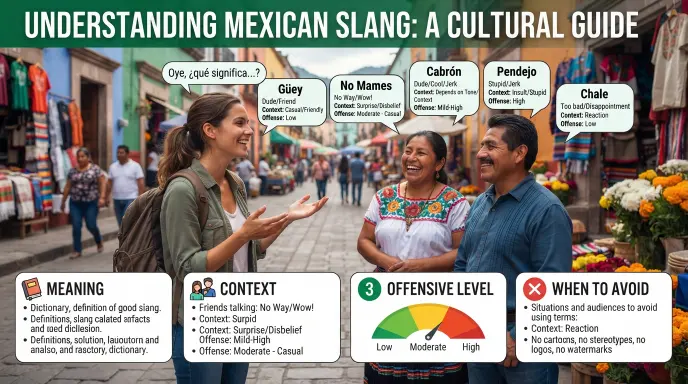
1. Güey (Wey)
Meaning: Originally an insult meaning “idiot,” but today it is often used like “dude,” “bro,” or “mate” between friends in Mexico.
Tone: Usually casual and friendly, but it can become insulting depending on the speaker’s tone.
Example:
“¡Qué onda, güey!”
(“What’s up, dude?”)
2. No Mames
Meaning: One of the most common Mexican slang expressions. It can mean “No way!”, “You’re kidding!”, or express disbelief. Literally, however, it is a vulgar phrase.
Tone: Informal and mildly to strongly vulgar depending on the situation.
Example:
“¡No mames! ¿De verdad ganaste la lotería?”
(“No way! Did you really win the lottery?”)
3. Chingar / Chingada
Meaning: A very versatile Mexican Spanish curse word with many meanings depending on the sentence. It may express anger, annoyance, failure, or emphasis.
Tone: Strongly vulgar in many situations.
Example:
“¡Vete a la chingada!”
This expression is considered highly offensive and should generally be avoided by language learners.
Most Common Mexican Slang Curse Words (Continued)
4. Cabrón
Meaning: Cabrón can describe someone as “tough,” “clever,” or “jerk,” depending on the context. Among close friends, it may even be used playfully.
Tone: Mild to highly offensive, depending on the relationship and tone of voice.
Example:
“Ese cabrón siempre gana.”
(“That guy always wins.”)
5. Pendejo
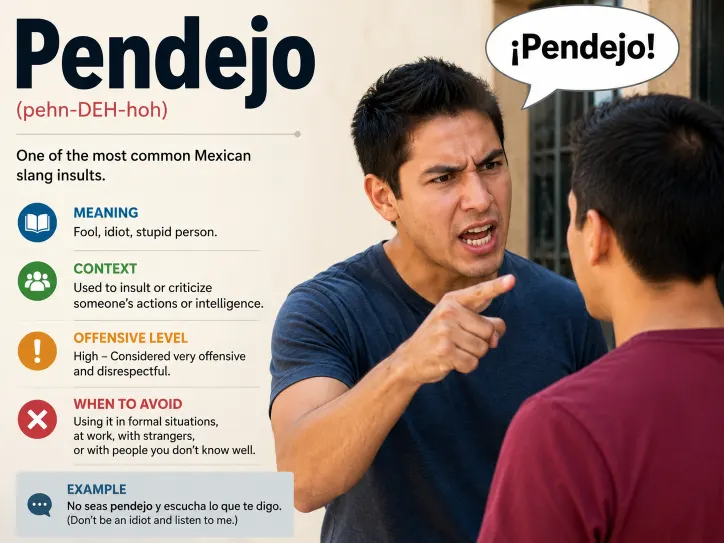
Meaning: This word usually means “idiot,” “fool,” or “stupid person.” It is one of the most common insults in Mexican Spanish.
Tone: Offensive.
Example:
“No seas pendejo.”
(“Don’t be an idiot.”)
Avoid using this expression unless you fully understand the social situation.
6. Pinche
Meaning: Pinche is often used before a noun to show annoyance or dislike. It can be translated as “damn” or “stupid” in many situations.
Tone: Mild to moderately vulgar.
Example:
“Este pinche tráfico.”
(“This damn traffic.”)
7. Culero
Meaning: A strong insult used to describe someone as mean, unfair, or unpleasant.
Tone: Offensive.
Example:
“Qué culero eres.”
(“You’re such a jerk.”)
8. Chale
Meaning: Unlike many words on this list, Chale is usually not a curse word. It is a slang expression used to show disappointment, surprise, or frustration.
Tone: Mild and generally acceptable in casual conversations.
Example:
“¡Chale! Perdí mi teléfono.”
(“Aw, I lost my phone.”)
Where Are Mexican Slang Curse Words Commonly Used?
Everyday Conversations
Many Mexican slang curse words appear in casual conversations between friends or family members. Native speakers often understand the intended meaning through tone and body language.
If you are learning Spanish, it is better to recognize these words than to use them yourself.
Movies and TV Shows
Mexican films, comedy shows, and television dramas frequently include slang to make conversations sound realistic.
Watching these programs can help you understand how the words are used naturally.
Music
Many Mexican rap, rock, and regional songs include curse words to express strong emotions or tell stories.
Lyrics often contain expressions that would not be appropriate in formal situations.
Social Media
You may see these expressions on:
- TikTok
- X (formerly Twitter)
- YouTube comments
Online users often use slang casually, but meanings still depend on context.
Gaming and Online Chats
Gamers sometimes use Mexican slang while chatting during online matches, especially when playing with Spanish-speaking friends.
These expressions may show excitement, frustration, or friendly teasing.
Real-Life Examples
Friends Talking
Carlos: “¡No mames! ¿Compraste un carro nuevo?”
Luis: “Sí, lo encontré a buen precio.”
Text Message
A: “Llegué tarde otra vez.”
B: “¡Chale! Espero que no tengas problemas.”
After Losing a Game
Player 1: “Ese nivel estuvo difícil.”
Player 2: “Sí, estuvo bien pinche complicado.”
Watching Sports
Friend 1: “¡Golazo!”
Friend 2: “Ese cabrón juega increíble.”
Online Comment
“No mames, ese video estuvo buenísimo.”
This example shows surprise and excitement rather than anger.
Origin and History
Roots in Mexican Spanish
Many Mexican slang curse words have existed for generations and developed through everyday speech rather than formal writing.
Some expressions came from old Spanish vocabulary, while others evolved into uniquely Mexican meanings over time.
Influence of Culture
Mexico’s regional cultures, humor, and everyday conversations have shaped how these words are used today.
The same expression may sound stronger in one region than another, and younger speakers may use certain words more casually than older generations.
Modern Popularity
Today, Mexican slang spreads quickly through:
- Social media
- Streaming platforms
- Podcasts
- YouTube
- Memes
- Online gaming
- Music
Because of this, many non-native Spanish speakers hear these expressions before they fully understand them.
Similar Mexican Slang or Related Terms
Other Informal Expressions
Not every popular Mexican slang word is a curse word. Some are simply casual expressions used in everyday speech.
| Slang | Meaning | Offensive Level |
| Órale | Wow!, Come on!, Okay! | Not offensive |
| Ándale | Hurry up!, Let’s go! | Not offensive |
| Chido | Cool, Great | Not offensive |
| Güey (Wey) | Dude, Bro (or idiot in some contexts) | Mild to Moderate |
| Chale | Oh no!, That’s unfortunate | Usually not offensive |
| No Mames | No way!, You’re kidding! | Vulgar |
| Pinche | Damn, Stupid | Mild to Moderate |
| Pendejo | Idiot | Offensive |
When Should You Avoid Using Mexican Slang Curse Words?
Professional Settings
Avoid Mexican slang curse words at work, during job interviews, business meetings, or when speaking with customers. They can sound disrespectful and unprofessional.
School and College
Students should not use these expressions with teachers, professors, or school staff. Even if classmates joke with them, they are usually inappropriate in educational settings.
Family Gatherings
Many families consider strong curse words disrespectful, especially around parents, grandparents, or young children.
When Traveling in Mexico
If you are visiting Mexico, it is better to understand these words than to use them. As a non-native speaker, you may not recognize the correct tone or situation, which could accidentally offend someone.
Polite Alternatives
Respectful Expressions
If you want to express surprise or frustration without sounding rude, try these alternatives.
| Instead of… | Try Saying… |
| No Mames | ¡No puede ser! (That can’t be!) |
| Pinche | Qué malo (That’s bad.) |
| Pendejo | Cometió un error (He made a mistake.) |
| Strong insults | Speak calmly and respectfully |
These alternatives are much safer in public and professional conversations.
Why Do People Use Mexican Slang Curse Words?
To Express Strong Emotions
People often use these expressions when they feel:
- Angry
- Surprised
- Excited
- Frustrated
- Shocked
To Joke With Friends
Among close friends, some slang words become playful nicknames rather than insults. However, this depends on mutual trust and familiarity.
To Sound Natural
Native speakers often grow up hearing these expressions in conversations, movies, music, and online content. That does not mean they are appropriate in every situation.
Common Misunderstandings
Not Every Curse Word Has One Meaning
Many learners believe every Mexican slang curse word has a single English translation. That is not true.
The same word can express surprise, humor, friendship, or anger depending on:
- Tone of voice
- Facial expression
- Relationship between speakers
- Situation
- Region of Mexico
Literal Translation Can Be Misleading
Some expressions sound much harsher when translated word for word into English. Native speakers often understand meanings that cannot be translated directly.
For this reason, learning the context is more useful than memorizing literal translations.
Frequently Asked Questions
1. What are Mexican slang curse words?
They are informal Spanish swear words and strong expressions commonly used in Mexico to express emotions such as anger, surprise, frustration, or humor.
2. Are all Mexican slang curse words offensive?
No. Some are very offensive, while others are mild or used playfully among close friends. Context always matters.
3. Can tourists use Mexican slang curse words?
It is generally better to understand these words rather than use them. Misusing them may offend native speakers.
4. Are these words used on social media?
Yes. They are commonly seen on TikTok, Instagram, Reddit, YouTube, Facebook, and other online platforms.
5. Which Mexican slang curse word is the most common?
Expressions like No Mames, Güey, Pendejo, Pinche, and Cabrón are among the most frequently heard in casual Mexican Spanish.
6. Are Mexican slang curse words used in movies?
Yes. Mexican films, TV shows, and music often use them to make conversations sound natural and realistic.
7. Can the same word have different meanings?
Yes. Many Mexican slang words change meaning depending on tone, context, and the relationship between speakers.
8. Are these words appropriate at work?
No. Most Mexican slang curse words should be avoided in workplaces, schools, and other professional environments.
9. Why do native speakers use them?
People use them to express emotions, emphasize a point, joke with friends, or make conversations sound more natural.
10. What’s the safest approach for Spanish learners?
Learn what the words mean and when they are used, but avoid saying them until you fully understand their cultural and social context.
Quiz: Mexican Slang Curse Words (1–10)
1. What are Mexican slang curse words mainly used for?
A. Writing formal letters
B. Expressing emotions, humor, or frustration in casual conversations
C. Learning mathematics
D. Giving business presentations
✅ Answer: B
2. Are all Mexican slang curse words considered offensive?
A. Yes, always
B. No, some can be playful depending on the context and relationship
C. Only on social media
D. Only in schools
✅ Answer: B
3. Where are Mexican slang curse words most commonly heard?
A. Academic journals
B. Casual conversations, movies, music, and social media
C. Court documents
D. Scientific research papers
✅ Answer: B
4. Why is context important when using Mexican slang curse words?
A. It changes the weather
B. The same word can sound friendly or highly offensive depending on the situation
C. It changes the spelling
D. It makes every word formal
✅ Answer: B
5. Which situation is the best place to avoid using Mexican slang curse words?
A. Talking with close friends who understand the joke
B. Formal workplaces, schools, or professional meetings
C. Watching a movie at home
D. Playing video games alone
✅ Answer: B
6. Which platform may include Mexican slang curse words in casual conversations?
A. TikTok
B. Reddit
C. Instagram
D. All of the above
✅ Answer: D
7. What is the safest way to use Mexican slang curse words if you are learning Spanish?
A. Use them with everyone immediately
B. Understand their meaning, tone, and cultural context before using them
C. Use them in every conversation
D. Memorize them without learning their meaning
✅ Answer: B
8. Why do some native speakers use Mexican slang curse words with friends?
A. To make every conversation formal
B. To express strong emotions, humor, or closeness
C. To improve grammar
D. To replace every Spanish word
✅ Answer: B
9. Which statement is true about Mexican slang curse words?
A. Every word has exactly the same meaning across all Spanish-speaking countries
B. Their meaning and strength can vary by region and context
C. They are only used in books
D. They are always polite expressions
✅ Answer: B
10. What should you do before using a Mexican slang curse word?
A. Say it without knowing the meaning
B. Learn its meaning, tone, and whether it may offend someone
C. Use it in a job interview
D. Assume it is harmless everywhere
✅ Answer: B
Conclusion
Mexican slang curse words are an important part of everyday Mexican Spanish, but their meanings depend heavily on context, tone, and the relationship between speakers. Some expressions are mild and commonly used among friends, while others are highly offensive and should be avoided in polite conversations.
If you’re learning Spanish or planning to visit Mexico, the best approach is to understand these words rather than use them freely. Knowing what they mean will help you enjoy movies, music, social media, and real-life conversations without accidentally offending someone. By respecting the cultural context behind these expressions, you’ll communicate more confidently and naturally.
Read More About!

My name is Olivia Bennett.I am a language enthusiast and educational writer with a strong interest in contemporary English and digital communication. I enjoys making language learning engaging and accessible.