Dom slang usually refers to “dominant,” especially in online conversations about relationships, power dynamics, or adult contexts. The exact meaning depends on where the word appears and how the people using it understand the term.
People often search for dom slang after seeing “dom” in a text, social media post, dating profile, or online discussion. In some contexts, it simply describes a person who takes a leading or controlling role. In adult conversations, however, dom can have a more specific meaning connected to consensual dominance and submission.
Understanding the context is important because the term is not always used in exactly the same way. This guide explains the common meaning of dom slang, where it appears, how its tone can change, and what readers should know before using it.
Quick Answer: What Does Dom Mean in Slang?
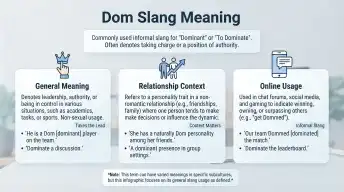
Dom is commonly short for “dominant.” In slang and online conversations, it can describe someone who takes a leading or controlling role, especially in discussions about relationships or consensual adult power dynamics.
What Does Dom Slang Mean?
Dom slang is an informal shortened form of “dominant.” The word is often used online because it is quick, recognizable, and easy to use in casual conversations.
The meaning can depend strongly on context. For example, someone may use “dom” to describe a person who naturally prefers to take charge. In adult or relationship discussions, the term can refer to a person who takes the dominant role in a consensual power dynamic.
The abbreviation is usually written in lowercase as “dom,” although capitalization can vary depending on the platform or writing style.
You may encounter the term in:
- Text messages
- Dating profiles
- Online communities
- Social media discussions
- Relationship conversations
- Adult-oriented discussions
- Informal chats
Because the word can have an adult meaning, it is important not to assume that every use refers to the same type of relationship or interaction.
In simple terms, “dom” usually means someone who takes a dominant or leading role, but the exact meaning comes from the surrounding conversation.
Dom Full Form
The most common full form of dom in this slang context is “dominant.”
“Dominant” describes someone or something that has greater control, influence, or authority in a particular situation.
When shortened to “dom,” the word becomes more informal and conversational. This is common in online communities where users prefer shorter expressions.
For example:
“He prefers being the dom.”
Here, “dom” is being used as a shortened form of “dominant.”
Another example is:
“Her profile says she is a dom.”
In this case, the meaning depends on the profile and the surrounding information. If the profile is discussing relationship dynamics, the term may have a specific adult or consensual meaning.
The abbreviation itself does not automatically explain every detail of the person’s preferences. Context is still necessary.
The full form of dom is generally “dominant,” but its specific meaning can vary according to the conversation.
Different Meanings of Dom
The word dom can carry slightly different meanings depending on the setting. These meanings should be kept separate rather than treated as one fixed definition.
Dom as “Dominant”
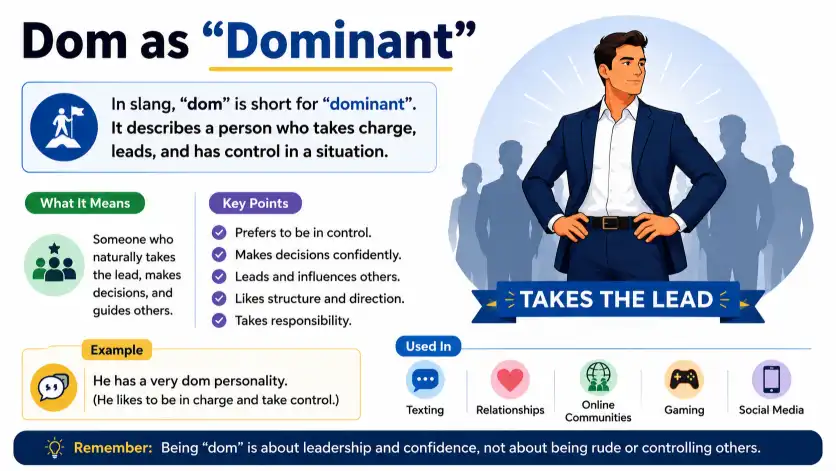
The broadest meaning is simply dominant.
Someone may use the word to describe a person who tends to lead, take control, or make decisions.
For example:
“She has a very dom personality.”
This could mean that she naturally takes charge in a particular social or relationship setting.
The phrase is informal, so it would sound less natural in formal writing.
In this general sense, dom describes a person who takes a leading or controlling role.
Dom in Relationship Contexts
In relationship discussions, dom may describe someone who prefers a dominant role within a consensual dynamic.
The word can appear in dating profiles, private messages, and online communities where people openly discuss relationship roles.
It is important to understand that being described as “dominant” does not mean someone has unlimited control over another person. Healthy relationship dynamics depend on communication, boundaries, and mutual agreement.
In relationship contexts, dom usually describes a consensual role rather than automatic control over another person.
Dom in Adult Contexts
In adult conversations, dom can have a more specific meaning connected to dominance and submission.
This usage is common in discussions of consensual adult power dynamics. The term may be paired with words such as sub, which is commonly short for “submissive.”
Because this meaning is more sensitive, readers should look at the full conversation before interpreting the word.
When “dom” appears in an adult context, it usually refers to a dominant role within a consensual power dynamic.
Where Is Dom Slang Commonly Used?
Dom is mainly found in informal online communication rather than formal writing. Its use is particularly common in spaces where people discuss relationships, dating, identity, or adult topics.
Texting
People may use “dom” in private conversations when discussing relationship preferences or personal roles.
Dating Profiles
The term can appear in dating or relationship profiles where users briefly describe themselves or the type of relationship dynamic they prefer.
Social Media
“Dom” may appear in posts, comments, captions, or discussions. The surrounding content is important because the word can have different meanings.
Online Communities
Certain communities use “dom” as familiar shorthand for “dominant.” People who are unfamiliar with the term may need the surrounding conversation to understand it correctly.
Private Chats
Private messages can contain the term when people are discussing relationships or personal preferences.
Overall, dom slang is mainly an informal online expression, and its meaning becomes clearer when you consider the platform and conversation around it.
Is Dom Slang Rude, Offensive, or Harmless?
“Dom” is not automatically rude or offensive, but its meaning can become sensitive because it is sometimes used in adult relationship contexts. The word itself is usually neutral when used to describe a dominant role.
In a general conversation, “dom” may simply describe someone who likes to take charge. In a dating or adult discussion, it can carry a more specific meaning.
The surrounding conversation is therefore important. A person who sees the word in a message should not assume its meaning without checking the context.
For example:
“He has a dom personality.”
This could describe someone who naturally takes control in a relationship or social situation.
By contrast:
“She is looking for a dom.”
This is more likely to refer to a specific adult relationship dynamic.
The word is usually not offensive by itself, but its context can make the conversation personal or adult in nature.
How Is Dom Used in Texting?
In texting, “dom” is usually used as a short form of “dominant.” People may choose it because it is quicker than writing the full word.
For example:
“Are you more dom or sub?”
Here, the meaning depends on the relationship and conversation. In an adult context, the question is referring to a particular power dynamic.
Another example is:
“He says he’s dom.”
This is still incomplete without context. The conversation around the message helps explain what the sender means.
Texting also makes tone harder to identify because readers cannot hear the speaker’s voice. A short message can therefore be interpreted differently by different people.
When you see “dom” in a text, read the surrounding messages before deciding exactly what the sender means.
Dom Slang on Social Media
On social media, “dom” can appear in relationship discussions, profiles, comments, memes, and online communities. Its meaning depends on the content surrounding it.
A post about personality might use “dom” to describe someone who is confident or takes charge. A dating-related post may use the same word to describe a preferred relationship role.
The platform itself does not give the word one fixed meaning. A user’s profile, caption, hashtags, and conversation can provide additional clues.
Because social media posts can reach a wide audience, people should also be careful when using personal or adult terminology publicly.
Social media context can help explain “dom,” but the word should not be interpreted without considering the complete post or conversation.
What Does DOM Mean in Text and Chat?
If you see what does dom mean in text, the answer usually depends on the conversation. In many informal chats, dom is a shortened form of “dominant” and can describe someone who takes a leading role.
The same basic meaning applies when people search dom full form in chat. In this slang context, the full form is generally “dominant.”
People may also search what does d o m mean when they see the letters written separately or without enough context. The surrounding messages are important because “dom” can have a general meaning or a more specific relationship-related meaning.
Example:
“Are you dom or sub?”
In a conversation about relationship dynamics, the word has a more specific meaning than simply describing someone who likes to take charge.
When someone asks what does dom mean in slang, the safest answer is that it usually means “dominant,” while the exact interpretation comes from the context.
Dom vs. Dominant
The words “dom” and “dominant” are closely related, but they are not used in exactly the same way.
| Term | Meaning | Typical Use |
| Dom | Informal short form | Chats, profiles, online communities |
| Dominant | Full and standard word | General and formal communication |
| Dom personality | Informal description | Casual relationship discussions |
| Dominant role | More descriptive phrase | Relationship or social discussions |
“Dominant” is a standard English word that can describe power, influence, behavior, or personality.
“Dom” is much more informal and can carry a specialized meaning in certain communities.
For example:
“He has a dominant personality.”
This sounds neutral and general.
“He identifies as a dom.”
This sounds more specific and may refer to a particular relationship dynamic.
“Dom” is a casual abbreviation of “dominant,” while “dominant” is the standard English term with a wider range of meanings.
Dom vs. Sub
“Dom” and “sub” are often used as opposite role terms when discussing consensual dominance and submission.
In this context:
- Dom generally means the dominant role.
- Sub generally means the submissive role.
These terms describe roles within a particular dynamic. They do not automatically describe someone’s entire personality or every relationship they have.
For example:
“They both understand their roles in the relationship.”
The terms should also not be treated as labels that remove the need for communication or boundaries.
A consensual relationship dynamic requires both people to understand and agree to what they are comfortable with.
Dom and sub are commonly presented as opposite roles, but the exact meaning still depends on the people and context involved.
What Does Dom Mean on a Dating App?
People may come across dom full form in dating app searches because dating profiles sometimes use short terms to describe relationship preferences.
On a dating app, dom can refer to someone who identifies with a dominant role in a consensual relationship dynamic. The exact meaning can vary from one profile or conversation to another.
Someone searching dom man meaning may also be trying to understand a profile that describes a man as “dom.” In that setting, the term generally means that the person identifies with a dominant role rather than simply saying that he is confident or likes making decisions.
A profile might say:
“Looking for a dom.”
In this context, dom is more likely to describe a specific relationship dynamic than an ordinary personality trait.
Dating profiles can use short terminology without much explanation, so it is better to read the complete profile or ask what the person means instead of assuming.
The meaning of dom on a dating app is usually more specific than its general slang meaning because it may describe a relationship role.
Real-Life Examples of Dom Slang
Examples can make the meaning easier to understand, especially because “dom” can appear in different types of conversations.
Casual Example
“He’s pretty dom when it comes to making decisions.”
Here, the speaker is describing someone who tends to take charge.
The tone is casual, and the word may simply describe a strong or controlling personality.
Texting Example
“Are you dom or sub?”
This question is more specific and may refer to relationship roles.
The meaning should be interpreted from the previous messages and the relationship between the people chatting.
Dating Profile Example
“Looking for someone who is confident and dom.”
Here, the person is describing the type of partner or relationship dynamic they prefer.
Dating-profile usage is usually more personal and should not be assumed to have the same meaning as general personality slang.
Online Community Example
“The post is about dom/sub dynamics.”
The context makes the intended meaning clearer because the discussion is specifically about those roles.
Community context often provides the information needed to understand specialized slang correctly.
General Personality Example
“She has a very dom attitude.”
This can suggest that the person tends to lead, direct, or take control.
In this example, the phrase can be understood as an informal description of behavior rather than a specific adult reference.
Why Do People Use Dom Instead of Dominant?
People often use “dom” because it is shorter, more informal, and familiar within certain online communities.
Online communication favors quick expressions. Short forms can make messages easier to type and can also signal that the speaker understands a particular community’s terminology.
For example, writing:
“I prefer a dominant role.”
is more formal than:
“I prefer being a dom.”
The second version sounds more conversational and community-specific.
The abbreviation can also make a profile or message more concise.
However, using a short form does not remove the need to explain it when speaking with someone who may not know the term.
“Dom” is popular mainly because it is concise and widely understood in the communities where the term is commonly used.
Common Misunderstandings About Dom Slang
One common misunderstanding is assuming that dom always means controlling or aggressive. That is not necessarily true.
Another mistake is assuming that anyone described as “dom” behaves that way in every part of life. A person may prefer a dominant role in one specific context without being dominant in their workplace, friendships, or family life.
Some people also assume that “dom” always has an adult meaning. While that meaning is common in certain contexts, the broader word “dominant” can describe ordinary personality or behavior as well.
It is also important not to assume that the term tells you everything about a person’s preferences. A single slang word rarely provides enough information to understand someone’s complete situation.
When Should You Avoid Using Dom Slang?
You should avoid using “dom” when the context is unclear, professional, or when the person you are speaking with may not understand the term. The word can carry a personal or adult meaning, so casual use may create confusion.
It is better to avoid the term in:
- Formal emails
- School assignments
- Job applications
- Professional meetings
- Customer communication
- Conversations with people you do not know well
- Public posts where the meaning may be misunderstood
You should also avoid assuming that someone wants to be called a “dom” simply because they appear confident or like taking charge.
If the conversation is personal, ask what the person means rather than making assumptions.
When the context is uncertain, clear and neutral language is usually the safest choice.
Is Dom Appropriate at Work?
“Dom” is generally not appropriate for workplace communication when it is being used in a personal or adult sense. It can make a professional conversation uncomfortable and may easily be misunderstood.
The standard word “dominant” can be completely appropriate in professional contexts when discussing business, market position, leadership, or behavior.
For example:
“The company has a dominant position in the market.”
Here, “dominant” has a normal business meaning.
Using “dom” in the same context would be unclear and unnecessary.
At work, use the full word “dominant” when you mean leadership, influence, or control in a professional sense.
Is Dom Appropriate for School?
“Dom” is usually unnecessary in school communication unless a teacher or student is specifically discussing the meaning of slang as a language topic.
Students may encounter the term online, but that does not mean it belongs in normal school writing.
For an assignment, use “dominant” if that is the intended meaning.
For example:
“The dominant character takes control of the situation.”
This is clearer and more suitable for academic writing than using “dom.”
In schoolwork, standard English is usually clearer and more appropriate than specialized slang.
How to Respond When Someone Uses Dom
If someone uses “dom” and you are unsure what they mean, you do not need to guess.
A simple response can be:
“What do you mean by dom?”
You can also ask:
“Do you mean dominant?”
This is especially useful when the word appears in a short text without enough context.
If the conversation becomes personal and you are uncomfortable, you can change the subject or clearly state your boundary.
Asking for clarification is better than making an assumption about a slang term with multiple possible contexts.
Is Dom Used by a Specific Age Group?
“Dom” is mainly associated with people who participate in online, dating, relationship, or adult communities where the terminology is already understood. It is not limited to one exact age group.
The word may appear in online conversations among adults, but seeing it online does not tell you the age or identity of the person using it.
Age should therefore not be guessed from the use of this slang alone.
Because the term can have an adult meaning, context is especially important when younger users encounter it online.
The word is not exclusive to one generation, and its presence in a conversation does not reveal the user’s age.
Is Dom Slang Safe to Use on Social Media?
The word itself is not automatically harmful, but its meaning can become personal or adult depending on the context. Public use should therefore be considered carefully.
A post about personality may use “dom” casually. A dating or relationship post may use it in a more specific way.
Before using it publicly, consider whether your audience understands the intended meaning.
You should also avoid using the term to label another person without their agreement, especially when discussing private relationship preferences.
Social media users should consider context, audience, and privacy before using specialized slang such as “dom.”
Polite Alternatives to Dom
The best alternative depends on what you actually mean.
| If you mean… | Better alternative |
| Someone who takes charge | Leader |
| Someone who makes decisions | Decisive person |
| Someone with strong control | Dominant |
| Someone who leads a situation | Person in charge |
| A relationship role | Dominant partner |
| A confident personality | Assertive person |
Using a more specific term can make your meaning clearer.
For example:
“She is very assertive during group discussions.”
This tells the reader what kind of behavior you mean without relying on slang.
Clear alternatives are useful when the audience may not understand “dom” or when the context requires more formal language.
Why Do People Search for Dom Slang Meaning?
People often search for dom slang meaning because they encounter the word without enough context to understand it.
Common situations include:
- Seeing “dom” in a text
- Finding it on a dating profile
- Reading it in an online discussion
- Seeing “dom/sub” together
- Encountering it in social media comments
- Hearing someone describe a person as “dom”
The search becomes especially useful when a word has both a broad meaning and a specialized meaning.
Understanding the surrounding conversation usually gives the strongest clue.
People search for the meaning of “dom” because the short word can have different levels of meaning depending on where it appears.
Dom Com Meaning Slang and Common Search Questions
People sometimes search dom com meaning slang or dom com meaning after seeing the term written online without enough context. These searches can be difficult because short slang terms may appear differently across websites, profiles, and online communities.
If someone searches definition of a dom, they are usually looking for a simple explanation of what the term means in a relationship or adult context. A dom generally refers to a person who takes the dominant role in a consensual dynamic.
The search dom meaning urban dictionary may also come from someone looking for a slang-style definition. Dictionary-style websites can provide informal explanations, but the surrounding conversation still matters when interpreting the term.
Similarly, dominant slang may refer to the informal use of “dominant” or its shortened form “dom.”
The important point is that “dom” should not automatically be interpreted in one way. The platform, conversation, and relationship context can all affect what the person means.
Frequently Asked Questions
Q.1 What does dom mean in slang?
Dom is usually short for “dominant.” It can describe someone who takes a leading role, especially in certain relationship or adult contexts.
Q.2 What does dom stand for?
Dom generally stands for “dominant.” It is an informal shortened form commonly used in online conversations.
Q.3 Is dom a bad word?
No. “Dom” is not automatically a bad word, but it can refer to personal or adult relationship topics, depending on the context.
Q.4 What is the opposite of dom?
In relationship and adult terminology, “sub” is commonly used as the contrasting term for “submissive.”
Q.5 Can dom mean dominant personality?
Yes. In some casual conversations, “dom” can be used to describe someone who tends to take charge or show a dominant personality.
Q.6 Can I use dom in formal writing?
Generally, no. “Dominant” is the better choice for formal, academic, and professional writing.
Conclusion
Dom slang is an informal short form of “dominant.” Its meaning can range from describing someone who naturally takes charge to referring to a specific dominant role in a consensual relationship or adult context. The surrounding conversation is essential because the word does not have one meaning in every situation.
The term is most common in informal online spaces, dating conversations, private chats, and communities that already understand the terminology. It is usually not suitable for professional or academic writing.
If you are unsure what someone means by “dom,” the best approach is to consider the context or ask for clarification rather than assume.
The key takeaway is simple: “dom” usually means “dominant,” but context determines what the speaker actually intends.
Read More About !
- AMG Meaning Slang: Simple Explanation and Examples
- Spanish to English Slang: Meaning in Text
- Iconic Slang Meaning in Text, Social Media, and Daily Talk

My name is Olivia Bennett.I am a language enthusiast and educational writer with a strong interest in contemporary English and digital communication. I enjoys making language learning engaging and accessible.