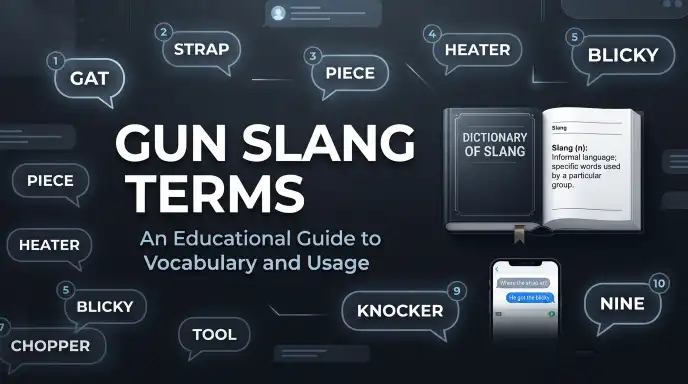
If you have seen words like gat, strap, piece, heater, or blicky in a song, movie, text, or social media post, you may wonder what they mean. These are examples of gun slang terms—informal words that can refer to a gun or firearm in certain contexts.
The tricky part is that slang does not always have one fixed meaning. A word such as burner or iron, for example, can mean something completely different when it appears in another conversation. The platform and surrounding sentence often tell you what the speaker means.
This guide breaks down common expressions in simple language. You will learn which words are used for guns, where you may encounter them, how older and newer expressions differ, and why context matters. You will also see examples that show how the same word can sound different depending on the situation.
Gun Slang Terms at a Glance
Here is a quick look at some expressions you may come across:
| Slang term | Common meaning | Typical context |
| Piece | A gun or firearm | Casual speech, fiction |
| Gat | A gun | Music, slang, older usage |
| Strap | A firearm | Modern slang, music |
| Heater | A gun | Older American slang |
| Iron | A firearm | Older slang |
| Burner | A firearm in some contexts | Crime-related slang |
| Roscoe | A gun | Older slang and fiction |
| Heat | A gun in some contexts | Music, street slang |
| Rod | A gun | Informal slang |
| Blicky | A firearm | Contemporary slang |
Not every term has the same level of popularity. Some are strongly linked with older American slang, while others are more likely to appear in contemporary music or online conversations.
Popular Words Used for Guns
Different communities and time periods have created different informal names for firearms. Some terms are still recognizable today, while others are mostly found in songs, movies, books, or older slang references.
Piece
Piece is a long-established informal word for a gun.
You may see it in crime fiction, movies, music, or casual dialogue. The word itself is not always related to firearms, so the surrounding sentence is important.
Example:
“The detective referred to the weapon as a piece.”
Here, the context makes the meaning clear.
Gat
Gat is an informal term for a gun.
It is especially associated with American slang and has appeared in hip-hop, movies, and crime-related fiction. It may sound old-school depending on who uses it and where you hear it.
Example:
“I heard the word ‘gat’ in an old rap song.”
The term is often recognized because of its long connection with popular culture.
Strap
Strap can refer to a firearm in modern slang.
You may encounter it in music, fictional dialogue, or some online communities. Because the word has a strong informal and street-slang tone, it is not a good choice for formal communication.
Example:
“The character used ‘strap’ instead of saying gun.”
Heater
Heater is an older slang expression for a firearm.
It has appeared in American crime writing and older popular culture. Today, many readers are more likely to recognize it from movies or books than from everyday conversation.
Example:
“The detective in the old movie called his firearm a heater.”
Iron
Iron has also been used as slang for a gun.
This one can be confusing because the normal meaning of iron has nothing to do with firearms. It may refer to the metal, an appliance, or something else entirely.
Example:
“The writer used ‘iron’ as an old-fashioned slang term.”
Always check the sentence before deciding what the speaker means.
Burner
Burner can refer to a firearm in some slang contexts, but it has several unrelated meanings.
For example, people may use burner when talking about a temporary phone or a cooking appliance. Because of this, the word should never be interpreted as a gun automatically.
Example:
“The crime novel used ‘burner’ when describing a firearm.”
The surrounding details make the intended meaning easier to identify.
Roscoe
Roscoe is an older slang term for a gun.
It is more likely to appear in classic crime stories, older movies, or writing that uses historical slang. It may sound unusual in modern everyday conversation.
Example:
“The detective story used ‘Roscoe’ as a nickname for the firearm.”
Heat
Heat can refer to a gun in certain slang contexts.
However, heat has many ordinary meanings. It can describe high temperature, pressure, attention, or trouble. That makes context especially important.
Example:
“The song used ‘heat’ in a way that referred to a firearm.”
Never assume the meaning from the word alone.
Rod
Rod can be used informally to refer to a gun.
The expression is less universal than the ordinary word gun, and its meaning can vary by community and context.
Example:
“The character used ‘rod’ as an informal nickname.”
Blicky
Blicky is a more contemporary slang term associated with a firearm in some communities.
It can appear in modern music and online slang discussions. Its use is more regional and culturally specific than a general English word such as gun.
Because slang changes quickly, recognition of this term may vary between age groups and regions.
Why Are There So Many Slang Words for Guns?
There is no single reason.
Slang develops through communities, music, storytelling, regional speech, and popular culture. Once an expression becomes recognizable, movies, songs, and online conversations can spread it to people outside the original community.
Some terms also come from older forms of slang and remain alive through books, films, and music even after everyday speakers stop using them often.
That means two expressions can both mean gun but feel completely different.
For example:
- Roscoe may sound old-fashioned.
- Heater may sound like older crime slang.
- Strap may sound more contemporary.
- Blicky may feel strongly tied to modern regional or music-related slang.
- Gun remains the clearest standard term.
The meaning may be similar, but the tone and cultural associations are not.
Where You Might Hear These Expressions
Gun slang does not appear equally across every platform. The setting can give you important clues about what a word means.
In Music and Lyrics
Songs, especially rap and hip-hop, are a common place where listeners encounter firearm-related slang.
Artists may use informal vocabulary as part of storytelling, character building, cultural expression, or descriptions of conflict. A listener should not assume that a slang reference automatically describes a real-life event.
In Movies and TV Shows
Crime dramas, action movies, and historical stories often use slang to make dialogue fit a character or time period.
An older movie may contain words that sound unfamiliar today. That does not necessarily mean the expression was unusual when the movie’s setting was current.
On Social Media
You may encounter these expressions in:
- TikTok comments
- Instagram captions
- Reddit discussions
- Posts about music
- Movie discussions
- Memes
- Online arguments
Social media also creates a major problem with slang: short messages remove context.
A single word can be difficult to interpret without reading the rest of the post.
In Gaming and Discord
Gaming communities use a lot of their own vocabulary.
A word related to a gun may describe an in-game weapon rather than a real firearm. Players may also use fictional weapon names, shortened terms, or game-specific slang.
For that reason, a gaming conversation should be interpreted within the game’s context.
In Text Messages
Texting makes slang easy to use but sometimes harder to understand.
There is no facial expression or voice tone to help explain the speaker’s intention. If someone uses an unfamiliar expression, looking at the surrounding messages can help reveal the meaning.
Part 1: Key Takeaway
Gun slang terms are informal expressions that may refer to guns or firearms, but their meanings and tones vary widely. Words such as piece, gat, strap, heater, iron, burner, Roscoe, heat, rod, and blicky can appear in different cultural, historical, and online settings.
The most important rule is simple: do not interpret the slang word by itself. Look at the full sentence, the platform, the speaker, and the situation before deciding what it means.
Some Gun Slang Words Have Other Meanings
One reason gun slang terms can be confusing is that many of these words have ordinary meanings too. A reader cannot always identify the intended meaning by looking at one word.
The full sentence, topic, and setting usually provide the answer.
“Guns” Can Mean Muscular Arms: Gun slang terms
The word guns does not always refer to firearms.
In casual conversation, people sometimes use guns to describe someone’s strong or muscular arms.
Example:
“He has been working on his guns at the gym.”
Here, the word has nothing to do with firearms.
“Iron” Has Several Meanings : Gun slang terms
Iron can refer to a metal, a household appliance, or a golf club. In some slang contexts, it can also refer to a firearm.
Example:
“The detective called the firearm an iron.”
The surrounding words make the slang meaning clear.
“Burner” Is Not Always a Gun
Burner can have several meanings.
It may refer to a cooking device, a temporary phone, or a firearm in certain slang contexts.
Example:
“She bought a burner phone for temporary use.”
Here, the word has nothing to do with a gun.
“Heat” Can Mean Many Things
Heat is another highly context-dependent word.
It can mean high temperature, pressure, attention, trouble, or a firearm in some slang usage.
Example:
“The team is under a lot of heat after the mistake.”
That sentence clearly does not refer to a firearm.
“Piece” Is Usually Not a Gun
The ordinary word piece has many meanings. It can describe part of something, artwork, writing, music, or an object.
Only certain contexts give it the slang meaning of a firearm.
This is why dictionary-style explanations should always show examples rather than presenting slang as if it has only one definition.
Are These Terms Offensive or Dangerous?
Most gun slang is informal rather than automatically offensive.
However, the subject itself can be serious. A word that sounds harmless in a movie discussion may sound threatening when used during a real argument.
The tone can depend on:
- Who is speaking
- Who is listening
- Whether the situation is real or fictional
- The surrounding words
- The platform
- The relationship between the speakers
For example, discussing the meaning of gat while reviewing a song is very different from using slang during a real-world confrontation.
When Context Changes the Meaning
Consider this simple difference:
“What does ‘strap’ mean in this song?”
This is a language question.
Now compare it with:
“He said he had a strap.”
Without more context, that sentence can sound much more serious.
This is why readers should avoid jumping to conclusions based on slang alone.
Old vs. Modern Gun Slang
Slang has a life cycle. Some expressions become popular, some fade away, and others survive mainly through music, movies, or older books.
| More old-fashioned expressions | More contemporary expressions |
| Roscoe | Blicky |
| Heater | Strap |
| Iron | Strap in some modern contexts |
| Piece | Blicky in some communities |
| Rod | Community-specific newer terms |
This does not mean that an older expression has completely disappeared or that a newer term is used everywhere.
Slang varies by region, age group, community, and culture.
A word that sounds normal to one group may sound strange or outdated to another.
Why Do Some Slang Terms Become Dated?
Slang changes because people change the way they communicate.
Music, television, social media, local communities, and younger generations can introduce new expressions. At the same time, older terms may stop appearing in everyday speech.
Some survive because they remain popular in:
- Classic movies
- Crime novels
- Rap lyrics
- Historical fiction
- Memes
- Online slang dictionaries
This means you may understand an old expression even if you would never use it yourself.
Can You Use Gun Slang in Everyday Conversation?
Technically, people can use slang in casual conversation, but the setting matters a lot.
If you are talking with close friends about a movie or song, an informal term may be understood.
In a formal setting, standard language is usually better.
With Friends
Friends who share the same slang may understand expressions such as gat or strap without explanation.
Even then, the topic and tone should be considered.
At School
Using firearm-related slang in a classroom can create confusion, especially if a teacher hears only part of the conversation.
If you are discussing language, literature, or a song, explain the term clearly rather than assuming everyone knows it.
At Work
Informal firearm slang is generally a poor choice in professional communication.
Words such as gun or firearm are clearer and more neutral.
With Parents or Teachers
If you are explaining something you saw online, it is better to say exactly what you mean.
For example:
“I saw the word ‘gat’ in a song. What does it mean?”
That makes it clear that you are asking about vocabulary rather than making a statement about a real firearm.
When Is It Better to Say “Gun” or “Firearm”?
In many situations, the standard word is simply clearer.
Use gun when you want a common, everyday term.
Use firearm when you need a more formal or precise term.
This is especially useful in:
- School assignments
- News writing
- Workplace communication
- Educational content
- Official documents
- Safety discussions
- Research
Slang can add cultural flavor, but it can also create ambiguity.
For example:
Informal:
“What does ‘gat’ mean?”
Clear and standard:
“What does this slang word for a firearm mean?”
The second version is easier for a general audience to understand.
Examples in Different Contexts
Seeing a word in a realistic setting is often the easiest way to understand it.
Text Message
A: “I heard ‘piece’ in that movie. What does it mean?”
B: “In that scene, it means a gun.”
The conversation is clearly about understanding movie dialogue.
Music Discussion
“The rapper uses several old slang words for firearms in the lyrics.”
Here, the language is being discussed rather than used as a direct statement.
Movie Discussion
“The character called his gun a heater.”
The word heater is being explained through fictional dialogue.
Gaming
“That game has several slang names for its weapons.”
In this context, the words may refer entirely to fictional objects inside the game.
Social Media
“I keep seeing ‘blicky’ in comments. What does it mean?”
This is a question about modern slang and its meaning.
School
“Our class is studying slang in popular music.”
This gives the reader a clear educational context.
Common Mistakes When Reading Gun Slang
Understanding slang requires more than memorizing definitions.
Mistake 1: Assuming Every Word Has One Meaning
A word such as burner can mean different things in different situations.
Always read the complete sentence.
Mistake 2: Treating Old Slang as Modern Slang
A term appearing in an old crime movie may not be common in everyday speech today.
The date and setting can matter.
Mistake 3: Assuming Everyone Uses the Same Slang
Slang varies between communities.
A term may be familiar in one region or music scene but unknown somewhere else.
Mistake 4: Ignoring Cultural Context
Some expressions are strongly connected to particular music scenes, communities, or regional varieties of speech.
Understanding that background can help explain why a particular word appears in a conversation.
Mistake 5: Taking Fiction Literally
Movies, songs, books, and games use language for storytelling.
A fictional character using a slang term does not tell you how every real person speaks.
Why Context Matters More Than the Slang Word
When you see an unfamiliar expression, ask three simple questions:
- Where did I see it?
- What was the person talking about?
- What words appeared around it?
These clues can often reveal the intended meaning.
For example, if you see burner in a discussion about smartphones, it may refer to a temporary phone. If the same word appears in an older crime story, it may have a different meaning.
The same principle applies to heat, iron, piece, and guns.
When Should You Avoid Using These Terms?
Avoid firearm-related slang when the meaning could easily be misunderstood.
This is especially important in:
- Workplace chats
- School messages
- Formal emails
- Public posts about real-world incidents
- Conversations with people who may not know the slang
- Situations involving actual safety concerns
If you need to communicate clearly, use gun or firearm instead.
Clear language reduces confusion.
Polite and Clear Alternatives :Gun slang terms
There is no need to use slang when a standard word works better.
Instead of “gat”
Say gun or firearm.
Instead of “piece”
Say gun when referring to the object generally.
Instead of “heater”
Say firearm in formal writing.
Instead of “strap”
Say gun if you simply want the listener to understand what you mean.
These alternatives are easier for a wider audience and usually sound more neutral.
Part 2: Key Takeaway :Gun slang terms
Understanding gun slang terms is mainly about context. Words such as guns, iron, burner, heat, and piece can have completely different meanings outside firearm-related conversations.
Older expressions may also sound different from modern slang, and a word that is familiar in one community may be unfamiliar in another.
If you are simply trying to understand something you read or heard, look at the sentence, platform, speaker, and situation before deciding what the slang means.
Gun Slang Terms in Different Situations
The meaning of a slang word becomes much easier to understand when you know where it appears. A term used in a song may have a different tone from the same term in a movie, game, or casual conversation.
Here is a simple comparison:
| Situation | What to expect | Best approach |
| Music | Cultural or artistic slang | Look at the lyrics and context |
| Movies | Character or period-specific language | Consider the setting |
| Gaming | Often fictional weapon language | Check the game context |
| Social media | Short, changing slang | Read surrounding comments |
| Texting | Informal personal language | Ask if the meaning is unclear |
| School | Educational discussion | Use clear explanations |
| Workplace | Formal communication | Prefer standard terms |
This is why memorizing a list of slang words is not enough. You also need to understand how the word is being used.
Gun Slang Terms in Music and Popular Culture
Music has played an important role in spreading slang.
Listeners may encounter words such as gat, strap, piece, heat, or blicky while listening to songs. These expressions can be part of storytelling, character development, cultural references, or descriptions of fictional situations.
However, hearing a term in a song does not mean that the word is common in everyday speech.
A song can also preserve older slang that younger speakers rarely use.
Why Lyrics Can Be Difficult to Understand
Lyrics often contain:
- Shortened expressions
- Regional slang
- Cultural references
- Metaphors
- Older vocabulary
- Words with multiple meanings
So, if a slang term appears in a song, read the surrounding lyrics before deciding what it means.
Gun Slang Terms in Movies and TV
Crime dramas and action movies frequently use informal language for realism.
A character may say piece, heater, or another slang term because the writer wants the dialogue to fit that character’s background or the time period.
Older films can be especially useful for learning dated slang.
For example, a word that sounds unusual today may have been recognizable to audiences when the movie was released.
This is one reason slang dictionaries should explain age and context, not just provide a one-word definition.
Gun Slang Terms in Gaming
Gaming creates another layer of confusion.
Players may use firearm-related slang while talking about fictional weapons. The conversation may have nothing to do with real-world firearms.
For example, a player might discuss:
- A weapon in a game
- A character’s equipment
- A fictional battle
- A game strategy
- A weapon nickname
The correct interpretation depends on the game and the conversation.
A reader should not automatically transfer a gaming meaning into a real-world conversation.
Gun Slang Terms on TikTok, Instagram, and Reddit
Social platforms change slang quickly.
A word can become popular through:
- Music clips
- Memes
- Viral videos
- Comment sections
- Creator communities
- Online trends
But popularity on one platform does not mean that everyone uses the word.
A term may also become outdated quickly. Something that feels current in one year can sound forced or dated later.
For readers trying to understand a post, the safest method is to examine the entire conversation rather than focusing on one slang word.
Are Gun Slang Terms Appropriate at Work?
Usually, no.
Professional communication should favor clear and neutral language.
Instead of using a slang nickname, use gun or firearm when the subject genuinely needs to be discussed.
This applies to:
- Emails
- Reports
- Workplace chats
- Presentations
- Official documents
- Customer communication
Slang can create unnecessary ambiguity, especially when the subject is sensitive.
Can You Use These Terms at School?
It depends on the purpose.
If you are studying slang, literature, music, or popular culture, discussing these expressions can be completely appropriate.
For example:
“The author uses the slang term ‘Roscoe’ to reflect the language of the period.”
That is an educational use.
However, using firearm slang casually in a classroom can easily be misunderstood. When discussing the topic, explain the meaning instead of assuming everyone knows it.
How to Understand an Unfamiliar Gun Slang Term
If you encounter a word you do not recognize, use this simple process.
Step 1: Read the Whole Sentence
Do not judge the meaning from one word.
Step 2: Look at the Topic
Is the person discussing a song, movie, game, real-world event, or something completely different?
Step 3: Check the Platform
TikTok, Reddit, Discord, gaming chats, and formal websites can have very different language styles.
Step 4: Consider the Speaker
Age, region, community, and cultural background can influence slang.
Step 5: Check a Reliable Reference
If the meaning is unclear, compare the word with established dictionary or language resources.
This approach is more reliable than assuming that the first definition you find applies everywhere.
Quick Comparison of Common Terms: Gun slang terms
| Term | Basic slang meaning | Style or context |
| Piece | Gun | Long-standing informal slang |
| Gat | Gun | American slang, music, older usage |
| Strap | Firearm | Contemporary informal usage |
| Heater | Gun | Older slang |
| Iron | Gun in some contexts | Older/context-dependent |
| Burner | Firearm in some contexts | Highly context-dependent |
| Roscoe | Gun | Dated slang |
| Heat | Firearm in some contexts | Context-dependent |
| Rod | Gun | Informal |
| Blicky | Firearm in some communities | Contemporary/regional |
These are not interchangeable in every sentence. Tone, audience, region, and time period can change how an expression feels.
Common Questions About Gun Slang Terms :Gun slang terms
Q1. What is the most common slang word for a gun?
There is no single slang word that is most common everywhere. Piece, gat, strap, and other expressions are recognized in different communities and contexts.
Q2. What does “gat” mean?
Gat is an informal slang term for a gun. It is often associated with American slang, music, and popular culture.
Q3. What does “strap” mean in slang?
Strap can refer to a firearm in some contemporary slang contexts. Its use and popularity vary by community.
Q4. What does “piece” mean in slang?
Piece can be an informal word for a gun. It also has many ordinary meanings, so context is important.
Q5. Is “heater” slang for a gun?
Yes. Heater has been used as slang for a firearm, particularly in older American slang and crime-related writing.
Q6. What does “Roscoe” mean?
Roscoe is an older slang term for a gun. It is more likely to appear in older fiction, movies, or historical-style dialogue than in everyday modern speech.
Q7. Does “burner” always mean a gun?
No. Burner has several meanings. In some slang contexts it can refer to a firearm, but it can also describe other things, including a temporary phone.
Q8. Can “guns” mean something other than firearms?
Yes. In casual speech, guns can refer to muscular arms. The surrounding conversation tells you which meaning is intended.
Q9. Are gun slang terms appropriate for professional writing?
Generally, no. Gun or firearm is clearer and more suitable for professional, academic, or official writing.
Q10. Why are some gun slang terms hard to understand?
Slang changes across time, regions, communities, and platforms. Some words also have several unrelated meanings.
What Makes a Slang Definition Reliable?
When reading a slang definition online, it helps to ask whether the explanation gives enough context.
A useful definition should tell you:
- What the word means
- Where it is commonly found
- Whether the meaning is current or dated
- Whether the word has other meanings
- What tone it carries
- Whether it is appropriate in formal communication
A one-line definition may identify a word, but it does not always explain how real people use it.
For a slang dictionary, context is just as important as the definition itself.
Conclusion
Gun slang terms are informal expressions that can refer to guns or firearms, but their meanings are shaped by context, culture, time period, and platform.
Words such as piece, gat, strap, heater, iron, burner, Roscoe, heat, rod, and blicky may appear in music, movies, gaming, social media, or casual speech. Some are old-fashioned, some are more contemporary, and some have completely different meanings outside firearm-related conversations.
If you are trying to understand a slang term, do not rely on the word alone. Check who said it, where it appeared, what the conversation is about, and how the word is being used.
For formal or professional communication, clear terms such as gun and firearm are usually the better choice.
Read More About !

Michael Brooks is a language writer at SlangPath with 7+ years of experience creating simple, practical content on English slang and everyday expressions.