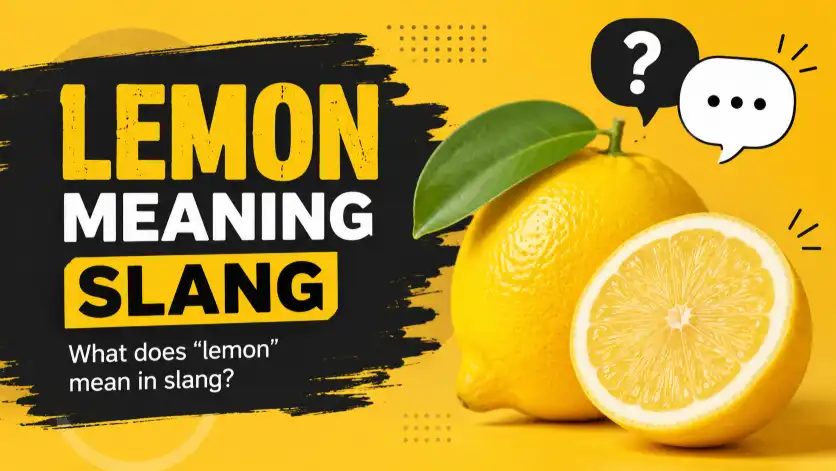
“Lemon” in slang means a person or thing that is disappointing, useless, or of poor quality.lemon meaning slang can be confusing because the word “lemon” has meanings beyond the yellow fruit.
In informal English, lemon can describe something that is defective, disappointing, unreliable, or not as good as expected. The exact meaning depends on the context in which someone uses it.
You may come across this expression in casual conversations, text messages, social media posts, online forums, product discussions, and reviews. For example, someone who buys a car that constantly breaks down might say, “I bought a lemon.”
Here, they are not talking about fruit. They are saying that the car turned out to be faulty or disappointing.
Quick Answer:lemon meaning slang
In slang, “lemon” usually describes something defective, disappointing, unreliable, or troublesome. It is especially common when talking about a bad product, vehicle, or purchase.
What Does Lemon Mean in Text?
In texting and casual conversation, lemon often refers to something that does not work properly or has turned out to be a poor choice.
For example:
“This phone is a lemon.”
The speaker means that the phone has problems or is disappointing.
Another example is:
“I think I bought a lemon.”
This usually means the person purchased something that looked fine at first but later turned out to have serious problems.
The expression is informal, so you are more likely to see it in casual conversations than in formal business or academic writing.
Common Meanings of “Lemon”
Depending on the context, lemon can describe:
- A defective product
- A troublesome vehicle
- A disappointing purchase
- Something that performs badly
- An unsuccessful or disappointing situation
- A troublesome person in some contexts
The most common slang use relates to something defective or disappointing.
Lemon Slang Meaning and Definition
A simple definition is:
Lemon: An informal word for something that is defective, unreliable, disappointing, or much worse than expected.
The word is often used when someone expected a product or purchase to work well but discovered problems afterward.
For example:
“I spent $1,000 on this laptop, and now it keeps crashing. It’s a lemon.”
The speaker is expressing disappointment because the expensive laptop is not working as expected.
What Does “Lemon” Stand For?
Unlike abbreviations such as “LOL,” “BRB,” or “IDK,” lemon does not stand for a longer phrase.
It is an ordinary English word that developed a figurative meaning through common informal usage.
So, if someone asks:
“What does lemon stand for in slang?”
the answer is that it does not have a specific full form. Instead, lemon is used figuratively to describe something defective, disappointing, or troublesome.
Why Is Something Called a Lemon?
The expression suggests that something may appear normal or attractive at first but turns out to have unexpected problems.
This idea is especially common with cars.
Imagine buying a used car that looks perfect. After a few days, you discover that the engine has problems, the brakes need repairs, and the car keeps breaking down.
You might say:
“I bought a lemon.”
This short phrase communicates a lot. It tells the listener that the purchase turned out badly and that the item has significant problems.
Over time, this meaning expanded beyond cars. People can now use “lemon” for different products and purchases that fail to meet expectations.
Is “Lemon” Rude or Offensive?
Lemon is generally not a swear word or highly offensive expression.
When you use it for an object, it is usually harmless informal language.
For example:
“My old printer is a lemon.”
This is simply a casual complaint.
However, the situation can change when you use lemon to describe a person.
For example:
“He’s a lemon when it comes to fixing computers.”
This may suggest that the person is ineffective or bad at something. Depending on the relationship and tone, it can sound insulting.
Friendly Use
Friends may use the term jokingly:
“My old laptop is such a lemon!”
The speaker may simply be making fun of their unreliable laptop.
Serious Use

Someone might use it seriously when complaining about a purchase:
“The dealer sold me a lemon.”
Here, the speaker is clearly unhappy about the product.
Insulting Use
Calling a person a “lemon” can be negative:
“He’s a complete lemon at this job.”
This suggests that the person performs poorly.
Therefore, context and tone matter.
Where Is “Lemon” Commonly Used?
The slang meaning of lemon is mainly found in informal communication.
You may encounter it in:
- Text messages
- Casual conversations
- Online forums
- Social media comments
- Product reviews
- Car discussions
- Gaming communities
- Online communities
- Informal blogs
It can appear on platforms such as Reddit, Instagram, TikTok, Facebook, Discord, and other social platforms when people are discussing disappointing products or experiences.
However, the expression is not limited to social media. It has been used in informal English for a long time.
Lemon in Everyday Conversation
People often use “lemon” when they want to complain about something without giving a long explanation.
For example:
“I bought this washing machine last week, and it has already stopped working. It’s a lemon.”
Instead of explaining every problem, the speaker uses one informal word to communicate that the product is defective or disappointing.
This makes the expression useful in everyday speech.
Real-Life Examples of Lemon Slang
Example 1: A Bad Car
“I bought a used car last month, and it has broken down three times. It’s a lemon.”
Here, lemon means a defective or unreliable car.
Example 2: A Faulty Phone
“This phone is a lemon. The battery dies after an hour.”
The speaker is complaining about a phone that does not work properly.
Example 3: A Disappointing Purchase
“That expensive watch turned out to be a lemon.”
The product failed to meet the buyer’s expectations.
Example 4: A Casual Complaint
“My old computer is such a lemon, but I still use it.”
This use sounds humorous and informal.
Example 5: An Online Review
“I ordered this last week, and it stopped working almost immediately. I definitely got a lemon.”
Here, the writer is using “lemon” to describe a poor-quality product.
Example 6: Gaming Context
“This controller is a lemon. The buttons keep getting stuck.”
The term refers to faulty gaming equipment.
Lemon in a Friendly Context
“Lemon” can sound humorous when friends use it with each other.
For example:
“My ancient laptop is being a lemon again.”
The speaker is probably not making a serious complaint. They are using colorful informal language to joke about a device that keeps causing problems.
The same word can sound much harsher in a serious argument.
That is why it is useful to consider who is speaking, what they are discussing, and how the word is being used.
Lemon in an Argument
The word lemon can take on a more negative tone during an argument. When someone says that a product, vehicle, or service is a “lemon,” they are usually expressing strong disappointment.
For example:
“You knew this car was a lemon before you sold it to me.”
This sentence sounds serious because the speaker believes the seller knew about the problems.
The word can also describe a person in some informal contexts:
“He’s a lemon when it comes to fixing things.”
Here, “lemon” suggests that the person is not good at the task.
Because this use can sound insulting, it is better to use it carefully when talking about people.
Lemon in Gaming and Online Communities
In gaming conversations, lemon can describe faulty or disappointing equipment, especially when players discuss controllers, consoles, computers, or other hardware.
For example:
“I bought a new controller, but the buttons stopped working. I got a lemon.”
The meaning remains connected to the idea of something defective.
Online communities can also develop their own meanings for ordinary words. Therefore, if you see “lemon” in a gaming chat or social media post, check the surrounding conversation before deciding what the person means.
It does not automatically have one special gaming definition.
Lemon on Social Media
On platforms such as TikTok, Reddit, Instagram, Facebook, and Discord, people may use lemon casually when discussing bad purchases or disappointing experiences.
For example:
“Spent $200 on this and it broke in two days. What a lemon!”
The phrase expresses frustration in a short and conversational way.
On Reddit and other discussion platforms, users may also describe unreliable products, cars, electronics, or services as lemons when sharing personal experiences.
However, “lemon” is not exclusively internet slang. Its informal meaning existed long before modern social media.
Origin and Background of Lemon Slang
The figurative use of lemon has a long history in informal English.
The word became strongly associated with something defective or disappointing, especially a product that appears acceptable but turns out to have serious problems.
Cars played an important role in making this expression widely recognized. People began describing unreliable vehicles as lemons, which led to the familiar phrase:
“I bought a lemon.”
The meaning later expanded beyond automobiles. Today, someone can call many different products or purchases “lemons” when they turn out to be faulty or disappointing.
This explains why the word is still commonly understood even when no fruit is involved.
Lemon Meaning in Different Contexts
The meaning can change slightly depending on what the speaker is discussing.
Lemon for a Car
When talking about a car, lemon usually means a vehicle with repeated or serious problems.
“That used car was a lemon.”
Lemon for Electronics
For phones, laptops, televisions, or other devices, it can mean a defective product.
“My new laptop is a lemon.”
Lemon for Household Products
It can also describe appliances or other household items that fail to work correctly.
“The washing machine turned out to be a lemon.”
Lemon for a Person
When used for a person, it can suggest that someone is ineffective, troublesome, or poor at a particular task.
“He’s a lemon at repairing computers.”
This use is more likely to sound insulting than when the word describes an object.
Lemon vs. Similar Slang Terms
Several English words can express a similar idea, but each one has a slightly different feel.
| Term | Meaning | Typical Tone |
| Lemon | Something defective or disappointing | Informal |
| Dud | Something that fails or disappoints | Informal |
| Junk | Something of very poor quality | Negative |
| Faulty | Something that does not work correctly | Neutral |
| Bust | Something unsuccessful or useless | Casual |
| Bad buy | A purchase that was not worth the money | Casual |
Lemon vs. Dud
“Lemon” and “dud” are close in meaning.
“This car is a lemon.”
“This product is a dud.”
A lemon often suggests a product with defects or ongoing problems. A dud can describe something that simply failed to meet expectations.
Lemon vs. Junk
“Junk” usually sounds harsher.
“This phone is junk.”
The speaker is strongly criticizing the quality.
By comparison:
“This phone is a lemon.”
sounds more like a complaint about a defective or disappointing item.
Lemon vs. Faulty
“Faulty” is more formal and precise.
“The device is faulty.”
This would work well in a customer-service complaint or technical report.
“Lemon” is more conversational:
“I think I got a lemon.”
When Should You Avoid Using “Lemon”?
There is generally no problem with using lemon in casual conversation. However, you should think about the situation and audience.
Formal Writing
Avoid slang in formal reports unless there is a specific reason to include it.
Instead of:
“The machine is a lemon.”
you could write:
“The machine has repeated mechanical faults.”
The second sentence sounds more professional and precise.
Professional Communication
When speaking to a customer, manager, teacher, or business representative, clearer wording may be better.
Instead of:
“You gave me a lemon.”
you could say:
“The product appears to be defective.”
This makes the complaint sound more professional.
Talking About People
Be especially careful when calling a person a “lemon.”
The word may sound like an insult, particularly if you use it in front of others.
Polite Alternatives to Lemon
If you want to communicate the same idea without slang, you have several options.
For a Defective Product
- Defective
- Faulty
- Unreliable
- Poorly made
- Not functioning properly
Fore a Disappointing Purchase
- Disappointing purchase
- Poor choice
- Not worth the price
- Below expectations
- Unsatisfactory product
For a Disappointing Experience
- Unsuccessful
- Disappointing
- Problematic
- Unsatisfactory
- Not what I expected
These alternatives are particularly useful in professional conversations.
Why Do People Use Lemon as Slang?
People use slang because it can communicate an idea quickly and naturally.
Compare these two sentences:
“This car has experienced several serious mechanical problems.”
and:
“This car is a lemon.”
The first sentence gives more technical information. The second is shorter and more conversational.
Slang also adds emotion. When someone says, “I bought a lemon,” the listener can usually understand that the person feels disappointed or frustrated.
This makes the expression useful in everyday conversations.
Impact of Using Lemon in Communication
The word lemon can make communication sound more relaxed and expressive.
Compare:
Formal:
“The product has several defects.”
Informal:
“This product is a lemon.”
Both communicate a negative opinion, but the tone is different.
The informal version sounds more conversational, while the formal version sounds more professional.
Choosing between them depends on your audience and purpose.
Is Lemon Safe for Social Media?
Yes. The common slang use of lemon is generally safe for social media.
It is not normally considered profanity or an inherently offensive word.
You can use it when talking about:
- Cars
- Electronics
- Appliances
- Purchases
- Poor-quality products
- Disappointing experiences
For example:
“This laptop turned out to be a lemon.”
is generally harmless.
However, using “lemon” as an insult toward a person can still offend someone, even though the word itself is not a swear word.
Different Tones of Lemon
The same slang term can communicate different emotions depending on the situation.
Friendly Tone
“My old car is a lemon, but I still love it.”
This sounds humorous and affectionate.
Casual Tone
“That phone is a lemon.”
This is a simple informal complaint.
Argumentative Tone
“You sold me a lemon and never mentioned the problems.”
This sounds angry and confrontational.
Gaming Tone
“This controller is a lemon. The buttons don’t work.”
This describes faulty gaming equipment.
Social Media Tone
“Two days after buying it, the thing broke. What a lemon!”
This communicates frustration in a casual online style.
Can Lemon Have Other Meanings?
Yes. The word lemon has many meanings outside slang.
It can literally refer to the fruit. It can also appear in recipes, product names, expressions, titles, and specialized communities.
Some online communities may use the word in niche ways that differ from its common slang meaning.
For this reason, you should always consider the context.
If someone says:
“I need a lemon for my drink.”
they almost certainly mean the fruit.
But if someone says:
“I bought a lemon.”
they may be saying that they purchased something defective or disappointing.
The surrounding words usually reveal the intended meaning.
Real-Life Examples of “Lemon” in Different Situations
Understanding slang becomes easier when you see how people use it naturally. The meaning of lemon can remain similar while the tone changes depending on the situation.
Friendly Example
“My old laptop is such a lemon, but I can’t replace it yet.”
This sounds lighthearted. The speaker is complaining about the laptop but is not necessarily angry.
Casual Example
“I think this printer is a lemon.”
Here, the speaker casually suggests that the printer is faulty or unreliable.
Serious Example
“The dealership sold me a lemon, and now I’m dealing with expensive repairs.”
This sounds more serious because the speaker is describing a real financial problem.
Argumentative Example
“You knew that car was a lemon before you sold it.”
Here, the word carries a strong negative tone because the speaker is accusing someone of selling a defective vehicle.
Gaming Example
“My new controller is a lemon. The buttons keep getting stuck.”
In this context, “lemon” means faulty gaming equipment.
Social Media Example
“Bought this yesterday and already had to return it. What a lemon!”
This is a casual way to express disappointment online.
Why Context Matters
One of the most important things to remember about slang is that context determines meaning.
Consider this sentence:
“That car is a lemon.”
The meaning is fairly clear because “car” gives you useful context.
Now consider:
“He is a lemon.”
This could mean that the person is considered ineffective or troublesome, but the exact meaning depends on the conversation.
The word can therefore change from a simple description of a defective object to a negative comment about a person.
When reading slang online, look at the words before and after the slang term. Also consider who wrote it, who they were talking to, and what topic they were discussing.
How to Respond When Someone Calls Something a Lemon
If someone says:
“This phone is a lemon.”
they are probably expressing dissatisfaction.
A natural response could be:
“What happened to it?”
or:
“Is it not working properly?”
If they say:
“I bought a lemon.”
you might respond:
“What’s wrong with it?”
This shows that you understand they are probably talking about a disappointing or defective purchase.
Is “Lemon” the Same as “Bad”?
Not exactly.
“Bad” is a very broad word. It can describe almost anything negative.
“Lemon” is more specific. In its common slang use, it often suggests that something is defective, unreliable, or disappointing after being purchased or used.
For example:
“This car is bad.”
This could mean the car is ugly, slow, uncomfortable, expensive, or poorly designed.
But:
“This car is a lemon.”
strongly suggests that the car has serious problems or does not work as it should.
So, while both words can express negativity, “lemon” gives the listener more information about the type of problem.
Is “Lemon” the Same as “Broken”?
Not always.
Something that is broken may have stopped working completely.
A lemon, however, does not necessarily have to be completely broken. It may still work but have repeated problems, poor performance, or serious defects.
For example:
“The car still runs, but it’s a lemon.”
This suggests that the vehicle works to some degree but has enough problems to make it a disappointing purchase.
Lemon vs. Disappointing
“Disappointing” focuses on the person’s expectations.
For example:
“The movie was disappointing.”
This means the movie was not as good as the person expected.
“Lemon” is more commonly connected with products or things that have problems.
“The washing machine is a lemon.”
This suggests that the washing machine is defective or unreliable.
Therefore, the two words overlap but are not perfect substitutes.
Common Phrases With Lemon
Several expressions use the word lemon in informal English.
“I bought a lemon.”
This means the speaker bought something that turned out to be defective or problematic.
“It’s a lemon.”
This means the thing being discussed is faulty, unreliable, or disappointing.
“What a lemon!”
This expresses frustration or surprise about something that performs badly.
“That car is a lemon.”
This commonly refers to a vehicle with serious or repeated problems.
These phrases are generally informal and work best in casual conversations.
Common Mistakes When Using Lemon Slang
People sometimes misunderstand slang because they focus on the literal meaning of the word.
Mistake 1: Assuming It Always Means the Fruit
If someone says:
“My car is a lemon.”
they are not talking about food.
The context tells you that “lemon” is being used figuratively.
Mistake 2: Treating It as an Acronym
“Lemon” is not an acronym like “LOL” or “OMG.”
It does not have a standard texting full form.
Mistake 3: Using It in Every Negative Situation
Not every bad thing should automatically be called a lemon.
The term works best when something is defective, unreliable, or unexpectedly disappointing.
Mistake 4: Using It as an Insult
Calling a person a “lemon” can sound rude.
If you want to remain respectful, describe the specific problem instead.
For example:
“He needs more experience with computers.”
is more polite than:
“He is a lemon with computers.”
Is Lemon Appropriate for Formal Writing?
Generally, no.
Formal writing usually requires precise and professional vocabulary.
Instead of:
“The machine is a lemon.”
you could write:
“The machine has several mechanical defects.”
Instead of:
“We received a lemon.”
you could write:
“The product we received appears to be defective.”
The formal alternatives communicate the same basic idea without relying on slang.
Lemon Meaning Slang: Quick Comparison
| Expression | Meaning | Example |
| A lemon | A defective or disappointing thing | “This car is a lemon.” |
| A dud | Something that fails or disappoints | “The product was a dud.” |
| Junk | Something considered very poor quality | “This device is junk.” |
| Faulty | Something that does not work correctly | “The machine is faulty.” |
| Bad buy | Something that was a poor purchase | “That was a bad buy.” |
The best choice depends on the situation and the tone you want.
FAQs About Lemon Meaning Slang
Q.1 What does lemon mean in slang?
Lemon usually means something defective, unreliable, disappointing, or troublesome. It is especially common when talking about products, vehicles, or purchases.
Q.2 What does lemon mean in text?
In text messages, “lemon” generally has the same informal meaning. Someone may use it to say that an item or purchase has turned out badly.
Q.3 What does “I bought a lemon” mean?
It usually means “I bought something that turned out to be defective or problematic.” The phrase is especially common when talking about cars.
Q.4 Is lemon a bad word?
No. “Lemon” is not normally considered a swear word. However, calling a person a lemon can sound insulting depending on the context.
Q.5 Is lemon slang used on TikTok and Reddit?
It can appear on social media and online forums, especially when users discuss disappointing products, cars, purchases, or experiences. However, the expression is older than modern social media.
Q.6 Does lemon have a full form in texting?
No. Lemon does not have a standard full form. It is a regular English word that also has an informal figurative meaning.
Conclusion
The slang meaning of lemon usually refers to something that is defective, unreliable, disappointing, or troublesome. You may hear it when people discuss cars, electronics, appliances, purchases, or other things that fail to meet expectations.
The phrase “I bought a lemon” is one of the most common examples and usually means that someone purchased something that turned out to have serious problems.
Although “lemon” is generally harmless slang, context matters. It can sound humorous when used among friends but more insulting when directed at a person. For formal communication, words such as faulty, defective, unreliable, or disappointing are usually better choices.
Understanding the context will help you recognize whether “lemon” refers to the fruit or its informal meaning—and will help you use the expression naturally and appropriately.
Read More About !

Michael Brooks is a language writer at SlangPath with 7+ years of experience creating simple, practical content on English slang and everyday expressions.