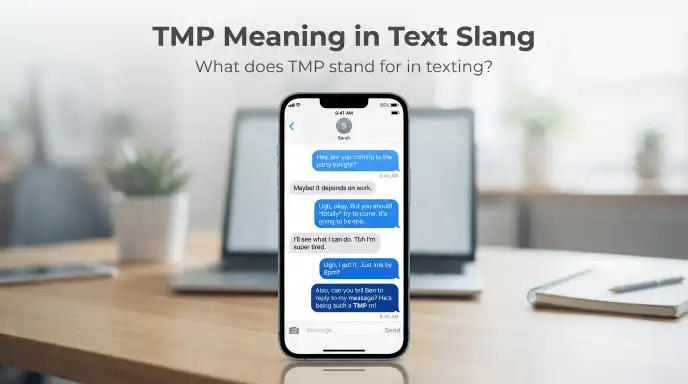
TMP in text slang is a short abbreviation that can mean “tomorrow” in some casual conversations, depending on the context.
When someone types “TMP” in a text, chat, or social media message, it can be confusing if you do not know the context. Short forms like TMP are common because people often want to type quickly without writing a full phrase.
The good news is that TMP can have different meanings, depending on the conversation. In many casual online conversations, people use it as an abbreviation rather than as a traditional slang word. The surrounding words usually give you the best clue about what the sender means.
What Does TMP Mean in Text?
TMP meaning in text slang can vary by context. One possible meaning is “Tomorrow,” especially in informal messages where people shorten words to save time. However, TMP may also represent other phrases in different communities, workplaces, games, or online spaces.
For example:
“I’ll send it tmp.”
Here, the sender may be using TMP as a shortened form of “tomorrow.”
Another person might use TMP for a completely different phrase. That is why you should not automatically assume that every “TMP” has the same meaning.
TMP as “Tomorrow”
One casual interpretation of TMP is “tomorrow.” This type of shortening fits the quick style people often use when texting friends or sending short messages.
Instead of typing:
“I will call you tomorrow.”
Someone might write:
“I’ll call you tmp.”
This use is informal. You are more likely to see shortened forms like this in quick chats than in formal writing.
Why Do People Shorten “Tomorrow”?
Texting is built around speed. People often remove letters, shorten words, or use abbreviations when they believe the other person will understand the message.
The goal is simple: say more with fewer characters.
This is especially common in:
- Casual texting
- Group chats
- Gaming conversations
- Social media messages
- Quick conversations between friends
Still, TMP is not a universal replacement for “tomorrow.” Context matters.
How to Understand TMP From Context
The easiest way to figure out what TMP means is to read the complete message.
Look at the words before and after TMP. Ask yourself what interpretation makes the sentence sound natural.
For example:
“Can you finish this tmp?”
If the conversation is about a deadline, TMP could possibly refer to tomorrow.
But consider:
“The TMP file is missing.”
Here, the meaning is probably related to a file or technical term rather than texting slang.
This shows why searching for one fixed definition can sometimes lead to the wrong answer.
TMP Meaning Can Change by Conversation
Slang and abbreviations are highly dependent on the group using them. A term that means one thing in a text conversation may have another meaning in gaming, technology, school, or work.
For instance, someone discussing computers might use TMP as part of a technical term. Someone chatting with a friend may use the same three letters as a casual abbreviation.
That difference is important.
In Casual Messages
TMP may appear as a quick abbreviation for a time-related word such as “tomorrow.”
Example:
“I’ll give you the details tmp.”
In Technical Conversations
TMP can also appear in technology-related language. In that setting, it may have nothing to do with slang.
Example:
“Check the tmp folder before deleting anything.”
The surrounding topic gives you the strongest clue.
Is TMP a Slang Word or an Abbreviation?
It is more accurate to think of TMP as an abbreviation that can be used informally, rather than treating it as one fixed slang word.
Slang usually carries a particular social or cultural meaning. Abbreviations, on the other hand, often shorten longer words or phrases.
TMP can fall into either category depending on how someone uses it.
This is why the same three letters can feel confusing to different readers.
Examples of TMP in Texting
Here are some simple examples showing how TMP might appear in casual messages:
Example 1:
“I’ll talk to you tmp.”
Example 2:
“Can we finish this tmp?”
Example 3:
“Send me the picture tmp.”
Example 4:
“Don’t forget about our plan tmp.”
In each example, the surrounding conversation would help determine whether TMP is actually being used to mean “tomorrow” or something else.
Why Context Matters With Short Texting Terms
Three-letter abbreviations can be especially tricky because they contain very little information on their own.
If someone sends:
“TMP”
you may have no way to know what they mean.
But if they write:
“I’ll send the document tmp.”
the context gives you a much stronger clue.
This is a useful rule for understanding internet language:
Never interpret an unfamiliar abbreviation by the letters alone. Read the whole message first.
TMP in Different Online Spaces
The meaning of TMP can shift depending on where you see it.
A person sending a private message may use it casually. A gamer may use TMP as part of a game-related expression. Someone working with computers may use TMP in a technical sense.
Text Messages
In personal texting, short forms are often created for convenience. TMP may be used as a quick shorthand when the sender expects the reader to understand the intended meaning.
Social Media
On social platforms, abbreviations help people keep captions, comments, and messages short. However, TMP is not necessarily understood by everyone.
Gaming Chats
Gaming communities use many abbreviations. If TMP appears during a game discussion, check the topic before assuming it means “tomorrow.”
Work or School Chats
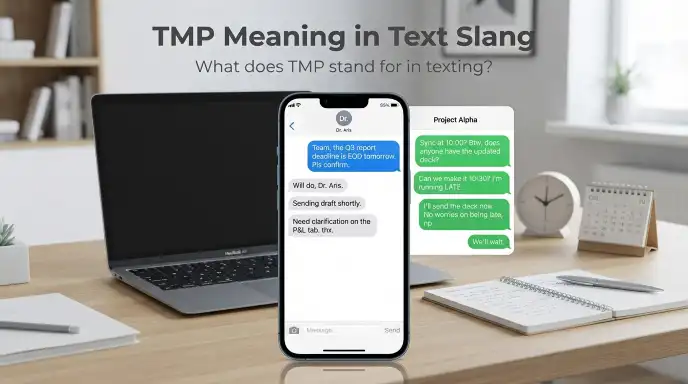
Be more careful in professional or academic conversations. If the meaning is unclear, writing the complete word or phrase is usually better than relying on an uncommon abbreviation.
TMP vs. Tomorrow
If TMP is being used to mean “tomorrow,” the main difference is formality.
| Form | Style |
| Tomorrow | Standard and clear |
| TMP | Short and informal |
| Tomorrow? | Casual but easy to understand |
| TMP? | Very brief and context-dependent |
For a formal email, assignment, report, or professional message, “tomorrow” is the safer choice.
For a quick conversation with someone who already understands your texting style, an abbreviation may be acceptable.
When Should You Use TMP?
If you know the person understands the abbreviation, using TMP can make a casual message shorter.
For example:
“I’ll see you tmp.”
But if you are speaking with someone unfamiliar with texting abbreviations, it is better to write the full word.
Clear communication is more important than saving a few characters.
When You Should Avoid TMP
Avoid unclear abbreviations when the message has important information.
This includes:
- Formal emails
- School assignments
- Business communication
- Official documents
- Instructions
- Messages involving deadlines
If there is any chance the reader could misunderstand you, write the complete word instead.
A Simple Way to Remember TMP
Think of TMP as a context-based abbreviation rather than a word with only one definition.
If you see it in a casual conversation about plans, dates, or the next day, a time-related meaning such as “tomorrow” may make sense.
If you see it beside words connected to computers, files, software, or another specialized topic, it may have a completely different meaning.
The sentence around TMP is often more important than the abbreviation itself.
Quick Takeaway
TMP meaning in text slang depends on context. In some informal conversations, it may be used as a shortened form of “tomorrow.” However, TMP can also represent technical or community-specific terms.
Before replying, look at the full message and the topic of the conversation. If the meaning still seems unclear, asking the sender what they mean is better than guessing.
Not every use of TMP is about the same thing. Once you move beyond a basic texting conversation, the abbreviation can take on different meanings. This is especially true when people use short forms in online communities, technical discussions, games, or private group chats.
The safest approach is to look at who is using TMP, where they are using it, and what the conversation is about.
Does TMP Always Mean “Tomorrow”?
No. TMP does not have one universal meaning in every text or online conversation.
If someone uses TMP while discussing plans for the next day, you may understand it as “tomorrow.” But if the conversation is about software, documents, gaming, or another specific subject, the letters may stand for something completely different.
For example:
“I need to finish this tmp.”
This sentence alone does not give enough information.
Compare it with:
“I’ll finish the assignment tmp.”
The second sentence gives a clearer time-related context.
This is why abbreviations should always be interpreted alongside the rest of the message.
TMP in Casual Chat
People often shorten words when talking with friends because casual conversations do not require formal language.
A person may leave out letters, use initials, or create their own shortcuts. If everyone in the conversation understands the shortcut, there is no need to explain it every time.
For example:
“Are we meeting tmp?”
If the conversation is already about scheduling, the intended meaning may become obvious to the other person.
Another person who joins the conversation later, however, might not understand TMP at all.
Why Friends Understand Short Forms Easily
Close friends often develop their own communication habits. They may use abbreviations that are not common outside their group.
That means a term can feel completely normal to one group and confusing to another.
This happens frequently in:
- Friend groups
- Family chats
- Gaming teams
- Online communities
- School groups
- Private social media conversations
TMP and Internet Communication
Internet communication has made abbreviations extremely common.
People send messages while multitasking, chatting quickly, playing games, commenting on posts, or using mobile phones. Short forms can make communication faster.
However, not every abbreviation becomes widely recognized.
Some terms become popular across the internet, while others remain limited to a particular group.
TMP may belong to the second category depending on how it is being used.
That is why it is risky to assume that everyone who sees TMP will understand the same definition.
How to Reply When Someone Uses TMP
If you understand the context, you can simply respond normally.
For example, if someone says:
“I’ll send it tmp.”
and the conversation is clearly about tomorrow, you can answer:
“Okay, sounds good.”
But what if you are unsure?
There is nothing wrong with asking.
You could say:
“What do you mean by TMP?”
Or:
“Does TMP mean tomorrow here?”
A short clarification can prevent a misunderstanding.
TMP in a Sentence
Seeing an abbreviation inside a complete sentence can make its meaning easier to identify.
Consider these examples:
“Can you call me tmp?”
If the discussion involves future plans, TMP may refer to tomorrow.
“The tmp folder contains old files.”
Here, the technical context points toward a computing-related meaning.
“Our group uses TMP for this.”
This could refer to an abbreviation created by that particular group.
The same three letters can therefore lead to different interpretations.
What Does TMP Mean on Social Media?
On social media, TMP may appear as an informal abbreviation, but its meaning is not automatically fixed.
People use shortened language in comments, captions, direct messages, and group conversations. Some abbreviations are widely recognized, while others depend heavily on the community.
If you encounter TMP in a TikTok comment, Instagram message, Discord chat, or another online space, check the surrounding conversation before deciding what it means.
The platform alone does not determine the definition.
TMP in Group Chats
Group chats are one of the places where unusual abbreviations can spread quickly.
Imagine five friends regularly discussing their schedules. If one person starts using TMP as shorthand for “tomorrow,” the rest of the group may understand it without explanation.
Eventually, TMP becomes part of their shared communication style.
A new member might see:
“Let’s do it tmp.”
and wonder what the abbreviation means.
This shows an important feature of slang and texting language: meaning can develop inside a community.
Is TMP Common in Texting?
TMP is not as universally recognized as some extremely common texting abbreviations.
Many people may understand very popular forms such as “LOL,” “BRB,” or “IDK” immediately. TMP can require more context.
That does not make it meaningless. It simply means that the reader should not assume one definition without checking the conversation.
If you are writing for a broad audience, using a clearer word is usually better.
TMP and Formal English
Text abbreviations belong mainly to informal communication.
You would normally avoid writing TMP in:
- Academic essays
- Job applications
- Formal reports
- Business proposals
- Professional emails
- Official notices
For example, instead of:
“I will submit it tmp.”
a formal message would be clearer as:
“I will submit it tomorrow.”
The second version removes uncertainty and sounds more professional.
Can TMP Be Used With Friends?
Yes, if everyone involved understands what you mean.
Casual communication allows more flexibility than formal writing. Friends may shorten words, remove vowels, use initials, or create personalized expressions.
For example:
“See you tmp!”
could work perfectly well between people who already use TMP in that way.
But if you send the same message to someone unfamiliar with your abbreviation, they may need clarification.
TMP vs. Other Text Abbreviations
TMP belongs to a much larger world of shortened online language.
People regularly use abbreviations to communicate quickly.
Examples include:
- IDK — I don’t know
- BTW — by the way
- TBH — to be honest
- IMO — in my opinion
- BRB — be right back
- FYI — for your information
Unlike some of these widely recognized abbreviations, TMP can be more dependent on context.
That difference is worth remembering when interpreting a message.
Why Abbreviations Can Cause Confusion
Short forms save time, but they can also create misunderstandings.
Imagine receiving this message:
“I’ll do it tmp.”
If you do not know what TMP means, you might delay your response or misunderstand the deadline.
Now imagine the message says:
“I’ll do it tomorrow.”
There is almost no confusion.
This is why good communication is not simply about being brief. It is about being clear enough for the other person to understand you.
TMP in Different Age Groups
People of different ages may use texting language differently.
Younger internet users often encounter abbreviations through social media, gaming, memes, and online communities. Older users may prefer complete words, especially in professional or unfamiliar conversations.
Neither style is automatically wrong.
The important thing is to understand the audience.
If you are texting a close friend, an abbreviation may feel natural. If you are contacting a teacher or employer, clear standard English is usually the better choice.
What If Someone Sends Only “TMP”?
A single abbreviation can be difficult to interpret.
If someone simply messages:
“TMP”
you do not have enough context to confidently identify the intended meaning.
The best response is not to invent an answer.
Instead, ask:
“What does TMP mean here?”
This is especially useful when the message could affect plans, deadlines, payments, instructions, or other important information.
How to Identify the Correct TMP Meaning
Use these simple clues:
1. Look at the Topic
Is the conversation about plans, computers, games, school, or something else?
2. Read the Entire Sentence
The surrounding words may reveal what TMP represents.
3. Consider the Sender
A friend may use casual shorthand differently from a coworker or technical expert.
4. Check Previous Messages
Earlier messages can provide the missing context.
5. Ask If Necessary
If you still cannot understand it, clarification is the safest option.
Common Mistakes People Make With TMP
One common mistake is assuming that every abbreviation has one fixed definition.
Another mistake is treating an informal abbreviation as suitable for every situation.
A third mistake is ignoring context.
For example, someone may see TMP online and immediately decide that it means “tomorrow.” That interpretation might work in one message but fail completely in another.
A better habit is to treat the abbreviation as a clue, not a complete answer.
Should You Use TMP in Your Own Messages?
You can use TMP in casual communication if your audience understands it.
However, if you are unsure whether the other person knows the abbreviation, writing the complete word is safer.
Instead of:
“I’ll call you tmp.”
you can simply write:
“I’ll call you tomorrow.”
The second version is only slightly longer but much easier for everyone to understand.
The Bottom Line
TMP is a context-dependent abbreviation. In some casual text conversations, it may be used as a shortened form of “tomorrow,” while in technical or community-specific settings it can have another meaning.
The surrounding words, topic, and relationship between the people chatting all help reveal the intended definition.
If the meaning is uncertain, do not guess. A quick question can save an entire conversation from confusion.
Understanding a short texting term is not only about knowing what the letters stand for. You also need to know when people use the term, how it sounds in a conversation, and whether it fits the situation.
TMP is a good example because its meaning can change depending on the subject and the people involved. In a casual message, it may be intended as a quick abbreviation for “tomorrow.” In another setting, it may refer to something completely different.
The examples and questions below make the meaning easier to understand.
Real-Life TMP Text Examples
Seeing TMP in complete messages can help you recognize how context affects its interpretation.
Example 1: Making Plans
Text:
“Are you free tmp?”
Possible meaning:
The sender may be asking whether you are free tomorrow.
Example 2: Sending Something Later
Text:
“I’ll send the photos tmp.”
Possible meaning:
The sender may mean that the photos will be sent tomorrow.
Example 3: Discussing a Deadline
Text:
“Can we finish this tmp?”
Possible meaning:
If the conversation is about a deadline, TMP may refer to tomorrow.
Example 4: Casual Reminder
Text:
“Don’t forget our meeting tmp.”
Possible meaning:
The sender may be referring to a meeting planned for tomorrow.
These examples show why the surrounding message matters.
When TMP Does Not Mean Tomorrow
It is important not to force the “tomorrow” meaning into every conversation.
Consider this sentence:
“Delete the tmp files.”
Here, the word is connected to computing rather than a casual texting abbreviation.
Another example is:
“The TMP setting needs to be changed.”
The correct meaning would depend on the subject being discussed.
This is why TMP should always be interpreted according to context.
TMP in Informal Conversations
Informal conversations give people more freedom to experiment with language.
Friends may shorten words simply because everyone in the group understands them. They may also develop abbreviations that are not commonly used outside their circle.
TMP can work in this type of conversation when the meaning is already clear to the participants.
For example:
“See you tmp!”
A friend who regularly uses the abbreviation may understand it immediately.
A stranger might not.
Is TMP Appropriate for Everyone?
Not necessarily.
Before using an abbreviation, think about the person receiving your message.
If you are chatting with:
- A close friend
- A sibling
- A familiar group
- An online friend
- A gaming teammate
an informal abbreviation may be fine.
If you are communicating with:
- A teacher
- A manager
- A client
- A customer
- A professional organization
using the full word is usually a better choice.
Clear language makes communication easier and avoids unnecessary questions.
TMP in Professional Communication
Professional writing usually favors clarity over speed.
If you need to tell a coworker about something happening the next day, writing “tomorrow” is much clearer than using an abbreviation that the person may not recognize.
For example:
Less clear:
“I’ll complete it tmp.”
Clearer:
“I’ll complete it tomorrow.”
The second sentence leaves less room for misunderstanding.
TMP in School Conversations
Students often use abbreviations when chatting with classmates.
A student might write:
“Can you send the notes tmp?”
If the group already uses TMP to mean tomorrow, everyone may understand the message.
However, the same abbreviation should not normally appear in a formal school assignment.
Instead of using texting language in an essay, use standard English.
How TMP Fits Into Modern Slang
Modern slang changes quickly.
New abbreviations can appear through social media, gaming communities, memes, private groups, and online conversations. Some become widely recognized, while others disappear after a short time.
TMP demonstrates why internet language cannot always be treated like a traditional dictionary.
A term may have:
- A general meaning
- A community-specific meaning
- A technical meaning
- A personal or group meaning
The situation determines which interpretation makes sense.
TMP and Texting Etiquette
Good texting is not only about being fast. It is also about making your meaning easy to understand.
If you know your recipient understands TMP, there may be no problem using it.
If you suspect they may be confused, use the full word.
This small choice can make a big difference when the message contains important information.
A Good Rule to Follow
Use abbreviations when they improve convenience, not when they reduce clarity.
That rule works for TMP and almost every other texting abbreviation.
How to Ask About TMP Politely
If someone sends TMP and you do not understand it, you do not need to feel embarrassed.
You can ask naturally:
“What does TMP mean here?”
Or:
“Do you mean tomorrow by TMP?”
Another simple option is:
“Sorry, what does TMP stand for?”
These questions are direct and polite.
TMP Meaning in Text: Key Points
Here are the main things to remember:
- TMP can have more than one meaning.
- In some casual conversations, it may be used for “tomorrow.”
- Context is essential when interpreting it.
- Technical conversations may use TMP differently.
- It is more suitable for informal communication.
- Formal writing should normally use complete words.
- A single “TMP” message may not provide enough information.
- Asking the sender is better than making an incorrect assumption.
Frequently Asked Questions About TMP
Q.1 What does TMP mean in text slang?
TMP can have different meanings depending on the conversation. In some informal texting contexts, it may be used as a shortened form of “tomorrow.”
Q.2 Is TMP a common texting abbreviation?
TMP is not universally understood in the same way as many very common texting abbreviations. Its meaning often depends on context.
Q.3 Does TMP always mean tomorrow?
No. TMP can represent different words or phrases in different situations. The conversation should be checked before choosing a meaning.
Q.4 Can TMP mean something technical?
Yes. TMP can appear in technical and computing-related contexts where it has nothing to do with casual texting.
Q.5 Can I use TMP with my friends?
Yes, if your friends understand what you mean. Informal conversations allow more flexibility with abbreviations.
Q.6 Should I use TMP in a formal email?
It is better to avoid it in formal communication. Write the complete word or phrase so your message stays clear.
Q.7 What does TMP mean on social media?
There is no single social-media definition for TMP. Its meaning depends on the post, comment, message, and community using it.
Q.8 What should I do if I do not understand TMP?
Read the surrounding conversation first. If the meaning remains unclear, ask the sender what they mean.
Q.9 Is TMP considered slang?
TMP can function as informal shorthand in some conversations, but it is not a single fixed slang term with one universal definition.
Q.10 Why do people use TMP instead of writing the whole word?
People use short forms because they can make casual messages quicker and more convenient. The abbreviation only works well when the reader understands it.
Conclusion
TMP meaning in text slang depends heavily on context. It may be used informally to refer to “tomorrow,” but the same letters can have other meanings in technical, professional, gaming, or community-specific conversations.
When you see TMP in a message, look at the complete sentence and the subject being discussed before deciding what it means. And when you use TMP yourself, remember that clear communication matters more than saving a few keystrokes.
If your reader understands the abbreviation, it can keep a casual conversation short. If there is any doubt, simply use the full word.
Read More About !

Michael Brooks is a language writer at SlangPath with 7+ years of experience creating simple, practical content on English slang and everyday expressions.