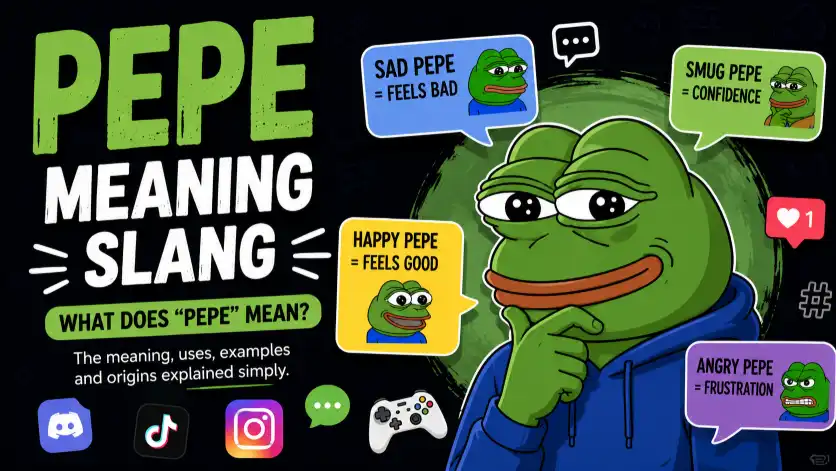
Pepe meaning slang usually refers to Pepe the Frog, an internet meme used to express different emotions, reactions, or humor online.
Pepe meaning slang can be confusing because the word “Pepe” can have different meanings depending on where you see it. In internet conversations, Pepe often refers to Pepe the Frog, a popular meme character used in reaction images, memes, GIFs, and online emotes.
People may use different Pepe images to show emotions such as sadness, happiness, frustration, excitement, or humor.
However, Pepe is not always internet slang. In Spanish-speaking communities, Pepe is also a common nickname for José. So, seeing the word by itself does not always mean that someone is talking about a meme.
If you have seen “Pepe” on social media, Discord, Reddit, gaming chats, or in a text message, the surrounding conversation can help you understand what the person means.
Quick Answer:pepe meaning slang
Pepe meaning slang usually refers to Pepe the Frog or a Pepe meme used to express an emotion or reaction online. However, “Pepe” can also simply be a Spanish nickname for José.
What Does Pepe Mean in Text?
In texting, Pepe usually refers to a Pepe meme, image, sticker, or emote when the conversation is about internet culture.
Unlike abbreviations such as “LOL” or “BRB,” Pepe does not have one fixed meaning. Instead, the specific Pepe image often tells you what the person is trying to express.
For example, someone might send a sad Pepe after saying:
“I studied for hours and still failed the test.”
In this situation, the Pepe image adds a feeling of disappointment.
Someone else might send a happy Pepe after saying:
“I finally got the new phone I wanted!”
Here, the Pepe reaction may show excitement or happiness.
So, when you see Pepe in a text, do not automatically translate it into one word. Look at the image, caption, and conversation around it.
Pepe Meaning in Slang
As internet slang, Pepe generally refers to Pepe the Frog.
Pepe the Frog is a cartoon character that became widely known through internet meme culture. Over time, people created many different versions of the character. Each version could show a different mood or reaction.
Because of this, “Pepe” can be connected with emotions such as:
- Happiness
- Sadness
- Anger
- Frustration
- Excitement
- Confusion
- Smugness
- Disappointment
- Humor
For example:
“That Pepe is literally me.”
This can mean the person strongly relates to the emotion shown by the Pepe image.
Another example is:
“Send Pepe.”
This might mean that someone wants a Pepe reaction or meme that fits the current situation.
Does Pepe Have a Full Form?
No, Pepe does not have a standard slang full form.
If you are searching for “Pepe full form” or asking “what does Pepe stand for?”, it is important to know that Pepe is not normally an acronym.
In internet culture, Pepe is the name of the famous frog character.
It is therefore different from texting abbreviations such as:
- LOL
- IDK
- BTW
- WYD
- WYA
Those terms are formed from words or phrases. Pepe is primarily a name and meme reference.
Who Is Pepe the Frog?
Pepe the Frog is a cartoon character created by artist Matt Furie. The character originally appeared in the comic series Boy’s Club.
Pepe later became popular online as people shared images of the character in different situations.
One reason Pepe became so recognizable is its wide range of expressions. Users could take the character and place it into different contexts to communicate feelings quickly.
This helped turn Pepe into more than just a comic character. It became part of internet meme language.
Today, when someone says “Pepe” in an online conversation, they may be referring to the character, a specific reaction image, or an emote based on the character.
Pepe as a Spanish Nickname
There is another important meaning of Pepe that has nothing to do with internet slang.
In Spanish, Pepe is a traditional nickname for José.
For example:
“His name is José, but everyone calls him Pepe.”
Here, Pepe is simply a person’s nickname.
This means that context is extremely important.
If you see:
“Pepe is coming to dinner.”
the person may be talking about someone named Pepe.
But if you see:
“Send me a Pepe meme 😂”
the meaning is clearly connected to internet culture.
Pepe in Social Media
Pepe can appear on many social platforms where users share memes and reaction content.
You may encounter Pepe in:
- Instagram comments
- TikTok comments
- Reddit posts
- Discord chats
- Gaming communities
- YouTube comments
- Group chats
- Meme pages
- Text messages
The exact use can vary from one community to another.
For example, a person might post a Pepe image after seeing an embarrassing video. Another person might use a different Pepe image to celebrate a gaming victory.
Therefore, the image itself often matters more than the word “Pepe.”
Pepe on Discord
Discord users often communicate through emotes, stickers, GIFs, and reaction images. Pepe is commonly associated with this style of communication.
For example:
Message:
“We lost the match in the final seconds.”
Reaction:
Sad Pepe
The reaction communicates disappointment without requiring a long reply.
Another situation might be:
Message:
“I finally beat the hardest level.”
Reaction:
Happy Pepe
Here, the image shows excitement or approval.
This is why Pepe can work almost like a visual form of slang.
Pepe in Gaming
Gaming communities use Pepe reactions for many different situations.
A gamer might use Pepe after:
- Winning a difficult match
- Losing unexpectedly
- Making a funny mistake
- Getting a rare item
- Watching an impressive play
- Failing a challenge
- Seeing an unlucky result
For example:
“I had one health point and still won.”
Someone might reply with an excited Pepe emote.
On the other hand:
“I lost after being ahead the whole game.”
A sad Pepe reaction would fit the situation.
In gaming, the meaning depends heavily on the specific Pepe expression and the event being discussed.
Key Takeaway
Pepe in slang usually refers to Pepe the Frog, a popular internet meme character used to express different emotions through images and emotes.
However, Pepe can also be a Spanish nickname for José, so context matters. If you see Pepe alongside a meme, frog image, GIF, or emote, it most likely refers to internet culture. If it appears as someone’s name, it may simply be a nickname.
Is Pepe Rude, Offensive, or Neutral?
Pepe is generally neutral. The word itself is not a rude or offensive slang term. In most online conversations, it refers to Pepe the Frog as a meme, reaction image, sticker, or emote.
For example:
“That Pepe reaction is so funny.”
Here, the use is completely casual and harmless.
However, some specific Pepe images have been used in offensive or extremist contexts. The Anti-Defamation League notes that most uses of Pepe have been non-bigoted, but some versions were appropriated for racist and antisemitic messages. Therefore, the meaning should always be judged from the actual image and surrounding context.
This means that simply seeing a Pepe image does not automatically mean that the person is expressing a hateful message.
Why Can Pepe Have Different Meanings?
Pepe became popular because internet users created many different versions of the character.
One Pepe might look:
- Happy
- Sad
- Angry
- Confused
- Smug
- Excited
- Nervous
- Disappointed
As a result, the character became a flexible reaction tool.
For example:
“I finally finished my assignment.”
Happy Pepe
The image can show satisfaction.
Another example:
“The website crashed right before I submitted it.”
Sad Pepe
Here, the image expresses frustration or disappointment.
So, Pepe does not represent one specific emotion. The particular version determines the message.
Different Pepe Meanings
Sad Pepe
Sad Pepe is commonly associated with disappointment, loneliness, failure, or feeling down.
Example:
“I waited all week and the event got canceled.”
Sad Pepe
The image reinforces the feeling of disappointment.
Happy Pepe
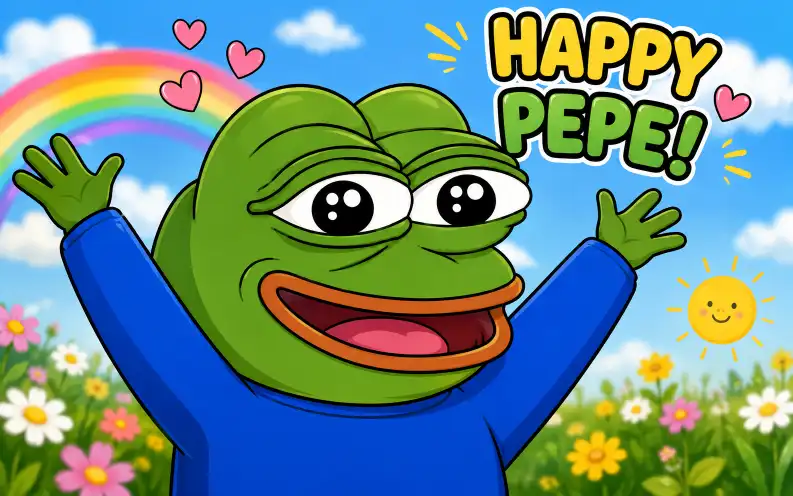
A happy Pepe can represent excitement, satisfaction, or a positive reaction.
Example:
“I finally got the game I wanted.”
Happy Pepe
The reaction shows happiness.
Smug Pepe
Smug Pepe can communicate confidence, satisfaction, or playful arrogance.
Example:
“I told you I would win.”
Smug Pepe
The reaction may suggest that the person feels pleased about being right.
Angry Pepe
An angry version can show frustration or annoyance.
Example:
“The game disconnected me again.”
Angry Pepe
The image makes the frustration more dramatic or humorous.
Confused Pepe
A confused Pepe can be used when something does not make sense.
Example:
“Why did that just happen?”
Confused Pepe
The reaction communicates confusion without needing a long explanation.
Pepe and “Feels Good Man”
One of the most recognizable phrases connected with Pepe is “Feels Good Man.”
The phrase became associated with Pepe through early internet meme culture. Another related version, “Feels Bad Man,” developed as a way to express disappointment or sadness.
These expressions helped establish Pepe as a reaction character.
The idea is simple:
Feels Good Man → positive feeling
Feels Bad Man → negative or disappointing feeling
Today, users may recognize the Pepe image even when these words are not included.
Pepe on Reddit
Pepe has been widely used in online communities, including Reddit.
A Reddit user might post a Pepe reaction to:
- A funny story
- An embarrassing situation
- Unexpected news
- A personal achievement
- A disappointing result
- A joke or meme
For example:
“I accidentally sent my private message to the group chat.”
A user might respond with a shocked or embarrassed Pepe.
The important thing is that Pepe is usually functioning as a reaction rather than a conventional slang word.
Pepe on TikTok
On TikTok, Pepe can appear in memes, edits, comments, or reaction content.
For example, someone may use a Pepe image to react to a relatable situation:
“Me checking my bank account after shopping.”
followed by a sad Pepe image.
Here, Pepe adds humor to the situation.
The character can also appear in edited videos where the creator uses different expressions to exaggerate a reaction.
Pepe on Instagram
Instagram users may encounter Pepe in:
- Meme posts
- Comment sections
- Story posts
- Reaction images
- Stickers
- Short videos
For example:
“This is literally me.”
followed by a Pepe meme.
In this situation, the user is saying that they relate to the emotion or situation represented by the image.
Pepe in Discord Chats
Discord is especially suitable for Pepe because communities can create and use custom emotes.
A server might have several Pepe-style reactions for different situations.
For example:
“Who forgot to save the file?”
Sweating Pepe
Or:
“We actually won!”
Celebrating Pepe
The exact meaning depends on the custom emote.
This is why it is not always enough to search for a simple Pepe meaning. You may need to identify the particular Pepe variation being used.
Pepe in Gaming
Gamers often use Pepe reactions to communicate quickly during conversations.
For example:
“I lost the final round with one hit left.”
Sad Pepe
This shows disappointment.
Another example:
“I beat the boss on my first attempt.”
Happy Pepe
This shows excitement.
Pepe can also be used sarcastically.
“Great, another server error.”
Angry Pepe
The reaction makes the complaint humorous rather than completely serious.
Real-Life Examples of Pepe Slang
Friendly Example
“That Pepe meme 😂”
Meaning: The person thinks the Pepe meme is funny.
Casual Example
“Send me that Pepe.”
Meaning: The person wants the Pepe image, GIF, or reaction.
Gaming Example
“We threw the whole match.”
Sad Pepe
Meaning: The image shows disappointment about losing.
Social Media Example
“Me trying to stay calm.”
Angry Pepe
Meaning: The Pepe reaction adds humor to the situation.
Relatable Example
“When you check your account after ordering food.”
Sad Pepe
Meaning: The image represents regret or disappointment about spending money.
Spanish Name Example
“Pepe is coming over tonight.”
Meaning: Here, Pepe may simply be someone’s name or nickname, not internet slang.
Is Pepe Always a Meme?
No.
Pepe can refer to the meme character, but it can also be:
- A person’s name
- A Spanish nickname for José
- A character reference
- A reaction image
- A GIF
- A Discord emote
- A gaming emote
- A broader meme format
That is why the sentence matters.
If someone says:
“Pepe is my cousin.”
it probably refers to a person.
If someone says:
“That Pepe reaction is perfect.”
it refers to internet meme culture.
Pepe vs. Emoji
Pepe and emojis can serve a similar purpose, but they are not the same thing.
An emoji is a standardized small symbol such as:
😂 ❤️ 😭 😡
A Pepe reaction is usually an image, GIF, sticker, or emote based on the frog character.
For example:
“I can’t believe you did that 😂”
uses an emoji.
A person might instead send a laughing or shocked Pepe reaction.
Both communicate emotion, but Pepe provides a more specific visual style.
Pepe vs. GIF
A GIF is an animated image format. A Pepe GIF is simply a GIF featuring Pepe.
For example, a moving Pepe image might show:
- Laughing
- Crying
- Dancing
- Celebrating
- Looking shocked
Therefore, Pepe describes the character, while GIF describes the format.
A Pepe image can be static, animated, or used as an emote.
Is Pepe Safe for Social Media?
Ordinary Pepe memes and reaction images are generally fine for casual social media use.
However, users should be careful with unfamiliar variations.
Pepe has a complicated online history because some versions were deliberately created or used with racist, antisemitic, or extremist messages. The ADL specifically emphasizes that context matters and that simply using a Pepe image does not automatically indicate extremist beliefs.
Before sharing a Pepe image publicly, check:
- What the image shows
- What text appears with it
- Who originally posted it
- What the surrounding conversation is about
- Whether it contains political or hateful imagery
A simple funny or emotional Pepe reaction is very different from a deliberately altered version containing hateful symbols or language.
Why People Use Pepe
There are several reasons people continue to use Pepe online.
It Is Easy to Understand
A facial expression can communicate an emotion immediately.
It Adds Humor
A funny Pepe reaction can make an ordinary conversation more entertaining.
It Is Relatable
People often use Pepe images to represent situations they have personally experienced.
It Saves Time
Sending a reaction image can be faster than writing a complete response.
It Fits Internet Culture
Pepe has been part of online meme culture for many years, so many internet users already recognize the character.
Impact of Pepe on Communication
Pepe shows how online communication has become increasingly visual.
People do not always communicate through words alone. They also use:
- Emojis
- GIFs
- Memes
- Stickers
- Reaction images
- Emotes
A single Pepe image can replace a sentence such as:
“I am disappointed, but I am trying to laugh about it.”
However, visual reactions can also cause confusion. Someone unfamiliar with a specific Pepe variation may not understand what it represents.
That is why context and audience are important.
When Should You Avoid Using Pepe?
You do not necessarily need to avoid Pepe completely. Instead, be selective about which Pepe image you use and where you use it.
Avoid unfamiliar or controversial Pepe variations in:
- Professional emails
- Job applications
- Academic work
- Formal business communication
- Official announcements
- Serious conversations
Even a harmless meme may seem unprofessional in a formal environment.
If you are unsure how an image will be interpreted, a simple emoji or clear sentence is often safer.
Key Takeaway
Pepe is a flexible internet meme reference rather than a slang word with one fixed definition.
It can represent happiness, sadness, frustration, humor, confusion, or many other emotions depending on the image.
The word can also simply be a Spanish nickname for José, so context is essential.
Most importantly, do not assume that every Pepe image has the same meaning. The specific image, caption, platform, and surrounding conversation all help determine what the sender means.
Origin and Background of Pepe
The internet meaning of Pepe comes from Pepe the Frog, a cartoon character created by artist Matt Furie. Pepe first appeared in Furie’s comic series Boy’s Club in the mid-2000s.
The character later spread across internet communities and became a popular meme. Users began sharing different versions of Pepe to represent different emotions and situations.
Over time, Pepe became much more than one specific meme. It developed into a large collection of reaction images, GIFs, stickers, and emotes.
This is why you may see one Pepe looking happy and another looking sad or angry. The character itself stays recognizable, but the expression and context change the meaning.
How Pepe Became Internet Slang
Pepe became popular because online users found the character easy to adapt.
A person could take a Pepe image and use it to represent almost any relatable situation.
For example:
“Me checking my grades after thinking I did well.”
A sad Pepe image could make the situation instantly understandable.
Another person might use a confident Pepe image with:
“Told you I was going to win.”
The image adds an emotional layer to the text.
This helped Pepe become a form of visual internet slang. Instead of using only words, people could communicate through a familiar character.
The Evolution of Pepe Memes
Pepe has changed considerably since its early appearances.
Different online communities created their own Pepe variations, jokes, and meanings. Some versions became associated with particular emotions, while others were used for specific situations.
This evolution explains why there is no single definition for Pepe meaning slang.
The word can point to:
- The original cartoon character
- A meme featuring the character
- A reaction image
- A GIF
- A Discord emote
- A gaming reaction
- A particular Pepe variation
The context tells you which one is intended.
Is Pepe Still Popular?
Pepe remains recognizable in internet culture, especially among communities that use memes, emotes, and reaction images.
Its continued use is partly due to how flexible the character is. New users can create or share different versions while keeping the recognizable Pepe style.
The character has therefore remained part of online meme culture even as social platforms and communication styles have changed.
Pepe and Internet Culture
Pepe is an example of how internet communities create their own visual language.
Traditional communication depends heavily on words. Online communication often combines words with:
- Images
- Memes
- Emojis
- GIFs
- Stickers
- Emotes
- Reaction pictures
Pepe fits naturally into this environment because one image can communicate an entire reaction.
For example, a sad Pepe can communicate disappointment without someone needing to write:
“I am disappointed about what happened.”
This makes the conversation faster and more expressive.
Pepe vs. Wojak
Wojak is another popular internet meme character.
Both Pepe and Wojak are often used to express emotions or relatable situations, but they have different visual identities.
| Term | Main Use |
| Pepe | Frog-based memes and emotional reactions |
| Wojak | Human-like character used for feelings and situations |
| Meme | General term for shareable internet humor |
| Emote | Small visual reaction used in online chats |
For example, someone might use Pepe to express sadness through a recognizable frog character, while a Wojak image might represent a more specific personal or social situation.
Pepe vs. Meme
It is also important to understand that Pepe and meme are not synonyms.
A meme is a broad category of internet content.
Pepe is a specific character that can be used to create memes.
Think of it this way:
Meme = the broader format
Pepe = one popular character used in that format
Therefore, saying:
“I saw a Pepe meme.”
is more specific than saying:
“I saw a meme.”
Pepe vs. Emote
An emote is a small image or animation used to communicate a reaction, especially in gaming and streaming communities.
A Pepe image can be used as an emote.
For example:
“That was the funniest match ever.”
Someone might respond with a laughing Pepe emote.
So, Pepe describes the character, while emote describes how the image is being used.
Pepe vs. Emoji
An emoji is a standardized symbol or picture, such as:
😂 😭 😡 ❤️
Pepe is not an emoji in the traditional sense.
Instead, Pepe is usually represented through:
- Images
- Stickers
- GIFs
- Memes
- Custom emotes
Both emojis and Pepe reactions can communicate emotions, but Pepe usually carries more specific meme-culture meaning.
When Should You Avoid Using Pepe?
The word Pepe itself does not need to be avoided. However, you should think carefully about the particular image or emote you are sharing.
Avoid using an unfamiliar Pepe variation when:
- You do not understand its meaning.
- The image contains political messaging.
- The image includes offensive language.
- The image contains hateful symbols.
- You are communicating in a formal environment.
- You are speaking about a serious personal issue.
A simple Pepe reaction may be perfectly harmless in a gaming chat but inappropriate in a professional email.
Pepe in Professional Communication
Using Pepe in a professional setting is usually unnecessary.
For example, instead of replying to a manager with:
“Sad Pepe 😭”
a clearer response would be:
“I understand. I will take care of it.”
Professional communication should focus on clarity rather than meme-based reactions.
Similarly, Pepe is usually not suitable for:
- Job applications
- Business proposals
- Academic essays
- Official reports
- Formal complaints
- Professional presentations
Casual slang has its place, but the audience should always come first.
Polite Alternatives to Pepe Reactions
If you want to communicate the same emotion without using a Pepe meme, you can use simple words or emojis.
Instead of Sad Pepe
Use:
- “That’s disappointing.”
- “I feel bad about that.”
- “That’s really unfortunate.”
- 😔
Instead of Angry Pepe
Use:
- “That’s frustrating.”
- “I’m really annoyed.”
- “That is not okay.”
- 😡
Instead of Happy Pepe
Use:
- “That’s great!”
- “I’m so happy!”
- “Nice!”
- 🎉
These alternatives are easier to understand when speaking with someone who is not familiar with meme culture.
Why Do People Still Use Pepe?
People use Pepe because it makes online conversations more expressive.
A short reaction can sometimes communicate a complicated feeling.
For example:
“I waited three hours and then the event was canceled.”
A sad Pepe reaction can communicate:
“I understand how disappointing that is.”
The character can also make serious situations feel more humorous when the context allows it.
Another reason is familiarity. People who spend time in meme communities may immediately recognize a Pepe reaction without needing an explanation.
Impact of Pepe on Modern Communication
Pepe represents a broader change in how people communicate online.
Internet users increasingly combine traditional language with visual elements.
A single message might contain:
“No way 😂”
plus a GIF, sticker, or Pepe emote.
This combination can communicate tone more clearly than words alone.
However, visual slang also has limitations. A reaction that one person sees as funny may seem confusing or inappropriate to another person.
That is why online communication still depends heavily on context, audience, and tone.
Is Pepe Safe for Social Media?
Ordinary Pepe memes are generally suitable for casual social-media use. However, not every Pepe image carries the same message.
Because the character has been used in many different online communities, some versions have political, offensive, or extremist associations.
That does not mean that Pepe itself is an offensive term.
Instead, check the specific image before sharing it.
A simple sad, happy, funny, or confused Pepe is different from a deliberately altered image containing hateful content.
When in doubt, use a neutral reaction image or emoji.
How to Understand Pepe Correctly
If you come across Pepe in a message, use these steps:
1. Look at the Image
If there is a frog character, the internet-meme meaning is likely.
2. Read the Caption
The caption can explain whether the image is supposed to be funny, sad, angry, or sarcastic.
3. Consider the Platform
A Pepe emote on Discord or in a gaming chat is likely to be a reaction.
4. Check the Conversation
If someone is discussing a person named Pepe, it may simply be a name.
5. Consider the Language
In Spanish-speaking contexts, Pepe may be a nickname for José.
This simple process can prevent misunderstandings.
Frequently Asked Questions
Q.1 What does Pepe mean in slang?
Pepe usually refers to Pepe the Frog or a Pepe meme used as an online reaction. The exact meaning depends on the image and context.
Q.2 What does Pepe mean in texting?
In texting, Pepe usually refers to a meme, reaction image, GIF, sticker, or emote featuring Pepe the Frog.
Q.3 What does Pepe stand for?
Pepe does not have a standard slang full form. In internet culture, it is the name of the Pepe the Frog character.
Q.4 Is Pepe a bad word?
No. Pepe is not inherently a bad word or offensive slang. However, some specific Pepe images have been used in offensive or extremist contexts.
Q.5 Is Pepe a Spanish name?
Yes. Pepe is a traditional Spanish nickname for José. In that context, it has nothing to do with internet memes.
Q.6 What does Pepe mean on Discord?
On Discord, Pepe usually refers to a Pepe-based emote, sticker, or reaction. Its meaning depends on the particular image.
Q.7 What does Sad Pepe mean?
Sad Pepe usually represents sadness, disappointment, loneliness, or emotional frustration.
Q.8 What does Smug Pepe mean?
Smug Pepe usually expresses confidence, satisfaction, or playful arrogance.
Q.9 Who created Pepe the Frog?
Matt Furie created Pepe the Frog as a character for his Boy’s Club comic series.
Q.10 Is Pepe still used as slang?
Yes. Pepe remains recognizable in online meme and reaction culture, although the exact popularity and meaning can vary between communities.
Conclusion
Pepe meaning slang usually refers to Pepe the Frog, a well-known internet meme character used to communicate emotions through images, GIFs, stickers, and emotes. Unlike traditional texting abbreviations, Pepe does not have one fixed meaning.
A happy Pepe can show excitement, a sad Pepe can show disappointment, and a smug Pepe can express confidence or playful arrogance. The image and conversation provide the real meaning.
It is also important to remember that Pepe can simply be a Spanish nickname for José. Therefore, context is always important.
For casual conversations, gaming chats, Discord, social media, and meme communities, Pepe can be a fun way to express reactions. In professional or serious communication, however, clear words are usually a better choice.
Read More About !

My name is Olivia Bennett.I am a language enthusiast and educational writer with a strong interest in contemporary English and digital communication. I enjoys making language learning engaging and accessible.