Slang for best friends refers to informal words or nicknames people use to describe their closest friends in everyday conversations, texting, and social media. Common examples include bestie, BFF, bro, sis, homie, and ride or die, each expressing friendship, trust, or loyalty.
Slang for best friends is a popular search because people often want fun, modern, and natural ways to describe their closest friends. Instead of always saying “best friend,” many people use casual slang that feels more personal and expressive. These words appear in everyday conversations, text messages, social media posts, gaming chats, and online communities. Some slang terms have been around for years, while others became popular through platforms like TikTok, Snapchat, Instagram, Discord, and Reddit.
Knowing the meaning behind these slang terms helps you understand online conversations and choose the right word for different situations. Some expressions sound playful, while others show loyalty, trust, or a strong friendship.
Quick Answer:slang for best friends
Slang for best friends refers to informal words or nicknames people use to describe their closest friends. Common examples include bestie, bro, sis, homie, BFF, day one, fam, ride or die, and partner in crime.
What Does Slang for Best Friends Mean in Text?
In text messages and online conversations, slang for best friends means casual words people use instead of saying “best friend.” These terms make conversations feel warmer, more relaxed, and more personal.
The exact meaning depends on the relationship between the people talking. Some slang words show affection, while others highlight trust, loyalty, or years of friendship.
For example:
- “You’re my bestie forever.”
- “Thanks for always being there, bro.”
- “That’s my day one.”
- “My ride or die never lets me down.”
These expressions are common in:
- Text messages
- Instagram captions
- TikTok comments
- Snapchat chats
- Discord servers
- Gaming communities
- Reddit discussions
Most of these terms are friendly and positive, although some are more suitable for close friends than professional conversations.
Slang for Best Friends Full Form / Definition
Unlike internet abbreviations, slang for best friends is not one single word with one full form. Instead, it includes many informal expressions that people use depending on their culture, age, and friendship.
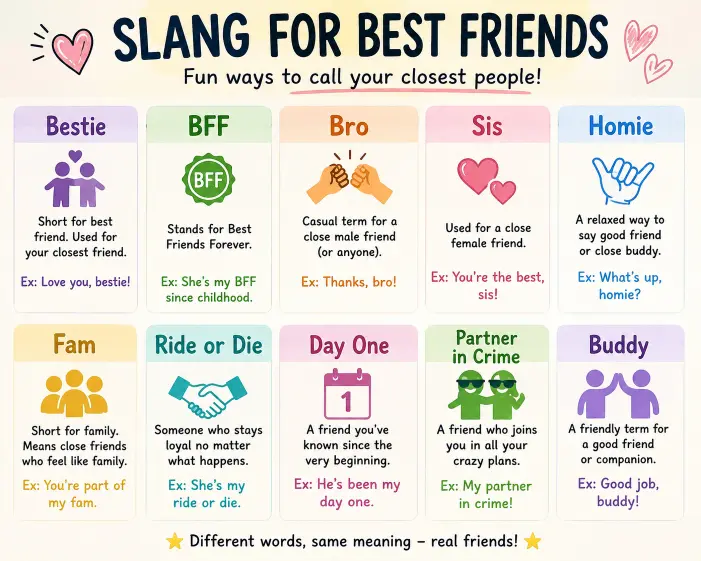
Here are some of the most common ones.
| Slang | Meaning | Common Use |
| Bestie | Best friend | Everyday texting and social media |
| BFF | Best Friends Forever | Texting and captions |
| Bro | Close male friend (sometimes any close friend) | Casual conversation |
| Sis | Close female friend | Friendly chats |
| Homie | Trusted close friend | Everyday slang |
| Fam | Someone considered like family | Social media and texting |
| Ride or Die | A friend who stays loyal through everything | Emotional conversations |
| Day One | A friend you’ve known for a very long time | Social media and real life |
| Partner in Crime | A friend who enjoys adventures with you | Funny or playful conversations |
| Buddy | Friendly companion | Casual everyday English |
Although these words have similar meanings, they carry different tones. Choosing the right one depends on your friendship and the situation.
Is Slang for Best Friends Rude, Offensive, or Neutral?
In most situations, slang for best friends is completely neutral or positive. These expressions usually show affection, loyalty, and closeness.
However, context always matters.
Neutral Examples
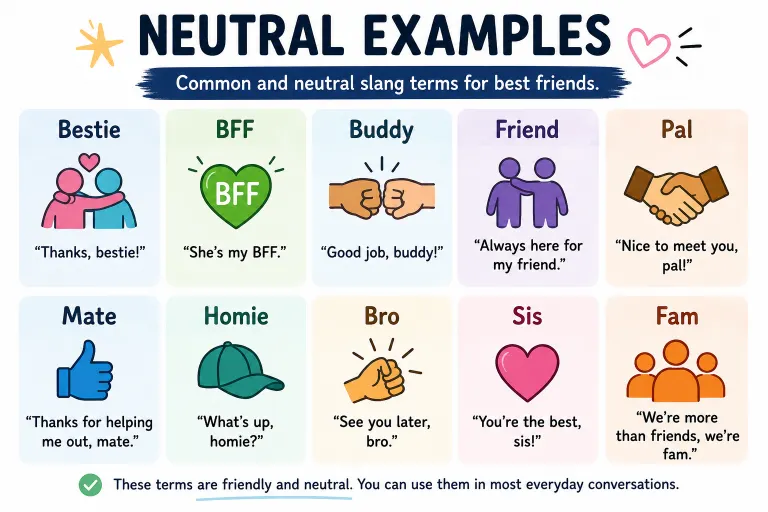
- Bestie
- Buddy
- BFF
- Partner in crime
These are safe in most casual conversations.
Friendly Informal Examples
- Bro
- Sis
- Homie
- Fam
These work well among friends but may sound too casual in professional settings.
Words That Depend on Context
Some slang terms can sound awkward if used with strangers.
For example:
- Calling someone bro during a formal business meeting may seem unprofessional.
- Calling a new coworker bestie may feel forced because the relationship is still new.
When talking with teachers, employers, clients, or people you do not know well, using friend, colleague, or the person’s name is usually the better choice.
Where Is Slang for Best Friends Commonly Used?
These expressions appear in many parts of everyday life, especially online.
Text Messages
Friends often use short, casual slang while chatting.
Example:
“Morning, bestie! Hope your day goes well.”
TikTok
Creators frequently mention their best friends in videos, captions, and comments.
Example:
“POV: Your bestie always has your back.”
People use friendship slang in:
- Photo captions
- Story replies
- Reels
- Comments
Example:
“Couldn’t do life without my ride or die.”
Snapchat
Snapchat conversations often include quick slang like:
- Bro
- Bestie
- Fam
- Homie
because the platform encourages casual communication.
Discord
Gaming groups and online communities often say:
- Bro
- Homie
- Fam
- Buddy
These words help create a friendly atmosphere.
Reddit users sometimes describe longtime friends as:
- Day one
- Ride or die
- Homie
The exact slang varies depending on each subreddit and community.
Why Do People Use Slang for Best Friends?
People use friendship slang because it feels more personal than simply saying friend.
Some of the biggest reasons include:
It Shows Closeness
Calling someone bestie instantly signals a close relationship.
It Makes Conversations Feel Relaxed
Informal words create a warm and natural tone.
Instead of saying:
“Thank you, my best friend.”
Many people simply write:
“Thanks, bestie!”
It Saves Time
Short slang like BFF, bro, or fam is quick to type.
It Reflects Internet Culture
Many friendship terms become popular through:
- TikTok
- Snapchat
- Discord
- Online gaming
Young people often adopt new expressions after seeing creators or influencers use them.
It Builds Group Identity
Friend groups often develop their own nicknames.
For example, one group may always say bro, while another prefers bestie or fam.
Using the same slang helps friends feel connected and creates a shared identity.
Origin and Background of Slang for Best Friends
People have always created nicknames for their closest friends. While the idea of calling someone a special name is centuries old, many modern friendship slang terms became popular through pop culture, music, movies, and the internet.
As texting and social media grew, shorter and catchier words replaced longer phrases like “my best friend.” Today, many slang terms spread quickly because people use them in viral videos, memes, and online conversations.
Here is how some popular terms became common:
Bestie
“Bestie” is a shortened, affectionate version of best friend. It became widely popular in the early 2000s and is now one of the most common friendship slang words worldwide.
BFF
BFF stands for Best Friends Forever. It became popular through text messaging and instant messaging because it was faster to type than the full phrase.
Bro
Originally short for brother, “bro” now often refers to a trusted friend, regardless of whether the two people are related.
Homie
“Homie” comes from the word homeboy or homegirl and describes someone from your neighborhood or a very close friend.
Fam
“Fam” is short for family. It refers to people who feel like family, even if they are not related by blood.
Ride or Die
This phrase describes someone who stays loyal during both good and difficult times. It has become a symbol of unwavering friendship.
Day One
“Day one” refers to a friend who has been with you since the beginning of your journey, often from childhood or your earliest memories.
Real-Life Examples of Usage
The meaning of friendship slang changes slightly depending on the situation. Here are examples from everyday life.
Friendly Examples
These examples show affection and appreciation.
- “Happy birthday, bestie! You’re the best.”
- “My ride or die always knows how to cheer me up.”
- “Thanks for helping me today, bro.”
- “You’re family to me, fam.”
Casual Conversation Examples
People naturally use friendship slang in daily chats.
Friend A: Are you coming tonight?
Friend B: Of course, bestie!
A: Need help moving tomorrow?
B: Thanks, buddy. I appreciate it.
Friend A: You’re always there for me.
Friend B: That’s what homies do.
Argumentative Conversation Examples
Even during disagreements, friendship slang can soften the conversation.
Example 1
Friend A: Bro, why didn’t you answer my messages?
Friend B: Sorry, I was busy all day.
Example 2
Friend A: Bestie, you forgot our plans again.
Friend B: I know. I’ll make it up to you.
Example 3
Friend A: You’re supposed to be my ride or die.
Friend B: I still am. Let’s talk about what happened.
Gaming Examples
Gaming communities frequently use casual friendship slang.
- “Nice teamwork, bro!”
- “Let’s queue again, homie.”
- “GG, bestie.”
- “Our squad carried us today, fam.”
Social Media Examples
These expressions appear naturally in captions and comments.
Instagram Caption:
“Weekend adventures with my bestie ❤️”
TikTok Caption:
“POV: Your ride or die always says yes.”
Snapchat Message:
“Miss you, bro.”
Reddit Comment:
“My day one helped me through everything.”
Discord Chat:
“Good game, homies!”
Comparison with Similar Slang
Many friendship slang words sound similar, but each has a slightly different meaning.
| Slang | Meaning | Best Used For | Tone |
| Bestie | Closest friend | Everyday conversations | Warm and affectionate |
| BFF | Best Friends Forever | Texting and social media | Sweet and playful |
| Bro | Close friend | Casual conversations | Relaxed |
| Sis | Close female friend | Friendly chats | Caring |
| Homie | Trusted longtime friend | Casual speech | Loyal |
| Fam | Friends who feel like family | Social media and texting | Friendly |
| Ride or Die | Extremely loyal friend | Emotional conversations | Strong loyalty |
| Day One | Friend from the beginning | Long-term friendships | Nostalgic |
| Buddy | Friend or companion | Everyday English | Neutral |
| Partner in Crime | Friend who joins your adventures | Fun situations | Humorous |
When to Avoid Using Slang for Best Friends
Although these expressions are friendly, they are not suitable for every situation.
Avoid using friendship slang when:
- Speaking during formal business meetings.
- Writing professional emails.
- Talking with clients or customers.
- Communicating with teachers in formal settings.
- Meeting someone for the first time.
- Speaking in interviews or official presentations.
For example, saying:
“Thanks, bro.”
may sound perfectly natural among friends but may appear too informal in a workplace.
Instead, you could simply say:
- Thank you.
- I appreciate your help.
- Thanks, my friend.
Polite Alternatives
If you want to sound more professional or respectful, choose one of these alternatives.
| Informal Slang | Polite Alternative |
| Bestie | Close friend |
| Bro | Friend |
| Sis | Friend |
| Homie | Trusted friend |
| Fam | Dear friends |
| Buddy | Friend |
| Ride or Die | Loyal friend |
| Day One | Lifelong friend |
| Partner in Crime | Close companion |
These alternatives work well in formal conversations while keeping the meaning clear.
Impact of Using Slang in Communication
Friendship slang can make conversations feel more personal, but using it appropriately is important.
Positive Effects
- Builds stronger personal connections.
- Makes conversations feel relaxed.
- Shows trust and affection.
- Creates a sense of belonging.
- Reflects modern online culture.
Possible Drawbacks
- Some people may not understand newer slang.
- Overusing slang can sound immature in professional settings.
- Certain terms have different meanings across cultures.
- Older generations may interpret some expressions differently.
The best approach is to match your language to your audience. Using slang with close friends usually feels natural, while formal situations often call for more standard language.
Is Slang for Best Friends Safe for Social Media?
Yes. Most friendship slang is completely safe to use on social media because it is positive and non-offensive.
It is commonly seen on:
- Instagram captions
- TikTok videos
- Snapchat stories
- Facebook posts
- Discord chats
- Reddit discussions
- X (formerly Twitter)
However, keep these tips in mind:
- Avoid tagging strangers with overly familiar slang.
- Be respectful if someone prefers formal language.
- Remember that some slang terms may have different meanings in different regions.
- Choose expressions that match your relationship with the other person.
Using friendship slang thoughtfully helps your messages sound genuine, friendly, and appropriate.
Quiz: Test Your Knowledge of Slang for Best Friends
Q.1. What does “bestie” usually mean?
A. A stranger
B. A close or best friend
C. A teacher
D. A neighbor
Answer: B. A close or best friend
Q.2. What does BFF stand for?
A. Best Friend Forever
B. Friends Forever
C. Best Funny Friend
D. Best Family Friend
Answer: B. Best Friends Forever
Q.3. Which slang describes a friend who stays loyal through difficult times?
A. Buddy
B. Homie
C. Ride or Die
D. Sis
Answer: C. Ride or Die
Q.4. Which slang refers to a friend you’ve known since the beginning?
A. Day One
B. Bro
C. Bestie
D. Partner
Answer: A. Day One
Q.5. Which platform commonly uses friendship slang?
A. TikTok
B. Instagram
C. Discord
D. All of the above
Answer: D. All of the above
Q.6. Which term is generally the most professional?
A. Bro
B. Homie
C. Friend
D. Fam
Answer: C. Friend
Q.7. Which slang comes from the word family?
A. Buddy
B. Fam
C. Bestie
D. Day One
Answer: B. Fam
Q.8. Which slang is often used for a trusted close friend?
A. Homie
B. Neighbor
C. Stranger
D. Opponent
Answer: A. Homie
Q.9. When should you avoid using friendship slang?
A. While chatting with close friends
B. In a formal business email
C. In a private text message
D. While commenting on a friend’s photo
Answer: B. In a formal business email
Q.10. What is the main purpose of using slang for best friends?
A. To confuse people
B. make conversations more personal and friendly
C. To replace every formal word
D. write academic papers
Answer: B. To make conversations more personal and friendly
Frequently Asked Questions
Q.1. What does slang for best friends mean in text?
It refers to informal words or nicknames people use for their closest friends. Popular examples include bestie, bro, homie, fam, and BFF.
Q.2. What does BFF stand for?
BFF stands for Best Friends Forever. It is one of the most popular abbreviations used in texting and social media.
Q.3. Is “bestie” only used by girls?
No. Anyone can use bestie regardless of gender. It simply refers to a close friend.
Q.4. Is it okay to use friendship slang at work?
Usually, no. Friendship slang is best for casual conversations. In professional settings, words like friend, colleague, or the person’s name are more appropriate.
Q.5. Which slang word is the most popular for a best friend?
Bestie is one of the most widely used friendship slang terms because it is friendly, easy to understand, and popular across texting and social media.
Conclusion
Slang for best friends adds personality, warmth, and fun to everyday conversations. Whether you say bestie, bro, homie, fam, BFF, day one, or ride or die, each term highlights a different type of close friendship. The best choice depends on your relationship, the situation, and the tone you want to create.
Understanding slang for best friends meaning in text also helps you follow conversations on TikTok, Instagram, Snapchat, Discord, Reddit, and other online communities. While these expressions are great for casual communication, it’s important to use more formal language in professional or official settings.
By learning what these friendship slang terms mean, where they come from, and when to use them, you can communicate more naturally and confidently both online and offline.
Read More About!

My name is Olivia Bennett.I am a language enthusiast and educational writer with a strong interest in contemporary English and digital communication. I enjoys making language learning engaging and accessible.