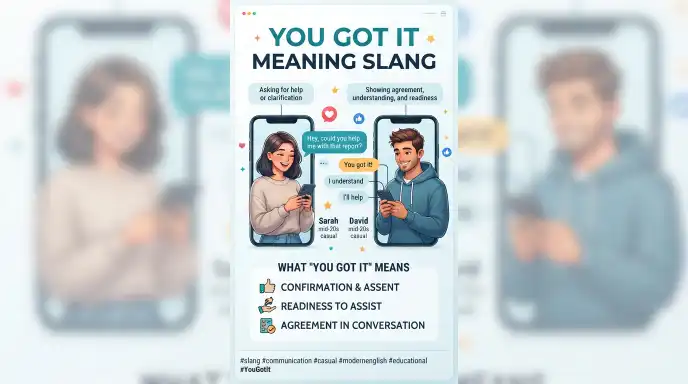
“You got it” is a casual phrase used to show agreement, understanding, or willingness to help.
You got it meaning slang is usually searched by people who see the phrase in a text, chat, comment, or social media post and want to know what the speaker really means. Although “you got it” is not a traditional slang abbreviation, it is a very common informal expression in everyday English.
People often use it to say “sure,” “okay,” “of course,” “I understand,” or “I will do it.” The exact meaning depends on the conversation and the speaker’s tone.
You might see “you got it” in texting, Instagram comments, Snapchat messages, gaming chats, or casual conversations. It can sound friendly and helpful, but it can also sound firm or slightly sarcastic in certain situations.
Quick Answer:You Got It Mean in Text
“You got it” is an informal expression that usually means “sure,” “of course,” “I understand,” or “I will do that.” It is generally friendly and neutral rather than offensive.
What Does “You Got It” Mean in Text?
In text messages, “you got it” usually means “sure” or “no problem.” Someone may use it when they agree to a request or want to show that they understand what another person wants.
For example:
“Can you send me the notes later?”
“You got it!”
Here, “you got it” means “Sure, I can do that.”
The phrase can also mean “I understand.”
“Meet me outside at 7.”
“You got it.”
In this case, the person is confirming that they understood the instruction.
The expression is flexible because its meaning changes slightly with context. It may communicate agreement, understanding, confirmation, encouragement, or confidence.
“You Got It” Full Form and Definition
“You got it” does not have a special full form like internet abbreviations such as “LOL” or “BRB.”
It is a complete English phrase.
The word “got” is the past tense of “get,” but in the expression “you got it,” the phrase is usually understood idiomatically rather than literally.
Depending on context, it can mean:
- Sure
- Okay
- No problem
- I understand
- I will do it
- Of course
- Exactly
- That’s right
So, when someone asks “What does you got it stand for?”, the answer is that it does not stand for a hidden set of words. It is simply an informal expression used to confirm agreement or understanding.
Is “You Got It” Slang?
“You got it” is sometimes described as slang because it is very common in casual communication. However, it is more accurate to call it an informal expression or conversational phrase.
It is not slang in the same way as highly informal terms such as “sus,” “lit,” or “bruh.”
“You got it” has been used in spoken English for a long time. People can use it in everyday conversations without sounding especially trendy or internet-focused.
That makes it useful in many situations.
For example:
“Can you help me with this?”
“You got it.”
This sounds natural and friendly.
Is “You Got It” Rude, Offensive, or Neutral?
“You got it” is generally neutral, friendly, and polite enough for casual communication.
It is not normally considered rude or offensive.
The tone can change depending on the situation, however. A warm response such as:
“You got it! 😊”
sounds enthusiastic and helpful.
A short response such as:
“You got it.”
may sound more direct.
If someone says it with an annoyed voice, it could even sound sarcastic. Written messages can have the same problem because texting does not always show emotion clearly.
Friendly Tone
“Can you pick up some snacks on your way home?”
“You got it!”
This shows willingness to help.
Neutral Tone
“Please send the document before noon.”
“You got it.”
This simply confirms the request.
Possible Sarcastic Tone
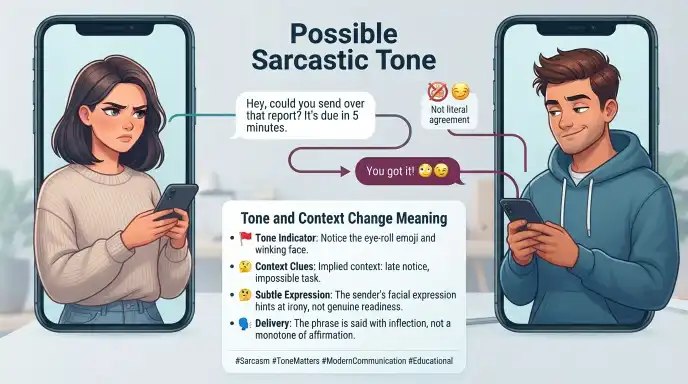
“You got it. Because apparently I’m the only one who can do it.”
Here, the phrase itself is not offensive. The surrounding words create the sarcastic meaning.
Where Is “You Got It” Commonly Used?
“You got it” appears in many forms of casual communication.
Texting
Friends and family may use it when confirming a request.
“Can you call me tonight?”
“You got it.”
People may use the phrase in direct messages or comments when agreeing to something.
“Can you send me that picture?”
“You got it!”
Snapchat
The expression works naturally in quick conversations where people want a short confirmation.
Discord
Discord users may say “you got it” when responding to a request from another person.
“Can you invite Alex to the server?”
“You got it.”
Gaming
Gamers may use the phrase to confirm a task or instruction.
“Watch the left side.”
“You got it.”
The phrase can appear in casual comments when someone agrees to help or confirms that they understand something.
Unlike newer internet slang, “you got it” is not limited to one particular platform or age group.
Real-Life Examples of “You Got It”
The easiest way to understand this phrase is to look at how people actually use it.
Example 1: Helping a Friend
“Can you bring my charger tomorrow?”
“You got it.”
Meaning: Sure, I will bring it.
Example 2: Confirming Instructions
“Turn left after the gas station.”
“You got it.”
Meaning: I understand.
Example 3: Agreeing to a Request
“Could you check my email for mistakes?”
“You got it!”
Meaning: Of course, I can do that.
Example 4: Customer Service
“Can I get a large coffee?”
“You got it.”
Meaning: Certainly.
Example 5: Gaming
“Protect the base while I collect the items.”
“You got it.”
Meaning: I understand the task and will do it.
Example 6: Social Media
“Can you tag me in the post?”
“You got it!”
Meaning: Sure, I will.
Different Tones of “You Got It”
The phrase can communicate different emotions depending on how it is written.
Friendly
“You got it! I’ll send it tonight.”
This sounds warm and helpful.
Casual
“You got it. See you later.”
This is simple and relaxed.
Enthusiastic
“You got it! Let’s do it!”
This shows excitement and agreement.
Professional-Casual
“You got it. I’ll have the report ready by Friday.”
This can work in a relaxed workplace conversation.
Firm
“You got it. I understand what needs to be done.”
This emphasizes certainty.
Sarcastic
“Oh, you got it. I’ll do everything myself.”
The meaning here depends on the larger sentence and the situation.
“You Got It” vs. Similar Slang and Expressions
Several expressions have meanings that overlap with “you got it.” They are not always interchangeable, though.
| Expression | Common Meaning | Tone |
| You got it | Sure; I understand; I’ll do it | Friendly, casual |
| Gotcha | I understand | Very casual |
| Sure thing | Of course; yes | Friendly |
| No problem | I am happy to help | Casual |
| Absolutely | Definitely; yes | Strong agreement |
| For sure | Definitely | Casual |
| You bet | Definitely; of course | Friendly, informal |
| Okay | I understand or agree | Neutral |
| Roger that | Message understood | Informal, sometimes playful |
“You Got It” vs. “Gotcha”
“Gotcha” is often used to mean “I understand.”
“Don’t forget the meeting is at 10.”
“Gotcha.”
“You got it” can also mean “I understand,” but it can additionally mean “I will do that.”
“You Got It” vs. “Sure Thing”
“Sure thing” usually focuses more on agreement.
“Can you help me later?”
“Sure thing.”
“You got it” can communicate the same idea while also suggesting that the speaker understands the request.
When Should You Avoid Using “You Got It”?
There is usually no serious problem with using this expression. Still, context matters.
In highly formal writing, a more direct phrase may be better.
For example, instead of:
“You got it.”
you could write:
“Certainly. I will take care of it.”
For a formal business email, “Certainly” or “Understood” may sound more professional.
You may also want to avoid the phrase when the recipient could misunderstand whether you are agreeing or simply acknowledging what they said.
For example:
“The deadline is Friday.”
“You got it.”
This could mean “I understand,” but the reader may not know whether you are also promising to meet the deadline.
A clearer response would be:
“Understood. I’ll have it finished by Friday.”
Polite Alternatives to “You Got It”
If you want a more formal or clearer response, you can use:
- Certainly.
- Of course.
- Absolutely.
- No problem.
- Understood.
- I understand.
- I’ll take care of it.
- I’ll handle that.
- Consider it done.
- Sure, I’ll do that.
- Yes, I understand.
- That’s correct.
The best alternative depends on what you want to communicate.
If you are confirming an instruction, “Understood” is clear.
You can replace it with:
For accepting a request, “Sure” or “Absolutely” sounds more natural. For agreeing to handle something, “I’ll handle it” gives a clearer response.
Why Do People Say “You Got It”?
People use “you got it” because it is short, natural, and easy to understand.
Instead of writing:
“Yes, I understand your request and I agree to do what you have asked.”
someone can simply write:
“You got it.”
The shorter expression keeps conversations moving.
It can also sound more friendly than a simple “yes.”
Compare:
“Can you help me?”
“Yes.”
with:
“Can you help me?”
“You got it!”
The second response feels more encouraging and conversational.
Impact of Using “You Got It” in Communication
Informal phrases can make conversations feel more natural. “You got it” often creates a friendly sense of cooperation.
It can communicate three things at once:
- Acknowledgment — “I heard you.”
- Understanding — “I know what you mean.”
- Agreement — “I’m willing to do it.”
However, the phrase does not always communicate all three. Context determines which meaning is strongest.
That is why tone and surrounding words matter, especially in text messages.
Is “You Got It” Safe for Social Media?
Yes. “You got it” is generally safe and harmless for social media.
It does not normally contain profanity, insults, sexual language, or offensive wording.
People can use it in:
- Instagram comments
- TikTok conversations
- Snapchat messages
- Discord chats
- Reddit discussions
- Gaming communities
- Text messages
The phrase itself is not normally a moderation concern.
Still, any expression can be used sarcastically or aggressively depending on the surrounding message. The context matters more than the phrase alone.
“You Got It” in Different Situations
The meaning becomes clearer when you look at the situation.
When Someone Makes a Request
“Can you save me a seat?”
“You got it.”
Meaning: I will save you a seat.
When Someone Gives an Instruction
“Send me the file when you’re finished.”
“You got it.”
Meaning: I understand and will do it.
When Someone Checks Understanding
“So we’re meeting at six, right?”
“You got it.”
Meaning: Yes, that’s correct.
When Someone Gives Encouragement
“I think I can finish this today.”
“You got it!”
Here, the meaning can shift toward “You can do it!” or “I believe you can.”
This is an important contextual difference. The phrase can sometimes express confidence rather than agreement.
Can “You Got It” Mean “You Can Do It”?
Yes, in certain contexts.
Consider:
“Do you think I can pass this exam?”
“You got it!”
Here, the phrase may mean “Yes, you can do it.”
The same words can therefore have different meanings depending on the conversation.
This is why translating slang or informal expressions word-for-word can sometimes produce an incorrect meaning.
Is “You Got It” the Same as “I Got It”?
No. These two expressions can have different meanings.
“You got it” often means:
- Sure.
- I understand.
- I will do it.
- You can do it.
“I got it” often means:
- I understand.
- I will handle it.
- I have it.
- I can take care of this.
For example:
“Can you handle this problem?”
“I got it.”
The speaker means that they will take responsibility for it.
But:
“Can you handle this problem?”
“You got it.”
means something closer to “Sure, I will.”
Is “You Got It” Old or New Slang?
“You got it” is not a new internet slang term.
It has been part of informal spoken English for many years. Modern social media and texting have helped keep the expression common, but they did not create it.
This makes it different from newer online expressions that become popular through TikTok, gaming communities, memes, or other internet trends.
You can hear “you got it” among different generations and in many English-speaking communities.
Common Mistakes When Using “You Got It”
One common mistake is assuming that “you got it” always means “you understand.”
That is not always true.
For example:
“Can you bring some water?”
“You got it.”
This means “Sure, I’ll bring some.”
Another mistake is treating it as a formal business phrase in every situation. It is acceptable in many casual workplace conversations, but a formal email may benefit from clearer wording.
A third mistake is ignoring tone.
“You got it!”
and
“You got it.”
may communicate slightly different feelings because punctuation can influence how a short message is interpreted.
FAQs About “You Got It” Meaning Slang
Q.1 What does “you got it” mean in slang?
It usually means “sure,” “of course,” “I understand,” or “I will do it.” The exact meaning depends on the context.
Q.2 Is “you got it” slang or an idiom?
It is best described as a common informal expression. People sometimes call it slang because it is widely used in casual speech and texting.
Q.3 Is “you got it” rude?
No. It is normally friendly or neutral. It can sound sarcastic only when the surrounding context or tone makes it sarcastic.
Q.4 What does “you got it” mean in texting?
In texting, it often means “sure,” “okay,” or “no problem.” It can also mean “I understand.”
Q.5 Can “you got it” mean “I understand”?
Yes. When someone gives you information or an instruction, “you got it” can confirm that you understand.
Q.6 What is a polite alternative to “you got it”?
Depending on the situation, you can use “certainly,” “of course,” “understood,” “absolutely,” or “I’ll take care of it.”
Conclusion
You got it meaning slang is usually connected with agreement, understanding, or willingness to help. In texting and everyday conversation, it can mean “sure,” “no problem,” “I understand,” or “I’ll do it.”
The phrase is generally friendly, neutral, and safe to use. Its exact meaning depends on the situation, punctuation, and tone. It can even express encouragement when someone says, “You got it!” to mean “You can do it.”
For casual conversations, texting, gaming, and social media, the expression sounds natural. In formal communication, clearer alternatives such as “certainly,” “understood,” or “I’ll take care of it” may be more appropriate.
Read More About !
- Slang Insults: Meaning, Examples, and Common Uses
- Chub Slang Meaning Explained: Uses and Examples
- AMG Meaning Slang: Simple Explanation and Examples

My name is Olivia Bennett.I am a language enthusiast and educational writer with a strong interest in contemporary English and digital communication. I enjoys making language learning engaging and accessible.