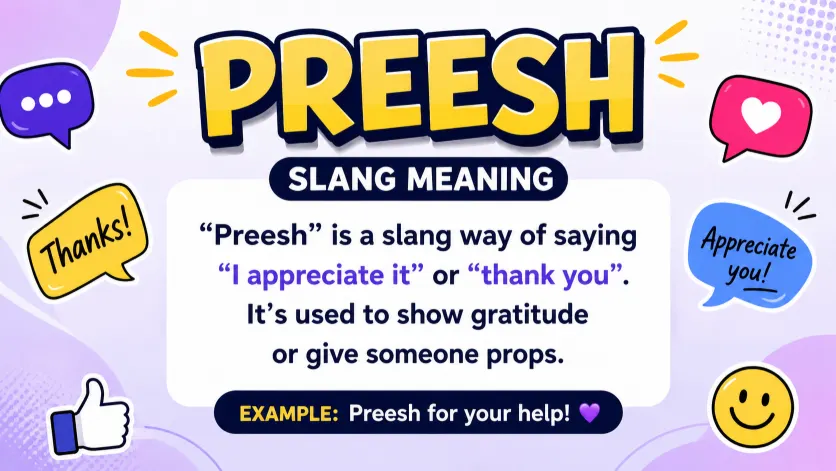
Preesh is a casual slang word meaning “I appreciate it,” commonly used in texts, chats, and social media as a short way to express thanks or gratitude.
Preesh slang is a short and friendly way of saying “I appreciate it” or “thanks, I appreciate you.” You’ll often see it in text messages, online chats, gaming communities, and social media comments when someone wants to express gratitude quickly without sounding too formal. Although it is common in casual conversations, many people are unsure what it means because it is not a traditional dictionary word.
If you’ve seen someone reply with “preesh” after receiving help, advice, or a compliment, they are simply showing appreciation in a relaxed and conversational way. In this guide, you’ll learn what preesh slang means, where it came from, how people use it on platforms like TikTok, Discord, Snapchat, Instagram, and Reddit, whether it’s appropriate in different situations, and how it compares with similar expressions.
Quick Answer
Preesh slang means “I appreciate it” or “I appreciate you.” It is an informal abbreviation of the word appreciate and is commonly used in texting, social media, gaming chats, and everyday online conversations to thank someone in a warm, casual way.
What Does Preesh Slang Mean?
The simplest meaning of preesh slang is “I appreciate it.” Instead of typing the full phrase, people shorten it to preesh because it feels quicker, more relaxed, and friendlier in casual conversations. It communicates gratitude without sounding overly formal, making it especially popular in digital communication.
Unlike internet abbreviations made from initials, preesh is a shortened pronunciation of the word appreciate rather than an acronym. When someone says “Preesh!”, they are thanking another person while keeping the conversation natural and informal. Depending on the context, it can also imply respect, acknowledgment, or appreciation for someone’s time or effort.
Saying Thanks in a Casual Way
The most common use of preesh is as a casual thank-you. It often appears after someone receives help, advice, or a favor. Because it feels friendly and conversational, many people prefer it over a formal “thank you” when chatting with friends or teammates.
Examples:
- “You covered my shift? Preesh!”
- “Thanks for sending the notes. Preesh!”
- “You didn’t have to help, but preesh.”
In each example, preesh expresses sincere appreciation without making the conversation sound overly formal.
Showing Appreciation for Someone
Sometimes preesh refers to appreciating a person rather than a specific action. In these situations, it carries a warmer emotional tone and shows gratitude toward someone’s kindness, support, or friendship.
Examples:
- “You’re always there when I need help. Preesh.”
- “Preesh you for checking in today.”
- “I really preesh everything you’ve done.”
Although the wording is informal, the feeling behind it is genuine.
Full Form or Complete Meaning
Unlike abbreviations such as LOL or BRB, preesh does not have a traditional full form. Instead, it is simply a shortened version of the word appreciate.
People usually use it as a replacement for longer expressions, including:
| Preesh Expression | Complete Meaning |
| Preesh | I appreciate it |
| Preesh! | Thanks, I appreciate it |
| Preesh you | I appreciate you |
| Much preesh | Many thanks or I really appreciate it |
Because it comes from everyday spoken English rather than internet initials, preesh is easy to understand once you know its connection to the word appreciate.
Is Preesh an Acronym?
No. Preesh is not an acronym or an abbreviation made from capital letters. It is simply a shortened pronunciation of appreciate that became popular in casual speech before spreading to text messages and social media.
This is one reason people sometimes become confused when they search for a “preesh full form.” The word itself does not stand for anything else—it is simply an informal way of saying appreciate.
Different Meanings of Preesh Slang
In most situations, preesh has only one core meaning: expressing appreciation. However, the tone can change depending on the conversation.
Preesh as Gratitude
This is by far the most common meaning. Someone says preesh to thank another person for helping, supporting, or doing something thoughtful.
For example:
- “You fixed my computer? Preesh!”
- “Thanks for the recommendation. Preesh.”
The speaker is simply expressing gratitude in a casual way.
Preesh as Respect or Recognition
Sometimes people use preesh to recognize someone’s effort rather than to thank them directly. In this context, the word means “I recognize what you did, and I value it.”
For example:
- “You’ve been working hard lately. Preesh.”
- “Preesh all the effort you put into this project.”
Here, the speaker is acknowledging another person’s contribution rather than responding to a specific favor.
What Does Appreesh Mean?
appreesh meaning is closely connected to preesh and is used as an informal way to express appreciation. It comes from the same idea of shortening appreciate in casual speech and online conversations. Someone may use appreesh when thanking a friend, teammate, or another person for their help.
For example, a person might say, “Appreesh for helping me out,” instead of using the more standard “I appreciate your help.” The tone remains casual, friendly, and conversational.
This variation is most suitable for texts, chats, gaming conversations, and social media rather than formal writing.
Where Is Preesh Commonly Used?
Because preesh is informal, it appears mostly in casual conversations instead of professional writing. It is especially common where fast, friendly communication is preferred.
Text Messages
Friends often use preesh instead of typing longer thank-you messages. It keeps conversations quick while still sounding warm and appreciative.
Examples:
- “Preesh for picking me up.”
- “Preesh! That really helped.”
The word fits naturally into everyday texting because it is short and easy to type.
Social Media
On platforms like TikTok, Instagram, X (Twitter), Reddit, and Snapchat, people often comment preesh when thanking creators for useful advice, entertaining content, or thoughtful replies.
For example:
- “Preesh the tutorial!”
- “Preesh for sharing this.”
- “Honestly, preesh the advice.”
Using preesh in comments creates a relaxed, friendly tone that matches how people usually communicate on social media.
Gaming and Discord
In gaming communities and Discord servers, players frequently thank teammates using preesh after receiving help, strategy tips, or in-game support.
Examples include:
- “Preesh for the revive.”
- “Preesh for carrying the team.”
- “Preesh, that guide saved me.”
Because online games often move quickly, short expressions like preesh make communication faster without losing meaning.
Is Preesh Rude, Offensive, or Harmless?
The short answer is no preesh is generally harmless. It is a friendly slang word used to show appreciation, and most people understand it as a casual way of saying “I appreciate it.” Unlike some internet slang, it does not contain rude language or offensive meanings.
However, because it is informal, preesh is not suitable for every situation. The people you’re talking to and the setting both matter. Using it with close friends usually feels natural, while using it in a formal email may sound too casual.
Is It Offensive?
No. Preesh is not considered offensive or insulting. It is simply a shortened form of appreciate, so it carries a positive meaning.
Whether you’re thanking someone for a favor or recognizing their effort, the word is generally received as polite and friendly. There are no known offensive meanings attached to preesh in modern internet slang.
Is It Professional?
Not really. While preesh is respectful, it is also very informal.
In professional settings, it’s better to write:
- Thank you.
- I appreciate your help.
- Thank you for your time.
- Much appreciated.
These expressions sound more polished and are better suited to workplaces, schools, and official communication.
Real-Life Examples of Preesh Slang
Seeing preesh in real conversations makes it much easier to understand. Below are examples from different situations where people naturally use the slang.
Friendly Conversation
Friends often use preesh after receiving a favor or thoughtful gesture. It keeps the conversation relaxed while still expressing genuine gratitude.
Examples:
- “You brought me coffee? Preesh!”
- “Preesh for helping me study.”
- “You’re the best. Preesh.”
Text Messages
In texting, preesh replaces longer thank-you messages. It’s quick, natural, and commonly used between people who already know each other.
Examples:
Friend: “I emailed you the notes.”
You: “Preesh! I really needed them.”
Friend: “I’ll meet you outside.”
You: “Awesome, preesh.”
Gaming
Online games often require fast communication, so players use short expressions like preesh to thank teammates without interrupting gameplay.
Examples:
- “Preesh for the backup.”
- “Preesh for the health pack.”
- “Couldn’t have won without you. Preesh.”
Discord Communities
Discord users frequently thank moderators, community members, or teammates using preesh because it feels friendly and fits the casual atmosphere of most servers.
Examples:
- “Preesh for answering my question.”
- “Preesh for sharing the guide.”
- “Really preesh the help.”
TikTok and Instagram
Social media users often leave preesh in comments to thank creators for useful advice, tutorials, or entertaining videos.
Examples:
- “Preesh for the tips!”
- “This helped a lot. Preesh!”
- “Preesh for posting this.”
School Conversations

Students sometimes use preesh with classmates when exchanging notes or helping each other with homework. It feels casual and friendly but is usually avoided when speaking directly to teachers.
Examples:
- “Preesh for sending today’s homework.”
- “Preesh for explaining the math problem.”
What Does Big Preesh Mean?
The phrase big preesh meaning refers to showing a stronger or more enthusiastic sense of appreciation. Adding big gives the thank-you a little more emphasis, similar to saying “I really appreciate it” or “many thanks.”
For example:
- “You saved me a seat? Big preesh.”
- “Big preesh for sending that over.”
- “You helped me finish this on time. Big preesh.”
The phrase is still informal, so it fits naturally into conversations with friends, online communities, teammates, and other casual settings.
Origin and History of Preesh
The exact origin of preesh is not fully documented, so it would be inaccurate to credit one person or platform with creating it. What is clear is that the word developed as a spoken shortening of appreciate, which people later carried into texting and online conversations.
As messaging apps and social media encouraged faster communication, shortened words became more common. Preesh naturally fit this trend because it was easy to type, easy to understand, and already sounded familiar in everyday speech.
Spoken English Before Internet Slang
Many people assume preesh began online, but it likely became popular in spoken conversations before spreading across digital platforms. Friends often shortened appreciate while talking, and the same pronunciation eventually appeared in text messages.
Because slang usually spreads through conversation rather than official language rules, there is no single confirmed date when preesh first appeared.
Growth Through Social Media
Although the origin is uncertain, social media helped preesh reach a much larger audience.
Today, it appears regularly on:
- TikTok
- Snapchat
- Discord
- X (Twitter)
- Text messaging apps
Its popularity comes from being short, positive, and easy to understand.
Similar Slang and Related Terms
Several internet slang expressions communicate appreciation or agreement. While they share similar ideas, each has a slightly different tone.
| Slang | Meaning | Tone | Best Used For |
| Preesh | I appreciate it | Friendly | Thanking someone casually |
| TY | Thank you | Neutral | Quick messages |
| TYSM | Thank you so much | Warm | Showing stronger gratitude |
| Thx | Thanks | Casual | Everyday texting |
| Much appreciated | Thank you very much | Polite | Work or respectful conversations |
| FRFR | For real, for real | Emphasizing honesty | Agreement or sincerity |
Preesh vs Thanks
Although both express gratitude, they don’t always sound the same.
Thanks is the standard choice and works almost everywhere. Preesh, however, feels more personal and conversational. It often suggests that the speaker genuinely values someone’s effort rather than simply acknowledging it.
For example:
- “Thanks for the help.” → Neutral.
- “Preesh for the help.” → Friendly and relaxed.
Preesh vs TYSM
TYSM means “Thank You So Much.” It expresses stronger appreciation than preesh and is often used when someone has done something especially kind or meaningful.
Choose preesh for everyday conversations and TYSM when you want your gratitude to sound more enthusiastic.
Why Do People Use Preesh?
People choose preesh because it feels natural, modern, and conversational. It lets them express appreciation without sounding overly formal or repetitive.
Instead of writing a long thank-you message, they can communicate the same feeling with a single word.
Common reasons people use preesh include:
- It saves time while texting.
- It sounds friendly and genuine.
- It fits casual online conversations.
- It shows appreciation without being overly formal.
- It creates a relaxed and approachable tone.
For many younger internet users, preesh has become part of everyday digital communication because it balances gratitude with simplicity.
Platform Differences
The meaning of preesh stays the same across platforms, but its tone can vary depending on where it’s used.
| Platform | How It’s Usually Used |
| Text Messages | Thanking friends casually |
| TikTok | Appreciating creators or videos |
| Friendly comments and replies | |
| Snapchat | Quick conversations between friends |
| Discord | Thanking teammates or community members |
| Showing appreciation for helpful advice | |
| Workplace Chat | Better replaced with “Thanks” or “Much appreciated” for a more professional tone |
Using the right tone for each platform helps your message sound natural while avoiding situations where informal slang may seem out of place.
When Should You Avoid Using Preesh?
Although preesh is friendly and positive, it is not appropriate for every conversation. Because it is informal slang, using it in professional or formal settings may make your message sound too casual.
When in doubt, consider who you are speaking to and whether the situation calls for standard English instead of internet slang.
Professional Communication
Avoid using preesh in business emails, job applications, official reports, or workplace messages unless you know your team regularly uses casual language.
Instead, choose more professional expressions such as:
- Thank you.
- I appreciate your help.
- Much appreciated.
- Thank you for your support.
These alternatives sound respectful and are suitable for formal communication.
School and Academic Writing
While classmates may understand preesh, it is usually better not to use it when communicating with teachers, professors, or school administrators.
For example, instead of writing:
“Preesh for reviewing my assignment.”
Write:
“Thank you for reviewing my assignment. I appreciate your feedback.”
This creates a more professional impression.
Speaking With People Who May Not Know Internet Slang
Not everyone is familiar with online slang. Older family members, new coworkers, or people who rarely use social media may not understand what preesh means.
In these situations, using the full phrase “I appreciate it” avoids confusion and makes your message clear to everyone.
What Does Preesh It Mean?
The phrase preesh it meaning is another casual use of preesh that expresses appreciation for something someone has done. In simple terms, it means that the speaker values or appreciates the action, help, advice, or effort.
For example, someone might write, “Preesh it!” after receiving useful information or getting help from a friend. The wording is relaxed and conversational rather than formal.
This type of usage is mainly suited to casual messages, social media conversations, gaming chats, and friendly online discussions.
Polite Alternatives to Preesh
If you want to sound more formal or simply prefer standard English, there are many alternatives that express appreciation just as well.
| Alternative | Best Used For |
| Thank you | Everyday conversations |
| Thanks | Casual chats |
| I appreciate it | Professional and personal situations |
| Much appreciated | Workplace communication |
| Thank you very much | Formal gratitude |
| I appreciate your help | Business and academic settings |
| I’m grateful | Personal and sincere conversations |
Each alternative has a slightly different tone, but all communicate appreciation clearly.
Common Misunderstandings About Preesh
Although preesh is easy to understand once you know its meaning, several misconceptions still exist.
It Is Not an Acronym
One common misunderstanding is that preesh stands for multiple words.
It does not.
Unlike abbreviations such as LOL, BRB, or IDK, preesh is simply a shortened form of the word appreciate.
It Does Not Always Replace “Thank You”
Some people think preesh should replace thank you in every conversation.
That’s not true.
While it works well in casual chats, professional situations usually call for more traditional expressions of gratitude.
It Is Not New to Every Platform
Another misconception is that TikTok invented preesh.
Although TikTok helped popularize many slang terms, there is no reliable evidence showing that preesh originated there. The shortened spoken form existed before becoming common on social media.
Is Preesh Safe to Use on Social Media?
Yes. Preesh is considered safe to use on social media because it has a positive meaning and is not associated with offensive language.
It is commonly used on:
- TikTok
- Snapchat
- Discord
- X (Twitter)
- Text messaging apps
Since the slang simply expresses appreciation, it is generally acceptable in comments, captions, replies, and direct messages.
The only thing to remember is that some audiences may prefer more formal language, especially in professional networking spaces.
Frequently Asked Questions
Q1:What does preesh mean in text?
Preesh means “I appreciate it” or “I appreciate you.” It is a casual way to thank someone in text messages and online conversations.
Q2:Is preesh a real word?
No. Preesh is informal slang, not a standard dictionary word. It is a shortened version of appreciate that became popular in casual speech and online communication.
Q3:What is the full form of preesh?
Preesh does not have a traditional full form. It is simply a shortened pronunciation of the word appreciate.
Q4:Is preesh rude?
No. Preesh is friendly, polite, and positive. However, because it is informal, it is best avoided in professional or academic writing.
Q5:Where is preesh commonly used?
You will often see preesh in text messages, Discord chats, TikTok comments, Instagram posts, Snapchat conversations, Reddit discussions, and online gaming communities.
Q6:Can I use preesh at work?
It depends on your workplace. If your team communicates casually, it may be acceptable. For emails, reports, or conversations with clients, use “Thank you” or “I appreciate it” instead.
Q7. Is “Preesh” considered formal English?
Answer: No, “Preesh” is informal slang and is best used in casual texts, chats, and social media.
Q8. Can I use “Preesh” instead of “thank you”?
Answer: Yes, “Preesh” is a relaxed way to say “I appreciate it” or “thanks” in informal conversations.
Q9. Where is the slang word “Preesh” most commonly used?
Answer: “Preesh” is popular in texting, TikTok, Instagram, Snapchat, Discord, and everyday online chats.
Q10. How do you reply when someone says “Preesh”?
Answer: You can reply with “No problem,” “You’re welcome,” “Anytime,” or “Happy to help!”
Conclusion
Preesh slang is a casual and friendly way of saying “I appreciate it” or “I appreciate you.” It has become popular in text messages, social media, and online communities because it expresses gratitude in a quick and natural way. While the word is informal, it carries a positive meaning and helps make everyday conversations feel more relaxed.
Understanding when to use preesh is just as important as knowing what it means. It works well with friends, family, teammates, and social media communities, but standard expressions like “Thank you” or “I appreciate your help” remain the better choice for professional and formal situations. By matching your language to the context, you can use preesh naturally and confidently without causing confusion.
Read More About!

My name is Olivia Bennett.I am a language enthusiast and educational writer with a strong interest in contemporary English and digital communication. I enjoys making language learning engaging and accessible.