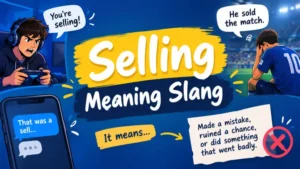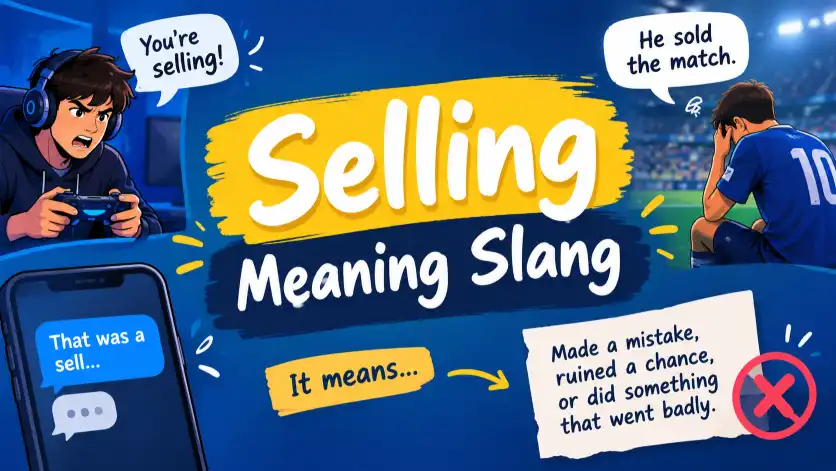
“Selling” in slang usually means messing up, playing badly, or hurting your chances of success. It is especially common in gaming, sports, texting, and online conversations.
If someone says “you’re selling” or “I sold,” they usually are not talking about selling a product. They mean that someone made a mistake, wasted an opportunity, or did something that could cause a loss.
The phrase selling meaning slang can be confusing because “selling” also has its normal English meaning. In everyday English, selling means offering something to someone in exchange for money. In online slang, however, it can describe a person who is failing, making bad decisions, or throwing away an advantage.
This guide explains what selling means in slang, how people use it, and what phrases like “I sold,” “you’re selling,” and “he sold the game” mean.
Quick Answer: Selling Meaning Slang
In slang, selling means messing up, underperforming, or causing a situation to go badly. It is often used when someone makes a bad play, misses an easy chance, or makes a mistake that hurts their team.
Example:
“Bro, you’re selling!”
This means:
“Bro, you’re messing up and making things harder for us.”
The expression is especially common in gaming and sports, but people can also use it jokingly in normal conversations.
What Does Selling Mean in Slang?
The selling meaning slang is usually connected to failure or a costly mistake.
When someone says that another person is “selling,” they may mean that the person is:
- Making repeated mistakes
- Playing badly
- Wasting an opportunity
- Hurting their team’s chances
- Making a poor decision
- Turning a good situation into a bad one
The phrase does not always mean that the person actually caused a loss. Sometimes people say “you’re selling” after even one bad move.
Example
Imagine your team is winning a game. One player makes a careless move and gives the other team an easy advantage.
A teammate might say:
“Why did you do that? You’re selling!”
Here, “selling” means:
“You are making a mistake that could cost us the game.”
It can be serious criticism, but friends often use it as a joke.
What Does “I Sold” Mean?
“I sold” means “I messed up” or “I ruined my chance.”
This is one of the most common forms of the slang.
For example:
“I had an easy shot and missed. I sold.”
The speaker is admitting that they made a mistake.
Another example:
“I had the perfect chance to ask her, but I got nervous. I sold.”
Here, “I sold” means the person failed to take advantage of the opportunity.
So, “I sold” does not necessarily involve money or an actual sale. It usually means:
I messed up.
What Does “You’re Selling” Mean?
“You’re selling” means “you are making mistakes” or “you are hurting the situation.”
It is often directed at another person.
For example:
“We were winning. Why are you pushing alone? You’re selling.”
The speaker is saying that the person’s decision could make the team lose.
The phrase can also be playful:
Friend: “I forgot my own password again.”
You: “Bro, you’re selling 😂”
In this case, nobody is talking about an actual competition. The phrase is being used to joke about a mistake.
What Does “He Sold” Mean?
“He sold” usually means “he messed up” or “he failed at an important moment.”
For example:
“He had an open goal and missed. He sold.”
This means the person had a good opportunity but failed to use it.
In gaming:
“He sold the round.”
This can mean that his mistake caused the team to lose the round or made winning much harder.
The exact meaning depends on what happened before the phrase was used.
What Does “Sold the Game” Mean?
“Sold the game” usually means someone made mistakes that caused their team to lose or nearly lose a game.
For example:
“We were ahead by 10 points, but he sold the game.”
This means the team had a strong advantage, but the person’s poor decisions or performance helped throw that advantage away.
The phrase is especially common in competitive gaming and sports conversations.
It does not necessarily mean the person intentionally lost. Often, it simply means they played badly at an important moment.
Selling Meaning in Gaming
Gaming is one of the main places where this slang appears.
Players may call someone a seller when that person’s mistakes are hurting the team.
For example:
“Stop selling and help the team!”
This could mean:
- Stop making bad plays.
- Stop taking unnecessary risks.
- Stop wasting opportunities.
- Start helping your teammates.
Common gaming examples
“Bro is selling.”
→ Bro is playing badly.
“I sold that round.”
→ I made a mistake and hurt my team’s chances.
“You sold the whole game.”
→ Your mistakes seriously affected the result.
“Stop selling.”
→ Stop making mistakes that hurt the team.
The expression is informal and works best in casual gaming conversations.
Selling Meaning in Sports
The same slang can be used when talking about sports.
A fan might say:
“They were winning and started selling.”
This means the team began making mistakes and lost its advantage.
Another example:
“He sold in the final minute.”
This means the player made an important mistake near the end of the game.
The word is often used by fans when reacting to a disappointing performance.
Selling vs. Throwing:selling meaning slang
Selling and throwing can have similar meanings, but they are not always exactly the same.
| Term | Common meaning |
| Selling | Making mistakes or wasting an advantage |
| Throwing | Causing a game or situation to go badly |
| Choking | Failing when success seemed very likely |
| Fumbling | Mishandling an opportunity |
For example:
“I sold.”
Usually means: “I messed up.”
“I threw the game.”
Usually means: “I caused the game to go badly.”
These expressions can overlap, especially in gaming.
Is Selling a Slang Word?
“Selling” itself is not originally a slang word. It is a normal English word and the present participle of sell.
The slang use comes from using the idea of selling something away to describe losing an advantage or ruining an opportunity.
That is why the meaning can change depending on context.
Normal meaning
“She is selling her old phone.”
Here, selling means offering the phone for money.
Slang meaning
“She is selling the game.”
Here, selling means she is making mistakes that are hurting the chance of winning.
Understanding the surrounding conversation is important.
Is Selling Rude or Offensive?
Selling is usually not a swear word or an offensive term. However, it can sound rude if you use it to criticize someone’s performance.
Among friends, it may be harmless:
“Bro, I sold so badly 😂.”
The person is laughing at their own mistake.
But saying:
“You always sell because you’re terrible.”
sounds much more insulting.
The difference is mainly tone, relationship, and context.
If you are talking to someone you do not know well, clearer and more polite wording is usually better.
Selling Meaning in Texting
In texting, selling is usually short and casual.
Someone might text:
“I sold 😭”
This often means:
“I messed up.”
Or:
“Bro sold.”
This can mean:
“Bro made a bad mistake.”
Because texting is informal, people often leave out the full explanation. The other person is expected to understand what happened from the previous messages.
When Should You Avoid Using “Selling”?
The slang version of selling is best avoided in formal situations.
You may want to avoid it when:
- Writing a formal email
- Talking to a teacher
- Speaking with a manager
- Writing a school assignment
- Communicating with someone who may not know internet slang
- Discussing a serious mistake where joking could seem disrespectful
Instead of:
“I sold the project.”
you could say:
“I made a mistake on the project.”
Instead of:
“You’re selling.”
you could say:
“That decision is making the situation harder.”
The normal business meaning of selling is, of course, perfectly appropriate in professional settings.
Part 1 Key Takeaway:selling meaning slang
In slang, selling usually means messing up, failing, or wasting an opportunity. It is especially common in gaming, sports, texting, and casual online conversations.
The most common phrases are:
- I sold = I messed up.
- You’re selling = You are making mistakes.
- He sold = He messed up.
- Sold the game = Made mistakes that hurt or ruined the chance of winning.
- Stop selling = Stop making mistakes.
The meaning always depends on the context, but the basic idea is someone is making the situation worse instead of helping it.
Where Is “Selling” Commonly Used?
The slang selling is mostly used in casual online spaces where people talk about games, sports, mistakes, or missed opportunities. The exact tone can change from one platform to another.
Gaming and Discord
Gaming is one of the most common settings for this slang.
A player may say:
“Stop selling and play safe.”
This means the player should stop making risky or careless moves.
On Discord, friends may also use “selling” as playful criticism after someone makes a bad play.
TikTok
On TikTok, people may use “selling” in comments when someone makes a mistake or ruins an opportunity.
For example:
“He was doing so well until he started selling.”
The comment means that the person was doing well but then began making mistakes.
Instagram and Snapchat
The term can also appear in casual comments, stories, and private messages.
“You sold 😂”
might be sent to a friend after they make an embarrassing mistake.
Reddit users may use the term when discussing games, sports, online events, or other situations where someone appears to have wasted an advantage.
Group Chats
In a group chat, selling can be used for almost any small mistake.
“I forgot to bring the tickets. I sold.”
The speaker is jokingly admitting that they caused a problem.
Selling Meaning Across Different Contexts
The meaning stays close to “messing up,” but the situation changes how strong the expression sounds.
| Context | What “selling” usually means |
| Gaming | Making bad plays |
| Sports | Playing badly or wasting a lead |
| Texting | Making a mistake |
| Dating | Ruining a chance with someone |
| School | Making an avoidable mistake |
| Group chats | Joking about a mistake |
| Workplace | Usually informal and better avoided as slang |
The word is flexible because people can apply it to both serious and very small mistakes.
What Does “Selling the Bag” Mean?
“Selling the bag” is a related expression.
It usually means ruining or wasting a valuable opportunity, especially one involving money, success, a relationship, or another important goal.
For example:
“He had the job offer and then missed the interview. He sold the bag.”
This means he ruined a valuable opportunity.
The phrase can also be used jokingly:
“She liked your message and you never replied. You sold the bag.”
Here, the speaker means the person wasted a possible romantic opportunity.
Selling vs. Selling the Bag
These expressions are closely related, but “selling the bag” usually emphasizes the value of the opportunity that was lost.
“I sold.”
→ I messed up.
“I sold the bag.”
→ I messed up and wasted an important opportunity.
Why Do People Say “Selling”?
People use selling because it is a quick way to describe a mistake without giving a long explanation.
Instead of saying:
“You made several poor decisions and now our chance of winning is much lower,”
someone can simply say:
“You’re selling.”
The phrase is short, easy to understand within the right group, and often has a humorous tone.
It can also make self,criticism feel lighter.
For example:
“I missed an open shot. I’m selling 😭.”
The speaker is admitting the mistake while making the situation sound less serious.
Is “Selling” Serious or Usually a Joke?
It can be either.
The context determines how serious it is.
Playful use
“I forgot my charger again. I’m selling.”
This is probably just a joke about a small mistake.
Competitive use
“Stop selling! We need this win.”
This sounds more serious because the speaker is frustrated about the result.
Self,directed use
“I had one job and I sold.”
This often shows that the person is laughing at their own mistake.
So, selling does not automatically mean someone is seriously failing. It can be anything from friendly teasing to real criticism.
Can “Selling” Be Used in a Positive Way?
Usually, selling itself has a negative meaning in this slang usage because it describes a mistake or poor performance.
However, people sometimes use it humorously without actually blaming someone.
For example:
“I sold that answer so badly 😂.”
The speaker is not necessarily upset. They may simply be making fun of themselves.
If someone performs well, people are more likely to use words such as:
- Clutch
- Cooked
- Carried
- Locked in
- Came through
These expressions generally point toward successful performance rather than failure.
Common Misunderstandings About “Selling”
1. It Does Not Always Mean Selling Something
This is the biggest misunderstanding.
“He is selling his car.”
This is literal.
“He is selling the game.”
This is slang.
Always check the context before deciding which meaning applies.
2. It Does Not Always Mean Cheating
Some people may hear “selling” and assume that someone intentionally lost.
That is not always the case.
A person can be “selling” simply because they made an accidental mistake.
3. It Does Not Always Mean a Complete Loss
Someone can be called a seller even before the team actually loses.
For example:
“You’re selling!”
might be said after one bad decision while the team is still winning.
4. It Is Not Always an Insult
Friends often use the term to tease each other.
The same phrase can sound friendly in one conversation and harsh in another.
Selling vs. Fumbling:selling meaning slang
Selling and fumbling can both describe a missed opportunity.
However, they are often used in slightly different ways.
Fumbling commonly focuses on mishandling an opportunity.
Selling often focuses on making mistakes that hurt the final result.
For example:
“I fumbled the interview.”
This suggests the person handled the interview poorly.
“I sold the interview.”
This could also mean the person messed up the opportunity, but it sounds more like casual internet slang.
The two words can overlap, especially in social media conversations.
Selling vs. Choking:selling meaning slang
Choking usually describes failing when the pressure is high and success seemed close.
Selling is broader.
A person can be “selling” at any point because of poor decisions or mistakes.
For example:
“We were winning and I sold.”
This simply means the person made mistakes.
“We were winning easily and then choked.”
This puts more focus on failing under pressure near the expected success point.
These words are related, but they are not perfect replacements for each other.
Can You Say “Selling” at Work?
The answer depends on the meaning.
If you mean selling products or services, the word is completely normal in professional English.
For example:
“Our team is selling software to small businesses.”
That is standard English.
If you mean the internet slang meaning, it is better to avoid it in formal communication.
For example:
“I sold the presentation.”
A coworker who knows internet slang may understand you, but it is less clear than:
“I made several mistakes during the presentation.”
For workplace communication, clear language is usually the safer choice.
Can Students Use “Selling” at School?
Students may use the slang with friends, especially when talking about games, tests, sports, or mistakes.
For example:
“I studied all night and still got that question wrong. I sold.”
That is casual slang.
But it would not be suitable for a formal school assignment.
Instead of writing:
“The character sold the situation.”
a student should explain exactly what happened.
For teachers and schoolwork, standard English is clearer.
When Should You Avoid Using “Selling”?
Avoid the slang when the listener may not understand internet expressions or when the situation requires respectful, clear language.
You should generally avoid it:
- In formal emails
- In job applications
- In academic writing
- In professional reports
- When speaking to someone you do not know well
- When discussing a serious mistake
- When criticizing someone who may take the comment personally
You can use it more freely with close friends or online communities where this slang is already common.
Polite Alternatives to “Selling”:selling meaning slang
If you want to express the same basic idea without slang, use a phrase that clearly explains the problem.
| Slang | Polite or clear alternative |
| “You’re selling.” | “You’re making mistakes.” |
| “I sold.” | “I messed up.” |
| “He sold the game.” | “His mistakes hurt the team.” |
| “Stop selling.” | “Try to be more careful.” |
| “I sold the bag.” | “I wasted the opportunity.” |
These alternatives work better when clarity matters more than casual style.
Is “Selling” Still Common Slang?
The slang use remains recognizable in online gaming, sports discussions, and casual internet conversations.
However, slang changes quickly. Different online communities may use the expression more or less often, and a phrase that is popular in one group may sound unusual in another.
For that reason, it is better to understand selling as current informal internet slang rather than assume that everyone uses it.
The safest clue is the context. If people are discussing a game, match, missed opportunity, or mistake, selling probably has its slang meaning.
Real,Life Examples of “Selling”:selling meaning slang
Example 1: Gaming
Alex: “We had that round!”
Sam: “I know. I missed the final shot.”
Alex: “You sold 😭.”
Meaning: Sam made a mistake that hurt the team’s chance of winning.
Example 2: Sports
“They had a huge lead and started selling in the final minutes.”
Meaning: The team made mistakes and allowed its advantage to disappear.
Example 3: School
“I knew the answer but changed it at the last second. I sold.”
Meaning: The speaker made a mistake despite knowing the correct answer.
Example 4: Dating
“She gave you her number and you never texted? You sold.”
Meaning: You may have wasted a possible romantic opportunity.
Example 5: Everyday Life
“I left my wallet at home on the day we went shopping. I sold.”
Meaning: The speaker made a frustrating mistake.
Example 6: Self,Joke
“I walked into the wrong classroom. I’m selling today.”
Meaning: The speaker is joking about having a bad day or making mistakes.
Quick Guide to Common Selling Phrases:selling meaning slang
Here is a simple way to remember the most common expressions:
- I sold → I messed up.
- You sold → You messed up.
- He sold → He made a mistake.
- You’re selling → You are making mistakes right now.
- Stop selling → Stop making mistakes.
- Sold the game → Made mistakes that hurt or ruined the chance of winning.
- Sold the bag → Wasted an important opportunity.
- Seller → Someone who keeps making mistakes or hurting the outcome.
The exact meaning can change slightly, but these are the main ideas to remember.
Frequently Asked Questions:selling meaning slang
Q1. What does selling mean in slang?
In slang, selling usually means messing up, making mistakes, or hurting your chances of success. It is common in gaming, sports, texting, and social media.
Q2. What does “I sold” mean?
“I sold” means “I messed up.” It is often said when someone makes a mistake or wastes a good opportunity.
Example:
“I had an easy chance to score, but I missed. I sold.”
Q3. What does “you’re selling” mean?
“You’re selling” means “you are making mistakes” or “you are making the situation worse.”
It is often used during games or when someone is making a poor decision.
Q4. What does “he sold” mean?
“He sold” usually means that he messed up or failed at an important moment.
The phrase can refer to a game, sports match, school situation, relationship, or another opportunity.
Q5. What does “sold the game” mean?
“Sold the game” means someone made mistakes that caused their team to lose or seriously hurt its chances of winning.
It does not always mean the person intentionally wanted to lose.
Q6. What does “selling the bag” mean?
“Selling the bag” means wasting or ruining an important opportunity.
The opportunity could involve money, work, dating, success, or another valuable goal.
Q7. Is selling a bad word?
No. Selling is not a swear word. The slang version can be critical, but it is often used casually or as a joke among friends.
Q8. Is selling used in gaming?
Yes. Gaming is one of the most common places to hear this slang.
A player may be called a seller when their mistakes are hurting the team’s chances of winning.
Q9. Can I use “selling” in a formal conversation?
The normal word selling is fine in formal English when talking about sales.
The slang meaning is different. For professional or academic communication, clearer phrases such as “I made a mistake” or “the decision caused a problem” are better.
Q10. Does selling always mean someone intentionally failed?
No. Someone can be “selling” because of an accidental mistake, poor decision, bad timing, or weak performance.
The expression does not automatically mean the person wanted to fail.
How to Understand “Selling” From Context:selling meaning slang
The easiest way to understand selling is to look at the words around it.
If you see:
“She is selling her old phone.”
The meaning is literal. She wants to sell the phone.
If you see:
“She sold the game.”
The meaning is slang. She made mistakes that hurt the chance of winning.
If you see:
“I sold the interview.”
The speaker probably means they handled the interview badly or wasted the opportunity.
If you see:
“I sold my friend.”
This can be more context,dependent. It could refer to letting a friend down, exposing them, or failing to help them. The surrounding conversation is needed before choosing a specific meaning.
This is why slang should not always be translated word,for,word.
Why Context Matters With Selling:selling meaning slang
The word selling can describe very different situations even when the basic idea stays connected to failure or loss.
Consider these examples:
Haan, in examples mein “I sold” ka pattern repeat ho raha hai. Isko natural aur varied bana sakte hain:
- “He sold the match.”
→ He made mistakes that hurt his team. - “She sold at the last moment.”
→ She made a costly mistake when it mattered most. - “You’re selling right now.”
→ You are making poor plays or bad decisions. - “That mistake was a sell.”
→ That mistake caused a big loss. - “They completely sold the round.”
→ They lost the advantage because of their mistakes.
“He sold us out.”
→ This is a different expression and can mean betraying or abandoning someone.
That last example is important. “Selling” does not automatically mean the same thing as “selling out.”
A small change in wording can create a different meaning.
Is “Selling” Used by a Specific Age Group?
There is no strict age group that owns the slang.
It is most noticeable in online and youth,oriented communities, especially gaming and social media, but adults who spend time in those spaces may use it too.
Rather than assuming that only teenagers use the term, it is more accurate to look at the community and conversation.
Someone who regularly plays competitive games may understand “you’re selling” immediately, while someone who rarely uses social media may not.
Selling in Casual Conversation:selling meaning slang
One reason this slang is useful is that it can describe small mistakes in a funny way.
For example:
“I made coffee and forgot the sugar. I’m selling today.”
The mistake is not serious. The speaker is simply using gaming,style slang to joke about having a bad moment.
This kind of playful use can make the expression broader than its original competitive setting.
Still, the listener needs to know the slang for the joke to work.
What Is a “Seller”?
A seller can refer to someone who repeatedly makes mistakes or hurts the chances of success.
For example:
“Why is our seller always pushing alone?”
In a gaming conversation, this could mean a teammate keeps making poor decisions.
The term is usually informal and can be teasing or insulting depending on tone.
It is not a formal label for someone’s actual ability.
Common Phrases You May See Online
Here are some common forms worth remembering:
| Phrase | Simple meaning |
| I sold | I messed up |
| You sold | You messed up |
| He sold | He made a mistake |
| She sold | She made a mistake |
| You’re selling | You are making mistakes |
| Stop selling | Stop making mistakes |
| He sold the game | His mistakes hurt the result |
| I sold the bag | I wasted an important opportunity |
| Seller | Someone who keeps making mistakes |
These expressions are casual and should be understood from the situation.
What Are Better Words in Formal English?
If you need to communicate clearly, you do not need slang.
Depending on the situation, you can say:
- I made a mistake.
- I messed up.
- I missed the opportunity.
- I made a poor decision.
- I handled it badly.
- I hurt our chances.
- I wasted the opportunity.
- I performed poorly.
These phrases are easier for a wider audience to understand.onclusion
Conclusion
The selling meaning slang is simple once you know the context. It usually means messing up, making a bad decision, underperforming, or wasting an advantage.
The most common forms are:
“I sold” → I messed up.
“You’re selling” → You are making mistakes.
“He sold” → He messed up.
“Sold the game” → Mistakes hurt or ruined the chance of winning.
“Sold the bag” → An important opportunity was wasted.
You will most often see this slang in gaming, sports, texting, Discord, social media, and casual conversations.
It is not normally offensive, but it can sound insulting when directed at someone in a serious way. It is also not suitable for most formal or professional writing when used as slang.
The best way to understand selling is to check the context. If someone is talking about a product, it probably has its normal meaning. If they are talking about a game, mistake, missed opportunity, or poor decision, selling probably means messing up or throwing away an advantage.
Read More About !

Michael Brooks is a language writer at SlangPath with 7+ years of experience creating simple, practical content on English slang and everyday expressions.