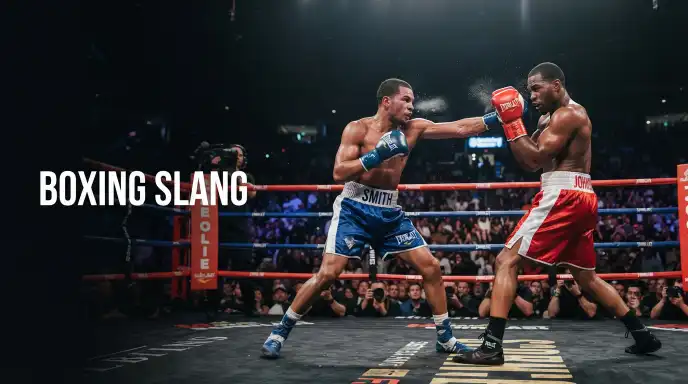
Boxing slang means the special words and phrases used by boxers, coaches, fans, and commentators to talk about boxing.
Have you ever watched a boxing match and heard a word you did not understand? A commentator may say that a boxer has a “glass jaw” or that he is “on the ropes.” These phrases are common in boxing slang.
They help fighters, coaches, fans, and commentators talk about boxing in a simple and colorful way. Boxing slang includes special words and phrases used inside and outside the ring. For example, “glass jaw” means a boxer gets hurt or knocked down easily. Learning boxing slang can help students understand sports news and videos.
It can also help bloggers and content writers write better boxing content. Daily English users may also hear some of these phrases in normal conversations. This guide explains common boxing terms in easy English with simple examples.
Boxing Slang Terms 1–17
1. Glass Jaw
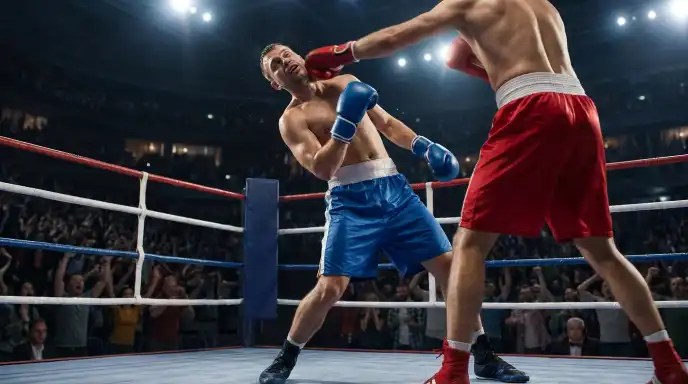
Meaning: A boxer with a glass jaw gets hurt or knocked down easily.
Examples:
- People say the young boxer has a glass jaw.
- One hard punch showed his glass jaw.
2. On the Ropes
Meaning: A boxer is on the ropes when they are pushed back against the ring ropes.
Examples:
- The champion trapped him on the ropes.
- He stayed on the ropes for too long.
3. Knockout
Meaning: A knockout happens when a punch makes a fighter unable to continue.
Examples:
- The match ended with a knockout.
- She won the fight by knockout.
4. KO
Meaning: KO is a short form of the word knockout.
Examples:
- He scored a KO in the third round.
- The crowd went wild after the KO.
5. TKO
Meaning: TKO means the fight stops because a boxer cannot safely continue.
Examples:
- The referee stopped the fight by TKO.
- He won with a TKO in round six.
6. Down for the Count
Meaning: A boxer is down for the count when they cannot get up before the referee finishes counting.
Examples:
- The punch left him down for the count.
- He was down for the count after the final punch.
7. Go the Distance
Meaning: To go the distance means to fight until the final round ends.
Examples:
- Both fighters went the distance.
- I think this fight will go the distance.
8. Glass Chin
Meaning: A glass chin means a boxer can be knocked down easily.
Examples:
- Fans often call him a fighter with a glass chin.
- His glass chin became a problem during the fight.
9. Haymaker
Meaning: A haymaker is a very strong swinging punch.
Examples:
- He threw a huge haymaker at his opponent.
- The haymaker nearly ended the fight.
10. Jab
Meaning: A jab is a quick straight punch from the lead hand.
Examples:
- Use your jab to keep your opponent away.
- Her quick jab landed cleanly.
11. Cross
Meaning: A cross is a strong straight punch from the rear hand.
Examples:
- He landed a powerful cross.
- The boxer followed his jab with a cross.
12. Hook
Meaning: A hook is a curved punch that comes from the side.
Examples:
- She landed a sharp left hook.
- His hook caught the other fighter by surprise.
13. Uppercut
Meaning: An uppercut is a punch that moves upward toward the head or body.
Examples:
- The boxer landed a strong uppercut.
- His uppercut pushed his opponent back.
14. Body Shot
Meaning: A body shot is a punch aimed at the opponent’s body.
Examples:
- The body shot slowed the fighter down.
- She landed two clean body shots.
15. Liver Shot
Meaning: A liver shot is a hard punch aimed at the right side of the body.
Examples:
- The liver shot made him drop his guard.
- One liver shot changed the whole fight.
16. Rabbit Punch
Meaning: A rabbit punch is a punch to the back of the head or neck.
Examples:
- The referee warned him after a rabbit punch.
- The boxer must avoid using a rabbit punch.
17. Cheap Shot
Meaning: A cheap shot is an unfair or unexpected hit.
Examples:
- The fighter complained about the cheap shot.
- Nobody liked the cheap shot during the match.
What These Boxing Terms Mean in Real Life
The first 17 terms show how rich boxing slang can be. Some words describe punches, while others describe fighters, actions, or moments during a match.
Terms such as jab, cross, hook, and uppercut describe different types of punches. Words like glass jaw, glass chin, and haymaker describe a fighter’s strengths or weaknesses.
Some boxing expressions can also appear in everyday English. For example, people may use “on the ropes” to describe someone who is under serious pressure. “Go the distance” can also describe someone who keeps going until the end.
These terms are useful for students who read sports content, bloggers who write about boxing, and content writers who want their articles to sound natural. They also make boxing conversations easier to follow.
Quick Practice
Try to remember these five terms:
- Glass jaw = easily hurt by punches
- Haymaker = powerful swinging punch
- Jab = quick straight punch
- Southpaw = a left-handed boxing stance
- On the ropes = trapped or under pressure
Knowing these basic terms gives you a strong start before learning the next group of boxing expressions.
Boxing Slang Terms 18–34
18. Brawler
Meaning: A brawler is a boxer who likes close and hard fights.
Examples:
- The brawler moved forward without fear.
- Fans love watching this tough brawler.
19. Slugger
Meaning: A slugger is a boxer who depends on powerful punches.
Examples:
- The slugger has amazing punching power.
- He became famous as a heavy-hitting slugger.
20. Puncher
Meaning: A puncher is a boxer known for strong punches.
Examples:
- He is one of the hardest punchers in the gym.
- The young puncher has a dangerous right hand.
21. Counterpuncher
Meaning: A counterpuncher attacks after the other boxer throws a punch.
Examples:
- The counterpuncher waited for an opening.
- He is a smart and patient counterpuncher.
22. Swarmer
Meaning: A swarmer is a boxer who stays close and throws many punches.
Examples:
- The swarmer kept moving toward his opponent.
- She had trouble dealing with the fast swarmer.
23. Outboxer
Meaning: An outboxer uses movement and distance to control the fight.
Examples:
- The outboxer used his speed to win.
- He stayed outside and fought like an outboxer.
24. Southpaw
Meaning: A southpaw is a boxer who fights with the right hand and right foot forward.
Examples:
- The champion is a skilled southpaw.
- Fighting a southpaw can be difficult for new boxers.
25. Orthodox
Meaning: An orthodox boxer usually keeps the left hand and left foot forward.
Examples:
- He uses an orthodox boxing stance.
- The orthodox fighter faced a fast southpaw.
26. Peekaboo
Meaning: Peekaboo is a boxing style that keeps the hands high near the face.
Examples:
- The coach taught him the peekaboo style.
- His peekaboo guard helped protect his face.
27. Shell
Meaning: A shell is a defensive position that protects the boxer from punches.
Examples:
- He moved into a tight shell.
- The boxer used a shell to block the attack.
28. Guard
Meaning: A guard is the position used to protect the head and body.
Examples:
- Keep your guard up during the round.
- His guard dropped when he became tired.
29. Footwork
Meaning: Footwork is the way a boxer moves their feet in the ring.
Examples:
- Her footwork was quick and smooth.
- Good footwork helped him avoid the punch.
30. Ring Generalship
Meaning: Ring generalship means controlling the action and space during a fight.
Examples:
- The champion showed excellent ring generalship.
- His ring generalship helped him control the match.
31. Fight IQ
Meaning: Fight IQ means a boxer’s ability to make smart choices during a fight.
Examples:
- His fight IQ is one of his biggest strengths.
- She used her fight IQ to change her plan.
32. Chin
Meaning: A boxer’s chin describes how well they can take punches.
Examples:
- He has a very strong chin.
- Her strong chin helped her stay in the fight.
33. Iron Chin
Meaning: An iron chin means a boxer can take very hard punches without going down.
Examples:
- The veteran is known for his iron chin.
- His iron chin helped him survive the attack.
34. Punch Drunk
Meaning: Punch drunk describes someone who seems confused after taking many punches.
Examples:
- The boxer looked punch drunk after the round.
- Too many hard hits can leave a fighter punch drunk.
Understanding Fighter Styles
Boxing slang often tells us how a fighter likes to fight. A brawler prefers close action, while a slugger depends on powerful punches. A counterpuncher waits for an opponent to attack before responding.
An outboxer usually prefers space and movement. A swarmer does the opposite and tries to stay close. Learning these terms can help readers understand boxing reports without needing a long explanation.
Stance is also important. An orthodox boxer normally leads with the left side, while a southpaw uses the opposite stance. These words appear often in boxing news, match previews, and commentary.
Boxing Defense and Movement
Good boxing is not only about throwing punches. Defense and movement are also important. Terms such as guard, shell, footwork, and peekaboo describe ways a boxer protects themselves or moves around the ring.
A strong fight IQ also helps a boxer choose the right move at the right time. Ring generalship describes a fighter’s ability to control where and how the action happens.
These expressions are useful for anyone who wants to understand boxing slang in sports articles, interviews, videos, and conversations.
Boxing Slang Terms 35–50
35. Ring Rust
Meaning: Ring rust means losing some skill or sharpness after a long time away from boxing.
Examples:
- The boxer showed some ring rust after two years away.
- His timing improved as his ring rust faded.
36. War
Meaning: A boxing war is a very tough fight with many hard exchanges.
Examples:
- The two fighters gave the fans a real war.
- That match was an exciting war from start to finish.
37. Battle
Meaning: A battle is a hard and competitive boxing match.
Examples:
- The fighters prepared for a long battle.
- Their final round felt like a battle.
38. Dogfight
Meaning: A dogfight is a close and rough fight between two boxers.
Examples:
- The match became a dogfight in the middle rounds.
- Both fighters stayed strong during the dogfight.
39. Journeyman
Meaning: A journeyman is an experienced boxer who fights many opponents during their career.
Examples:
- The young prospect faced an experienced journeyman.
- The journeyman had fought many tough opponents.
40. Prospect
Meaning: A prospect is a young boxer who may become a top fighter.
Examples:
- The young prospect won his fifth fight.
- Many fans think the prospect has a bright future.
41. Contender
Meaning: A contender is a boxer who has a good chance of fighting for a title.
Examples:
- He became a top contender after his big win.
- The contender wants a title fight next.
42. Champion
Meaning: A champion is a boxer who holds a boxing title.
Examples:
- The champion defended his title again.
- Everyone wanted a chance to fight the champion.
43. Glass Cannon
Meaning: A glass cannon is a fighter with great power but poor ability to take punches.
Examples:
- The fighter is known as a glass cannon.
- The glass cannon can end a fight very quickly.
44. Heavy-Handed
Meaning: Heavy-handed describes a boxer who punches with great power.
Examples:
- The new boxer is very heavy-handed.
- His heavy-handed punches made his opponent careful.
45. One-Punch Power
Meaning: One-punch power means having enough strength to knock someone out with one punch.
Examples:
- The champion has serious one-punch power.
- His one-punch power makes every punch dangerous.
46. Eat a Punch
Meaning: To eat a punch means to take a hard punch without avoiding it.
Examples:
- He had to eat a punch before moving forward.
- She can eat a punch and keep fighting.
47. Take a Dive
Meaning: To take a dive means to lose or fall on purpose.
Examples:
- The fans accused the fighter of taking a dive.
- A professional boxer should never take a dive.
48. Pull Your Punches
Meaning: To pull your punches means to hit with less power than usual.
Examples:
- The two friends pulled their punches during training.
- He pulled his punches because it was only practice.
49. Throw in the Towel
Meaning: To throw in the towel means to stop a fight because it is too dangerous to continue.
Examples:
- The trainer threw in the towel in the final round.
- His corner decided to throw in the towel.
50. Hit the Canvas
Meaning: To hit the canvas means to fall onto the floor of the boxing ring.
Examples:
- The boxer hit the canvas after a strong hook.
- He got back up after hitting the canvas.
Why Learn Boxing Slang?
Learning boxing slang can make boxing matches much easier to understand. Words like ring rust, prospect, and contender describe fighters and their careers. Other expressions, such as throw in the towel and take a dive, describe actions during or around a fight.
These terms are also useful outside boxing. Expressions like “throw in the towel” and “go the distance” can appear in everyday English. Understanding them can help students read sports stories, help bloggers write natural content, and help content writers explain boxing topics clearly.
For daily English users, boxing expressions can make conversations more interesting and help them understand phrases they may hear in movies, sports shows, and online discussions.
Exercise
Fill in the Blanks
- A boxer who has been away from the sport for a long time may have some ______.
- A young boxer with the potential to become a star is called a ______.
- A fighter with great punching power but a weak ability to take punches can be called a ______.
- If a trainer wants to stop a dangerous fight, they may ______.
- When a boxer falls onto the ring floor, they ______.
Answers
- Ring rust
- Prospect
- Glass cannon
- Throw in the towel
- Hit the canvas
Context-Based MCQs
1. What does “ring rust” mean?
A. A damaged boxing ring
B. Losing sharpness after time away from boxing
C. A type of boxing glove
D. A strong punch
Answer: B
2. What is a “prospect” in boxing?
A. A retired referee
B. A boxing trainer
C. A young fighter with future potential
D. A type of punch
Answer: C
3. What does “throw in the towel” mean?
A. Start another round
B. Stop the fight
C. Change boxing gloves
D. Enter the ring
Answer: B
4. What does “heavy-handed” mean?
A. A boxer with powerful punches
B. slow feet
C. weak defense
D. large gloves
Answer: A
5. What does “take a dive” mean?
A. Jump out of the ring
B. Train underwater
C. Lose or fall on purpose
D. Avoid a punch
Answer: C
FAQs About Boxing Slang
1. What does boxing slang mean?
Boxing slang means special words and phrases used by boxers, coaches, fans, and commentators.
2. What is a knockout in boxing slang?
A knockout, or KO, happens when a boxer is unable to continue after being knocked down.
3. What does “glass jaw” mean in boxing?
“Glass jaw” describes a boxer who gets hurt or knocked down easily by punches.
4. What does “on the ropes” mean?
“On the ropes” means a boxer is trapped or pushed against the ropes of the ring.
5. What does “go the distance” mean in boxing?
“Go the distance” means both boxers fight until the final round ends.
6. What is a haymaker in boxing?
A haymaker is a large, powerful swinging punch.
7. What does “southpaw” mean in boxing?
A southpaw is a boxer who fights with the right hand and right foot forward.
8. What does “throw in the towel” mean?
“Throw in the towel” means stopping a fight because continuing is no longer safe.
Conclusion
Learning boxing slang can improve your writing, blogging, speaking, and communication skills. These words help you understand boxing matches and sports content with less confusion. Try using new boxing terms in your essays, emails, blog posts, and daily conversations. Start with simple words like jab, hook, southpaw, and knockout. Then practice more advanced expressions such as ring rust, fight IQ, and throw in the towel. With regular practice, these terms will become easier to remember and use.
Read More About !

Michael Brooks is a language writer at SlangPath with 7+ years of experience creating simple, practical content on English slang and everyday expressions.