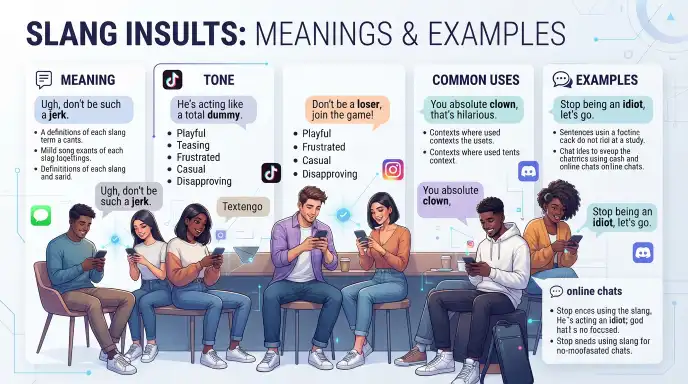
Slang insults are informal words or phrases used to tease, criticize, mock, or put someone down. They can range from mild jokes between friends to language that feels genuinely rude or hurtful. The meaning of a slang insult often depends on the relationship between the people, the situation, and the tone behind the words.
People search for slang insults because they may see unfamiliar expressions in texts, social media comments, gaming chats, or online arguments. A phrase that looks offensive at first may sometimes be friendly teasing between close friends. In another situation, the same type of expression may be meant as a serious personal attack. Understanding slang insults therefore requires more than knowing the words themselves. This guide explains how these expressions work, where they appear, how their tone changes, and when using them may be inappropriate.
Quick Answer: What Are Slang Insults?
Slang insults are informal expressions used to criticize, tease, mock, or offend someone. Some are mild and playful, while others can be harsh or harmful, so the meaning depends on the words, tone, relationship, and situation.
What Does Slang Insults Mean?
The phrase “slang insults” combines two ideas: slang and insults.
Slang refers to informal language that people often use in casual conversations, online communities, texting, gaming, and social media. Slang can change quickly and may be understood mainly by certain groups.
An insult is language that expresses disrespect, criticism, or dislike toward another person. When an insult uses informal or community-based language, it can be described as a slang insult.
For example, someone might call a close friend a silly nickname after they make a small mistake. The speaker may not intend to cause harm. In contrast, someone may use the same type of informal language during an argument to deliberately embarrass another person.
This is why slang insult meaning cannot always be understood from a dictionary definition alone. Context plays a major role.
A few important factors include:
- Who is speaking: Friends may communicate differently from strangers.
- Why they are speaking: A joke has a different purpose from an attack.
- How they say it: Tone can change the meaning.
- Where it happens: Gaming chat and workplace communication have different standards.
- How the listener reacts: A phrase intended as humor can still hurt someone.
Types of Slang Insults
Not all slang insults have the same level of seriousness. Some are harmless in certain relationships, while others can quickly become offensive.
Mild Slang Insults
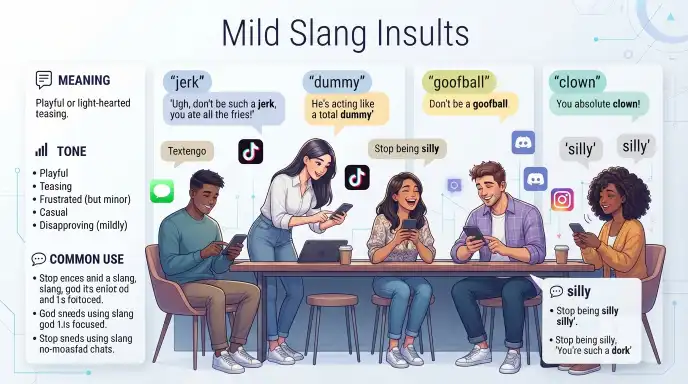
Mild slang insults are usually simple expressions that may sound rude but are not necessarily intended to cause serious harm.
Friends may use these expressions when joking about a small mistake or funny situation. For example:
“You really forgot your keys again, genius.”
The word “genius” is not normally an insult. In this sentence, however, it is being used sarcastically. The speaker may be teasing a friend rather than seriously questioning their intelligence.
The same sentence could sound more hostile if it came from a stranger during an argument.
Playful or Teasing Insults
Some slang insults are used as part of friendly teasing. Close friends may call each other silly names or use exaggerated expressions because they understand the joke.
For example:
“You absolute clown, how did you miss that?”
If two friends are laughing during a casual game, the expression may be playful. It does not necessarily mean the speaker genuinely considers the other person a “clown.”
Still, playful intent does not guarantee that everyone will enjoy the joke. If someone feels uncomfortable, continuing to use the expression can cross a boundary.
Rude Slang Insults
Rude slang insults are more direct. They may be used when someone is annoyed, angry, or trying to criticize another person.
For example:
“Stop acting like a jerk.”
This statement is clearly negative, even though it uses a relatively mild insult.
Rude slang can appear in arguments, comment sections, private messages, and online discussions. The stronger the language becomes, the more likely it is to create conflict.
Strong or Offensive Slang Insults
Some slang insults are deliberately harsh and can seriously offend people. These may involve profanity, degrading language, or attacks on personal characteristics.
Such language should be handled carefully, especially in public or professional settings. Insults targeting someone’s race, religion, disability, gender, nationality, or another protected characteristic can move beyond ordinary rude language into hateful or discriminatory speech.
For an educational slang guide, it is more useful to explain the function and context of these expressions than to provide a long list of offensive terms.
Are Slang Insults Always Offensive?
No, slang insults are not always equally offensive. Some expressions are used as friendly jokes, while others are clearly intended to hurt or humiliate someone.
The relationship between the speakers is one of the biggest factors. Two close friends may use teasing language that would sound insulting between strangers.
For example:
“You’re such a disaster.”
If a friend says this after someone spills a drink and both people laugh, it may be harmless teasing. If someone says it during a serious disagreement, the same words can feel much more hostile.
The situation also matters. A joke in a private conversation is different from publicly insulting someone in front of hundreds of people.
The listener’s response matters as well. If a person says that a nickname or insult makes them uncomfortable, continuing to use it is no longer reasonable to dismiss as “just a joke.”
Tone and Context
Tone and context can completely change how a slang insult is understood. The exact words do not always tell the reader whether something is playful, sarcastic, or aggressive.
Friendly Tone
A friendly tone often appears between people who already know each other well.
“Bro, you’re such a mess today 😂”
The speaker may be joking about a small mistake rather than genuinely criticizing the person.
Humorous Tone
Humorous insults often appear in memes, gaming conversations, or casual group chats.
“That was the worst cooking attempt I’ve ever seen.”
If everyone is laughing about the failed meal, the statement may be playful rather than serious.
Sarcastic Tone
Sarcasm says one thing while intending another meaning.
“Wow, brilliant move.”
If someone makes an obvious mistake, “brilliant” may actually mean the opposite. The surrounding situation helps the reader understand the sarcasm.
Angry Tone
An angry insult is usually more direct and personal.
“Stop being a jerk and listen.”
Here, the speaker is not simply joking. They are expressing frustration with another person’s behavior.
Aggressive Tone
Aggressive insults are intended to attack, intimidate, or humiliate someone. These should not be confused with friendly teasing.
Repeated aggressive insults can damage relationships and may become harassment when they are unwanted and persistent.
Why Context Matters With Slang Insults
A slang insult rarely exists in isolation. The same expression can have different meanings depending on who says it, where it appears, and how the conversation develops.
Consider the phrase:
“Nice one, genius.”
In one conversation, it could be a joke between friends after a silly mistake. In another, it could be a sarcastic criticism meant to embarrass someone.
Online communication makes this even more complicated because readers cannot always hear the speaker’s voice. Emojis, punctuation, previous messages, and shared jokes may provide clues, but they do not always remove ambiguity.
When you see an unfamiliar slang insult, consider these questions:
- Is the conversation serious or playful?
- Do the people know each other?
- Is the speaker angry?
- Is the phrase part of a meme or joke?
- Is the person being targeted comfortable with the language?
- Is the expression being used repeatedly?
- Does the wording attack someone’s personal identity?
Looking at these details gives you a much better idea of what the expression actually means.
Common Contexts for Slang Insults
Slang insults appear in many forms of informal communication.
Texting
Friends may use teasing expressions in private messages. Short slang phrases can make conversations feel more relaxed and humorous.
Social Media
Slang insults can appear in comments, captions, memes, and replies. Public conversations can make these expressions more sensitive because many people may see them.
Gaming
Gaming communities often use competitive banter and playful trash talk. A mild insult between teammates may be intended as humor, but repeated personal attacks can become harassment.
Online Communities
Forums and group chats can develop their own slang. A phrase that seems harsh to an outsider may have a different meaning within a particular community.
The important point is that slang insults are highly context-dependent. Understanding the setting is often just as important as understanding the words.
Where Are Slang Insults Commonly Used?
Slang insults are most common in informal spaces where people communicate casually. Their tone can change depending on the platform, audience, and relationship between the people involved.
Texting
In text messages, friends may use slang insults as jokes, teasing, or quick reactions. Since texting does not include voice tone or facial expressions, the meaning can sometimes be unclear.
For example:
“You really forgot that again, you clown 😂”
Between close friends, this may be playful. Between strangers, it could sound disrespectful.
Emojis, previous messages, and shared jokes can help explain the intended tone. Even so, readers should not assume that every insult in a text message is harmless.
In short, texting makes slang insults easy to use, but the lack of physical tone can also make them easier to misunderstand.
TikTok and Instagram
On TikTok and Instagram, slang insults can appear in comments, captions, memes, replies, and short videos. Some are used for humor, while others appear during disagreements.
A creator may jokingly call a friend a “clown” in a video. Viewers may understand the expression as part of the joke because of the video, facial expressions, and surrounding context.
Comment sections can be different. A person who does not know the creator may use an insult seriously, which can make the interaction more hostile.
Social media slang often depends on the surrounding content, so one word should not be interpreted without looking at the full post or conversation.
Reddit discussions can contain slang insults during debates, jokes, gaming conversations, and community discussions. Different subreddits can also have different communication styles.
A mild expression may be accepted as normal banter in one community but considered rude in another. Users should therefore pay attention to the community’s culture and the tone of the discussion.
On Reddit, community context can strongly influence whether an insult sounds humorous, casual, or aggressive.
Discord
Discord is widely used for group chats, gaming communities, hobby groups, and private conversations. Slang insults may appear naturally when friends are joking around or reacting to something unexpected.
For example:
“Bro, you’re actually terrible at this game.”
If everyone is laughing during a friendly match, the statement may be playful trash talk. If the same comments continue after someone asks the speaker to stop, the situation becomes different.
On Discord, the relationship between users and the ongoing conversation often determines whether slang is friendly banter or unwanted abuse.
Gaming
Gaming is one of the places where people commonly encounter informal insults. Players may use slang during competitive matches, especially when joking with teammates or opponents.
For example:
“Nice shot, genius!”
This could be genuine praise, sarcasm, or playful teasing depending on what happened during the game.
Competitive trash talk is not automatically harassment. However, repeated personal attacks, threats, or targeted abuse go beyond ordinary game-related banter.
Gaming slang can be playful, but competitive language should not become personal harassment.
School and Friend Groups
Students may hear slang insults in conversations with friends, group chats, or online communities. These expressions may function as jokes, nicknames, or reactions to mistakes.
However, repeated insults can become hurtful when the person receiving them does not enjoy the joke. The difference between teasing and bullying often involves repetition, intent, power differences, and the reaction of the person being targeted.
A slang insult may sound harmless in a friendship, but repeated unwanted insults should not be dismissed as simple joking.
Workplace Communication
Slang insults are generally not appropriate for professional communication. Even mild expressions can create confusion or make a conversation appear disrespectful.
For example, calling a coworker a “clown” during a private joke may still be risky if the relationship is not close. Using insulting slang in an email, meeting, customer conversation, or professional group chat can damage trust.
Professional communication should focus on the person’s actions or ideas instead of attacking the person.
When communication is professional, clear and respectful language is safer than slang insults.
Real-Life Examples of Slang Insults
The meaning of a slang insult becomes clearer when it is placed in a realistic situation. These examples show how the same type of language can have different effects.
Friendly Teasing
Alex: “You left your phone at home again, genius.”
Sam: “I know, I know. I’m hopeless today.”
The exchange sounds playful because both people understand the joke and Sam responds comfortably.
Friendly teasing usually depends on mutual understanding and comfort between the people involved.
Casual Texting
“Bro, you’re such a mess today 😂.”
A close friend may use this after the other person makes several small mistakes. The emoji can suggest humor, although emojis alone do not guarantee that the message will be received positively.
Casual texting often makes slang feel lighter, but the relationship still matters.
Sarcastic Conversation
“Great job, genius. You deleted the whole file.”
This sentence is sarcastic because “genius” is being used to express the opposite idea. The speaker is criticizing the mistake rather than genuinely praising the person.
Sarcastic slang can be difficult to understand without knowing what happened before the message.
Gaming Example
“You missed the easiest shot, bro.”
During a friendly match, this could be competitive banter. If the speaker continues attacking the player’s intelligence or personal life, it becomes more serious.
Gaming trash talk should remain focused on the game rather than turning into personal attacks.
Discord Example
“You’re such a troll tonight 😂.”
If friends are intentionally making jokes in a group chat, “troll” may be playful. The same word could be more critical when directed at someone who is repeatedly disrupting a serious discussion.
Discord slang often takes its meaning from the group’s shared humor and communication style.
Social Media Example
“This comment section is full of clowns.”
Here, the speaker is criticizing other commenters. The expression is informal and dismissive rather than neutral.
Public slang insults can attract conflict because the targeted people and other viewers may interpret them differently.
Argumentative Example
“Stop acting like a jerk and listen to what I’m saying.”
The speaker is clearly frustrated. The word “jerk” is being used as a direct negative judgment.
In an argument, even mild slang can make the situation more hostile.
Workplace Example
“You messed this up again, you clown.”
This wording is inappropriate in a professional environment. It attacks the person instead of addressing the specific mistake.
A better approach would be:
“There is an error in this report. Let’s fix it before sending it.”
Professional disagreements are usually more effective when they focus on the problem rather than insulting the person.
Slang Insults vs. Formal Insults
They can both express criticism, but they usually differ in wording and setting.
| Feature | Slang Insults | Formal Insults |
| Language | Informal and casual | More standard or formal |
| Common setting | Texting, chats, gaming, social media | Formal discussions or serious disagreements |
| Tone | Often playful, sarcastic, or rude | Usually more direct |
| Context | Strongly depends on the relationship | Often easier to understand |
| Workplace use | Usually inappropriate | Still needs caution |
| Online use | Very common | Less common in casual spaces |
Slang insults often feel more conversational because they use expressions associated with everyday speech and online culture.
Formal insults may sound less like internet language, but they can still be offensive. Changing the style of an insult does not automatically make it respectful.
The main difference is style and setting, not whether the language can hurt someone.
Slang Insults vs. Playful Teasing
Playful teasing and genuine insults are not always the same thing. The difference usually becomes clearer when you consider intent, relationship, tone, and the other person’s reaction.
Playful teasing often happens between people who already have a comfortable relationship. Both sides may understand that the words are part of a joke.
A genuine insult is more likely to focus on putting someone down, expressing anger, or causing embarrassment.
Several clues can help:
- The people know each other well.
- Both people are comfortable with the joke.
- The situation is clearly playful.
- The person being teased responds positively.
- The language does not target a sensitive personal characteristic.
- The teasing does not continue after someone asks for it to stop.
A joke should not be treated as harmless simply because the speaker says it was a joke. The listener’s comfort matters too.
Why Do People Use Slang Insults?
People use slang insults for different reasons, and the purpose is not always to offend someone.
Humor
Friends may use exaggerated insults to make each other laugh.
Teasing
A mild insult can become part of an inside joke between friends.
Emotional Expression
People sometimes use stronger language when they are angry, frustrated, or surprised.
Gaming Banter
Players may use informal insults as part of competitive conversation.
Online Culture
Memes and social media trends can spread slang expressions quickly.
Group Identity
Certain communities develop shared expressions that outsiders may not immediately understand.
However, understanding the reason behind an insult does not mean that every use is appropriate.
People may use slang insults for humor, bonding, frustration, or competition, but context and personal boundaries still determine whether the language is acceptable.
Common Misunderstandings About Slang Insults
One common mistake is assuming that every slang insult is extremely offensive. Some expressions are mild and are often used as jokes between friends.
Another mistake is assuming that every insult is harmless because people use it casually online. Frequent use does not mean everyone is comfortable with the language.
People can also misunderstand sarcasm. A phrase may look positive on the surface but actually communicate criticism.
Another problem occurs when online slang is moved into real-life professional situations. A word that works in a gaming chat may sound completely inappropriate in a workplace.
The safest way to understand slang insults is to consider the complete conversation instead of judging a phrase from the words alone.
:::
When Should You Avoid Using Slang Insults?
Slang insults should be avoided when the situation is formal, sensitive, or when you are unsure how the other person will react. Informal language that works among close friends can sound disrespectful in other settings.
You should generally avoid slang insults:
- During job interviews
- In professional emails
- When speaking with customers
- In school assignments
- When talking to teachers
- During serious family discussions
- With people you do not know well
- During sensitive conversations
- When someone has already asked you to stop
- When the expression targets a person’s identity or personal characteristics
A person’s reaction is also important. If someone says they do not like a nickname or insult, continuing to use it can turn teasing into unwanted behavior.
When there is doubt, respectful and direct language is usually the better choice.
Polite Alternatives to Slang Insults
You do not need an insult to express disagreement, frustration, or criticism. Clear language can communicate the same concern without attacking another person.
Instead of saying:
“You’re such an idiot.”
You could say:
“I don’t think that was a good decision.”
Instead of:
“You’re being a jerk.”
You could say:
“I don’t like the way you’re speaking to me.”
Instead of:
A more natural and softer version:
“I don’t think that’s a very good idea.”
You could say:
“I don’t think that idea will work.”
These alternatives focus on the action, idea, or situation rather than attacking the person’s character.
Respectful wording makes it easier to disagree without unnecessarily creating conflict.
Are Slang Insults Safe on Social Media?
Slang insults are not automatically unsafe on social media, but public insults can quickly become harmful when they are targeted, repeated, or aggressive.
A mild joke between friends may be understood differently from an insult directed at a stranger in a public comment section.
Social media also has an important difference from private conversation: posts and comments can be seen, shared, or saved by many people. A comment intended as a joke may therefore reach an audience that does not understand the original context.
Users should be especially careful with language that targets:
- Race or ethnicity
- Religion
- Disability
- Nationality
- Gender
- Sexual orientation
- Personal appearance
- Other sensitive personal characteristics
Repeated unwanted insults can also contribute to bullying or harassment.
On social media, consider both the target and the wider audience before using an insulting slang expression.
Slang Insults in Gaming
Gaming is a common environment for slang, jokes, and competitive banter. Players may use informal insults after a missed shot, failed move, or unexpected loss.
For example:
“Bro, how did you miss that?”
This can be harmless banter between friends.
A different situation would be:
“You’re useless. You should never play this game.”
If such comments are repeated to attack a player personally, the language becomes much more hostile.
The difference between trash talk and harassment is important. Competitive banter usually focuses on the match and is understood as part of the game. Harassment can involve repeated personal attacks, threats, humiliation, or unwanted targeting.
Gaming slang can be part of friendly competition, but personal attacks should not be treated as normal trash talk.
How Slang Insults Affect Communication
Slang insults can have both social and negative effects depending on how they are used.
Possible Positive Effects
In close friendships, mild teasing can:
- Create humor
- Strengthen inside jokes
- Make conversations feel relaxed
- Show familiarity
- Add personality to casual communication
These benefits depend on mutual comfort. A joke works best when everyone involved understands and accepts it.
Possible Negative Effects
Slang insults can also:
- Start arguments
- Cause embarrassment
- Create misunderstandings
- Damage friendships
- Encourage bullying
- Make online discussions hostile
- Make professional communication appear disrespectful
The speaker’s intention is only one part of the situation. The person receiving the comment may understand it very differently.
Good communication considers both what the speaker intended and how the message is likely to affect the listener.
Common Slang Insults and Their General Tone
There is no universal scale for slang insults because tone changes with context. However, some common informal expressions generally have recognizable uses.
| Expression | General Tone | Possible Use |
| Clown | Teasing or dismissive | Someone acting foolishly |
| Jerk | Rude | Someone behaving badly |
| Loser | Insulting | Criticizing someone’s success or behavior |
| Idiot | Stronger insult | Calling someone’s action foolish |
| Dummy | Mild or playful | Friendly teasing |
| Fool | Mild to moderate | Calling someone’s behavior unwise |
| Troll | Dismissive | Someone deliberately causing online reactions |
These expressions can still be offensive depending on the speaker, situation, and relationship.
A slang insult’s usual tone is only a starting point; the surrounding conversation determines its actual impact.
Are Slang Insults Appropriate at School?
Slang insults are usually best avoided in formal school communication. Students may use casual teasing among friends, but teachers, classmates, and school staff may interpret the same words differently.
A playful nickname can also become a problem if the person receiving it does not want it. Repeated unwanted name-calling may contribute to bullying.
In assignments, presentations, emails, and other academic work, students should use standard and respectful language.
For example, instead of writing:
“The character is a total idiot.”
A student could write:
“The character makes several poor decisions.”
The second sentence communicates the idea more clearly and suits academic writing better.
Casual slang may fit a private conversation, but schoolwork and formal school communication require more careful language.
Are Slang Insults Appropriate at Work?
Most slang insults are not appropriate in professional communication. Even when intended as a joke, they can make coworkers feel uncomfortable or create an unprofessional impression.
Workplace communication should focus on tasks, ideas, mistakes, and solutions.
For example:
“You completely messed this up.”
can be changed to:
“There are a few problems with this version. Let’s review them.”
The second approach identifies the problem without attacking the person.
This is especially important when communicating with managers, clients, customers, or people you have not worked with before.
At work, respectful wording protects relationships and keeps communication focused on solving problems.
Common Questions About Slang Insults
Q.1 What are slang insults?
Slang insults are informal words or expressions used to tease, criticize, mock, or offend someone. Their seriousness depends on the language, tone, relationship, and situation.
Q.2 Are slang insults always offensive?
No. Some are used playfully between close friends, while others are intended to hurt or humiliate someone. Context is important.
Q.3 What are some examples of slang insults?
Common mild examples include words such as clown, jerk, dummy, fool, and troll. Their meaning can change depending on the situation.
Q.4 Can friends use slang insults as jokes?
Yes, friends sometimes use mild insults as playful teasing. However, everyone involved should be comfortable with the language. If someone asks you to stop, respect that request.
Q.5 Are slang insults appropriate at work?
Generally, no. Slang insults can sound disrespectful or unprofessional in workplace communication, even when the speaker intends them as jokes.
Q.6 Can slang insults become bullying?
Yes. Repeated unwanted insults, especially when they are intended to embarrass, threaten, or isolate someone, can become bullying or harassment.
Conclusion
Slang insults are informal expressions that can be used for teasing, humor, criticism, frustration, or personal attacks. Their meaning is strongly influenced by context, tone, relationship, and setting. A phrase that sounds funny between close friends may feel offensive when used by a stranger or in a professional environment.
Online and gaming communities often use slang more freely, but personal attacks should not be confused with harmless banter. When you are unsure how a phrase will be received, respectful and direct language is the safer choice.
Read More About !
- Chub Slang Meaning Explained: Uses and Examples
- AMG Meaning Slang: Simple Explanation and Examples
- Spanish to English Slang: Meaning in Text

Michael Brooks is a language writer at SlangPath with 7+ years of experience creating simple, practical content on English slang and everyday expressions.