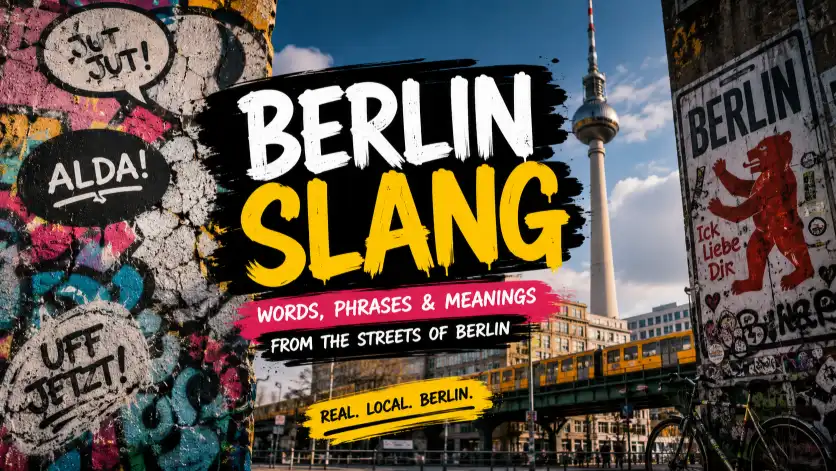
Berlin slang is a mix of traditional Berlinerisch expressions and modern informal words used in everyday life. Some classic Berlin words include Ick, Jut, Kiez, Späti, Schrippe, and Keule, while younger people may also use modern German slang such as Digga, Alter, krass, and wild.
If you are searching for Berlin slang, you may want to understand what people say in Berlin, how traditional Berlin speech differs from modern youth language, and which words you can safely use in daily conversations. This guide explains the meaning, tone, and real-life use of popular Berlin slang in simple English.
One important thing to understand is that Berlin slang is not one fixed list of words. Traditional Berlinerisch is a regional way of speaking, while modern Berlin also has multilingual urban speech and German youth slang.
So, a word you hear from a lifelong Berliner may be very different from a word you hear from a teenager on TikTok or in a Berlin nightclub.
Quick Answer: What Is Berlin Slang?
Berlin slang refers to informal words, phrases, and ways of speaking associated with Berlin. It includes traditional Berlinerisch expressions such as Ick for “I” and Jut for “good,” as well as modern casual words used by younger people and urban communities.
The best way to understand Berlin slang is to separate classic Berlin dialect from modern German youth and city slang. They often overlap, but they are not exactly the same.
What Does Berlin Slang Mean?
Berlin slang means the informal language people associate with life and culture in Berlin.
Depending on the situation, it can include:
- Traditional Berlinerisch dialect
- Casual Berlin expressions
- Neighborhood or Kiez vocabulary
- Modern German youth slang
- Words influenced by Berlin’s multicultural communities
- Informal language used in music, social media, and nightlife
Berlin has people from many different backgrounds. Because of this, the language heard in the city can change from one neighborhood, age group, or social group to another.
A useful way to think about Berlin slang is this:
| Type of language | What it means |
| Traditional Berlinerisch | Classic regional Berlin speech |
| Modern Berlin slang | Casual words commonly heard in the city |
| German youth slang | Modern informal words used by young people across Germany |
| Kiezdeutsch | A modern urban way of speaking influenced by multilingual communities |
Not every slang word used in Berlin started in Berlin. For example, Digga is widely used in modern German conversation, but its well-known roots are connected to northern German and Hamburg youth and hip-hop culture rather than traditional Berlinerisch.
Traditional Berlin Slang vs. Modern Berlin Slang
The biggest mistake people make when learning Berlin slang is treating every casual German word as an old Berlin dialect word.
That is not accurate.
Traditional Berlinerisch
Traditional Berlinerisch includes words and pronunciation patterns strongly connected with Berlin.
Examples include:
- Ick instead of ich — “I”
- Jut instead of gut — “good”
- Allet instead of alles — “everything”
- Schrippe — bread roll
- Stulle — sandwich or slice of bread
- Molle — beer
- Keule — friend or mate in some contexts
Berlin’s official tourism language guide continues to list many of these classic expressions, including Atze, Dalli, Ejal, Icke, Kiez, Knorke, Molle, Schrippe, Späti, and Stulle.
Modern Berlin Slang
Modern Berlin slang can include words that are popular across Germany, especially among young people.
You may hear:
- Digga — dude, bro, mate
- Alter — dude, man
- Krass — unbelievable, intense, amazing
- Wild — out of control or unbelievable
- Bodenlos — extremely bad, outrageous, or out of line, depending on context
- Ehre — respect
- Sus — suspicious
These words may be heard in Berlin, but many are not exclusive to Berlin.
That difference matters if you want to sound accurate when talking about Berlin slang.
Most Common Traditional Berlin Slang Words
Here are some of the best-known words you may hear when learning about traditional Berlin speech.
Ick
Ick means “I.”
It is the famous Berlinerisch version of the standard German word ich.
Example:
“Ick hab keene Zeit.”
Meaning: “I don’t have time.”
The word Ick is strongly associated with traditional Berlin speech and Berlin identity.
Jut
Jut means “good” or “fine.”
It comes from the standard German word gut.
Example:
“Allet jut!”
Meaning: “Everything is good!”
You may see jut in humorous Berlin phrases, dialect writing, and traditional local speech.
Allet
Allet means “everything.”
It is a Berlinerisch form of the German word alles.
Example:
“Allet klar?”
Meaning: “Everything okay?” or “All clear?”
You may hear it together with other Berlin dialect forms.
Kiez
Kiez means a local neighborhood or area.
This word is especially important in Berlin because many people strongly identify with their local neighborhood.
Example:
“Mein Kiez ist in Kreuzberg.”
Meaning: “My neighborhood is in Kreuzberg.”
Kiez is not just a random slang word. It is an important everyday word connected with local community and neighborhood identity.
Späti
Späti is short for Spätverkauf.
It usually means a small shop that stays open late and sells everyday items such as drinks, snacks, and other basic goods.
Example:
“Let’s stop at the Späti.”
For many visitors, Späti becomes one of the first informal Berlin words they learn.
Schrippe
Schrippe means a bread roll.
In other parts of Germany, people may use different words for the same type of bread.
Example:
“Ich hole noch Schrippen zum Frühstück.”
Meaning: “I’m getting some bread rolls for breakfast.”
It is a classic regional word often connected with Berlin and the surrounding area.
Stulle
Stulle usually means a sandwich or a slice of bread with something on it.
It often refers to a simple everyday meal.
Example:
“Ich nehme eine Stulle zur Arbeit.”
Meaning: “I’m taking a sandwich to work.”
Molle
Molle is a traditional Berlin word for a beer.
The word is strongly connected with classic Berlin drinking culture.
Example:
“Nach der Arbeit trinken wir eine Molle.”
Meaning: “After work, we’re having a beer.”
The official Berlin language guide includes Molle among its well-known Berlinerisch terms.
Dalli
Dalli means “hurry up” or “come on.”
It is used when you want someone to move faster.
Example:
“Dalli, sonst verpassen wir die Bahn!”
Meaning: “Hurry up, or we’ll miss the train!”
The tone is casual and can sound playful or impatient depending on how it is said.
Atze
Atze is an informal word for a friend, buddy, or close person.
Its exact tone can depend on the speaker and social group.
Example:
“Na, Atze, alles klar?”
Meaning: “Hey, mate, everything okay?”
It has strong connections with Berlin and casual local speech.
Knorke
Knorke means great, excellent, or very good.
Today, it can sound old-fashioned, playful, or deliberately retro.
Example:
“Der Film war knorke!”
Meaning: “The movie was great!”
Do not assume every young Berliner uses this word in normal daily conversation. Some classic dialect words survive mainly as cultural markers, humorous expressions, or words associated with older speakers.
Is Traditional Berlin Slang Still Common?
Yes, but it depends on what type of Berlin slang you mean.
Classic Berlinerisch still has strong cultural importance, but current discussions about Berlin language also point to a decline in everyday use of the traditional dialect. Some linguistic observers note that strong traditional Berlin speech is less common in central parts of the city than in earlier generations, while newer urban varieties continue to develop.
That means a visitor should not expect every person in Berlin to say:
“Ick bin Berliner.”
Many people speak standard German with only a few regional words.
Others may use:
- Modern youth slang
- Multilingual urban expressions
- Standard German
- English loanwords
- A mixture depending on the situation
This is why learning only old-fashioned Berlin dialect words will not always help you understand conversations between young people in modern Berlin.
Modern Berlin Youth Slang You May Hear
Modern Berlin has a large youth culture, music scene, online culture, gaming community, and international population. Because of this, many informal words used in the city also come from wider German youth culture.
Digga
Digga means something like “dude,” “bro,” or “mate.”
It can be friendly, surprised, annoyed, or funny depending on tone.
Examples:
“Digga, was machst du?”
“Dude, what are you doing?”
“Digga, das war krass!”
“Bro, that was unbelievable !”
Digga is currently still highly visible in German youth language and was among the terms discussed in the 2026 Youth Word of the Year conversation. However, it should not be described as a traditional Berlin dialect word.
Alter
Alter can mean “dude,” “man,” or “bro” in casual conversation.
Its literal meaning is closer to “older person,” but slang use is very different.
Example:
“Alter, das kann nicht wahr sein!”
Meaning: “Dude, that can’t be true!”
The tone can show surprise, frustration, excitement, or disbelief.
Krass
Krass usually means “aggravating,” “,” or “amazing.”
The exact meaning depends on context.
Example:
“Der Film war krass.”
This could mean:
- The movie was amazing.
- The movie was intense.
- The movie was shocking.
Context tells you which meaning is intended.
Wild
Wild often means shocking, unbelievable, or extreme.
Example:
“Das ist wild.”
Meaning: “That’s shocking.”
It is especially common in casual youth and online language.
Ehre
Ehre literally relates to honor or respect, but in slang it often means “respect” or “you’re a real one.”
Example:
“Du hast mir geholfen? Ehre!”
Meaning: “You helped me? Respect!”
It can be sincere or playful.
What Is Kiezdeutsch?
Kiezdeutsch is not simply another name for old Berlinerisch.
It is a modern urban way of speaking German associated especially with young people in multilingual communities. The term is connected with urban neighborhoods, which helps explain why it is often discussed in relation to Berlin.
Modern Berlin speech can include influences from migration, multilingual communities, social media, music, and youth culture. Linguistic discussions also make a clear distinction between declining traditional Berlin dialect and newer urban varieties such as Kiezdeutsch.
This is important because people sometimes incorrectly describe all multicultural German youth speech as “Berlin slang.”
That is too simple.
Some expressions may be common in Berlin, while similar language patterns may also appear in other German cities.
Berlin Slang on Social Media and in Daily Life
The type of slang you hear can change depending on where you are.
| Situation | Likely language style |
| Talking with older locals | Traditional Berlinerisch may appear |
| Friends and casual chats | Digga, Alter, krass, wild |
| TikTok and Instagram | Fast-changing youth and internet slang |
| Gaming and Discord | German slang mixed with English internet terms |
| Local neighborhood life | Words like Kiez and Späti |
| Job interview | Standard German is safer |
| Formal email | Avoid slang |
| Tourist conversation | Simple standard German is usually best |
One important rule is simple:
Do not force Berlin slang into every conversation.
Knowing a slang word is useful. Using it naturally is more important.
A visitor who suddenly uses many dialect words can sound like they are performing a stereotype rather than speaking naturally.
Is Berlin Slang Rude or Offensive?
Most common Berlin slang is not automatically rude.
However, Berlin has a reputation for direct communication, and some expressions can sound stronger depending on tone.
Words such as:
- Digga
- Alter
- Atze
- Keule
are generally informal rather than automatically offensive.
But informal does not mean appropriate everywhere.
A word that sounds friendly between close friends may sound strange when used with:
- A teacher
- Your boss
- A stranger
- An older person
- Someone you have just met
Tone and relationship matter.
For example, saying “Digga” to a close friend may sound normal. Saying it to someone during a formal business meeting may sound unprofessional.
When Should You Avoid Using Berlin Slang?
Avoid Berlin slang when the situation requires formal or respectful language.
Be careful in:
- Job interviews
- Formal work meetings
- Business emails
- Government offices
- Academic writing
- Conversations with people you do not know well
You should also avoid using words from communities or language varieties that you do not fully understand.
The safest approach is to listen first.
If people around you naturally use a word, you can learn how it works from context. If you are unsure, standard German is usually the better choice.
More Popular Berlin Slang Words and Expressions
Berlin slang includes much more than Ick, Digga, and Späti. Some words come from traditional Berlinerisch, while others are modern expressions that you may hear in Berlin because they are popular across Germany.
Here are more useful words to know.
Ejal
Ejal means “I don’t care” or “it doesn’t matter.”
It is the Berlin dialect form of the standard German word egal.
Example:
“Dit is mir ejal.”
Meaning: “I don’t care about that.”
The phrase can sound casual and direct. Like many Berlin expressions, the tone depends on the situation.
Keule
Keule can mean “mate,” “buddy,” or “bro” in Berlinerisch.
It is often used as an informal way to address someone.
Example:
“Pass ma uff, Keule!”
Meaning: “Listen up, mate!”
However, the tone matters. The phrase can sound friendly between friends, but it can also sound challenging or unfriendly in an argument.
Dufte
Dufte means great, nice, or cool.
It is a classic Berlin expression.
Example:
“Die Party war dufte.”
Meaning: “The party was great.”
Today, dufte may sound traditional or slightly old-fashioned to some younger speakers. It can also be used playfully or with a retro feeling. Berlin’s official dialect guide still lists it as part of Berlinerisch vocabulary.
Bulette
Bulette means a meat patty or meatball, similar to a German Frikadelle.
The word is strongly associated with Berlin food culture.
Example:
“Ich nehme eine Bulette mit Brot.”
Meaning: “I’ll have a meat patty with bread.”
You may also hear the famous Berlin-style expression:
“Nu aba ran an de Buletten!”
The phrase does not always literally mean “Let’s eat.” It can also mean “Come on, let’s get started!” or “Let’s get to work!”
Fisimatenten
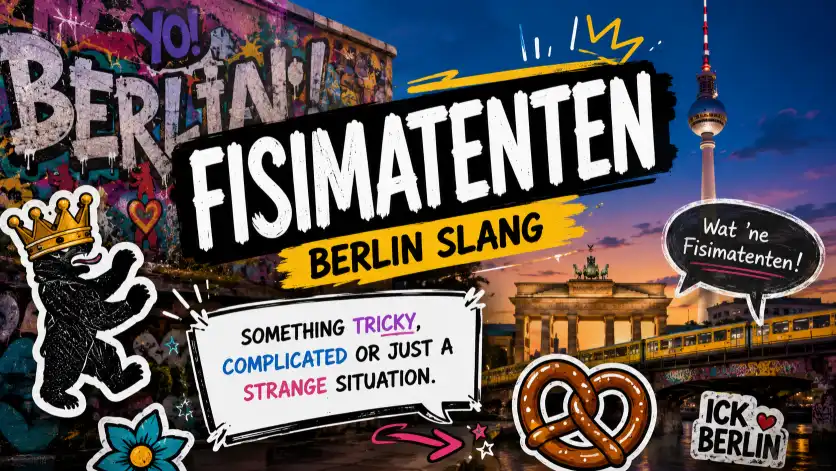
Fisimatenten means unnecessary nonsense, foolish behavior, or pointless trouble.
It is usually used when someone is making things more complicated than they need to be.
Example:
“Mach keine Fisimatenten!”
Meaning: “Don’t make unnecessary trouble!”
The exact history of this word is often debated, so it is better not to repeat popular but unsupported stories about its origin as a fact.
Pinte
Pinte means a pub or drinking place.
It is an informal word for a Kneipe, which is a casual bar or pub.
Example:
“Wir treffen uns später in der Pinte.”
Meaning: “We’ll meet later at the pub.”
The term is still known in informal German, and Berlin’s language guide describes it as a word for a drinking establishment.
Budike
Budike is an old Berlin word for a pub or small drinking place.
Today, it is much less common than some other Berlin words.
Example:
“Früher ging man in die Budike.”
Meaning: “People used to go to the pub.”
If you use this word today, it may sound deliberately traditional or old-fashioned rather than like modern youth slang. Berlin’s own guide notes that Pinte is more common today.
Schnurzpiepegal
Schnurzpiepegal means “I couldn’t care less.”
It expresses complete lack of interest.
Example:
“Was die denken, ist mir schnurzpiepegal.”
Meaning: “I couldn’t care less what they think.”
This expression can sound funny, dramatic, or strongly dismissive.
A shorter Berlin-style expression is:
“Dit is mir schnurz piepe!”
Meaning: “That doesn’t matter to me at all!”
JWD
JWD is an abbreviation for “janz weit draußen.”
It means very far away, especially somewhere far outside the center.
Example:
“Der wohnt jwd.”
Meaning: “He lives miles away.”
It is a useful example of traditional Berlin-style pronunciation appearing in written slang.
Fatzke
Fatzke is a negative word for someone who acts arrogant, vain, or full of themselves.
It is similar to saying:
- show-off
- arrogant guy
- poser
Example:
“Der hält sich für was Besseres. Was für ein Fatzke!”
Meaning: “He thinks he’s better than everyone else. What a show-off!”
Be careful with this word because it is clearly negative.
Bekloppt
Bekloppt means inexplicable,, silly, or foolish.
The exact strength depends on tone.
Example:
“Bist du bekloppt?”
Meaning: “Are you obsessed ?”
Friends may say it jokingly, but it can also sound insulting.
Modern Slang You May Hear in Berlin in 2026
Berlin is an international city, so modern speech changes quickly.
Young people may mix:
- German
- English internet language
- gaming vocabulary
- social media expressions
- words from multilingual communities
This does not mean every modern slang word belongs specifically to Berlin.
That distinction is important.
Crashout
Crashout means losing control emotionally or completely losing your temper.
The term appears in current German youth-language discussions and comes from modern internet culture.
Example:
“Wenn mein Handy jetzt ausgeht, gehe ich komplett Crashout.”
Meaning: “If my phone dies now, I’m going to completely lose it.”
It can be used seriously or jokingly. In 2026, Crashout appeared among the major terms in Germany’s Youth Word discussions.
Schere
Schere can mean “my mistake” in current German youth slang.
The expression became associated with gaming culture and is now also used in ordinary casual situations.
Example:
“Schere, ich hab dir gar nicht geantwortet.”
Meaning: “My bad, I didn’t reply to you.”
It is a modern slang expression rather than traditional Berlinerisch.
Ragebait
Ragebait means online content designed to make people angry and react.
Someone may post an intentionally extreme or provocative opinion to attract comments and attention.
Example:
“Ignore that post. It’s obvious ragebait.”
The word is especially connected with social media and online culture. It is also part of current German youth-language discussions in 2026.
Peak
Peak can mean the best part or highest point of something.
Example:
“Das Konzert war Peak.”
Meaning: “That concert was the absolute best.”
The expression comes from English and shows how strongly English continues to influence modern German youth language.
Macker
Macker can refer to a boyfriend, guy, friend, or dude depending on context.
It is not a new word, but it has experienced renewed attention in current youth-language discussions.
Example:
“Mein Macker kommt später vorbei.”
Meaning: “My boyfriend is coming over later.”
The tone can be affectionate, ironic, or casual.
Is Kiezdeutsch the Same as Berlin Slang?
No. Kiezdeutsch and Berlin slang are related in discussions about urban language, but they are not the same thing.
Traditional Berlinerisch is a regional dialect strongly connected with Berlin.
Kiezdeutsch is a modern urban variety of German associated with young people and multilingual communities. Similar language patterns can also appear in other German cities.
So, calling every Kiezdeutsch expression “Berlin slang” can be misleading.
Berlin has played an important role in public discussions about Kiezdeutsch, but the variety should not be treated as simply a replacement name for classic Berlinerisch.
Language discussions in 2026 continue to highlight a major change: traditional Berlin dialect has become less common in many parts of Berlin, while newer urban forms of speech have developed and become more visible.
Where Is Berlin Slang Commonly Used?
Berlin slang is most natural in relaxed and informal situations.
You may hear it in:
Daily Conversations
Friends may use words such as:
- Digga
- Alter
- Keule
- Krass
- Späti
Example:
“Digga, lass uns zum Späti gehen.”
Meaning:
“Dude, let’s go to the late-night shop.”
Berlin Neighborhoods
Words connected with local life are common when people talk about their area.
For example:
“Mein Kiez ist ruhig.”
Meaning:
“My neighborhood is quiet.”
For many Berliners, Kiez means more than a simple district. It can suggest a familiar local area where people know the streets, shops, and everyday places around them.
Text Messages
Short slang words work well in casual texting.
Examples:
“Digga 😭”
This can show surprise, frustration, or disbelief.
“Schere, hab’s vergessen.”
Meaning:
“My bad, I forgot.”
TikTok and Instagram
Social media spreads new slang very quickly.
Current expressions may come from:
- Viral videos
- Songs
- Memes
- Influencers
- Gaming
- International internet culture
For this reason, some words that people hear in Berlin may disappear within a few months, while classic words such as Ick or Späti remain strongly connected with Berlin.
Discord and Gaming
Gaming communities often use a mixture of German and English.
You may hear words such as:
- Sus
- Cringe
- Ragebait
- Crashout
- Peak
These words are usually better described as internet or youth slang rather than traditional Berlin slang.
Berlin Slang on Different Platforms
| Platform or Situation | Common Style |
| Texting | Short, casual words |
| TikTok | Fast-changing viral slang |
| Youth slang and English words | |
| Discord | Gaming and internet terms |
| Real-life Berlin conversations | Depends on age and social group |
| Local neighborhood talk | Kiez, Späti, regional words |
| Workplace chat | Usually less slang |
| Formal email | Standard German is best |
The same person may use very different language in each situation.
For example, someone might say “Digga, das ist wild” while talking to friends but use completely standard German in an office email.
Why Do People Use Berlin Slang?
People use slang for more than simply saving time.
Slang can help people:
- Sound friendly
- Show local identity
- Feel connected to a group
- Make conversations more relaxed
- Express surprise or emotion quickly
- Show humor
- Follow online trends
Traditional Berlin expressions can also show cultural identity.
For example, words such as Ick, Kiez, Späti, Schrippe, and Molle immediately create a strong Berlin connection.
However, using slang does not automatically make someone sound like a local.
Natural usage comes from understanding when, where, and with whom a word is used.
Common Mistakes People Make With Berlin Slang
Mistake 1: Thinking Every German Slang Word Is Berlin Slang
This is one of the most common mistakes.
Words such as Digga, Crashout, Ragebait, and Peak may be heard in Berlin, but they are not automatically Berlin dialect words.
Always separate:
Words from Berlin
from
Words currently used in Berlin
That makes your understanding much more accurate.
Mistake 2: Using Old Words as if Everyone Uses Them
Words such as knorke and dufte are famous Berlin expressions.
However, famous does not always mean commonly used by every young Berliner today.
Some words may sound:
- Traditional
- Old-fashioned
- Humorous
- Retro
- Deliberately local
This does not make them wrong. It simply means context matters.
Mistake 3: Using Slang in Formal Situations
Even harmless slang can sound inappropriate in the wrong place.
Avoid strong casual language in:
- Job applications
- Interviews
- Formal presentations
- University essays
- Official emails
Mistake 4: Copying Pronunciation Without Understanding the Word
Trying to copy Ick or other dialect pronunciation can sound unnatural if you do not understand the sentence.
It is better to use a few words naturally than to fill every sentence with fake dialect.
Can You Use Berlin Slang at Work?
Usually, only in casual situations with people you know well.
Berlin workplaces can be informal, especially in creative, technology, media, or startup environments. However, workplace culture varies.
A simple rule is:
Follow the language used by the people around you.
If your coworkers casually say:
“Krass!”
or
“Alles klar, Digga?”
you may understand the tone of the workplace.
But for communication with:
- Clients
- Managers
- New colleagues
- Official organizations
standard German is safer.
Can Tourists Use Berlin Slang?
Yes, but use it lightly.
Words such as:
- Kiez
- Späti
- Schrippe
- Ick
- Dalli
can be fun to learn and may help you understand local culture.
However, tourists do not need to force dialect into every sentence.
A natural approach is:
- Learn what the word means.
- Listen to how locals use it.
- Notice the tone.
- Use it in a casual situation if it feels appropriate.
Understanding slang is often more useful than trying to actively use every slang word.
When Should You Avoid Berlin Slang?
Avoid Berlin slang when clarity, professionalism, or respect is more important than sounding casual.
Do not use it when:
- You do not understand the word fully.
- The person may misunderstand your tone.
- You are writing a formal message.
- You are speaking to someone in a professional setting.
- The expression has a negative meaning.
- You are copying language from a community without understanding its context.
The safest rule is simple:
Listen first and use slang naturally, not as a performance.
Origin and History of Berlin Slang
Berlin slang has developed over centuries, so it does not have one single origin. Traditional Berlin speech, usually called Berlinisch or Berlinerisch, developed through different regional and social language influences as Berlin grew into a major city.
Linguistic history connects Berlinisch with both Low German influences and later forms of High German. Over time, migration and contact between different groups also helped shape the vocabulary and character of Berlin speech. This is one reason why Berlin slang has such a mixed and distinctive sound.
Today, Berlin language continues to change.
Classic expressions such as:
- Ick
- Jut
- Allet
- Schrippe
- Stulle
- Molle
remain important cultural markers.
At the same time, Berlin’s younger speakers may use new words influenced by:
- Social media
- Music
- Gaming
- English
- Migration
- Multilingual communities
- Internet culture
This means modern Berlin slang is constantly changing, while traditional Berlinerisch remains an important part of the city’s identity.
Berlin Slang and Migration
Berlin has changed through many waves of migration, and language has changed with the city.
Traditional Berlin speech itself developed through contact between different linguistic influences. Modern urban language in Berlin also reflects the city’s multilingual communities.
Kiezdeutsch is one important example. Linguistic research describes it as an urban contact variety that developed in multilingual and multiethnic neighborhoods. It is not simply “bad German” or broken German. Researchers have found systematic patterns in its grammar and usage.
This is an important distinction.
Traditional Berlinerisch, Kiezdeutsch, and modern youth slang can overlap in real life, but they are not the same thing.
Is Traditional Berlin Slang Disappearing?
Traditional Berlinerisch is still known and used, but strong dialect use is changing.
In modern Berlin, many residents speak mostly standard German. Others use only a few traditional Berlin words in everyday conversation.
A 2026 discussion of the changing Berlin dialect notes that there are no official statistics showing exactly how many people still speak Berlinisch regularly. The dialect remains visible through well-known local words such as Schrippe, Bulette, and JWD, but its everyday use varies by generation, neighborhood, and social background.
This does not mean Berlin slang will suddenly disappear.
Instead, some parts of it may survive through:
- Family speech
- Local identity
- Humor
- Media
- Music
- Advertising
- Famous expressions
- Tourism
- Everyday words such as Kiez and Späti
Other words may sound increasingly old-fashioned.
That is normal for slang and dialects.
Berlin Slang vs. Standard German
The easiest way to understand Berlin slang is to compare it with standard German.
| Berlin slang or dialect | Standard German | English meaning |
| Ick | Ich | I |
| Jut | Gut | Good |
| Allet | Alles | Everything |
| Dit | Das | That |
| Wat | Was | What |
| Kiek mal | Schau mal | Look |
| JWD | Ganz weit draußen | Very far away |
| Ejal | Egal | It doesn’t matter |
These differences are one reason traditional Berlin speech can sound very different from standard German.
However, visitors do not need to learn the entire dialect.
Knowing a few common words can help you understand local conversations and Berlin culture.
Berlin Slang vs. German Youth Slang
These two categories often get confused.
Berlin Slang
Berlin slang is connected with:
- Berlin
- Local culture
- Berlinerisch
- Neighborhood vocabulary
- Regional speech
Examples include:
- Ick
- Jut
- Kiez
- Späti
- Schrippe
- Stulle
- Molle
German Youth Slang
German youth slang is broader.
It can spread across:
- Berlin
- Hamburg
- Munich
- Cologne
- TikTok
- Discord
- Gaming communities
Examples may include:
- Digga
- Cringe
- Sus
- Wild
- Peak
- Ragebait
A young Berliner may use both types of language in the same conversation.
For example:
“Digga, mein Späti im Kiez hat schon zu.”
Meaning:
“Dude, my late-night shop in the neighborhood has already closed.”
In this sentence, Digga is broader youth slang, while Späti and Kiez have a much stronger Berlin connection.
Berlin Slang vs. Kiezdeutsch
Berlin slang and Kiezdeutsch should also not be treated as identical.
| Language variety | Main connection |
| Berlinerisch | Traditional regional Berlin speech |
| Berlin slang | Informal words associated with Berlin |
| Kiezdeutsch | Urban German variety connected with multilingual communities |
| Youth slang | Informal language popular among young people |
Kiezdeutsch developed as part of Germany’s multilingual urban language landscape and has been studied using naturally occurring speech from young people in Berlin neighborhoods.
The most respectful approach is to understand Kiezdeutsch as a real language variety rather than treating it as a joke or automatically calling it incorrect German.
Real-Life Berlin Slang Examples
Here are examples showing how Berlin slang may appear in natural situations.
Talking to a Friend
Person 1: “Na, alles klar, Atze?”
Person 2: “Ja, allet jut.”
Meaning:
Person 1: “Hey, mate, everything okay?”
Person 2: “Yeah, everything’s good.”
Going to the Späti
Person 1: “Wir brauchen noch Getränke.”
Person 2: “Kein Problem, ich geh schnell zum Späti.”
Meaning:
Person 1: “We still need drinks.”
Person 2: “No problem, I’ll quickly go to the late-night shop.”
Talking About a Neighborhood
Person 1: “Wo wohnst du?”
Person 2: “In einem ruhigen Kiez.”
Meaning:
Person 1: “Where do you live?”
Person 2: “In a quiet neighborhood.”
Modern Casual Conversation
Person 1: “Digga, hast du das gesehen?”
Person 2: “Ja, das war komplett wild.”
Meaning:
Person 1: “Dude, did you see that?”
Person 2: “Yeah, that was completely shocking.”
This example shows modern German youth slang that may be heard in Berlin but is not traditional Berlinerisch.
A Classic Berlin-Style Expression
Person 1: “Dalli, wir müssen los!”
Meaning:
“Hurry up, we need to go!”
The tone can be playful or impatient depending on the situation.
Is Berlin Slang Rude?
Most Berlin slang is not rude by itself. Context and tone decide how a word sounds.
Friendly words include:
- Kiez
- Späti
- Stulle
- Dalli
Some words can become rude depending on how they are used.
For example:
- Fatzke can insult someone.
- Bekloppt can sound joking or offensive.
- Keule can sound friendly or aggressive depending on tone.
Berlin also has a popular reputation for direct and quick speech, sometimes described through the idea of the Berliner Schnauze. However, directness does not automatically mean rudeness.
The relationship between speakers matters.
Can You Use Berlin Slang With Teachers or Parents?
Usually, use caution.
Words such as Kiez and Späti are generally harmless everyday words.
However, terms such as:
- Digga
- Alter
- Keule
- Fatzke
are much more informal.
A simple rule is:
Use slang with teachers, parents, or older people only if that style already feels normal in your relationship.
If you are unsure, use standard German.
Can You Use Berlin Slang at Work?
For casual conversations with friendly coworkers, some harmless expressions may be fine.
For example:
“Ich hole noch etwas vom Späti.”
This simply means:
“I’m getting something from the late-night shop.”
However, avoid heavy slang in:
- Job interviews
- Formal presentations
- Business emails
- Client meetings
- Official documents
Professional communication should focus on clarity.
Why Is Berlin Slang So Popular Online?
Berlin has a strong cultural image.
People often associate the city with:
- Music
- Art
- Nightlife
- Street culture
- International communities
- Alternative culture
- Youth culture
Because of this, Berlin words can spread outside the city.
Späti, for example, is widely recognized as a Berlin cultural word.
At the same time, social media can make words look more “Berlin” than they really are.
A word used in a viral video by a Berliner is not automatically traditional Berlin slang.
Always check whether a term is:
- Traditional Berlin speech.
- Modern slang used in Berlin.
- German youth slang.
- International internet slang.
That distinction prevents many common misunderstandings.
When Should You Avoid Using Berlin Slang?
Avoid Berlin slang when the situation requires a formal, neutral, or respectful tone.
Be careful when:
- Applying for a job
- Writing an academic paper
- Sending a formal email
- Speaking with a client
- Talking to someone you do not know
- Using a word whose meaning you do not fully understand
You should also avoid trying to imitate an entire dialect just to sound local.
Using one familiar word naturally is better than forcing many expressions into a sentence.
Common Misunderstandings About Berlin Slang
“Everyone in Berlin speaks strong Berlinerisch.”
Not true.
Berlin is a large and highly diverse city. Many people mainly speak standard German.
“Every slang word used in Berlin is Berlin slang.”
Not true.
Modern German youth slang is used in Berlin, but many words come from wider national or international trends.
“Kiezdeutsch is simply broken German.”
Not accurate.
Linguistic research describes Kiezdeutsch as a systematic urban language variety rather than simply incorrect German.
“Old Berlin words are no longer useful.”
Not true.
Words such as Kiez, Späti, Schrippe, and Molle remain important for understanding Berlin culture, even when some other classic words sound old-fashioned.
“Using Berlin slang makes you sound like a Berliner.”
Not necessarily.
Language sounds most natural when it develops through real use and understanding.
Frequently Asked Questions About Berlin Slang
What is Berlin slang called?
Traditional Berlin slang and dialect are commonly called Berlinisch or Berlinerisch. Informally, people may also refer to it as Berliner Schnauze, especially when talking about Berlin’s direct and distinctive speaking style.
What does “Ick” mean in Berlin slang?
Ick means “I.”
It is the famous Berlin dialect form of the standard German word ich.
What does “Späti” mean in Berlin?
Späti means a small shop that stays open late.
It comes from Spätverkauf and is strongly associated with Berlin daily life.
What does “Kiez” mean in Berlin slang?
Kiez means a local neighborhood or community area.
The word is strongly connected with local identity in Berlin.
What does “Digga” mean in Berlin?
Digga means something like “dude,” “bro,” or “mate.”
You can hear it in Berlin, but it is broader German youth slang and should not be described as traditional Berlin dialect.
Is Berlin slang offensive?
Most common Berlin slang is harmless.
However, some words can sound insulting or aggressive depending on their meaning and tone. Always consider the relationship and situation.
Do young people in Berlin still speak Berlinerisch?
Some do, but language use varies greatly. Many young Berliners mainly use standard German, modern youth slang, or other urban language varieties. Traditional Berlin speech remains an important cultural reference, but its strongest forms are not used equally by everyone.
What is the difference between Berlin slang and Kiezdeutsch?
Berlin slang is a broad term for informal language associated with Berlin.
Kiezdeutsch is a specific urban German variety associated with multilingual and multiethnic neighborhoods and youth communities.
They can exist in the same city, but they are not the same language variety.
Can tourists use Berlin slang?
Yes. Tourists can safely learn and use common words such as Kiez and Späti.
It is better to use slang naturally rather than trying to imitate an entire Berlin accent.
Conclusion
Berlin slang is a mix of old local tradition and constantly changing modern language. Classic Berlinerisch gives you words such as Ick, Jut, Schrippe, Stulle, and Molle, while everyday Berlin life also includes familiar local words such as Kiez and Späti.
Modern youth slang adds another layer, but not every trendy German or internet word should be called Berlin slang. The key is context.
If you want to understand Berlin slang, learn the classic words, notice which expressions are still natural today, and remember that Berlin’s language changes with its people. Understanding the difference between traditional Berlinerisch, modern Berlin speech, Kiezdeutsch, and wider German youth slang will help you use and understand these expressions more accurately.
Read More About !

My name is Olivia Bennett.I am a language enthusiast and educational writer with a strong interest in contemporary English and digital communication. I enjoys making language learning engaging and accessible.