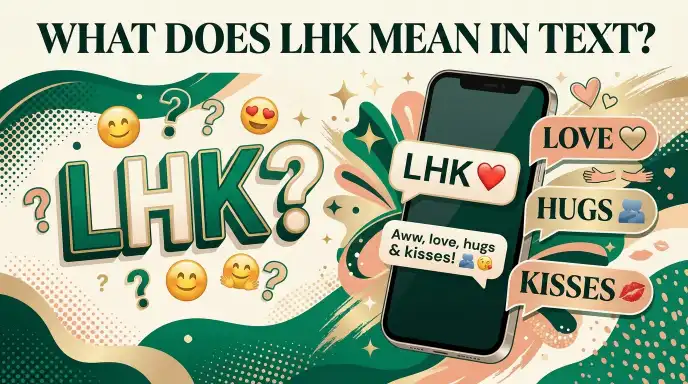
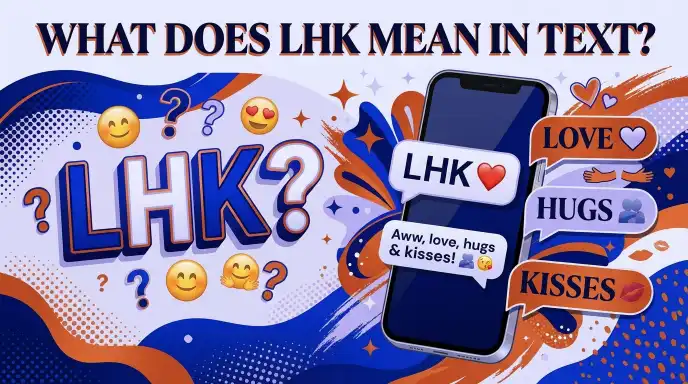
LHK most commonly means “Love, Hugs and Kisses” in text messages. It is an affectionate abbreviation people use to express love, warmth, and care when communicating with friends, family members, or romantic partners.
You may see LHK in WhatsApp conversations, Snapchat messages, Instagram DMs, TikTok comments, and regular SMS texts. People generally use it at the end of a message to make their words sound sweeter and more personal.
Although LHK is not as popular as abbreviations like LOL, IDK, or BRB, it has a clear purpose in informal communication. It allows someone to express affection without typing a longer phrase.
If someone sends you LHK, they are most likely sharing a friendly or loving message. However, the exact intention can depend on your relationship with that person and the conversation you are having.
LHK Meaning in Text
LHK stands for “Love, Hugs and Kisses.” It is an informal texting abbreviation used to express affection, appreciation, and emotional warmth. People often add it to the end of a conversation as a sweet way to say goodbye or remind someone that they care.
Think about a conversation between two close friends. One friend has helped the other through a difficult day, and the conversation is finally coming to an end.
The person might write:
“Thanks for always being there for me. You’re amazing. LHK ❤️”
Here, LHK communicates more than a simple thank,you. It adds affection and makes the message feel personal.
The expression combines three familiar gestures of affection. Love represents emotional care, hugs suggest comfort, and kisses add a sweet or intimate touch.
It does not necessarily indicate romantic feelings. Friends, siblings, parents, and other family members can use it too.
What Does Each Letter in LHK Stand For?
LHK is formed from the first letters of three separate words. Each letter contributes to the overall affectionate meaning.
| Letter | Word | Explanation |
| L | Love | Shows affection and emotional care. |
| H | Hugs | Represents comfort, support, and closeness. |
| K | Kisses | Adds a sweet or loving expression. |
When combined, these words create a short message that communicates warmth toward another person.
For example, a parent might send LHK to their child before bedtime. A close friend might use it after a meaningful conversation, while a romantic partner might include it in a goodnight message.
The abbreviation is especially useful when both people already understand its meaning.
Is LHK Slang, an Acronym, or an Abbreviation?
LHK is best described as an informal texting abbreviation or initialism.
It is formed by taking the first letter of each word in the expression Love, Hugs and Kisses. Because people generally read the letters separately, it technically fits the definition of an initialism.
In everyday language, however, people often group it with texting slang and internet abbreviations.
You do not need to understand the technical difference to use it correctly. The important thing is knowing what it communicates and when it is appropriate.
Here are some other familiar texting expressions:
- ILY: I Love You.
- XOXO: Hugs and Kisses.
- LOL: Laughing Out Loud.
- IDK: I Don’t Know.
- BRB: Be Right Back.
- TTYL: Talk To You Later.
Unlike LOL or IDK, which can appear in almost any casual conversation, LHK is more closely connected to affectionate messages.
What Does LHK Mean From a Girl?
When a girl sends LHK, she is generally expressing affection, friendliness, or appreciation.
For example:
Person 1: Thanks for helping me prepare for the interview.
Person 2: Of course! I hope everything goes well.
Person 1: You’re so sweet. LHK ❤️
In this situation, the abbreviation shows that the sender appreciates the other person’s support.
If a girl sends it to someone she likes romantically, it may also carry a more personal meaning. However, the abbreviation alone does not prove romantic interest.
Look at the overall conversation, the relationship, and how she normally communicates.
What Does LHK Mean From a Guy?
When a guy uses LHK, it generally has the same affectionate meaning.
He might send it to a close friend, family member, or romantic partner. It can be his way of ending a conversation on a positive note.
For example:
Person 1: Good luck with your new job tomorrow!
Person 2: Thanks! I’m a little nervous.
Person 1: You’ll do great. LHK!
The sender is offering encouragement and adding a friendly expression of affection.
It is not necessarily a romantic signal. Some people naturally use affectionate language with the people they care about.
Does LHK Have Different Meanings in Different Conversations?
The most commonly documented texting meaning is Love, Hugs and Kisses. However, abbreviations can sometimes have different interpretations in private conversations or specific online communities.
For instance, someone might use the same letters as a personal shorthand or create a meaning understood only by their friends.
This is why you should not assume that every unfamiliar abbreviation has exactly the same meaning everywhere.
Pay attention to how it appears in the message.
- If it appears after a goodbye, it probably expresses affection.
- If it follows a thank,you message, it may communicate appreciation.
- If it appears in a romantic conversation, it may express intimacy.
- If the surrounding sentence does not make sense, ask the sender what they mean.
Context is more reliable than guessing based on three letters alone.
Is LHK the Same as ILY or XOXO?
No. These expressions are related because they can all communicate affection, but they are not identical.
LHK – Love, Hugs and Kisses
This combines three affectionate expressions into one short abbreviation.
ILY – I Love You
This directly communicates love. It can be used between romantic partners, family members, and close friends.
XOXO – Hugs and Kisses
This is a familiar written sign,off that represents hugs and kisses. People often use it in friendly or romantic messages.
For example:
- “Goodnight, LHK!” expresses love, hugs, and kisses.
- “I miss you. ILY!” directly expresses love.
- “See you soon. XOXO!” gives the message a warm goodbye.
The best choice depends on the tone you want to communicate.
When Does Someone Usually Use LHK?
LHK is most suitable for conversations where people are comfortable expressing affection.
It can appear in several situations:
1. Ending a conversation
Someone might use it when saying goodbye to a close friend or family member.
2. Showing appreciation
After receiving help or emotional support, a person might add LHK to express gratitude.
3. Sending goodnight messages
It can make a simple goodnight text sound more loving.
4. Celebrating special occasions
People may include it in birthday wishes, congratulations, or holiday messages.
5. Comforting someone
When a friend is going through a difficult time, LHK can add a caring touch to an encouraging message.
The abbreviation is not necessary in every conversation. Sometimes writing the complete words feels more natural, especially when communicating with someone who does not know texting slang.
Where Do People Use LHK?
LHK is an informal expression that can be used across different messaging platforms. Its meaning does not change simply because someone uses it on a different app.
However, the way people communicate on each platform can influence where and how the abbreviation appears.
LHK on TikTok
TikTok is known for short videos, comments, captions, and private messaging. People sometimes use abbreviations to keep their online conversations short and casual.
LHK may appear when someone wants to express appreciation or affection toward another user.
For example:
Person 1: Your videos always make my day better!
Person 2: That means so much. Thank you for watching. LHK ❤️
In this situation, the creator is responding warmly to a supportive viewer.
You might also see the abbreviation in a personal caption or a message between friends who communicate through TikTok.
It is worth remembering that LHK is not a TikTok,specific trend or an official platform abbreviation. Its meaning comes from general texting language.
LHK on Snapchat
Snapchat is popular for quick conversations, pictures, short videos, and personal messages.
Because many conversations on Snapchat are informal, affectionate expressions can fit naturally into chats between people who know each other.
For example:
Person 1: I had so much fun hanging out with you today.
Person 2: Same! We should do it again soon.
Person 1: Definitely. Goodnight, LHK 😘
Here, the sender uses LHK to end the conversation with affection.
It may also appear in a Snap caption or a private message after someone shares good news.
The sender does not need to explain the abbreviation if the other person already understands it.
LHK on Instagram
Instagram conversations happen through direct messages, comments, stories, and personal posts.
Someone might use LHK when thanking a friend, responding to a thoughtful message, or showing appreciation.
For example:
Person 1: I saw your new pictures. You look so happy!
Person 2: Thank you! It was such a wonderful day.
Person 1: You deserve all the happiness. LHK 💗
The abbreviation makes the response feel affectionate without requiring a long explanation.
On Instagram, it is more naturally suited to personal conversations than professional discussions or business communication.
LHK on WhatsApp
WhatsApp is widely used for conversations with family members, friends, classmates, and colleagues.
LHK can fit into personal WhatsApp chats, especially when someone wants to end a conversation warmly.
For example:
Person 1: Did you reach home safely?
Person 2: Yes, just got home. Thanks for checking.
Person 1: Good! Get some rest. LHK ❤️
Here, the sender uses the abbreviation to show care.
It may also appear in family group chats, birthday greetings, and private conversations between romantic partners.
LHK in Regular SMS Messages
LHK is not limited to social media apps. It can also appear in ordinary SMS messages.
Texting abbreviations became popular partly because people wanted shorter ways to communicate before modern messaging apps became common.
For example:
Person 1: Have a safe journey. Let me know when you arrive.
Person 2: Will do. Thanks!
Person 1: Take care. LHK.
The abbreviation adds a little affection to an otherwise simple travel,related conversation.
If the recipient is unfamiliar with LHK, writing Love, Hugs and Kisses in full may be clearer.
How to Understand LHK Without Misreading the Message
Seeing an unfamiliar abbreviation can sometimes make an ordinary conversation confusing. The easiest way to understand LHK is to read the complete message rather than focusing only on the three letters.
For example, compare these messages:
- “Goodnight, LHK ❤️”
- “Thank you for everything. LHK!”
- “Sending you lots of love. LHK.”
All three use the abbreviation as an affectionate sign,off.
Now consider the relationship between the people communicating. A message from a parent may express family love, while the same abbreviation from a romantic partner may feel more intimate.
Pay Attention to Emojis
Emojis can help communicate the emotional tone of a message.
For example:
- ❤️ usually adds a loving or affectionate feeling.
- 😘 can suggest a kiss or playful affection.
- 💗 often expresses warmth and care.
- 🤗 can represent a hug or comfort.
However, emojis are not strict definitions. People use them differently, so the words and relationship still matter.
Consider the Previous Conversation
A message rarely exists on its own. What someone said earlier can help explain why they used an abbreviation.
If the conversation involved support, gratitude, or saying goodbye, an affectionate interpretation is likely.
If the message is confusing, asking the sender is perfectly normal.
Understanding texting slang should make communication easier, not create unnecessary misunderstandings.
10 Real Chat Examples of LHK in Text Messages
Understanding an abbreviation becomes much easier when you see how people use it in natural conversations. LHK is generally used to add affection to a message, but the feeling behind it can change depending on the situation.
Someone might use it after receiving help, while saying goodnight, sending birthday wishes, or talking to someone they love. It can make an ordinary message feel more thoughtful without requiring a long explanation.
Here are ten realistic conversations showing how LHK can appear in everyday texting.
Example 1: Between Close Friends
A: I was having such a terrible day yesterday. I honestly didn’t feel like talking to anyone.
B: I’m glad you called me. You know you can always talk to me whenever something is bothering you.
A: I really appreciate that. You’re one of the few people who actually listen without judging me. LHK ❤️
B: Always! Don’t ever feel like you have to deal with everything alone.
Meaning: The sender uses LHK to express affection and appreciation toward a close friend who provides emotional support. It shows that their friendship means a lot.
Example 2: Between Family Members
A: Did you eat something before leaving for school? Don’t skip breakfast again.
B: Yes, Mom. I had breakfast before leaving. You don’t need to worry.
A: Okay, that’s good. Make sure you take care of yourself and call me when you get some free time. LHK.
B: I will. Love you!
Meaning: Here, LHK is used in a family conversation to express care and affection. The sender is ending an ordinary reminder with a loving message.
Example 3: Between Romantic Partners
A: I wish we could spend more time together. This week has been so busy.
B: I know, but we’ll make time for each other this weekend. I promise.
A: I’m already looking forward to seeing you. I miss our long conversations and random jokes. LHK 😘
B: I miss you too. Can’t wait for the weekend!
Meaning: In this conversation, LHK expresses romantic affection. The sender uses it to show love and make the conversation feel more intimate.
Example 4: After Receiving Help
A: I finally submitted my college application. I was so nervous about making a mistake.
B: See! I told you everything would work out. You spent so much time preparing for it.
A: Honestly, I couldn’t have finished it without your help. Thanks for checking everything and encouraging me. LHK!
B: You’re welcome! Now let’s hope you get accepted.
Meaning: The sender uses LHK to show appreciation toward someone who helped them complete an important task. It adds a personal touch to a simple thank,you message.
Example 5: Saying Goodnight
A: I’m going to bed now. I’m completely exhausted after today’s work.
B: You should get some proper rest. Tomorrow is another busy day for you.
A: You’re right. Thanks for reminding me to slow down sometimes. Goodnight, sweet dreams. LHK 💗
B: Goodnight! Sleep well and take care of yourself.
Meaning: LHK is used as an affectionate sign,off. The sender wants to end the conversation with warmth rather than simply saying goodbye.
Example 6: Comforting Someone During a Difficult Time
A: I’ve been feeling really stressed lately. Everything seems to be happening at once.
B: I’m sorry you’re dealing with so much. Remember that you don’t have to figure everything out in one day.
A: I needed to hear that. Thanks for checking on me even when you’re busy with your own things. LHK ❤️
B: Anytime! I’m always happy to listen whenever you need someone.
Meaning: The sender uses LHK to express gratitude and affection toward someone who offers emotional support. It helps make the conversation feel caring and reassuring.
Example 7: Birthday Wishes
A: Happy birthday! I hope this year brings you happiness, success, and everything you’ve been working toward.
B: Thank you so much! Your message really made me smile.
A: You deserve all the good things in life. Enjoy your special day, eat lots of cake, and celebrate properly. LHK! 🎂
B: That’s so sweet of you. Thank you for remembering!
Meaning: LHK adds warmth to a birthday greeting. The sender uses it to show affection while wishing someone a wonderful day.
Example 8: Between Siblings
A: Did you remember to bring my headphones? I need them for the trip tomorrow.
B: Yes, they’re in my backpack. I’ll give them to you when I get home.
A: Finally! I thought you were going to forget again like last time. You’re actually useful sometimes. LHK 😂
B: Wow, such a beautiful compliment. You’re welcome!
Meaning: The abbreviation is used playfully between siblings. Even though the conversation includes teasing, LHK adds an affectionate ending.
Example 9: After Meeting Someone
A: I had such a great time today. We should definitely plan another day out soon.
B: Absolutely! I haven’t laughed that much in ages.
A: Same! Thanks for making today special. It was exactly what I needed after such a stressful week. LHK 💕
B: I’m glad you enjoyed it. Let’s plan something again next weekend.
Meaning: The sender uses LHK to express appreciation and affection after spending quality time with someone.
Example 10: Ending a Long Conversation
A: I think I’ve talked your ear off today. I should probably let you get back to your work.
B: Don’t worry about it. I enjoyed catching up with you. We hadn’t talked properly in weeks.
A: I know! We need to stop getting so busy and make more time for each other. Take care until we talk again. LHK ❤️
B: Definitely! Sending hugs back. Talk soon!
Meaning: LHK is used as a warm goodbye after a long conversation. It shows that the sender values the relationship and wants to stay connected.
How to Reply When Someone Says LHK
When someone sends you LHK, you do not need to overthink your response. The best reply depends on your relationship with the sender and how comfortable you feel expressing affection.
For example, if a close friend sends it, you can respond with a friendly message. If your partner uses it, you might want to return the affection. If someone you barely know sends it, a simple thank,you is enough.
There is no single correct response. Your reply should feel natural and match the tone of the conversation.
Funny Replies to LHK
If you have a playful relationship with the sender, a funny response can keep the conversation entertaining.
You can use humor without making the other person feel that their affection is unwelcome.
Here are some examples:
- “That’s a whole package of affection! 😂”
- “Love received, hugs downloading, kisses pending!”
- “Where’s the delivery confirmation for all those hugs?”
- “Three letters and so much emotional investment!”
- “Sending virtual hugs, but real snacks would be better.”
- “Okay, but I want unlimited hugs with that deal! 😂”
- “My daily dose of affection has officially arrived.”
- “That’s sweet! Now send some chocolate too. 🍫”
Example conversation:
A: Goodnight! LHK ❤️
B: Love accepted. Hugs received. Kisses still loading! 😂
A: You’re impossible!
B: Just keeping things interesting.
These responses work well when both people enjoy joking around.
Casual Replies to LHK
Sometimes you want to acknowledge someone’s message without making the conversation overly emotional.
Casual replies are useful when talking to friends, relatives, or people you communicate with regularly.
Try these:
- “Aww, thanks!”
- “Same to you!”
- “Take care!”
- “Appreciate it!”
- “Talk to you soon!”
- “That’s really sweet!”
- “Hope you have a great day too!”
- “Sending good vibes your way!”
Example conversation:
A: Hope everything goes well tomorrow. LHK!
B: Thanks! Same to you. Have a lovely evening.
A: You too!
This type of response is simple, polite, and natural.
Friendly Replies to LHK
If someone close to you sends LHK, you can respond with a little more warmth.
These replies are suitable for close friends, siblings, and family members.
- “Sending lots of love back! ❤️”
- “Big hugs to you too!”
- “You’re the sweetest!”
- “Love you lots!”
- “Always here for you!”
- “Sending you the biggest virtual hug!”
- “You mean a lot to me!”
- “Right back at you! 💗”
Example conversation:
A: Thanks for being such a wonderful friend. LHK!
B: Aww, love you! Sending the biggest hugs right back.
A: So lucky to have you!
B: Feeling is mutual!
These replies communicate genuine affection without making the conversation complicated.
Neutral Replies to LHK
Not everyone is comfortable using affectionate expressions. You might also receive LHK from someone with whom you have a formal or less personal relationship.
In that situation, you can respond politely without returning the same level of affection.
Some neutral replies include:
- “Thank you!”
- “That’s very kind of you.”
- “I appreciate your message.”
- “Take care as well.”
- “Have a wonderful day!”
- “Thanks for your good wishes.”
- “Wishing you all the best too!”
- “Hope you have a lovely evening.”
Example conversation:
A: Take care and have a wonderful weekend. LHK!
B: Thank you! I hope you have a great weekend too.
A: Thanks!
This keeps the conversation respectful and friendly without suggesting a closer relationship than you intend.
What If You Don’t Know What LHK Means?
If someone sends you LHK and you have never seen the abbreviation before, asking for clarification is completely fine.
You can reply with:
- “Sorry, what does LHK stand for?”
- “I’ve never seen that abbreviation before. What does it mean?”
- “Is that your way of saying goodbye?”
- “Just curious, what do those letters mean?”
There is no need to pretend you understand every texting abbreviation. Internet language changes constantly, and even regular social media users come across expressions they have never seen before.
Is LHK Rude or Offensive?
No, LHK is generally not considered rude, offensive, or disrespectful. When used to mean Love, Hugs and Kisses, it is a positive expression that communicates affection and emotional warmth.
People usually use it with someone they know well, such as a close friend, family member, or romantic partner. It is intended to make a message feel sweeter rather than hurtful.
However, the way someone receives it depends on the relationship and the situation. An affectionate abbreviation that feels normal between close friends might seem too personal when sent to a stranger or professional contact.
Is LHK Safe to Use in Everyday Conversations?
Yes, LHK is generally safe to use in informal conversations.
You can include it in messages when you want to show someone that you care about them. It does not contain insulting language or an inappropriate expression in its usual meaning.
For example:
“Thanks for always making me smile. LHK ❤️”
This is a friendly way to express appreciation toward someone.
However, remember that not everyone understands uncommon texting abbreviations. If the recipient has never seen LHK before, they might ask you what it means.
Is LHK Appropriate at School?
LHK can be appropriate when chatting informally with classmates or close friends.
For example:
“Thanks for sharing your notes with me. LHK!”
There is nothing offensive about this message. It simply expresses appreciation.
However, using abbreviations in school assignments, essays, or formal messages to teachers is not recommended. Writing complete words makes your communication clearer and more appropriate.
Can You Use LHK at Work?
It is generally better to avoid LHK in professional communication.
Although the expression is harmless, it may sound overly personal when communicating with managers, clients, or colleagues you do not know well.
For example, instead of writing:
“Thank you for helping me with the presentation. LHK.”
You could write:
“Thank you for your help with the presentation. I really appreciate your support.”
The second message sounds professional while still showing gratitude.
Can LHK Be Misunderstood as Flirting?
Sometimes, yes.
If someone receives LHK from a person they barely know, they might wonder if the sender is trying to express romantic interest.
However, using LHK does not automatically mean someone is flirting. Friends and family members can use affectionate expressions without any romantic intention.
Consider the complete conversation before deciding what the sender means.
Who Uses LHK?
LHK is an informal abbreviation that can be used by people of different ages. It is not limited to one generation, although some people may recognize it more easily than others.
Its use depends on personal texting habits, relationships, and familiarity with internet abbreviations.
Do Gen Z Users Use LHK?
Some Gen Z users may use LHK when chatting with close friends or romantic partners.
However, it is not accurate to describe it as one of the biggest Gen Z slang trends. More familiar expressions such as ILY, LOL, IDK, and XOXO are generally easier for younger internet users to recognize.
LHK is more likely to appear in personal conversations than in widely shared social media trends.
Do Millennials Use LHK?
Millennials who grew up using SMS and early internet messaging may be familiar with affectionate abbreviations.
They often use shortened expressions to make conversations quicker and more personal.
LHK fits this style because it combines three affectionate words into one short expression.
Do Adults and Older People Use LHK?
Yes. Adults can use LHK when communicating with family members, close friends, and romantic partners.
For example, a parent might send it to a child after wishing them goodnight.
Similarly, someone might include it in a birthday message or a personal greeting.
There is no particular age group that owns this abbreviation.
Where Is LHK Commonly Used?
LHK is most suitable for informal and personal communication.
You may encounter it in:
- Private conversations between close friends.
- Family group chats.
- Romantic messages.
- Birthday greetings.
- Goodnight conversations.
- Personal social media comments.
- Messages expressing appreciation or support.
It is less suitable for academic writing, professional emails, and formal business discussions.
Is LHK Popular on Social Media?
LHK can appear across different social media platforms, but it is not among the most widely recognized internet abbreviations.
There is limited reliable information about its actual usage frequency, so it would be misleading to claim that it is trending or especially popular on a particular platform.
Its main purpose remains simple: expressing affection through a short written message.
Origin of LHK
The exact origin of LHK is uncertain. There is no widely verified record identifying the first person who created or used the abbreviation.
However, its structure follows a familiar pattern in digital communication. People often take the first letters of several words and combine them to create shorter expressions.
This approach became especially useful when texting through older mobile phones.
Connection With Early Texting Culture
Before smartphones and messaging applications became common, people frequently communicated through SMS.
Typing long messages could take time, particularly on older mobile phones with physical keypads.
As a result, users developed shorter expressions to communicate quickly.
Some familiar examples include:
- LOL – Laughing Out Loud.
- BRB – Be Right Back.
- IDK – I Don’t Know.
- TTYL – Talk To You Later.
- ILY – I Love You.
LHK follows a similar pattern by shortening Love, Hugs and Kisses into three letters.
How Internet Culture Influenced LHK
Internet culture changed the way people communicate.
Instead of writing complete sentences every time, users began combining abbreviations, emojis, and short expressions to make their messages more personal.
Affectionate expressions became especially common in conversations between friends, family members, and romantic partners.
LHK fits naturally into this style because it communicates several positive feelings in a compact form.
Did LHK Originate on Snapchat or Instagram?
There is no reliable evidence that LHK originated on Snapchat, Instagram, TikTok, or WhatsApp.
These platforms may provide places where people use the abbreviation, but that does not establish where it first appeared.
It is better to understand LHK as a general texting expression rather than a slang term created by one social media platform.
Is Its Original Meaning Still the Same?
The commonly documented meaning remains Love, Hugs and Kisses.
However, individual people or online communities can sometimes create their own meanings for familiar combinations of letters.
If someone uses LHK in an unusual way, the surrounding conversation can help clarify their intention.
LHK vs. IDK, IDC, IMO, and BRB
LHK is one of many abbreviations people use in digital communication. However, it has a different purpose from expressions such as IDK, IDC, IMO, and BRB.
Some abbreviations express emotions, while others communicate opinions, uncertainty, or temporary actions.
The following table explains their differences.
| Term | Meaning | Type | Usage | Popularity |
| LHK | Love, Hugs and Kisses | Affectionate abbreviation | Showing love and care | Less common |
| IDK | I Don’t Know | Initialism | Expressing uncertainty | Very common |
| IDC | I Don’t Care | Initialism | Showing indifference | Very common |
| IMO | In My Opinion | Initialism | Sharing personal opinions | Common |
| BRB | Be Right Back | Initialism | Temporarily leaving a conversation | Common |
LHK vs. IDK
LHK means Love, Hugs and Kisses, while IDK stands for I Don’t Know.
Both are used in casual digital communication, but their meanings are completely different.
Example:
- “Goodnight, LHK ❤️” expresses affection.
- “IDK what time the movie starts” expresses uncertainty.
LHK makes a message warmer, while IDK helps someone communicate that they do not know something.
LHK vs. IDC
IDC stands for I Don’t Care.
People use it when they want to express indifference or show that they do not have a strong preference.
For example:
“IDC which restaurant we choose.”
This means the person is comfortable with any choice.
LHK, on the other hand, communicates affection rather than indifference.
LHK vs. IMO
IMO means In My Opinion.
It is commonly used before or during a statement that expresses someone’s personal thoughts.
For example:
“IMO, this is the best movie of the year.”
LHK does not introduce an opinion. It is generally used as an affectionate expression, often at the end of a message.
LHK vs. BRB
BRB means Be Right Back.
It tells someone that the sender is temporarily leaving the conversation but expects to return.
For example:
“BRB, I need to answer the door.”
LHK has a different purpose. It communicates affection and can be used when ending a conversation.
Real,World Usage Example of LHK
Imagine two close friends who regularly talk about their daily lives.
One friend has been dealing with a stressful week because of schoolwork, family responsibilities, and other personal commitments. The other friend listens patiently and offers encouragement.
After a long conversation, they decide to end the chat for the evening.
The supportive friend sends:
“Don’t worry too much about tomorrow. You’ve worked hard, and I know you’ll do your best. Get some rest. LHK ❤️”
In this situation, LHK communicates affection and emotional support.
The sender is not asking a question or expecting an immediate response. They simply want to end the conversation with a positive message.
Now consider another situation.
A daughter is travelling to another city, and her mother sends her a WhatsApp message:
“Have a safe journey. Let me know when you arrive. Take care of yourself. LHK.”
Here, the abbreviation adds warmth to a normal travel reminder.
These situations show how the same three letters can fit into different relationships while maintaining an affectionate meaning.
Frequently Asked Questions
Q1. What does LHK mean in text messages?
LHK most commonly means Love, Hugs and Kisses. It is an affectionate abbreviation used at the end of messages to express love, warmth, and care toward someone.
Q2. What does LHK mean on TikTok?
On TikTok, LHK can appear in comments, captions, and private messages. It generally carries the same meaning as in regular texting: Love, Hugs and Kisses.
Q3. Is LHK slang?
Yes. LHK is an informal texting abbreviation or initialism. It combines the first letters of Love, Hugs and Kisses and is used in casual digital conversations.
Q4. Is LHK rude or offensive?
No. LHK is generally a positive and affectionate expression. However, it may feel too personal in professional conversations or when messaging someone you do not know well.
Q5. How should you reply to LHK?
You can reply with “Aww, thanks!”, “Sending hugs back!”, “Same to you!” or “Love you too!” Choose a response that matches your relationship with the sender.
Q6. What does LHK mean from a girl?
When a girl sends LHK, she is generally expressing affection, appreciation, or friendliness. It does not automatically mean she is romantically interested in you.
Q7. What does LHK mean from a guy?
When a guy uses LHK, it usually means Love, Hugs and Kisses. He may be showing affection toward a friend, family member, or romantic partner.
Q8. Is LHK the same as XOXO?
No. LHK means Love, Hugs and Kisses, while XOXO represents hugs and kisses. Both are affectionate expressions, but their wording and usage are different.
Q9. Can I use LHK with my friends?
Yes. You can use LHK with close friends when expressing appreciation, affection, or saying goodbye. It is especially suitable for informal conversations where both people are comfortable with affectionate language.
Q10. Is LHK still used in texting?
LHK can still appear in personal messages and online conversations. However, it is less widely recognized than common abbreviations such as LOL, IDK, and BRB.
Conclusion
LHK most commonly stands for Love, Hugs and Kisses. It is an affectionate texting abbreviation that people use to express warmth, appreciation, and care toward friends, family members, and romantic partners.
You may encounter it in WhatsApp messages, Snapchat chats, Instagram DMs, TikTok comments, and regular SMS conversations. It is especially useful when someone wants to end a message with a sweet or thoughtful expression.
Although LHK is generally friendly and harmless, it is better suited to personal conversations than formal communication. If someone sends it to you, a simple thank,you, friendly reply, or affectionate response is usually enough.
Understanding the context will help you recognize its meaning and respond naturally without overthinking those three letters.
Read More About !

My name is Olivia Bennett.I am a language enthusiast and educational writer with a strong interest in contemporary English and digital communication. I enjoys making language learning engaging and accessible.