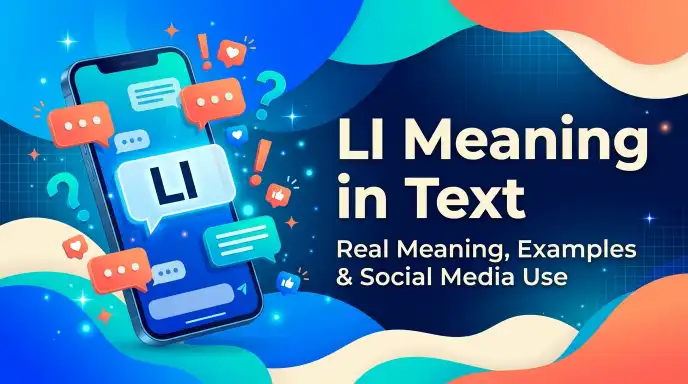
If someone sends you “LI” in a text message, it may mean “Laughing Inside.” It describes finding something funny without laughing out loud. However, LI can have different meanings depending on the conversation, including LinkedIn and Love Interest.
You might encounter this abbreviation in Snapchat messages, Instagram DMs, TikTok comments, WhatsApp conversations, and online communities. People sometimes use short expressions to communicate reactions without typing complete sentences.
Unlike familiar abbreviations such as LOL, LMAO, and IDK, LI is not widely recognized by everyone. Some people understand it immediately, while others may need additional context to figure out what the sender means.
If you have received LI in a message and are unsure how to interpret it, you are not alone. Its meaning can change depending on the subject, the platform, and the people communicating. Understanding these differences will help you avoid confusion and respond naturally.
LI Meaning in Text
In casual texting, LI can stand for Laughing Inside, an informal expression used when someone finds something funny but does not openly laugh.
Think about a situation where your friend sends you an embarrassing story while you are sitting in a quiet classroom. You find the story hilarious, but you cannot laugh because the teacher is nearby. Instead of explaining your reaction in a complete sentence, you might use LI to describe how you feel.
It communicates amusement without necessarily showing an outward reaction.
For example:
Person A: I accidentally called my teacher by my brother’s name today.
Person B: LI 😭
Person A: I wanted to disappear after that!
In this conversation, Person B finds the situation funny and uses LI to express an internal reaction. The crying emoji adds a playful tone to the message.
However, it is important to remember that LI is not as common as LOL, LMAO, or ROFL. Some people may understand it immediately, but others might interpret the letters differently.
What Does Laughing Inside Mean?
Laughing Inside describes the feeling of finding something amusing without showing much outward emotion. You might smile quietly, try to hold back your laughter, or simply enjoy a joke without actually laughing.
It is a reaction that many people experience in everyday situations.
Imagine sitting in a serious meeting when someone makes an unexpected comment. Everyone else remains quiet, but you find the comment hilarious. You try to control your expression because laughing would be inappropriate at that moment.
That feeling can be described as laughing inside.
People may use this expression when:
- They find an unexpected situation funny.
- Someone tells an embarrassing but harmless story.
- They are trying not to laugh in a quiet place.
- A friend makes a joke that catches them off guard.
- Something is amusing, even though they do not show it openly.
- They want to react humorously without typing a long message.
For example:
Friend 1: I waved at someone because I thought they were waving at me.
Friend 2: LI 😂
Friend 1: They were actually waving at the person standing behind me.
The response shows that Friend 2 finds the experience funny.
The important difference is that Laughing Inside describes an internal reaction. It does not necessarily mean someone is laughing loudly or uncontrollably.
Is LI an Acronym or an Abbreviation?
LI is an abbreviation formed from the first letters of the words Laughing Inside. More specifically, it can be described as an initialism because each letter represents a separate word.
In everyday internet communication, people may simply call it texting slang.
It follows the same general pattern as many other shortened expressions used in digital conversations.
Here are some familiar examples:
| Abbreviation | Full Meaning |
| LI | Laughing Inside |
| LOL | Laughing Out Loud |
| LMAO | Laughing My Ass Off |
| IDK | I Don’t Know |
| IDC | I Don’t Care |
| BRB | Be Right Back |
| IMO | In My Opinion |
| TBH | To Be Honest |
These abbreviations make online communication quicker, especially when people are chatting casually.
However, not all abbreviations have the same level of recognition. LOL and IDK are familiar to a large number of internet users, while LI is less established.
This means someone might understand the idea behind LI but still ask what the letters stand for.
Other Possible Meanings of LI
The meaning of LI is not limited to Laughing Inside. It can represent different expressions in different communities.
This is particularly important because two people may use the same abbreviation while discussing completely unrelated subjects.
Here are some other interpretations worth understanding.
1. LinkedIn
LI can be used as a shortened reference to LinkedIn, the professional networking platform.
People use LinkedIn to create professional profiles, connect with colleagues, share career updates, and explore employment opportunities.
For example:
Person A: I couldn’t find your professional profile.
Person B: Search for me on LI.
In this situation, LI refers to LinkedIn rather than Laughing Inside.
2. Love Interest
In romantic conversations, LI can stand for Love Interest.
A love interest is someone a person is romantically attracted to or a character involved in a romantic storyline.
This meaning sometimes appears in discussions about relationships, romance novels, television shows, and fictional characters.
For example:
Person A: Who is your favorite character in the story?
Person B: The main character’s LI is my favorite.
Here, the abbreviation refers to the character’s romantic interest.
3. Literally Tone Indicator
Some online communities use /li as a tone indicator meaning literally.
Tone indicators help readers understand the intention behind a message, especially when written communication makes sarcasm, humor, or seriousness difficult to identify.
For example:
“I literally waited three hours for the bus /li.”
The indicator tells the reader to understand the statement literally.
This is different from LI as Laughing Inside, so the slash and surrounding context are important.
How Can You Identify the Correct Meaning?
The easiest way to understand LI is to look at the complete conversation rather than focusing only on the abbreviation.
Consider these situations:
- “That video was so funny, LI.” The sender may mean Laughing Inside.
- “Can you send me your LI profile?” The sender means LinkedIn.
- “The main character finally meets her LI.” The sender means Love Interest.
- “I literally mean what I said /li.” The sender is using a tone indicator.
The topic gives you a useful clue about the intended meaning.
If the message still does not make sense, asking the sender is perfectly acceptable. A simple “What do you mean by LI?” can prevent an unnecessary misunderstanding.
Where Do People Use LI?
LI may appear in different digital spaces, including social media platforms, private messaging apps, and online communities.
However, its meaning is not necessarily the same everywhere. Some people may use it as an informal reaction, while others may use it as shorthand for a professional platform or a romantic term.
Understanding the communication style of each platform can help you interpret the abbreviation more accurately.
LI on TikTok
TikTok is known for short comments, funny videos, memes, trends, and informal internet expressions.
People often respond to entertaining content with a few letters, emojis, or short phrases instead of writing complete sentences.
LI may appear when someone wants to describe finding a video or situation funny without openly laughing.
For example:
User 1: This video gets funnier every time I watch it.
User 2: LI 😂
User 1: I knew you would find it funny!
In this example, User 2 is expressing amusement.
LI might also appear in discussions that have nothing to do with humor. Someone talking about career advice or professional networking could use it to refer to LinkedIn.
It is worth remembering that LI is not one of TikTok’s most widely recognized abbreviations. Its use is less established than expressions such as POV, FYP, GRWM, and LOL.
Therefore, the surrounding comment or video topic matters more than the platform itself.
LI on Snapchat
Snapchat is popular for private conversations, pictures, disappearing messages, and quick reactions.
Friends often use shortened expressions to respond to each other’s stories, funny pictures, and everyday experiences.
For example:
Friend 1: I tried making breakfast and accidentally added salt instead of sugar.
Friend 2: LI 😭
Friend 1: It tasted absolutely terrible.
In this conversation, Friend 2 uses LI to show that the mistake sounds funny.
Snapchat conversations are usually informal, so people may also use personal abbreviations that are familiar only within their friend groups.
For this reason, the sender’s usual communication style can help you understand what they mean.
If someone regularly uses LI as a reaction to funny messages, you may recognize the meaning more easily over time.
LI on Instagram
Instagram users communicate through comments, reels, stories, and direct messages.
Short abbreviations are common in casual conversations, particularly when someone wants to react quickly to a picture or video.
Imagine your friend shares a reel showing someone confidently walking into a room and immediately forgetting why they entered.
You might respond:
“LI, this happens to me every day 😂”
The message communicates amusement and makes the conversation feel relaxed.
LI can also appear in discussions about professional accounts and networking. In those situations, the person may be referring to LinkedIn.
For example:
“Your LI profile looks professional.”
Here, the abbreviation has a completely different meaning.
Instagram is used for both entertainment and professional networking, so it is important to understand the topic before interpreting the letters.
LI on WhatsApp
WhatsApp is used for personal conversations, family groups, school discussions, and workplace communication.
Because people use the app for different purposes, the same abbreviation can appear in several types of conversations.
In a personal chat, LI may describe a funny reaction.
For example:
Person A: Remember when we went to the wrong restaurant?
Person B: LI, that was such a ridiculous day.
Person A: We didn’t even notice until we checked the address!
Here, Person B is remembering an amusing experience.
In a family group, someone might use LI after receiving a funny picture or unexpected message.
However, not everyone on WhatsApp will recognize the abbreviation. Older family members or people who prefer traditional texting may be more familiar with LOL, haha, or simple emojis.
If you are sending a message to someone who may not understand LI, using a clearer expression can make communication easier.
LI in SMS and Regular Text Messages
Traditional SMS conversations also contain abbreviations because people often want to communicate quickly.
Short expressions can make everyday messaging more convenient, particularly when someone is sending a quick reaction.
LI may be used when a person finds something amusing but does not want to type a complete response.
For example:
Person A: I spent twenty minutes looking for my phone while holding it.
Person B: LI 😭
Person A: I really need more sleep.
The abbreviation communicates amusement about an everyday mistake.
In regular texting, LI might also have a personal meaning between two people. Some friends create their own shortcuts based on inside jokes, shared experiences, or repeated conversations.
This is another reason why context is important.
A message does not always follow the meanings found in online slang dictionaries. Sometimes the sender is using an abbreviation in a personal way that only the recipient understands.
LI vs. LOL: What Is the Difference?
LI and LOL may appear in similar conversations because both can communicate amusement.
However, their meanings are different.
LI stands for Laughing Inside, while LOL means Laughing Out Loud.
The main difference is the type of reaction they describe.
When someone uses LI, they may be saying that something is funny but that they are keeping their reaction to themselves.
When someone uses LOL, they are expressing laughter or showing that they found something amusing.
Consider this example:
Person A: I accidentally walked into the wrong shop and asked for a restaurant menu.
Person B: LI 😭
Person B finds the situation funny but uses LI to describe an internal reaction.
Now consider another conversation:
Person A: I just watched the funniest video.
Person B: LOL, send it to me!
Here, Person B uses LOL as a familiar way to react to something entertaining.
When Should You Use LI Instead of LOL?
You might use LI when describing a situation that makes you laugh internally rather than openly.
For example, you could use it when:
- You are trying not to laugh in class.
- A friend tells you an embarrassing story.
- Something funny happens during a serious conversation.
- You find a situation amusing but do not have a big reaction.
LOL is generally a more familiar choice when you simply want to tell someone that something is funny.
Because LI is less recognizable, LOL may be easier to understand when chatting with people who are unfamiliar with less common abbreviations.
Can LI and LOL Be Used Together?
People sometimes combine abbreviations and emojis to express their reactions more clearly.
For example:
“LI 😂”
This communicates an internal humorous reaction with an emoji that makes the playful tone easier to recognize.
However, there is no strict rule that requires people to combine these expressions.
The best choice depends on the conversation and how comfortably the other person understands internet slang.
LI vs. IDK, IDC, IMO, and BRB
Texting abbreviations often look similar because they use short combinations of letters. However, each expression communicates a different idea.
Understanding their meanings can help you recognize them when reading messages or participating in online conversations.
| Term | Meaning | Type | Usage | Popularity |
| LI | Laughing Inside | Abbreviation | Shows internal amusement | Low |
| IDK | I Don’t Know | Initialism | Expresses uncertainty | Very High |
| IDC | I Don’t Care | Initialism | Shows indifference | High |
| IMO | In My Opinion | Initialism | Shares a personal viewpoint | High |
| BRB | Be Right Back | Initialism | Indicates a short absence | High |
LI vs. IDK
LI describes amusement, whereas IDK means I Don’t Know.
People use IDK when they do not have an answer or are unsure about something.
For example:
Person A: Do you know when the store closes?
Person B: IDK, maybe around 9 PM.
In another conversation:
Person A: That was the funniest thing I’ve seen today.
Person B: LI 😂
The first abbreviation communicates uncertainty, while the second expresses amusement.
LI vs. IDC
IDC stands for I Don’t Care.
It is used when someone wants to communicate that something does not matter to them or that they have no particular interest in a situation.
For example:
Person A: Should we watch a comedy or an action movie?
Person B: IDC, you can choose.
Here, the person is saying that either option is fine.
LI has a different purpose because it describes a reaction to something amusing.
It is also worth remembering that IDC can sometimes sound dismissive depending on the conversation, while LI is generally associated with humor when used as Laughing Inside.
LI vs. IMO
IMO means In My Opinion.
People use it when sharing personal thoughts, preferences, or judgments.
For example:
Person A: Which movie do you like more?
Person B: IMO, the second one is much better.
LI does not introduce an opinion. It communicates amusement or another context,specific meaning.
LI vs. BRB
BRB means Be Right Back.
Someone might send this abbreviation when they need to leave a conversation temporarily but plan to return.
For example:
Person A: Are you still there?
Person B: BRB, someone is at the door.
LI is not used to announce a temporary absence. When it means Laughing Inside, it describes a humorous reaction instead.
Why Is It Important to Know These Differences?
Understanding abbreviations helps you avoid interpreting a message incorrectly.
For example, confusing IDK with IDC can completely change the meaning of a conversation. Similarly, interpreting LI as Laughing Inside when someone is talking about LinkedIn could create confusion.
You do not need to memorize every internet abbreviation. Learning the expressions you regularly encounter and paying attention to context is usually enough.
10 Real Chat Examples of LI in Text Messages
Understanding an abbreviation becomes much easier when you see how it fits into everyday conversations. LI can describe a quiet reaction to something funny, especially when someone finds a situation amusing but does not want to laugh openly.
The following examples show how someone might use LI in casual messages with friends, classmates, and people they know. Each conversation uses a different situation so you can understand the expression without seeing the same type of example repeatedly.
1. When Someone Makes an Embarrassing Mistake
Person A: I waved at someone today because I thought they were waving at me.
Person B: LI 😭
Person A: They were actually waving at the person behind me.
Person B: That makes it even worse!
Here, Person B finds the situation funny but is describing an internal reaction. The conversation is playful because the mistake is harmless and relatable.
2. When a Friend Shares a Funny School Story
Person A: I walked into the wrong classroom and started taking notes.
Person B: LI 😂
Person A: I only realized when the teacher started discussing chemistry.
Person B: How did you not notice?
In this example, LI communicates amusement about an unexpected classroom experience. Person B also continues the conversation by asking a question.
3. When Someone Makes an Unexpected Joke
Person A: My brother said he is going to become a millionaire.
Person B: LI, what is his plan?
Person A: He thinks sleeping all day will help him become famous.
Person B: That’s a serious business strategy!
The abbreviation works as an initial reaction to a funny statement. The rest of the conversation builds on the joke.
4. When Friends Remember an Old Memory
Person A: Remember when we got lost looking for that café?
Person B: LI, we walked around for almost an hour.
Person A: And then discovered it was right across the street.
Person B: We were completely lost!
Here, LI expresses amusement about a shared memory. It helps create a relaxed conversation between friends who understand the situation.
5. When Someone Sends a Funny Picture
Person A: Look at this picture from our school trip.
Person B: LI 😭
Person A: I didn’t even realize my hair looked like that.
Person B: The wind had other plans!
In this example, the abbreviation is used as a quick reaction to a funny picture. The emoji makes the playful tone easier to understand.
6. When Someone Describes an Awkward Moment
Person A: I accidentally called my neighbor by the wrong name.
Person B: LI 😂
Person A: Then I spent five minutes trying to explain myself.
Person B: I would have done the same thing!
Person B finds the experience amusing without directly saying that they are laughing loudly.
7. When Someone Makes a Relatable Observation
Person A: My phone battery lasts longer when I forget to use it.
Person B: LI, that’s how batteries work!
Person A: Let me enjoy my discovery.
This conversation shows how LI can fit into a casual exchange about something obvious but funny.
8. When a Friend Shares a Small Failure
Person A: I spent twenty minutes looking for my glasses.
Person B: LI 😭
Person A: They were on my head the entire time.
Person B: You need a vacation!
The abbreviation expresses amusement about an everyday mistake. The response keeps the conversation friendly rather than making the person feel bad.
9. When Someone Makes a Sarcastic Comment
Person A: He said he would arrive early and showed up an hour late.
Person B: LI, that’s so typical.
Person A: It happens every single time!
Here, LI is used to react to a situation that the two people already find amusing. The phrase “that’s so typical” adds a sarcastic but friendly tone.
10. When Someone Shares a Funny Secret
Person A: My sister still thinks I finished all the cookies.
Person B: LI 😂
Person A: Actually, my brother ate them yesterday.
Person B: Let her discover the truth!
This example demonstrates how the abbreviation can appear naturally when friends discuss small secrets or funny situations.
Important: These are illustrative conversations showing the Laughing Inside interpretation. Because LI is uncommon, actual users may understand it differently or use another meaning.
How to Reply When Someone Says LI
When someone sends you LI, your response depends on the situation and your relationship with that person.
If they are reacting to a funny story, you can continue the joke, send an emoji, or respond with another casual expression. You do not need to write a long message every time.
However, if you are unsure what they mean, asking for clarification is better than assuming.
Here are several ways to respond naturally.
Funny Replies to LI
Funny replies are suitable when you are chatting with friends who enjoy jokes, playful comments, and humorous conversations.
You can use these responses to keep the conversation entertaining:
- “Don’t laugh too hard 😂”
- “I knew you’d find that funny!”
- “Keep that laughter inside!”
- “You’re trying so hard not to laugh.”
- “At least someone understands my humor.”
- “That was supposed to be serious!”
- “Imagine what happened next!”
- “I can’t believe you found that funny.”
- “Your reaction is even funnier.”
- “You weren’t supposed to laugh at that!”
These replies work particularly well when the original message involves an embarrassing experience or an unexpected joke.
Casual Replies to LI
Sometimes a conversation does not need another joke. A simple response can be enough to acknowledge the other person’s reaction.
Here are some casual options:
- “Haha, I knew it.”
- “Right? 😂”
- “That was unexpected.”
- “I couldn’t help it.”
- “Exactly!”
- “You get it.”
- “I was thinking the same thing.”
- “That’s what I thought too.”
- “It was such a funny moment.”
- “Glad you understand.”
These responses are useful for everyday conversations on WhatsApp, Snapchat, and Instagram.
Friendly Replies to LI
If someone reacts to your story or shares a laugh with you, a friendly response can make the conversation feel more natural.
For example:
- “Glad you enjoyed that!”
- “I had to share it with you.”
- “You would’ve done the same.”
- “I knew you’d understand.”
- “We have the same sense of humor.”
- “That’s why I wanted to tell you.”
- “You always understand my jokes.”
- “I knew this would make you smile.”
- “We should laugh about it together.”
- “I’ll tell you what happened next.”
Friendly replies are especially useful when you want to continue a conversation rather than end it with a single reaction.
Neutral Replies to LI
Not every message requires humor. Sometimes you may want to acknowledge the abbreviation without making the conversation more playful.
Neutral replies are helpful when you are speaking with someone you do not know very well or when you are unsure about their intended meaning.
Consider these options:
- “Haha, I see.”
- “That’s funny.”
- “I understand.”
- “What do you mean by LI?”
- “Okay, got it.”
- “I see what you’re saying.”
- “Interesting!”
- “Fair enough.”
- “I wasn’t expecting that.”
- “Thanks for explaining.”
If the abbreviation is unfamiliar, asking what it means is completely acceptable.
What If You Do Not Understand LI?
You do not have to pretend that you understand every internet expression.
People use different abbreviations, and some are only familiar within particular groups or communities.
You can simply respond:
You: “What does LI mean here?”
Other person: “Laughing Inside.”
You: “Oh, now I get it 😂”
This keeps the conversation comfortable and avoids confusion.
Is LI Rude or Offensive?
No, LI is not generally considered rude or offensive when it is used to mean Laughing Inside. It is an informal expression that communicates amusement or an internal reaction to something funny.
It does not contain an insult or inappropriate language. Most of the time, its meaning is harmless.
However, the way someone uses it can affect how the message feels. A response that seems funny in one conversation might feel insensitive in another.
When Is LI Harmless?
LI is generally harmless when people are joking, sharing funny stories, or discussing entertaining situations.
For example:
Person A: I forgot why I walked into the kitchen.
Person B: LI 😂
Person A: I think my brain needs a restart.
Here, both people are discussing a harmless everyday experience. The abbreviation communicates amusement without insulting anyone.
It can also be appropriate when friends are laughing about an old memory or a silly mistake.
Can LI Sound Rude?
Although the abbreviation itself is not offensive, using it in the wrong situation can make someone feel uncomfortable.
Imagine someone tells you about a serious personal problem and you respond with LI. They may interpret your message as laughing at their situation.
For example:
Person A: I had a really difficult day, and nothing went as planned.
Person B: LI
This response could seem dismissive because the first person is looking for understanding rather than humor.
A more considerate response would be:
“Sorry you had such a difficult day. Are you feeling better now?”
The important point is to understand the emotional situation before using a humorous abbreviation.
Is LI Appropriate at School?
In casual conversations with classmates, LI can be acceptable if everyone understands what it means.
Students often use abbreviations when chatting during breaks, discussing funny classroom experiences, or sending messages in group chats.
However, it is better to use complete sentences when communicating with teachers or writing school assignments.
For example, instead of writing:
“LI, that was funny.”
You could write:
“That was amusing.”
Clear communication is especially important in educational settings.
Is LI Appropriate at Work?
Workplace communication usually requires a more professional tone.
If you are messaging a colleague about a funny situation, an informal expression might be acceptable depending on your workplace culture.
However, LI may confuse someone who has never encountered the abbreviation.
For professional emails, reports, client messages, and formal discussions, complete words are generally a better choice.
You can say:
“That was quite amusing.”
This communicates your reaction without relying on unfamiliar internet slang.
Should You Use LI With Everyone?
Not necessarily.
You can use informal abbreviations with friends who understand your texting style. However, when speaking with new people, older relatives, teachers, or professional contacts, familiar expressions are often easier to understand.
The goal of texting slang is to make communication convenient, not confusing.
Who Uses LI?
LI does not have one clearly established age group or a large, well,documented online user base.
Unlike widely recognized expressions such as LOL, IDK, and BRB, it is relatively uncommon in general digital conversations.
People may encounter it through different online communities, messaging habits, and discussions.
Teenagers and Young Adults
Teenagers and young adults frequently encounter internet abbreviations through social media, online games, private messages, and group chats.
They are often familiar with shortened expressions because digital communication is a regular part of their daily routines.
LI may appear in their conversations, particularly when discussing funny or embarrassing experiences. However, it should not be considered a universally popular expression among young people.
Some may recognize it, while others might have never seen it before.
Gen Z Usage
Gen Z is familiar with many forms of internet slang and texting shortcuts.
Expressions such as LOL, LMAO, TBH, IDK, and IMO are widely recognizable in online conversations.
LI is less established than these expressions.
Some users may understand Laughing Inside from the context, while others may prefer more familiar reactions such as:
- LOL
- LMAO
- Haha
- I’m dead
- That’s hilarious
- 😂
This shows why LI should be treated as an uncommon abbreviation rather than a major Gen Z slang trend.
Adults and Older Internet Users
Adults can also encounter LI through messaging apps, social media discussions, and professional conversations.
However, their interpretation may depend on the subject.
For example, someone working in recruitment or business may understand LI as LinkedIn. Someone discussing a romance novel may recognize Love Interest.
A person who does not regularly use internet abbreviations might not recognize Laughing Inside at all.
This is why the complete sentence is more useful than the user’s age when identifying the intended meaning.
How Often Does LI Appear Online?
There is no reliable public measurement establishing LI as a frequently used general,purpose texting abbreviation.
Compared with common expressions such as LOL, IDK, BRB, and TBH, it appears to be relatively uncommon.
Its different interpretations also make it difficult to measure as one single slang expression.
For example, a search for LI might include professional discussions about LinkedIn, entertainment conversations about Love Interest, and informal references to Laughing Inside.
Therefore, it is more accurate to describe LI as a less familiar abbreviation that people may encounter in specific contexts.
Origin of LI
The exact origin of LI as an abbreviation for Laughing Inside is unclear. There is no widely established historical record identifying a particular person, website, or social media platform as the creator of this expression.
Like many texting abbreviations, it follows the internet habit of shortening longer phrases into a few letters. People have used shortened expressions for years to make digital conversations quicker and easier.
To understand how LI developed, it helps to look at the growth of online messaging and the way people communicate through the internet.
How Did the Expression Laughing Inside Develop?
Before social media became a regular part of everyday life, people communicated through SMS messages, internet chat rooms, and instant messaging services.
Typing complete sentences was sometimes inconvenient, especially when users wanted to respond quickly. This encouraged people to create shorter versions of common expressions.
For example, LOL became a recognizable way to communicate laughter, while BRB helped people tell others they would return shortly.
LI follows a similar pattern. Instead of typing “I’m laughing inside,” someone can use two letters to express the same general idea.
The expression also reflects a familiar human reaction. People sometimes find something funny without laughing openly, particularly when they are in a quiet or serious environment.
LI and Internet Culture
Internet culture constantly introduces new abbreviations, reactions, and expressions.
Some become popular across multiple platforms, while others remain limited to smaller online communities.
For example, expressions such as LOL, LMAO, and IDK are widely recognized because they have been used across messaging platforms and social media for many years.
LI is less familiar. Its meaning may be understood by some users, but it has not achieved the same level of general recognition.
Online communication also encourages people to create personal shortcuts. Friends may use abbreviations based on inside jokes, shared experiences, or their usual texting habits.
This means you might encounter LI in a private conversation even if you rarely see it in public comments.
Did LI Originate on Snapchat or TikTok?
There is no reliable evidence establishing Snapchat or TikTok as the original source of LI.
Although people may use the abbreviation on these platforms, that does not mean it originated there.
Shortened expressions existed in SMS messages and online chat communities long before modern social media became popular.
It is therefore better to understand LI as an informal abbreviation associated with digital communication rather than a slang term created by one particular platform.
Is the Origin of LI Confirmed?
No single origin can confidently be established for every use of LI.
The Laughing Inside interpretation appears in online slang references, but its exact starting point and original creator are uncertain.
Other meanings, including LinkedIn and Love Interest, belong to different contexts and should not be treated as having the same origin.
The safest explanation is that LI is a context,dependent abbreviation whose meaning developed through different forms of digital communication.
Real,World Usage Example of LI
Understanding an abbreviation in a dictionary is helpful, but seeing how it might fit into an everyday situation makes its meaning easier to remember.
Imagine you are sitting with your classmates during a break. One of your friends starts telling everyone about an embarrassing experience from the previous week.
They explain how they entered the wrong classroom, sat down, opened their notebook, and started taking notes without realizing they were in a completely different lesson.
Everyone finds the story funny.
Later that evening, your friend sends the same story again in a WhatsApp group. You remember what happened and find it amusing, but you are not actually laughing out loud.
You respond:
You: “LI 😂”
Friend: “I still can’t believe I did that!”
You: “At least you realized before the lesson ended.”
In this situation, LI communicates that you find the experience funny without needing to explain your entire reaction.
Another Situation: During a Quiet Meeting
Imagine you are attending a meeting where everyone is expected to remain serious.
A colleague makes an unexpected but harmless comment. You find it funny, but laughing loudly would interrupt the discussion.
Later, you send a private message to another colleague:
“That comment was hilarious, LI.”
The expression describes your internal reaction.
However, this type of abbreviation is more suitable for an informal conversation between colleagues who understand your communication style. It would not be appropriate in a formal meeting report or professional email.
When LI Means Something Different
Consider another situation.
You are discussing career opportunities with a friend, and they say:
“Send me your LI profile.”
Here, the meaning is probably LinkedIn because the conversation is about professional networking.
Similarly, if someone discussing a romance novel says:
“The main character’s LI is so interesting.”
They are likely referring to the character’s Love Interest.
These examples show why you should never interpret LI without considering the topic.
The same two letters can communicate completely different ideas in different conversations.
Common Mistakes People Make When Understanding LI
Because LI is not a widely recognized texting abbreviation, it is easy to misunderstand it.
Some people assume that it always means Laughing Inside, while others may connect it with LinkedIn or another familiar term.
Here are some common mistakes to avoid.
1. Assuming LI Always Means Laughing Inside
The most important mistake is treating one interpretation as the only possible meaning.
LI can refer to different things depending on the subject.
For example, a funny conversation may suggest Laughing Inside, while a career discussion may suggest LinkedIn.
Always read the surrounding message before deciding.
2. Confusing LI With LOL
LI and LOL are sometimes associated with humor, but their meanings are different.
LI means Laughing Inside, while LOL means Laughing Out Loud.
Using one when you intend the other might slightly change the tone of your message.
3. Thinking LI Is Popular on Every Platform
Just because an abbreviation appears on TikTok or Snapchat does not mean everyone uses it.
LI is relatively uncommon compared with established expressions such as LOL, IDK, and BRB.
Some people may understand it, while others may ask what it means.
4. Ignoring the Conversation Topic
The topic is often the strongest clue.
If someone is discussing a funny video, Laughing Inside may make sense.
If the conversation involves employment, professional profiles, or job applications, LinkedIn is more likely.
Ignoring this difference can lead to unnecessary confusion.
5. Using LI in Formal Communication
Informal abbreviations are not always appropriate for professional emails, school assignments, or official messages.
Someone who does not recognize LI may misunderstand your response.
When clarity matters, writing the complete expression or using a familiar alternative is a better option.
Frequently Asked Questions
Q1. What does LI mean in text messages?
LI can mean Laughing Inside in casual text messages. It describes finding something funny without laughing out loud. However, it can also mean LinkedIn or Love Interest depending on the conversation.
Q2. What does LI mean on TikTok?
On TikTok, LI may be used to mean Laughing Inside when someone reacts to a funny video or comment. However, it is not a widely established TikTok abbreviation, so context is important.
Q3. Is LI slang?
Yes, LI can be considered informal texting slang when it stands for Laughing Inside. It is an abbreviation formed from the initial letters of two words, but it is less common than LOL or LMAO.
Q4. Is LI rude or offensive?
No, LI is not inherently rude or offensive. It generally communicates amusement. However, using it when someone is discussing a serious problem may make your response seem insensitive.
Q5. How should you reply to LI?
You can reply with “Haha, I knew it,” “Right? 😂,” or “Glad you found that funny.” If you do not understand the abbreviation, simply ask the sender what they mean.
Q6. What does LI mean on Snapchat?
On Snapchat, LI may mean Laughing Inside when someone uses it to react to a funny picture, story, or message. The sender may also be using a personal abbreviation understood within their friend group.
Q7. What does LI mean on Instagram?
On Instagram, LI may appear in comments or direct messages as a reaction to something amusing. In professional discussions, it can also refer to LinkedIn.
Q8. Is LI the same as LOL?
No. LI can mean Laughing Inside, while LOL means Laughing Out Loud. Both can communicate amusement, but they describe different reactions.
Q9. Can LI have a romantic meaning?
Yes. In relationship discussions, books, and fictional stories, LI can stand for Love Interest. It refers to someone a person is romantically attracted to or a character involved in a romantic storyline.
Q10. Should I use LI in professional messages?
It is generally better to avoid unfamiliar abbreviations in formal communication. Use complete expressions or familiar language when writing professional emails, contacting clients, or communicating with people who may not understand internet slang.
Conclusion
LI can mean Laughing Inside in casual texting, describing the feeling of finding something funny without laughing openly. People may use it when reacting to jokes, embarrassing experiences, funny pictures, or unexpected situations.
However, LI has other meanings, including LinkedIn and Love Interest. Its interpretation depends on the subject and the surrounding conversation rather than the letters alone.
You can use it casually with friends who understand the expression, but it is better to choose clearer language in formal or professional situations. When someone sends you LI and the meaning is unclear, asking for clarification is always a sensible response.
Understanding the context is the easiest way to use and interpret internet abbreviations correctly.
Read More About !

My name is Olivia Bennett.I am a language enthusiast and educational writer with a strong interest in contemporary English and digital communication. I enjoys making language learning engaging and accessible.