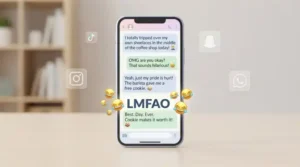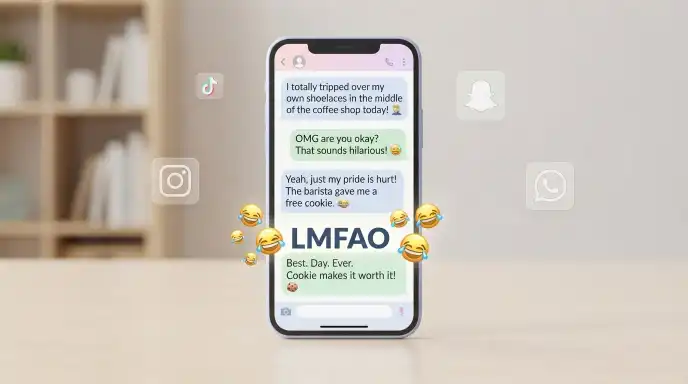
LMFAO in text means “Laughing My Freaking Ass Off” and shows that something is extremely funny. People use it in texting, TikTok, Snapchat, Instagram, WhatsApp, and other casual online conversations.
You may see LMFAO when someone reacts strongly to a joke, funny video, embarrassing moment, meme, or unexpected comment. It usually tells the other person, “That was really funny.”
The acronym can look confusing if you have never seen internet slang before. That is why people often search for its meaning when they come across it in a message or social media comment.
LMFAO Meaning in Text
LMFAO is an internet slang acronym that means “Laughing My Freaking Ass Off.” The original version contains stronger profanity, but “freaking” is commonly used as a softer explanation of the phrase.
In everyday texting, LMFAO simply means “That is extremely funny” or “I am laughing really hard.”
For example, imagine your friend sends you a video of someone making a ridiculous mistake. You might reply:
“LMFAO, I can’t believe he did that.”
You are not necessarily saying that you are literally laughing uncontrollably. You are showing that you found the situation very funny.
LMFAO is usually stronger than a simple LOL, although people use these expressions differently.
What Type of Slang Is LMFAO?
LMFAO is an acronym because it is formed from the first letters of a longer phrase.
It is also considered internet slang because people commonly use it in digital conversations rather than formal writing.
The expression belongs to the same broad group of online abbreviations as:
- LOL
- LMAO
- IDK
- IDC
- IMO
- BRB
- OMG
These shortened expressions make casual online conversations quicker and more expressive.
LMFAO focuses specifically on laughter or amusement.
What Does LMFAO Mean in Everyday Chat?
In a normal conversation, LMFAO tells someone that their message, joke, story, picture, or situation made you laugh.
For example:
Friend: “I went to the kitchen and forgot why I was there.”
You: “LMFAO, I do that every day.”
The acronym adds emotion to the response. Without it, a short reply such as “I do that too” may sound more neutral.
People can also combine LMFAO with emojis:Strong Amusement
People use this expression to react to something extremely funny, absurd, surprising, or entertaining.
The emoji helps show the emotional tone of the message.
LMFAO vs. LOL
LMFAO and LOL both communicate laughter, but LMFAO often sounds more intense.
LOL can mean:
“That is funny.”
LMFAO can suggest:
“That is extremely funny.”
However, online slang does not always follow strict rules. Someone may type LMFAO simply because they want to sound playful or enthusiastic.
Where People Use LMFAO
LMFAO can appear on almost any platform where people communicate casually. The meaning usually stays the same, but the way people use it can vary slightly.
LMFAO on TikTok
TikTok is one of the places where you may come across LMFAO in comments and replies.
Someone might watch a funny video and comment:
“LMFAO this was not supposed to happen 😂”
Another person may use it as a response to a funny comment.
TikTok users often combine slang with emojis, shortened words, and informal expressions. LMFAO fits naturally into that style.
It can also appear in direct messages when someone shares a funny TikTok with a friend.
LMFAO on Snapchat
Snapchat conversations are generally informal, especially between friends.
If someone sends a funny picture or video, the recipient might respond:
“LMFAO 😭”
The response means that the person found the snap very funny.
Sometimes LMFAO can also be used after a short story:
“LMFAO you actually did that?”
In this case, the acronym shows surprise mixed with amusement.
LMFAO on Instagram
Instagram users may use LMFAO in comments, direct messages, group chats, and Story replies.
For example:
“LMFAO the comments are even funnier than the post.”
Here, the person is laughing at the comments rather than necessarily the original post.
It can also appear as a quick reaction:
“LMFAO 😂”
Because Instagram has a strong casual and social environment, internet acronyms are common in conversations between friends and followers.
LMFAO on WhatsApp
WhatsApp users often use LMFAO in private chats and group conversations.
A friend might send a funny voice note, meme, photo, or story, and someone replies with:
“LMFAO.”
In a busy group chat, it can be a quick way to show that you found something funny without writing a full sentence.
For example:
A: “I just tried making pancakes and somehow burned the pan.”
B: “LMFAO.”
C: “How did you manage that?”
The acronym helps establish the playful tone of the conversation.
LMFAO in SMS
LMFAO can also appear in regular text messages.
For example:
“LMFAO you really forgot your own password again?”
The expression makes the message sound casual and humorous.
People are more likely to use it with friends, siblings, classmates, or other people with whom they already have a relaxed relationship.
It is generally not something you would use in a formal text to a teacher, employer, customer, or professional contact.
Why Do People Use LMFAO?
People use LMFAO because it communicates a strong emotional reaction with only a few letters.
Instead of typing:
“That is extremely funny and I am laughing so much right now.”
Someone can simply type:
“LMFAO.”
The acronym is quick and instantly recognizable to people who understand internet slang.
It can also make a message feel more energetic. Compare these two replies:
“That was funny.”
“LMFAO 😂”
The second response usually feels more expressive and casual.
LMFAO Can Show More Than Laughter
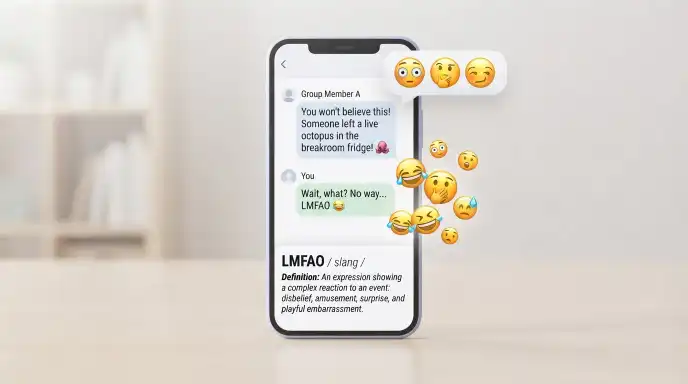
Although the main meaning relates to laughter, the acronym can sometimes communicate other emotions too.
Depending on the conversation, it may show:
- amusement
- disbelief
- surprise
- playful embarrassment
- shock at something funny
- agreement that something is ridiculous
For example:
“LMFAO, you actually sent that to him?”
The person may be laughing, but they are also surprised by what happened.
This is why context matters when interpreting slang.
When Someone Types LMFAO in Capital Letters
LMFAO is often written in capital letters because acronyms are traditionally written that way.
For example:
“LMFAO 😂”
However, lowercase forms are also common:
“lmfao 😂”
There is usually no major difference in meaning.
Capital letters may make the response look more noticeable or energetic, while lowercase typing can feel more relaxed.
You may also see variations such as:
- lmfao
- LMFAO
- lmfaooo
- LMFAOOOO
- lmfao 😭
Adding extra letters is often just a way to exaggerate the reaction.
Can LMFAO Be Used Alone?
Yes. Someone can reply with only “LMFAO” and still communicate a complete reaction.
For example:
A: “I accidentally called my teacher ‘Mom’ today.”
B: “LMFAO.”
The second person does not need to add anything else. The acronym itself communicates amusement.
People often use short reactions like this in fast,moving chats where long replies are unnecessary.
Can LMFAO Be Used in a Sentence?
Yes. It can appear at the beginning, middle, or end of a casual sentence.
Examples include:
“LMFAO, what were you thinking?”
“I was LMFAO when I saw that video.”
“That was so unexpected LMFAO.”
“LMFAO you actually believed him?”
The placement can change the rhythm of the message, but the basic meaning remains the same.
LMFAO and LMAO: What’s the Difference?
LMFAO and LMAO are closely related.
LMAO means “Laughing My Ass Off.”
LMFAO adds the word represented by the extra F, making it a stronger or more emphatic version.
In casual online communication, both expressions are often used simply to mean:
“That is really funny.”
People may choose one based on personal preference, the intensity of the joke, or the tone they want to create.
For example:
“LMAO, that’s funny.”
and
“LMFAO, that’s hilarious.”
Both communicate laughter, but the second can sound more exaggerated.
LMFAO and LOL: Are They the Same?
Not exactly.
LOL stands for “Laughing Out Loud.” It is one of the best,known internet expressions for showing amusement.
LMFAO generally has a stronger and more informal tone.
For example:
A: “I forgot my umbrella.”
B: “LOL.”
The response shows mild amusement.
But if the person then says:
“I ran outside and immediately got soaked.”
A stronger reaction might be:
“LMFAO 😭.”
Still, people do not always use these terms according to their literal intensity. Online slang is flexible, and personal texting habits matter.
Is LMFAO Always Literal?
No. Like many internet expressions, LMFAO is often figurative.
Someone may type it even when they are only smiling or mildly amused.
For example:
Friend: “I just spent five minutes looking for my phone while holding it.”
You: “LMFAO.”
You may laugh at the situation, but the acronym is mainly communicating your reaction rather than giving an exact description of your physical behavior.
The same thing happens with LOL and similar expressions.
Key Takeaway
LMFAO is an informal internet acronym used to show strong amusement. It usually means “Laughing My Freaking Ass Off” in softer explanations, while the original phrase contains stronger profanity.
You will most often see it in casual texts, social media comments, private messages, group chats, and online conversations.
It is useful when talking casually with people who understand internet slang, but it is not a good choice for formal school or professional writing.
Real Chat Examples of LMFAO
Seeing LMFAO in an actual conversation makes its meaning much easier to understand. In each example below, the acronym shows laughter, amusement, or a playful reaction.
Example 1: A Funny Mistake
A: I put my phone in the fridge this morning.
B: Wait, seriously?
A: Yeah. I was looking everywhere for it.
B: LMFAO 😭 How did you not notice?
Example 2: Watching a Funny Video
A: Did you watch the video I sent?
B: Yeah, I just finished it.
A: The ending got me.
B: LMFAO, I wasn’t expecting that either.
Example 3: A Friend’s Excuse
A: I told my teacher my homework disappeared.
B: What happened to it?
A: My little brother drew on it.
B: LMFAO, that’s actually a terrible excuse.
Example 4: Group Chat Humor
A: Who ate the last slice of pizza?
B: Not me.
C: I didn’t touch it.
D: Okay, fine. It was me.
B: LMFAO, we knew it was you.
Example 5: An Embarrassing Moment
A: I waved at someone across the street.
B: And?
A: They weren’t waving at me.
B: LMFAO 😭
A: I immediately pretended I was fixing my hair.
Example 6: Unexpected News
A: My brother just announced that he’s starting a cookie business.
B: He’s serious?
A: Completely serious.
B: LMFAO, he’s already planning his empire.
Example 7: Gaming Conversation
A: I missed the easiest shot in the whole game.
B: I saw that.
A: Please don’t talk about it.
B: Too late 😂 LMFAO.
Example 8: Funny Comment Section
A: Check the comments under that post.
B: I’m reading them now.
A: Some people are hilarious.
B: LMFAO, the comments are better than the actual post.
Example 9: Cooking Disaster
A: I tried making dinner without following the recipe.
B: How did it go?
A: The smoke alarm answered that question.
B: LMFAO. What did you make?
A: Something we’re never making again.
Example 10: Forgetful Friend
A: I spent ten minutes looking for my glasses.
B: Where were they?
A: On my face.
B: LMFAO 😂
A: Don’t judge me.
B: I’m definitely judging you.
How to Reply When Someone Says “LMFAO”
There is no special rule for responding to LMFAO. Your answer can depend on what caused the laughter and how casual the conversation is.
If someone sends “LMFAO” after your joke, story, or message, you can continue the conversation naturally instead of treating the acronym as a question.
Funny Replies
If you want to keep the conversation playful, try a humorous response.
- “I knew you’d laugh.”
- “Wait, it gets better.”
- “You haven’t heard the worst part yet.”
- “Don’t laugh at me 😂”
- “I’m glad someone appreciates my comedy.”
- “You would have done the same thing.”
These replies work best when both people are already joking around.
Casual Replies
Sometimes a simple reaction is enough.
- “I know 😂”
- “Right?”
- “Exactly!”
- “Same!”
- “For real.”
- “I couldn’t stop laughing either.”
You do not have to write a long response when the other person has already reacted positively.
Friendly Replies
If you want to keep the conversation warm and relaxed, you can answer with something like:
- “Glad I made you laugh.”
- “I knew you would understand.”
- “That was too funny.”
- “We’re both ridiculous.”
- “I couldn’t believe it either.”
These responses work well between friends or people who regularly use casual language.
Neutral Replies
If you do not want to continue the joke, a short response is perfectly fine.
- “Haha.”
- “Yeah.”
- “True.”
- “I know.”
- “😂”
- “Exactly.”
A reaction emoji can sometimes be enough to acknowledge the person’s message.
What Does LMFAO Mean When a Girl or Guy Sends It?
LMFAO does not have a special meaning based on if the sender is a girl or a guy.
If someone sends you “LMFAO,” they are generally showing that they found something funny or amusing.
For example:
You: “I accidentally wore two different shoes to class.”
Them: “LMFAO 😂”
The response is simply a reaction to your story.
It should not automatically be interpreted as flirting, romantic interest, sarcasm, or any other hidden message. The surrounding conversation gives you more information about the person’s intended tone.
Does LMFAO Mean They Are Really Laughing?
Not necessarily.
People use online expressions differently. One person may type LMFAO while actually laughing out loud, while another may use it simply to mean “That is hilarious.”
The acronym communicates a strong reaction rather than providing a literal measurement of how much someone is laughing.
For this reason, it is better to read the entire conversation instead of focusing on the acronym alone.
Is LMFAO Rude or Offensive?
LMFAO is informal slang, and the original phrase contains profanity. Because of this, some people may consider it inappropriate in formal or sensitive situations.
Among friends, it is commonly used as a casual expression of laughter.
The important factor is context.
A message such as:
“LMFAO 😂”
between close friends is usually understood as a playful reaction.
The same expression in a formal email to a manager or teacher may seem unprofessional.
Is LMFAO Safe to Use With Friends?
Usually, LMFAO is fine in casual conversations when everyone involved is comfortable with slang.
Friends may use it when talking about memes, funny videos, embarrassing moments, jokes, games, or everyday mistakes.
However, not everyone has the same attitude toward profanity. If you are unsure how someone feels about that type of language, a simpler option such as LOL, “haha,” or “that’s hilarious” may be better.
Can You Use LMFAO at School?
It depends on the situation.
A casual conversation with classmates is different from an assignment or formal message to a teacher.
LMFAO should generally be avoided in:
- Essays
- School assignments
- Formal presentations
- Academic reports
- Messages requiring formal language
If you are writing something for a teacher, standard English is usually more appropriate.
Instead of:
“LMFAO, that story was intense.”
you could write:
“That story was really funny.”
Can You Use LMFAO at Work?
LMFAO is generally not suitable for formal workplace communication.
Avoid it in professional emails, reports, applications, official documents, and messages to clients.
A relaxed workplace group chat may have a different tone, especially among coworkers who regularly use informal language. Even then, knowing your audience matters.
When you are unsure, choose a neutral expression such as:
“That’s funny.”
or
“Haha, I didn’t expect that.”
Who Uses LMFAO?
LMFAO is used by people who are familiar with internet slang and informal digital communication.
It can appear among teenagers, young adults, older social media users, gamers, and people who regularly communicate through messaging apps.
There is no strict age requirement for understanding or using the term.
Teenagers and Young Adults
Younger internet users may encounter LMFAO frequently in social media comments, group chats, memes, gaming conversations, and direct messages.
They may also combine it with emojis or other slang.
For example:
“LMFAO 😭”
“lmfaooo”
“LMFAOOOO 😂”
These variations usually keep the same basic meaning while adding emphasis.
Gen Z and Internet Slang
Gen Z users often communicate through a mixture of shortened words, acronyms, emojis, memes, and platform,specific expressions.
LMFAO can be part of that informal vocabulary.
However, it would be inaccurate to assume that every Gen Z person uses the acronym. Slang preferences differ between individuals, friend groups, regions, and online communities.
Some people prefer LOL. Others use LMAO, “haha,” “dead,” or laughing emojis.
Gamers and Online Communities
Gaming communities also use LMFAO when something funny happens during a game.
For example:
Player 1: “I jumped off the map again.”
Player 2: “LMFAO 😂”
The expression adds a humorous reaction to the situation.
Similar usage can appear in group chats, forums, Discord conversations, and other online communities.
Where You May See LMFAO Online
The acronym can appear in many forms of casual digital communication.
Common places include:
- TikTok comments
- Instagram comments
- Snapchat chats
- WhatsApp messages
- SMS texts
- Group chats
- Gaming conversations
- Online forums
- Social media replies
- Private messages
Its meaning does not normally change from one platform to another.
The main difference is the surrounding conversation.
For example, LMFAO in a TikTok comment may react to a video, while the same acronym in WhatsApp may respond to a friend’s personal story.
Why Do People Add Extra Letters to LMFAO?
You may sometimes see versions such as:
“LMFAOOO”
or:
“LMFAOOOOO”
The extra letters are usually used for emphasis.
They can make the reaction feel more dramatic, excited, or exaggerated.
For example:
“LMFAO”
sounds like a strong laugh.
“LMFAOOOO 😭”
can make the reaction look even more dramatic.
This is common in casual internet communication, where people often stretch words or repeat letters to express emotion.
You may see the same pattern with words such as:
- “noooo”
- “hahaha”
- “omgggg”
- “broooo”
The extra letters usually change the tone, not the basic meaning.
LMFAO With Emojis
LMFAO is often paired with emojis to make the intended emotion clearer.
Some common combinations include:
LMFAO 😂
Shows obvious amusement.
LMFAO 😭
Often communicates intense laughter or being overwhelmed by something funny.
LMFAO 💀
Can suggest that something was so funny that the person is jokingly “dead.”
LMFAO 😂😭
Combines several exaggerated reactions.
The emoji does not necessarily create a new dictionary meaning. It mainly adds emotional context to the slang.
Is LMFAO Stronger Than LMAO?
Both expressions communicate laughter, and people often use them interchangeably.
LMAO means “Laughing My Ass Off.”
LMFAO adds an extra word and is often used as a more emphatic version.
For example:
“LMAO, that’s funny.”
“LMFAO, that’s absolutely ridiculous.”
The second may sound more intense, but there is no strict rule saying LMFAO must always represent a stronger laugh.
Online slang is flexible. The person’s usual texting style and the situation often matter more than the exact acronym.
Is LMFAO the Same as LOL?
Both expressions can show that something is funny, but they have different tones.
LOL means “Laughing Out Loud.”
LMFAO is a stronger, more informal expression connected with laughing very hard.
Consider this conversation:
A: I forgot my umbrella again.
B: LOL.
Now imagine A continues:
A: Then I ran outside and slipped into a puddle.
B: LMFAO 😭
The second reaction sounds more exaggerated.
Still, people frequently use LOL even when something is extremely funny, so these expressions should not be treated like exact levels on a scale.
When You Should Avoid LMFAO
Although LMFAO is common online, there are situations where another expression would be more suitable.
Avoid it when writing:
- A formal school assignment
- A professional email
- A job application
- A business document
- A formal complaint
- An official report
- A serious message
You should also think carefully before using it when someone is discussing a serious personal issue.
For example, if someone tells you about a difficult experience, responding with LMFAO could appear insensitive unless the person is clearly making a joke.
Understanding tone and context is just as important as knowing the definition.
A Simple Way to Remember LMFAO
If you are new to internet slang, remember this simple idea:
LMFAO = “That is extremely funny.”
You do not need to memorize every possible use of the acronym.
When you see LMFAO after a joke, meme, funny story, video, or surprising situation, it is usually a strong laughing reaction.
The exact words behind the acronym are less important in everyday conversation than the emotion it communicates.
Comparison Table: LMFAO, IDK, IDC, IMO, and BRB
Internet abbreviations can look similar because they are all short, but they serve different purposes in a conversation. LMFAO is mainly a reaction, while IDK, IDC, IMO, and BRB communicate different ideas.
| Term | Meaning | Type | Usage | Popularity |
| LMFAO | Laughing My Freaking Ass Off | Slang acronym | Shows strong amusement or laughter | Common |
| IDK | I Don’t Know | Text abbreviation | Shows uncertainty or lack of knowledge | Very common |
| IDC | I Don’t Care | Text abbreviation | Shows indifference or lack of concern | Common |
| IMO | In My Opinion | Text abbreviation | Introduces a personal opinion | Common |
| BRB | Be Right Back | Text abbreviation | Tells someone you will return soon | Well,known |
LMFAO
This acronym is often used to show a strong reaction to something hilarious, ridiculous, or unexpectedly funny.
Example:
A: “I just walked into the wrong classroom.”
B: “LMFAO 😂”
The response shows amusement.
IDK
IDK means “I Don’t Know.”
It is used when someone does not know the answer to a question.
Example:
A: “What time does the movie start?”
B: “IDK. Let me check.”
IDC
IDC means “I Don’t Care.”
It can communicate indifference, although the tone may sometimes sound blunt depending on the conversation.
Example:
A: “Do you want pizza or burgers?”
B: “IDC, you choose.”
IMO
IMO means “In My Opinion.”
It tells the reader that the following statement represents the speaker’s personal view.
Example:
A: “Which song is better?”
B: “IMO, the first one.”
BRB
BRB means “Be Right Back.”
People use it when they temporarily leave a conversation but expect to return.
Example:
A: “Can you wait a minute?”
B: “Sure, BRB.”
These acronyms are useful because they make casual conversations shorter and faster.
Real,World Usage Example
Imagine two friends are sitting together after school and looking through funny photos on one person’s phone.
One of them finds an old picture from several years ago. The photo shows their friend wearing an unusual outfit.
Bilkul, Friend 1 / Friend 2 bhi hata dete hain:
A: “I just found my old school photos.”
B: “Oh no 😂 Let me see them.”
A: “Why was I dressing like that?”
B: “LMFAO, you really thought that look was working.”
A: “I honestly had no idea.”. What was I thinking?”
Friend 2: “LMFAO, this picture is hilarious.”
Here, LMFAO expresses amusement about the old photo.
The expression works because the conversation is casual and both friends understand the informal tone.
Now imagine the same situation in a formal setting. If someone were writing an article about the photograph, using LMFAO would not normally be appropriate. A phrase such as “This photo is very funny” would be clearer and more formal.
This example shows an important part of understanding slang: the meaning can stay the same while the appropriate setting changes.
How LMFAO Can Change the Tone of a Message
The words around LMFAO can affect how the message sounds.
Consider these examples:
“LMFAO 😂”
This usually sounds like a straightforward laughing reaction.
“LMFAO, you really did that?”
This can show both amusement and surprise.
“LMFAO stop 😭”
This can mean the person is laughing so much that they want the other person to continue or stop joking, depending on the context.
“LMFAO, that’s actually intense.”
This can communicate amusement combined with disbelief.
The acronym itself remains connected to laughter, but the surrounding words provide additional meaning.
Does LMFAO Mean Something Different in Social Media Comments?
Usually, no.
On social media, LMFAO still communicates strong amusement. The difference is that people may use it as a public reaction rather than a private response.
For example, someone might see a funny Instagram post and write:
“LMFAO 😭”
A TikTok user might comment:
“LMFAO the ending got me.”
A Snapchat user might send:
“LMFAO 😂”
All three examples communicate essentially the same idea: the person found something very funny.
The platform changes where the message appears, not its basic definition.
Can LMFAO Be Sarcastic?
Yes, LMFAO can sometimes be used sarcastically.
The context usually makes the difference.
For example:
A: “I studied for six hours and forgot everything during the test.”
B: “LMFAO, that’s rough.”
This sounds like genuine amusement mixed with sympathy.
But someone could also write:
“LMFAO, great job.”
If the person clearly made a mistake, this could be sarcastic rather than genuine praise.
That is why you should not interpret slang based on the acronym alone. Look at the entire message and the relationship between the people communicating.
Can You Use LMFAO With Someone You Don’t Know?
You can, but it depends on the setting.
On public social media, people sometimes use LMFAO when reacting to posts or comments from strangers.
For example:
“LMFAO this is too funny.”
That is generally a casual public reaction.
However, sending LMFAO directly to someone you do not know may feel overly informal in some situations.
If the conversation is professional or unfamiliar, a more neutral response may be safer.
For example:
“That was really funny.”
This communicates the same general reaction without relying on slang.
Is LMFAO Appropriate for Everyone?
Not necessarily.
Internet slang is shaped by personal preference, age, community, and communication style. Some people use strong slang frequently, while others prefer standard language.
The original phrase behind LMFAO includes profanity, so someone who avoids swear words may not want to use it.
There is also a difference between understanding a slang term and using it.
You may understand exactly what LMFAO means without ever using the acronym yourself.
That is completely normal.
Why Understanding LMFAO Matters
Knowing common internet slang can make online conversations easier to understand.
If someone writes:
“LMFAO 😂”
you do not need to wonder if they are angry or confused. In most casual contexts, they are showing amusement.
Understanding these expressions can also help parents, teachers, writers, students, and anyone who spends time online recognize the tone of digital conversations.
Slang changes quickly, so not every expression remains equally popular forever. Still, common acronyms such as LMFAO can remain recognizable for many years after their initial rise in online communication.
Frequently Asked Questions
Q1:What does LMFAO mean in text messages?
LMFAO means “Laughing My Freaking Ass Off.” It is used to show that something is very funny or amusing.
Q2:What does LMFAO mean on TikTok?
On TikTok, LMFAO is usually a reaction to a funny video, comment, or situation. It means the person found something very funny.
Q3:Is LMFAO slang?
Yes. LMFAO is an informal internet slang acronym commonly used in casual digital conversations.
Q4:Is LMFAO rude or offensive?
It can be considered informal or mildly offensive because the original phrase contains profanity. It is generally better suited to casual conversations than formal settings.
Q5:How should you reply to LMFAO?
You can reply naturally with “Same 😂,” “I know,” “Right?” “Haha,” or another playful response that matches the conversation.
Conclusion
LMFAO means “Laughing My Freaking Ass Off” and is used to express strong amusement in casual conversations.
You may see it in text messages, TikTok comments, Snapchat, Instagram, WhatsApp, group chats, gaming conversations, and other online spaces.
The acronym is informal and often works like a stronger laughing reaction. People may use it after a joke, funny video, embarrassing story, unexpected event, or ridiculous comment.
Remember that LMFAO is not appropriate for every situation. Because the original expression contains profanity, it is better to avoid it in formal schoolwork, professional communication, official documents, and serious conversations.
If someone sends you LMFAO in a casual chat, the simplest interpretation is usually “That is really funny.” A short response such as “Haha,” “Same,” or a laughing emoji can keep the conversation natural.
Read More About !

My name is Olivia Bennett.I am a language enthusiast and educational writer with a strong interest in contemporary English and digital communication. I enjoys making language learning engaging and accessible.